© Korean Powder Metallurgy Institute 1065
-1.Introduction
Al alloys possess several useful characteristics such as good machinability, low density and high strength-to- weight ratio. The 2xxx series Al alloys are applied to structural parts of aircraft and automobiles [1].
Recently, studies have employed the P/M method in the fabrication of Al alloys because fabrication of the net-shaped part can be achieved at a low cost. Many researches have made progress on the fabrication of Al composite materials using ceramic particles [2].
In the Al P/M method, the aging behavior of P/M alloys differs from cast and forged alloys. Frear et al. [3] reported that aging behavior is affected by grain size because the grain boundary is a fast diffusion path. And, it was reported that the aging behavior of composite materials is affected by a difference in the thermal expansion coefficients of the matrix and ceramic phases [4].
In this study, aging characteristics and mechanical properties of 2xxx series Al blended and composite powders were investigated.
2. Experimental Procedure
The starting powders, AMB 2712 (Al-3.8Cu-1.0Mg- 1.5Acrawax C wt.%: Ampal, USA) and AMB 2905 (Al-3.2Cu-1.0Mg-5.0Al2O3-1.2Acrawax C wt.%: Ampal,
USA) were fabricated by blending each elemental powder with Acrawax C as a lubricant. Acrawax C was completely removed by heating at 400oC for 30 min. The sintering
process was performed at 620oC under a dry N
2 atmosphere
for 60 min.
Sintered microstructure was examined by optical microscopy (OM). Solutionizing and aging treatments were performed at 518oC and 180oC, respectively. After aging,
the hardness measurement was performed using a Rockwell B scale hardness tester. The compressive test was performed at a constant strain rate (ν=1×10⁻³/s) using
cylindrical samples of 20 mm diameters. Each test was performed 5 times and the average value was calculated.
3. Results and Discussion
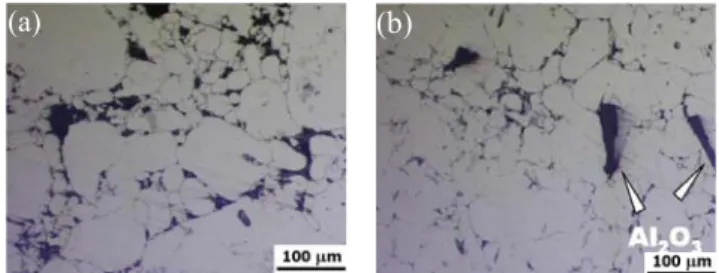
Figure 1 shows the OM microstructure of parts sintered at 620oC for 60 min. The relative densities of AMB2712
and AMB2905 were about 93% and 95%, respectively [5]. In the sintered part composed of blended powder, grain growth occurred at the Al matrix grain. However, relatively fine grain was homogenously distributed in the composite part because grain growth was suppressed by ceramic dispersion.
Fig. 1. OM microstructure of sintered parts: (a) AMB2712 and (b) AMB2905.
2006 POWDER METALLURGY World Congress
PC03-W-10
(a) (b)
Aging Characteristics of Al P/M Composites with Variation of Ceramic Contents
Kyung Ho Min1,a, Si-Young Chang2,b, Deok-Soo Kim3,c, Ji-Soon Kim4,d and Young Do Kim1,e1
Division of Materials Science and Engineering, Hanyang University, Seoul 133-791, Korea
2
Department of Materials Engineering, Hankuk Aviation University, Gyeonggi-do 412-791, Korea
3
Department of Industrial Engineering, Hanyang University, Seoul 133-791, Korea
4
School of Materials and Metallurgical Engineering, University of Ulsan, Ulsan 689-749, Korea
a
[email protected], [email protected], [email protected], [email protected],
e
[email protected] Abstract
The aging behavior of sintered Al composites with various ceramic contents was investigated. 2xxx series blended powder was used as the starting powder. Ceramic contents were 0wt.% and 5wt.%. The blended powders were compacted at
250MPa. The sintering process was performed at 620oC for 60min in a N
2 atmosphere. Each part was solution-treated at
518oC for 60min and aged at 180oC. The Rockwell hardness at the peak aging time increased with ceramic contents.
However, the peak aging time at maximum hardness was reduced with increased ceramic contents.
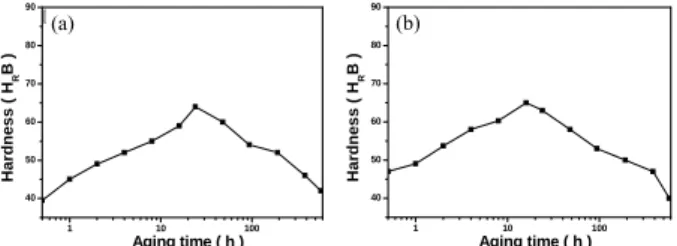
© Korean Powder Metallurgy Institute 1066 -Figure 2 shows the Rockwell hardness of AMB2712 and AMB2905 aged at 180oC. Considering the aging temperature, it was estimated that increases of hardness with aging time were due to the formation of GP II zones (θ″) by relatively higher aging temperatures. In Fig. 2a, the maximum hardness of AMB2712 was about 64HRB after an aging treatment of 24 h. Compared to the 2xxx series Al casting alloy with the same composition, the maximum hardness of AMB2712 was slightly higher [6]. However, it was confirmed that the aging time to obtain maximum hardness was reduced. Frear et al. [3] reported that age-hardening behavior is affected by grain size because the grain boundary is a fast diffusion pathway.
Fig. 2. Rockwell hardness of part aged at 180oC; (a) AMB2712 and (b) AMB2905.
In Fig. 2b, the maximum hardness of AMB2905 was about 65HRB after an aging treatment of 16 h. The increase in maximum hardness due to additions of ceramic reinforcement was not significant compared to AMB2712. It was estimated that increases of hardness were countervailed by interface separation due to differences in the thermal expansion coefficients of the matrix and ceramic reinforcement. However, it was confirmed that the aging time to obtain maximum hardness was reduced by the addition of ceramic reinforcement. During the aging treatment of 2xxx series Al alloys, maximum hardness was obtained by the formation of semicoherent θ′ which use coherent θ″ as nucleation sites. In the composite material, the coherent θ″ phase was finely distributed for a short time due to strain caused by differences in the thermal expansion coefficients of the matrix and ceramic reinforcement [4]. Therefore, it was considered that semicoherent θ′ phase using the fine θ″ phase as a nucleation site was also rapidly generated.
Table 1 shows a comparison of compressive properties before and after the aging treatment for AMB2712 and AMB2905. Because compressive properties were directly affected by ceramic reinforcement, it was estimated that dispersion hardening was dominant in the composite parts. However, the amount of increase of the compressive properties of the AMB2905 composite was less than that of AMB2712. This result may be due to interface separation because of differences in the thermal expansion coefficients of the matrix and ceramic reinforcement [7].
Table 1. Mechanical properties of Al metal matrix composites before and after aging treatments.
4. Summary
The effect of a ceramic phase on the aging and mechanical characteristics of commercial 2xxx series Al composite powder was investigated. The aging time of the blended powder to obtain maximum hardness was reduced by the generation of diffusion due to increased boundary ratios compared to the casting alloy. The aging time of the composite powder to obtain maximum hardness was also shorter than that of the blended powder due to strain caused by differences in the thermal expansion coefficients of the matrix and ceramic reinforcement. Mechanical properties of the composite powder were higher than that of the blended powder because of dispersion hardening. Increases in the mechanical properties were reduced due to interface separation caused by differences in thermal expansion coefficients.
5. References
1. I. J. Polmear, “Light Alloys”, Arnold, London (1995). 2. J. Zhang and A. T. Alpas, Proceedings of the ASM 1993
Materials Congress.
3. D. R. Frear, J. E. Sanchez, A. D. Romig, Jr. and J. W. Morris, Jr., Metall. Trans., 21 (1990) 2449.
4. V. C. Srivastava, R. K. Mandal and S. N. Ojha, Mater. Sci. Eng., A383 (2004) 14.
5. K. H. Min, S. P. Kang, B.-H. Lee and Y. D. Kim, J. Alloys Comp., 400 (2005) 150.
6. J. R. Davis; “Aluminum and Aluminum Alloys”, ASM International, Ohio, (1993)
7. V. C. Srivastava, A. Schneider, V. Uhlenwinkel and K. Bauckhage, Mater. Sci. Eng., A412 (2005) 19.
Material (GPa) E σ0.2
(MPa) (MPa)σmax (%) Ε AMB 2712 69.8 226 448 30.2 Before aging AMB 2905 73.4 274 572 28.6 AMB 2712 70.1 305 597 25.4 After aging AMB 2905 69.2 330 644 23.1 1 10 100 40 50 60 70 80 90 518o C STQ + 180 o C aging Hardnes s ( H R B ) Aging time ( h ) (b) 1 10 100 40 50 60 70 80 90 518oC STQ + 180 oC aging Hardnes s ( H R B ) Aging time ( h ) (a)