Quantum Computing Impact on SCM and Hotel Performance
Binaya Adhikari
1and Byeong-Yun Chang*
1
Graduate School of International Studies, Ajou University, Suwon, Korea
*Professor, School of Business, Ajou University, Suwon, Korea
1
[email protected],
*[email protected]
Abstract
For competitive hotel business, the hotel must have a sound prediction capability to balance the demand and supply of hospitality products. To have a sound prediction capability in the hotel, it should be prepared to be equipped with a new technology such as quantum computing. The quantum computing is a brand new cutting-edge technology. It will change hotel business and even the whole world too. Therefore, we study the impact of quantum computing on supply chain management (SCM) and hotel performance. Toward the goal we have developed the research model including six constructs: quantum (computing) prediction, communication, supplier relationship, service quality, non-financial performance, and financial performance. The result of the study shows a significant influence of quantum (computing) prediction on hotel performance through the mediating role of SCM in the hotel. Quantum prediction is highly significant in enhancing the SCM in the hotel. However, the direct effect between the quantum prediction and hotel performance is not significant. The finding indicates that hotels which would install the quantum computing technology and utilize the quantum prediction could hugely benefit from the performance improvement.
Keywords: Quantum Computing, Quantum Prediction, SCM, Hotel Performance, Structural Equation Modeling
1. Introduction
The decentralized or distributed wireless sensor architectures have been widely adopted for deployment and become a robust solution for the limitations imposed by centralized and hierarchical mobility management schemes for heterogeneous wireless networks. The centralized and hierarchical mobility management architectures lead to well-known bottlenecks and single-point of failure issues when data traffic increases significantly. In addition, the centralization of both the control and data plane functions at the central mobility anchor introduces scalability issues and sub-optimal routing paths between the mobile nodes (MNs) and their corresponding nodes (CNs) [1]. It has been a great challenge for hoteliers and academicians to maximize the output of the hotel sector to fulfill the growing demand of hotel guests at a lower cost in today’s rapidly globalizing world. To enhance the hotel performance efficiently and effectively, the hotel industry has been under tremendous pressure since the last few years [1]. Hence, the hospitality sector had started to copy the other sector by adopting the supply chain management (SCM) practices.
IJIBC 21-2-1
Manuscript Received: January. 13, 2021 / Revised: January. 18, 2021 / Accepted: January. 27, 2021 Corresponding Author: [email protected]
Tel: +82-31-219-2909
Quantum computing is completely a new technology that runs under the fundamental rule of quantum mechanics. Many researchers have been working to create a quantum computer that is believed to solve the computational problem more efficiently than the classical computer. In addition, Big tech companies such as Microsoft, Google Research, and D-Wave system have shown promising results in the field of quantum computing. The results in quantum technology are optimistic that the quantum computers may be available within a few years.
This research is carried out to show if the prediction capability of quantum computing or quantum prediction can be a helpful tool in making the SCM in hotels stable and provide hotels more sustainable business to the hoteliers, their suppliers, and guests. In short, the objective of this research is to study how quantum computing could influence the SCM in the hotel and hotel performance. Some questions to be answered by this research are;
1. Is quantum prediction expected to enhance the SCM capability in the hotel?
2. Will the mediating effect of the SCM in the hotel be able to enhance the hotel performance through quantum prediction?
3. Is quantum prediction alone be able to enhance the hotel performance?
The rest of this paper is organized as follows. Section 2 provides literature review of quantum computing, quantum prediction, SCM in the hotel, and hotel performance. Section 3 explains the methodology which is the data collection procedure and measurement technique of collected data. Section 4 discusses the result, finding from the data analysis. Finally, section 5 is a conclusion with the possible contribution and suggestion.
2. Literature Review
Quantum computing works according to the fundamental concept of quantum mechanics. In this computing, information is represented by quantum states and with the exploitation of quantum effects provided by quantum mechanics (like quantum superposition, quantum entanglement, quantum interference, etc.) [2]. Many scholars mentioned that quantum computing seems to outperform classical computing [3-5]. An extensive study of both strength and weakness of quantum computing is presented in [6]. The use of quantum computing is expected to predict statistical inferences, business decision making, and weather forecasting, pattern matching, web data mining, and so on.
Many researchers have defined SCM and related research is studied extensively in [7-9]. The most systematic and in-depth definition of SCM is that the integration of key business process from the end-user through original suppliers that produce products, services, and information that adds value for customer and stakeholders [10].
The objective of SCM can be divided into short term and long term. In the short term, reduction of cycle time and inventory falls and in the long-run profit maximization, increase in market share and so on. In this sense, quantum prediction can help predict and solve the glitches of the supply chain's traceability and transparency to enhance the hotel performance level in total.
3. Research Methodology
The conceptual model is developed by the collaboration of predictive value theory and the supply chain hospitality model. To explain the quality of quantum prediction, the predictive value theory is used.
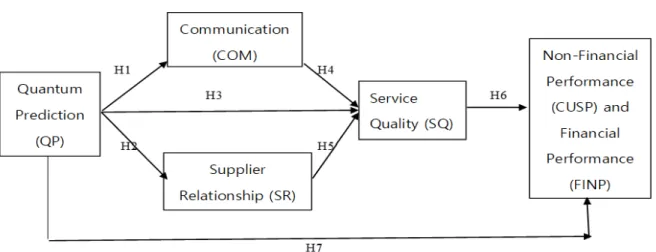
Since SCM is constantly subject to unpredictable events that can adversely influence its ability to achieve performance objectives, the quantum prediction could play a crucial role to bring balance in an unstable supply chain. The characteristics of prediction from predictive value theory like sensitivity, specificity, and predictive value are good measurements to measure the quantum prediction power. Consequently, the conceptual research
model is developed in Figure 1.
Figure 1. Conceptual Research Model
The conceptual framework has been developed after the extensive review of the literature on quantum computing, SCM in the hotel, and hotel performance. The hypothesis was then identified through the review of empirical research.
H1: Quantum prediction is positively related to the level of communication among organizations in the supply chain.
H2: Quantum prediction is positively related to the supplier’s relationship. H3: Quantum prediction is positively related to the customer service quality.
H4: Communication Between buyers and suppliers will have a positive effect on customer service quality. H5: Relationship with suppliers will have a positive effect on customer service quality.
H6a: Service quality will have a positive effect on a hotel's financial.
H6b: Service quality will have a positive effect on a hotel’s non-financial performance. H7a: Quantum prediction will have a positive effect on a hotel's financial performance. H7b: Quantum Prediction will have a positive effect on a hotel’s non-financial performance.
H8: Quantum prediction has positive effects on the hotel's financial and non-financial performance through its effect on SCM in the hotel.
The questionnaire was developed to collect the data about quantum prediction, SCM in the hotel, and hotel performance.
4. Data Analysis and Finding
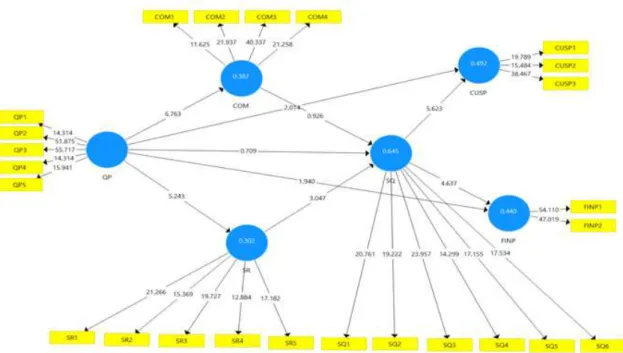
The current study has 7 direct hypotheses as shown in Figure 2 and Table 1. Direct hypotheses such as (H1, H2, H5, H6a, H6b, H7a) were supported as the t-value was greater than 1.96. However, direct hypotheses like (H3, H4, H7b) were not supported because their t-value was below 1.96.
Figure 2. Structural Model Assessment
Table 1. Structural Model Assessment (Direct Effect Results and Decision)
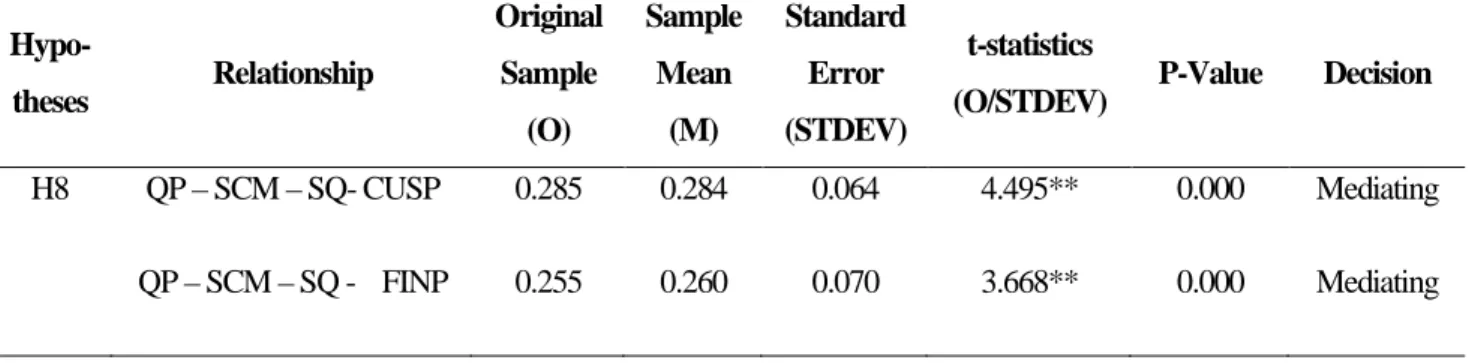
Table 2. displays the result of mediating analysis. In the Table 2, the t-value is more than 1.96. Hence, the mediating effect is significant. Therefore, we can conclude that SCM in the hotel mediates the relationship.
Hence H8 is accepted.
Table 2. Structural Model Assessment Results and Decision (Mediating Effect)
Hypo-theses Relationship Original Sample (O) Sample Mean (M) Standard Error (STDEV) t-statistics
(O/STDEV) P-Value Decision H8 QP – SCM – SQ- CUSP 0.285 0.284 0.064 4.495** 0.000 Mediating
QP – SCM – SQ - FINP 0.255 0.260 0.070 3.668** 0.000 Mediating
**p<0.01, *p<0.05
5. Conclusion and Future Research
The current study provides indicative evidence that quantum prediction could enhance hotel performance. However, technology alone is not enough to enhance hotel performance. Through the application of quantum prediction, policymakers of the hotel can enhance the hotel performance by reducing the disruption of SCM. That is, SCM in the hotel plays the role of mediator between quantum prediction and hotel performance. Therefore, it is essential to make the SCM in the hotel efficient and effective to achieve more from the current use of resources.
Moreover, quantum computing is a completely new technology that operates according to the fundamental rule of quantum mechanics. SCM in the hotel is a powerful element of the hotel which can be improved through this new technology. Since hotels are highly dependent upon the technology, upgrading the existing technology of the hotel from classical to quantum computing is more likely to increase the hotel performance. Our research has shown that quantum scientists, SCM managers, and top-level hotel managers have an optimistic view of this new technology on giving leverage to hotel performance. Quantum devices are going to arrive any time soon within a few years In this scenario, preparation of the hotel to install the new technology could be a wise decision by the hotel industry.
Based on our research, we could like to recommend future research to conduct more research on the applications of quantum technology and its benefits in various other different industries. Furthermore, the researcher can conduct research to recognize the challenges that hotel could face after the installation of quantum technology in the hotel system as well. Similarly, we would like to suggest hotel industries get ready to adopt this new technology in their establishment and take benefit from being an early adopter of this new technology. The cost-reducing and productivity-increasing features of SCM in the hotel can be stable with the help of quantum prediction.
Acknowledgement
References
[1] Nielsen, M. A., and Chuang, I. (2002). Quantum computation and quantum information, Cambridge University Press.
[2] Bennett, C. H., Bernstein, E., Brassard, G., and Vazirani, U. (1997). Strengths and weaknesses of quantum computing, 26(5), 1510-1523, SIAM journal on Computing. DOI: https://doi.org/10.1137/S0097539796300933
[3] Garcia, R. A., Park, B., and Chang, Byeong-Yun. (2019). CSR impact on business performance through GSCM: evidence from Guatemala, 11(4), 59-64, IJIBC. DOI: https://doi.org/10.7236/IJIBC.2019.11.4.59
[4] Kenzhekhanuly, Y. (2013). Impact of Green Supply Chain Management on Company Performances, MBA Thesis, Graduate School of International Studies, Ajou University. Suwon, South Korea.
[5] Lambert, D. M., and Cooper, M. C. (2000). Issues in supply chain management, 29(1), 65-83, Industrial Marketing Management. DOI: https://doi.org/10.1016/S0019-8501(99)00113-3
[6] Tan, K. C., Kannan, V. R., and Handfield, R. B. (1998). Supply chain management: supplier performance and firm performance, 34(3), 2-9, International Journal of Purchasing and Materials Management. https://digitalcommons.usu.edu/manage_facpub/278/ [7] Fantazy, K. A., Kumar, V., and Kumar, U. (2010). Supply management practices and performance in the Canadian hospitality
industry, 29(4), 685-693, International Journal of Hospitality Management. DOI: https://doi.org/10.1016/j.ijhm.2010.02.001 [8] B.-Y. Chang M. J. Magobe and Y. Kim (2015). E-commerce applications in the tourism industry: a Tanzania case study, 46(4),
53—64, South African Journal of Business Management. https://hdl.handle.net/10520/EJC180434
[9] Aligaesha, B. Park, B. and Chang, Byeong-Yun (2019). Globalization impact on small and medium enterprise: Tanzania case, 11(4), 65-70, IJIBC. DOI: https://doi.org/10.7236/IJIBC.2019.11.4.65
[10] Datta, P. P., and Christopher, M. G. (2011). Information sharing and coordination mechanisms for managing uncertainty in supply chains: a simulation study, 49(3), 765-803, International Journal of Production Research.