인터랙티브 영화에서의 서술적인 이야기 전개의 구조에 관한
방법론에 관하여
Finding a method of narrative storytelling in interactive cinema
조재준, Jae Joon Cho
Abstract of the research
“Interactivity refers to the possibility of an audience actively participating in the control of an artwork or representation.” Andy Cameron, Dissimulations
Interaction can be described as a way or function that improves the participation of audiences/viewers to being immersed into the medium itself. Until now, however, in terms of interactive cinema, interaction has not shown a sufficient participation for audiences. Specifically, audiences/viewers described that the structure of storytelling has failed to satisfy their requirements, in order to participate in the structure of storytelling.
The aim of the research itself, therefore, began to ask and wonder why audiences/viewers criticised the participation which audiences/viewers are able to control storytelling, in interactive cinema, could not satisfied them in order to control and follow a storyline of interaction. In general idea, in interactive cinema, the function which allows audiences/viewers to be immersed into the storylines, must allow the immediacies of interaction. Audiences/viewers must therefore be able to satisfy the general idea of interactive cinema through controlling the directions of every choice offered. They must also be able to be immersed in the interactive storylines. Which of the prime causes can be improved or re-considered, to satisfy the participation requirements of audiences/viewers? The intention of this research also began to investigate a suitable method of storytelling within a narrative structure of interactive medium (interactive cinema).
Through questioning the matter (it will be described in a later chapter), this research will be focused on the relationship between narrative structured interaction and audiences/viewers, which is of prime importance in relation to interaction.
To further the research, Pilot study (experiment with the basic interactive narrative structure) was offered in order to understand and maintain a suitable method of storytelling within a narrative structure of interactive cinema and it also was explored to understand how the aim of the research would be maintained for further qualitative research.
Keywords
User Interaction, Interactive Storytelling, Interactive Cinema
This research was supported by Seoul Future Contents Convergence (SFCC) Cluster established by Seoul R&BD Program and the second phase of the Brain Korea 21 Program in 2008.
*주저자: Computer Game/CT 연구실 중앙대학교 첨단영상대학원 아트센터 조재준 e-mail:[email protected] **교신저자: Computer Game/CT 연구실 중앙대학교 첨단영상대학원 아트센터 조옥희 e-mail:[email protected] **교신저자: Computer Game/CT 연구실 중앙대학교 첨단영상대학원 아트센터 유길상 e-mail:[email protected] ***교신저자: Computer Game/CT 연구실 중앙대학교 첨단영상대학원 아트센터 이원형 e-mail:[email protected]
Chapter 1.
1-1. Introduction
Proposal of this research: subject matter of this research
“Interactivity means the ability to intervene in a meaningful way within the representation itself, not to read it differently. Thus interactivity in music would mean the ability to change the sound, interactivity in painting to change colours, or make marks, interactivity in film…the ability to change the way the movie comes out.” Andy Cameron
Through the terms of success of interactive medium in 1980s, the ability of its platform particularly the way to combine elements of contents with audio and visual was grabbed (attracted) the attention of contemporary medium industry. By realizing the function of interactive medium, ‘interactive cinema’ was developed to intimate the new experience in which audiences could be participated in terms of controlling the plot lines (structures of storytelling).
Since the first interactive cinema, ‘I’m Your Man’, shown to the public in 1990s, what we presumed to call ‘interactive cinema’ however has not been successfully and meaningfully provided in the area of contemporary media. The reason why, ‘I’m your Man’, was not successful in the area of contemporary medium was that audiences were accustomed to the concept of participation of video games. Though video games provided a decision point every few seconds, a decision point in terms of interactive cinema could not be offered to satisfy audiences. This would mean that decision points would be strictly limited to offer participation (opportunities) in interactive cinema. Audiences also criticized the fact the controlling directions at every junctures in the narrative structure did not allow to immersion in the storylines.
1-1. Research questions and methodology 1-1-1. Research questions
Due to failure of appearance of interactive cinema to provide the satisfaction, the quality of interactive cinema treated as the fast paced excitement of medium. The idea of interactive cinema also could not allow a great deal of
interaction for audiences in the sense of its intention. Moreover this failure of interactive cinema may cause to make an attempt to solve these reasons of failure and develop forward progress in the area of our contemporary medium.
Intention of this research therefore began to consider how interactive cinema should be attempted to make an effort for solving the reasons of failure. Following questions will be considered through this research.
How the audiences/viewers can be satisfied their participation in terms of narrative structures of interactive cinema?
Which elements can be suggested for a suitable method of storytelling?
1-1-2. Research methodology
For engaging characters with audiences/viewers, interactive medium should intend to infer the identification of character for them by placing characters’ effective point of view and by focusing or staging activation of characters on general storytelling of whole structure of interactive medium. By understanding interactive medium which research have realized me interactive cinema itself witch it derived from the film could describe interactive structure based on storytelling could be distinguished from existing mediums in our society. The possibility it leads to participate storytelling of interactive medium, relationship between audiences/viewers and characters should be concerned because user-interface of interactive medium offer participation.
For these intentions of interactive medium, the research found itself that it should be carefully considered or concern how the intention of research engage the relationship between audiences/viewers and characters of interactive cinema. Even more for finding methodology of research, investigation should regard how theoretical basis of characters should consider with sociological contemporary society. When abstract basis of characters related or regarded our contemporary society, it will be created a new environment that audiences/viewers would totally agree with characters’ behaviour within interactive medium and considered as characters’ point of view.
Chapter 2. Structuring narrative form
2-1. Understanding ‘Choose Your Own Adventure’
In this section, it is attempting to explore and understand how the plots of ‘Choose Your Own Adventure’ are structured, and how the character can be followed and told by decision of audiences/viewers within structures of multiple stated narratives (plots).
Depending on the audience or viewer's decision, the plot would unfold in different ways and it may eventually lead them to number of different possible conclusions. Or the number of the audience’s decision may shrink number of conclusions and point only one conclusion by unexpected reasons. For instance, Upon making the decision whether to follow or accept a mission or not on the page in which it is described to guide readers to turn over the sudden chapters, or upon making the decisions the readers are given, the one main character which readers are emerged into can be rewarded with multiple conclusions or multiple paths which the readers may not expect by corresponding the choices on an adjacent pages.
2-2. Structuring the interactive storytelling 2-2-1. Understanding ‘The Branching Tree’ (complexity of digital storytelling)
Investigation of interactive structure was required to understand the complexity of its algorithm itself. As this figure 1 shows below, over the past few decades this diagram of the tree, algorithm of the branching tree has been used to explain the trees of human beings’ family history and the history of evolution through diverse subject areas such as biology and natural history.
Figure 1: The Tree (Branching Tree)
In terms of an artistic practice of medium, it also has been introduced to literatures such as a series of ‘Choose Your Own Adventure’. Despite its complexity of structure that these links are multiply linked, ‘Choose Your Own Adventure’ explain the interactive relationship between plots,
medium itself and reader to attain the satisfaction of interactive medium within the narrative structures, as the activation of readers’ choices are required the verbal choices, the medium (the story constructed to link within the pages) and the participation of the reader to follow the certain story.
However due to its complexity of branched paths in this algorithm, the convergence in which it refers to the point between every two branched junctures needed to be develop as simplified the primal branched or merged paths in its flow map. Through excluding branched structures for its simplification of the tree, the primal branching structures still can be suggested that they can be managed to maintain the intention of interrelationship between plots by propositioning the common plots. This would be meant that branching structures could be defined into three main (primal) sections of storytelling to relay simplified plots within interrelation of characters.
2-2-2. Understanding Ladder Junctures (Circumstanced Moves-Number of Cases)
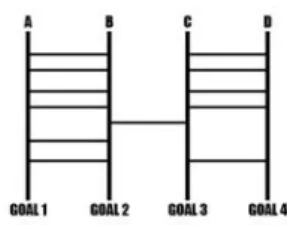
The algorithm of the ladder junctures was needed to investigate how the decision audiences/viewers made (caused) can be resulted (effected) only one purposed. As the figure the ladder junctures show, the majority of results can be operated within the boundaries of four main paths originated from the mathematical function (the theory of function). The ladder junctures, wherein you may explore or unfold the four main paths in which these four vertical lines are paralleled but these four vertical lines are also in conjunction with irregular horizontal lines can be followed to results by changing or altering the direction when you face the boundary. The one’s choice can be explored to change the one’s result.
Figure 2: Ladder Conjunction Diagram
When you do not recognize these four main paths as circumstanced moves or paths, you may felt that your destination can be directed or changed by
your will or by your purpose in between branches like you are facing choices between two irregular lines or paths. You will be also felt that these circumstanced directions can be occurred by your will or decision. In fact, the broad (influence) of your will or your choice to make a decision between two irregular lines however is limited. You will not be given the broad of your choices to make a decision in between two irregular paths. The decision you want to make or change for the direction of path in ‘Ladder Junctures’ can be described as fixed or arranged destiny or fate beforehand.
2-2-3. Understanding Diamond Junctures (Karma - Cause and Effect - Junctures)
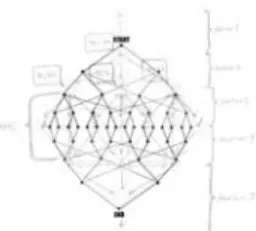
Figure 3: Triangulated Branching Tree Diagram
Through investigating algorithm of interaction between plots for interactive cinema, ‘Diamond Junctures’ was investigated and developed based on junctures of ‘Branching Tree’ and ‘Ladder Junctures’. As you may recognize this diamond junctures (karma junctures) in figure 3, the beginning of this structure of algorithm is similar to a non-linear structure in which the plot has beginning and end. However once the beginning of plot (it is more like pre-sequel to explain why audiences/viewers will be given the choices) initiated to start, audiences/viewers will be given the choices to follow in two different plots (these two different events are explained in the chapter of interactive cinema map later on)
As this particular algorithm follows three main paths, the three characters of the interacted three main plots are divided into these nine structures, with the beginning in which it is placed on the top of simplified tree. The paths of each character within the passage of time will be instructed in black, and interacted links between characters will be outlined specific colour which they will represent hyperlinks of each character. The branched links between characters represent the
relationship of characters and represent how they are related and how they are going to be interacted through possible movements which audiences/viewers made decisions within the events.
Chapter 3.
3-1. Case Study (exemplification of interactivity): “Hotel Dusk: Room 215”
Figure 4: Screen shots of “Hotel Dusk: Room 215”
For regarding the term of interactivity in interactive cinema, it was important to concern the interactive structure of video game. The reason why it is important to overlook at video game is, the general concept of video game is often referred to as interactivity. According to Newman, J (Videogames, Routledge), elements of video games may be seen or may be regarded as ‘interactive’. Because of these elements are often required considerable player (user) participation and responding to player action. In this case study, it is attempting to explore and analyze how the interactive novel, “Hotel Dusk: Room 215” is structured, and how viewers can be participated in terms of controlling its structures. Namely how interactive function (iconic representations) allows the participations in order to control the protagonist.
3-1-1. Structure of Storytelling:
In terms of its structures of storytelling, it may be regarded as a mystery or detective genre and it is also may be described as a noir-like structures. The structures of storytelling is basically regarded that they are divided into two sections, the past and the present in terms of participating. Commonly the structures of storytelling of the past and the present are appear to be happened in the place, ‘Hotel Dusk’ which it is described as a rundown hotel located in the southwestern United States near Los Angels, California during 1970s. Simply it is also, its storytelling can be told a
storytelling of ‘Kyle Hyde’ who is a former detective of the New York police Department and also who is seeking to search the truth of his old partner, ‘Brian Bradley’. His searching for ‘Brian Bradley’ began during his stay at the hotel, ‘Hotel Dusk’. It is also through wandering about the mystery of the hotel and through observing several other guests that the protagonist of its storytelling faced in the hotel, ‘Kyle Hyde’ finds himself that he is becoming the tangled person in the problem which they had in the past. By the coincidences he faced in the hotel, ‘Hotel Dusk’, he become to realize that several other guests may possess the clues which he has been searching for his old partner and also he become to realize that these clues will lead him to reveal the truth behind what happened.
3-1-2. Navigating the game play
Basically through participating (controlling the structures of storytelling) on behalf of protagonist, ‘Kyle Hyde’, participants (players) are able to control the protagonist (main character who is centred in its storytelling) to move around within the environment of ‘Hotel Dusk’ by participating the interface (platform) of Nintendo DS. Namely by engagement of its unique platform which it features the touch screen and microphone (voice recognizable platform), it allows the participant to control the protagonist. Whether the protagonist to unfold the objects, evidences or not (which they are placed within its environment) is depended on the participant.
3-2. Case Study (exemplification of interactivity): “The Satirical Pavilions” (collaborative work)
General concept of “The Satirical Pavilions”:
Intention of this collaborative work, “The Satirical Pavilions” is about ideal construction of a playful space where people are able to interact within public space (namely, it is opened space that allow people to be participated or engaged). Key reference points of “The Satirical Pavilions” are people (participants) and their experiences. Such experiences would be described as physical experiments.
3-2-1. Pavilion No.2: Literature Space (The
Satirical Library)
Figure 5: Still images of pavilion no.2
In this case study of ‘Pavilion No.2’, it is attempting to explain and analyze how the interactive novel is structured, and how viewers can be participated in terms of controlling its structures. For maintaining the concept of “The Satirical Pavilions”, my concern in this work was how the participation of spectators could be developed to allow them to be interacted. Therefore through developing this work based on her intention, I was considering to build the platform of DVD where participants are able to interact by triggering the interactive function (button).
Intention of this collaborative work, ‘Pavilion No.2’ is that allow the participation (audiences) to choose their own methods to build its own structures of plot through the engagement. Simply ‘Pavilion No.2’ can be described as the physical involvement interaction within the space where it gives the choice to make participations’ own story.
3-2-1-1. Navigating the interaction
Basically the participation is acted on behalf of the protagonist within the cyber environment. Once the protagonist enter the virtual environment where it is covered with phrases (letters) on the walls, the protagonist will be faced the turning point (or it can be addressed as event point of branched juncture) where it is covered with phrases to make the path of its storytelling. Such movement can be made by simply choose the answer, ‘Turn Left’ or ‘Turn Right’. Before making the decision for choice, the participation must consider to read the phrases which it was placed within the virtual environment to choose the right path. Once the participation made the decision, the participation will face the secret codes for move forward into next stage. At the same time the participation faces the secret code, the
participation must use the punched board which it will unfold the path to move forward. Such movement is regarded as physical involvement in this collaborative work. Whether the protagonist unfolds the right path which it will result satisfied conclusion or not is depended on the choices participation make.
3-2-1-2. Problems:
• Guidance (introduction): It is the most important element to describe how the participant could be interacted in terms of participation. If the participant would not be introduced or guided, the participant may be faced the difficulty of participation (responding) and even more the participant would lost the concern (interest) to proceed on further stage. Therefore as I described on previous chapter, introduction of plot (storytelling) is needed to being concerned for further artistic practice of interactive cinema. • In terms of interactivity of this work,
interactivity was only referred as a physical involvement. Such physical involvement was only able to being interacted by placing the punched board onto the screen for unfolding the secret. Therefore interactive function (interactive function refers to the representative icon (button)) is considered for further artistic practice
• While participating the narrative structure of its storytelling, participants could not able to read its contents of storytelling. The reason why they had a difficulty is virtual space which it only contains letters, could not be a readable phrases to understand in order to proceed. Even more participant would mind to spend their time to read phrases in order to proceed. Therefore narrative structure of storytelling of interactive cinema needed to be considered to how the narrative structure of its storytelling can be transformed into the visual formation for maintaining participant’s (audience) interest.
3-3. Case Study (practical exemplification of interactive cinema): “The Symphony of Vengeance”
3-3-1. Theoretical aspect
In this following section, artistic practice of personal programme of study (interactive cinema) is attempted to analyze and mainly this analyze is focused on three different aspects such as theoretical side, technical side and realistic side which it is presumed to explain how the artistic practice will be exhibited. It is also, through analyzing and investigating three aspects of practical exemplification, it will answer following research questions:
• How the audiences/viewers can be satisfied their participation in terms of narrative structures of interactive cinema?
• Which elements can be suggested for a suitable method of storytelling?
3-3-2. Approach to narrative
The symphony of vengeance was created based on the selection of previous personal programme of study, ‘human behaviour disorder in our modern society’. Namely it was specifically explored the social alienation such as ‘the bully’ and ‘cyber addiction’. By the investigation of previous study, it was extended to explore the hate or blame in our society.
For answering research questions, I have been investigating how the artistic practice of interactive cinema, ‘The symphony of vengeance’ represent a narrative structure to maintain a matter of viewers’ interest. Therefore the diagram which I described on previous chapter, was needed to be analyzed the construction of ‘Choose Your Own Adventure’ series of the novel based on the Marie-Laure Ryan's model of “the Tree” wherein the choices are largely branching binaries constructed, and it is reflected to develop the diagram which it may guarantee that choices, audiences/viewers made, will result to maintain the matter of their interest through controlling its narrative structures.
3-3-2-1. Interactivity as a choice: function of interactivity in terms of participation
For approaching the structure of narrative, interactivity was regarded as a choice within a narrative structure of the exemplification of artistic practice.
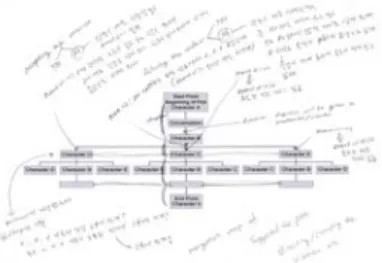
Figure 6: The progression of interactive cinema (the walk flow)
As this figure 7 shows, the diagram of ‘the progression of interactive cinema’ (Karma branch juncture) will be indicated to show how those branches linked by each point. When this diagram is applied to the instance of practical lead, the walk flow (route) was reflected to show how three main characters will be followed with the engaging of audiences/viewers within structure of three main plots. This progression map also intend to show how three main characters will be interacted in further practical lead and how they are related in the form of interactive cinema.
3-3-3. Approach to game like
Figure 7: Description of characters
Use of back-stories is common element in terms of interactive media, specifically in terms of video game. According to James Newman (author of ‘Videogames’), he described that the most fundamental idea of interactivity in terms of video game, is how the interactivity allow the user to follow a structure of storytelling while the user competing a range of its task.
• Establish the reason why characters conflict within the storytelling of the interactive media.
• Motivate the audiences (viewer) that the audiences can be immersed. Namely, structure the situation that the audiences find themselves in at the beginning of its storytelling.
3-3-3-1. Practical Led Exemplification: Description of Section No. 1 of Interactive
Cinema
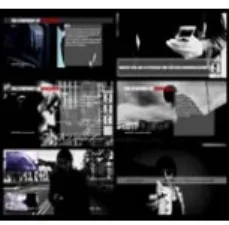
Figure 8: Still images of interactive sequence
Most of all, developing the narrative structure for practical led interactive cinema, pilot study (practical led exemplification) was suggested to experimenting the sequence of interactive cinema. Following description below will describe how the function as an interactive choice which allows audiences/viewers to make a decision, will be given and how the structure of storytelling will be proceed to convey the interaction for audiences/viewers.
3-3-4. Atmospheric character study
• Establish the visual style of the interactive cinema. Namely, by the consideration of the visual style, specifically the colours which are reflected for each character, atmospheres of each character are established within the interactive cinema.
As I pointed the visual style of the interactive cinema, it can be recognized in a range of ways, such as the use of primary colours. For instance, black and white colour which havily contrasted, was used to be a reference colour. Colour itself was linked to the representation of expression within the practical led exemplification.
• Provide the atmosphere what the character is intending to do within the structure of storytelling.
• Identify the theme the character has and identify the link between characters
By the concern of these elements, the idea of character within its storytelling can be immersed for the matter of the user’s (viewer) interest. Even the theme of its storytelling can be clearly represented.
3-3-5. Platform: simplified menu
Figure 9: Exemplification of interactive platform
“A good illustration is the zoom used in the Macintosh desktop environment. The outline zoom that accompanies the opening of an icon orients the user to the location and origin of the new window that appears on the desktop.” (Brenda Laurel, The art of human-computer interface design)
We may are used to being a participation through controlling the platform (interface) of video game and even more through controlling the platform of application in pc (personal computer such as laptop and desktop). Therefore investigation about how I will represent the platform (interface) of interactive cinema was also required to maintain the interest of audiences (viewers or users), because of the platform (interface) is also important element in development of interactive cinema.
Chapter 4. Conclusion
Summary of what was investigated
The intention of this report was to investigate the way or elements that improvesthe participation of viewers to being immeresed into the interactive cinema, and develop artistic practice of interactive cinema. By reviewing the literatures and reviewing the contemporary exemplifications of interactivity in terms of media, I was able to focus (investigate) which elements can be regarded to develop personal programme of study about interactive cinema. It is also, similarly by understanding the diagrams (algorithms) of interactive cinema, suitable diagram was developed for interactive function within the narrative structure of interactive cinema. Therefore combined diagrams which I analyzed on above chapters, were used to support the artistic practice.
The research questions such as 1. why audiences/viewers criticised the participation which audiences/viewers are able to control storytelling, 2. Which of the prime causes can be improved or re-considered, to satisfy the
participation requirements of audiences/viewers, were developed to reveal possibilities (elements) and explain how viewers (users) will maintain their interest through participating the structure of storytelling in the platform of interactive cinema from the perspective of practioner.
• Establish the reason why characters conflict within the storytelling of the interactive media
• Motivate the audiences (viewer) that the audiences can be immersed
• Establish the visual style of the interactive cinema
• Provide the atmosphere what the character is intending to do within the structure of storytelling.
• Identify the theme the character has and identify the link between characters
Reference
• Rafaeli, S., Interactivity: From New Media to Communication in Sage Annual Review of Communication Research: Advancing Communication Science Vol. 16, 110-134, 1998
• Mackay, H. and O’Sullivan, T., The Media Reader: Continuity and Transformation, SAGE Publications Ltd, 1999
• Murray, Janet H., Hamlet on the Holodeck: The Future of Narrative in Cyberspace, The MIT Press, 1998
• Ryan, Marie L., Narrativve as Virtual Reality, Johns Hopkins University Press, 2001
• Manovich, L., The Language of New Media, The MIT Press, 2002
• Handler Miller, C., Digital Storytelling: a creator’s guide to interactive entertainment, Focal Press, 2004
• Salen, K. and Zimmerman, E., The Game Design Reader: the rules of play anthology, The MIT Press, 2006
• Cameron, A. (1998) Dissimulations, available
http://www.daimi.au.dk/~sbrand/mmp2/Dissimulation s.html
• Interaction Design: beyond human-computer interaction, edited by Jennifer Preece, Yvonne Rogers, Helen Sharp