1. INTRODUCTION
Recent advances in computing hardware and software are responsible for the emergence of wireless sensor networks ca- pable of observing the environment, processing the data, and making decisions based on the observations. In particular, the development of technologies such as Bluetooth [1] or the IEEE 802.11 standard [2] enables us to connect the sensor no- des together wirelessly. This allows for deployment of ad hoc wireless sensor networks that do not require backbone infra- structure. This, together with progress in signal processing and sensing and computer technology, give rise to many new app- lications. Such wireless sensor networks can be used to moni- tor the environment, detect, classify, and locate specific events and track targets over a specific region. Examples of such sys- tems are in military, surveillance, monitoring of pollution, tra- ffic, agriculture, or civil infrastructures.
The essence of wireless sensor networks is to have sensor nodes within a region, make local observations of the environ- ment, and collaborate to produce a global result that reflects the status of the region covered [3]. This collaboration requi- res local processing of the observed data, communication bet- ween different sensor nodes, and information fusion. For ma- ny applications, the wireless sensor network is deployed in a harsh environment and some of the sensor nodes may be faul- ty or may fail during the wireless sensor network’s lifetime, thus requiring collaboration to be robust to sensor node failu- res. Two other constraints in wireless networks of autonomous sensor nodes come from the limited bandwidth and power so- urce of these elements, requiring collaboration to be commu- nication and power efficient.
Thus, the challenges of wireless sensor networks include distributed signal processing that makes use of the processing power of all the sensor nodes, ad hoc routing, and communica- tion protocols that enable information sharing among sensor nodes and fault tolerance that accounts for the possible misbe- haviors of a subset of the sensor nodes. All these challenges need to cope with the power constraint of the wireless sensor network. This paper focuses on finding and analyzing signal
processing algorithms for robust collaborative target detection based on the generalized approach to signal processing in the presence of noise [4-8]. Therefore, it addresses both the distri- buted signal processing and fault tolerance challenges. This work continues a preliminary study presented in [9].
The basic premise of target detection is that sensor nodes are deployed over a region of interest and are required to dete- rmine if a target is present in that region. In general, targets emit signals characterizing their presence in the region that can be measured by the sensors. Therefore, sensor nodes need to collaborate by exchanging and fusing their local informati- on to produce a result global to the region. The presence of fa- ulty sensor nodes affects this fusion process and can potential- ly corrupt the detection result. Target detection algorithms ne- ed to specify a way to fuse the signals measured at each sensor node to produce one consistent and useful result characterizing the whole region. These target detection algorithms can be ev- aluated for their performance in terms of accuracy, communi- cation overhead, and robustness to sensor node failure.
2. PROBLEM STATEMENT AND MODEL This section formulates the target detection problem being investigated. We consider the model for the wireless sensor network presented in [10]. The wireless sensor network is as- sumed to be composed of a set of nodes connected to sensor, called sensor nodes or simply nodes. A model is developed for each sensor node in fault-free and faulty mode and for the col- laboration among nodes. The target is modeled by the signal it emits.
Sensor nodes, with possibly different sensing modalities, are deployed over a regionLto perform target detection. Sen- sors measure signals at a given sampling rate to produce time series that are processed by the nodes. The nodes fuse the in- formation obtained from every sensor according to the sensor type and location to provide an answer to a detection query. We assume that the nodes have the ability to communicate with each other. The node peer-to-peer communication is as- sumed to be realizable with appropriate communication tech-
Collaborative Wireless Sensor Networks for Target Detection Based on the
Generalized Approach to Signal Processing
Jai-Hoon Kim*, Vyacheslav Tuzlukov**, Won-Sik Yoon***, Yong Deak Kim****
Department of Electrical & Computer Engineering, Ajou University, Suwon, Korea (*Tel : +82-31-219-2546; E-mail: [email protected] ;
** Tel : +82-31-219-1604; E-mail: [email protected] ; *** Tel : +82-31-219-2371; E-mail: [email protected] **** Tel : +82-31-219-2360; E-mail: [email protected])
Abstract: Collaboration in wireless sensor networks must be fault-tolerant due to the harsh environmental conditions in which such networks can be deployed. This paper focuses on finding signal processing algorithms for collaborative target detection based on the generalized approach to signal processing in the presence of noise that are efficient in terms of communication cost, precisi-on, accuracy, and number of faulty sensors tolerable in the wireless sensor network. Two algorithms, namely, value fusion and de-cision fusion constructed according to the generalized approach to signal processing in the presence of noise, are identified first. When comparing their performance and communication overhead, decision fusion is found to become superior to value fusion as the ratio of faulty sensors to fault free sensors increases. The use of the generalized approach to signal processing in the presence of noise under designing value and decision fusion algorithms in wireless sensor networks allows us to obtain the same performance, but at low values of signal energy, as under the employment of universally adopted signal processing algorithms widely used in practice.
Keywords: Collaborative target detection, generalized detector, decision fusion, value fusion, wireless sensor network.
niques [11].
We assume that the sensor nodes obtain a target energy me- asurement after T seconds while a target was at a given positi- on inside or outside the regionL. Obtaining that energy requ- ires preprocessing of the time series measured during period T and, possibly, fusion of data from different sensors by each node. The detection procedure consists of exchanging and fus- ing the energy values produced by the sensor nodes to obtain a detection query answer. Note that a more accurate answer can be obtained in a general if the sensors exchange their time se- ries rather than energies; however, that would require high co- mmunication bandwidth that may not be available in a sensor network. The performance of fusion is partly defined by the accuracy that measures how well sensor decisions represent the environment.
We assume that detection results need to be available at each node. The reason for such a requirement is that the res- ults can be needed for triggering other actions such as locali- zation of the target detected. This requirement can be fulfilled by having a central node make a decision and disseminate that decision to all the nodes in the wireless sensor network. The correctness of such a scheme relies on the central node’s cor- rectness, therefore, central node-based schemes have low ro- bustness to sensor failure. Distributing the decision making over several or all the nodes improves reliability at the cost of communication overhead.
The wireless sensor network considered is likely to contain faulty sensor nodes due to harsh environmental conditions. Fa- ults include misbehaviors ranging from simple crash faults, where a node becomes inactive, to Byzantine faults [10], whe- re the node behaves arbitrarily or maliciously. Faulty nodes are assumed to send inconsistent and arbitrary values to other nodes during information sharing. An example of such behavi- or, where four nodes, A, B, C, and D, measure energy values to determine if a target is in regionL, is given in Fig. 1.
Fig.1. Byzantine faulty behavior.
As the target is outside regionL, sensor A measures an en- ergy level of 1.4 (including noise), whereas sensors B and D measure an energy level of 0.1 and 0.5, respectively. Sensor C is assumed faulty and sends different measurements to the oth- er sensors (10, 1, and 10 to A, B, and D, respectively). As a re- sult, non-faulty sensors obtain different global information ab- out the region and may conclude differently on the presence of the target, i.e., sensors A and D may conclude that a target is present while sensor B concludes that no target is present.
The target detection algorithm needs to be robust to such inconsistent behavior that can jeopardize the collaboration in the wireless sensor networks. For example, if the detection re- sults trigger subsequent actions at each node, then inconsistent detection results can lead each node to operate in a different mode, resulting in the wireless sensor network going out of se-
rvice. The performance of fusion is therefore also defined by precision [12,13]. Precision measures the closeness of decisi- ons from each other, the goal being that all nodes obtain the same decision.
A target at location l emits a signal, which is measured by sensors deployed at locationssi ,i=1,...,n. The strength of the signal emitted by the target decays as a polynomial of the distance. If the decay factor is k, the signal energy of a target at location l measured by a sensor at locationsiis given by
< = , otherwise, ; if , ) ()
(
0 0 k rr i PT r r PT l S (1)where P is the power emitted by the target during time T and ||
||l si
r= − (2) is the geometric distance between the target and the sensor and
0
r is a constant that accounts for the physical size of the sen- sor and the target. Depending on the environment, i.e., atmos- pheric conditions, the value k typically ranges from 2.0 to 5.0 [14]. The energySi(l)also depends on the possible presence of obstacles lying between the target and the sensors. However, we assume no such obstacles to be present in the region consi- dered.
Energy measurements at a sensor are usually corrupted by noise. IfNidenotes the noise energy at sensor i during a parti- cular measurement, then the total energy measured at sensor i when the target is at location l is
i i i l S l N
E ()= ( )+ . (3) 3. DISTRIBUTED DETECTION
Classical multisensor detection assumes that all local sen- sors communicate their data to a central processor performing optimal or near optimal detection using conventional statisti- cal techniques [15]. Later investigations, however, focused on decentralized processing in which some preliminary process- ing of data is performed at each sensor node so that compres- sed information is gathered at the fusion center [16]. Decen- tralizing the detection results in a loss of performance compa- red to the performance of centralized systems since the fusion center of a decentralized system has only part of the informati- on collected by the sensor nodes. However, decentralized schemes require reduced communication bandwidth and it will be shown in this paper that they may achieve increased reliabi- lity. Further, the performance loss of decentralized schemes may be reduced by optimally processing the information at each sensor.
Wireless sensor network parallel topology where N sensors measure a signalyiproduced by a phenomenonH is shown in Fig. 2 [17]. Each sensorSiprocesses its signalyito generate a quantized informationliand all theli ,i=1,...,Nare then fused intol0at the fusion center. In the binary hypothesis testing problem, the observations at all the sensors either correspond to the presence of a target (the hypothesisH1) or to the absen- ce of a target (the hypothesisH0). The performance of detecti- on is measured by the probability of false alarmPF and the probability of missPM. ThePFis the probability of conclud-
ing that a target is present when the target is absent, i.e., ) | 1 {0 = H0 =Pl PF . (4) ThePM is the probability concluding that a target is absent when a target is actually present, i.e.,
) | 0 {0 = H1 =P l PM . (5)
Fig.2. Parallel topology.
The Neyman-Pearson criterion can be used to find optimum local and global decision rules that minimize the global proba- bility of missPMassuming that the global probability of false alarmPFis below a given boundα [16]. For this criterion, the mapping rules used at the nodes to deriveliand the decision rule at the fusion center are threshold rules based on likelihood ratios [18].
The thresholds used at each sensor and at the fusion center need to be determined simultaneously to minimize the proba- bility of missPMunder the constraintPF ≤α. This is a diffi- cult optimization problem since the number of fusion rules to be considered, i.e., the number of choices for thresholds, is lar- ge. The problem becomes somewhat tractable when assuming conditional independence of sensor observations and when li- miting the number of quantization levels used for values of li. Although many studies assumelito be binary values, design of multilevel quantizers for distributed hypothesis testing has also been considered [16]. Increasing the number of levels im- proves the system performance and coding quantized values into 3 bits was shown to give a near-optimum solution, i.e., performance close to the one of the centralized system [19].
The Neyman-Pearson criterion is applicable when observa- tion statistics under each hypothesis are completely known a
priori. This is often not the case and probability distribution
may be known approximatively or very coarsely. When detec- ting a target in a region, the probability distribution depends on the noise, the target emitted energy, and its position, which are unknown a priori. If only very coarse information about the observation is available, detection performance can be gu- aranteed only by nonparametric techniques. Such techniques
usually make some general assumptions about observation sta- tistics, such as symmetry of the probability density functions or continuity of the cumulative distribution functions.
4. DETECTION ALGORITHMS
Consider two target detection algorithms based on the gene- ralized approach to signal processing in the presence of noise: value fusion and decision fusion.
Building a robust wireless sensor network for target detecti- on requires an understanding of the agreement problem in un- reliable distributed systems. As processors in such a system cooperate to achieve a specified task, they often have to agree on a piece of data that is critical to subsequent computation. Although this can be easily achieved in the absence of faulty processors, for example, by simple message exchange and vo- ting, special protocols need to be used to reach agreement in the presence of inconsistent faults. Three problems have drawn much attention in trying to develop these protocols, na- mely, the consensus problem, the interactive consistency prob- lem, and the general problem [20,21]. The consensus problem considers n processes with initial valuesxiand these processes need to agree on a value
) ,..., (x1 xn f
y= , (6) with the goal that each non-faulty process terminates with a valuey=yi. The protocols for consensus need to be nontrivi- al, i.e., the consensus value y must depend on the initial values
i
x and should not be just a constant. They also need to meet the unanimity requirement, i.e., the consensus value isy= if x
all non-faulty processes have the same initial value x. The in-
teractive consistency problem is like the consensus problem with the goal that the non-faulty processes agree on a vector
) ,..., (y1 yn
=
y (7) withyi =xiif processyiis non-faulty. The general problem considers one specific processor, named “general”, trying to broadcast its initial value x to other processors with the requi-
rement that all non-faulty processes terminate with identical values y and y= if the general is non-faulty. x
The problem of target detection differs from previously stu- died problems in distributed signal detection because of the presence of faults that require special processing of the data. The problem also differs from previously studied problems in agreement in the sense that nodes sharing information may co- ntain local information that can be totally different from one node to another. In target detection, nodes close to the target report high energy measurements, while nodes far from target report low energy measurements. Thus, in fusion, there is a lack of common truth in the measured values. Yet, it is desir- able to arrive at a common value or common values and deter- mine the impact of faults in the methods developed to arrive at consensus.
The algorithms considered are nonparametric detection al- gorithms based on the generalized approach to signal process- ing in the presence of noise, which let the nodes share their in- formation and use a fusion rule to arrive at a decision. They use exact agreement to reach consensus, although other agree- ment types such as inexact agreement might be appropriate. Exact agreement guarantees that all the non-faulty nodes obta- in the same set S of data and the data sent by the non-faulty
nodes are part of this set. Different fusion algorithms can be derived by varying the size of the information shared between sensor nodes. Two extreme cases are explored: a) value fusion where the nodes exchange their raw energy measurements and
b) decision fusion where the nodes exchange local detection decisions based on their energy measurement [10].
Let N be the total numbers of sensors; n is the number of
maximum and minimum values dropped in fault tolerant fusi- on; m is the number of faulty sensors in the wireless sensor ne-
twork;KvandKdare the thresholds for value and decision fu- sion;PFis the probability of false alarm;PDis the probability of detection. According to the generalized approach to signal processing in the presence of noise [4-8], the probability dist- ribution function of the background noise is given by
)
(
2 0 2 2 2 1 ) ( σ πσ z K z f = , (8) whereK0(z)is the modified second kind Bessel function of an imaginary argument;z=η2 −ξ2;ξis the noise at the out- put of preliminary filter of the generalized detector andηis the noise at the output of additional filter of the generalized detec- tor, which is uncorrelated with the noiseξand has the same statistical parameters as the noiseξ, since the noiseξandηare obtained at the input of the generalized detector from the common noise; in a general case, the statistical parameters of the noiseξandηmay be differed. The thresholdsKvand Kd
are defined using the probability distribution function given by (8).
4.1 Value fusion
For non-fault-tolerant value fusion, false alarms occur when the average of the N values measured by the sensors is above
the thresholdKvin the absence of target. The measured values contain noise and the probability of false alarm is given by
∑
∑
= = ≤ =>
=
−
N i v i N i v i F N NK N P K N N P P 1 1]
[
]
[
1 11
)
(
1−Φ NKv = , (9) whereΦ(z)is the tabulated function [23] given by∫
∞ − = Φ z dx x K z (0.5 ) 2 1 ) ( 0 π . (10)For non-fault-tolerant value fusion, detections occur when the average of the N values measured by the sensors is above
the thresholdKvin the presence of target. The values measu- red consist of energy (function of the distance of the target from the sensor) plus noise and thePDfor a given position of target l is given by
∑
= > + = N i v i i D E l N K N P l P 1}
{
1[
( )]
) (∑
∑
= = − > = N i N i i v i NK E l N P 1 1}
{
( )∑
= − Φ − = N i i v E l NK 1}
{
( ) 1 . (11)For varying position of target, thePDis given by
∑
= − Φ − = N i i v D NK E l P 1}
{
() 1 , (12)where f(l) denotes the average of f(l)over different positi- ons l of the target in the region considered.
Now, let us consider thePFandPDin the presence of faults. ThePFgiven that m faults are present is determined in the
worst-case scenario, i.e., m sensors report the maximum allo-
wed value. In fault-tolerant value fusion, the n highest and n
lowest values are dropped so that the decision is based on the
n
N−2 middle-range values. Letdi,1≤i≤N−2nbe theN n
2
− values that are not dropped (withd1 ≤d2 ≤L≤dN−2n
and−∞≤di ≤+∞). False alarms occur when the average of i
d is above the thresholdKv. There are
(
)
m N
n
− ways of cho-
osing the n sensors that have lowest values, i.e., value less
thand1, and the probability for each of these sensors to have a value lower thand1isΦ(d1). There are
(
)
m n N m n − − − ways of
choosing then− non-faulty sensors that have highest values, m
i.e., values greater thandN−2n, and the probability for each of these sensors to have a value greater than dN−2n is1 −
) (dN−2n
Φ . The probability for remainingN−2nsensors to have value d1
,
d2,...,
dN−2n is f(d1),f(d2),...,f(dN−2n) and there are(N−2n)!possible permutations of these sensors (these permutations need to be considered since the valuesdiare ordered). Therefore, the probability of false alarm is given by
)
(
2 1 1 2 1 2 2 1 2 1 0 m N n P n N i v i n N n N K d n N d d d d d F = −∑
− = − − − ≥ − ∞ = ∞ = ∞ =∫ ∫
∫
4
4
4
3
4
4
4
2
1
L
1 ( 2 )!)
[
(
2)]
(
N n m d N n m n m n n N − Φ − − − − × − −∏
− = × n N j j j d d d f 2 1 ) ( ) ( . (13)ThePDgiven that m faults are present is determined in the worse case scenario, i.e., m sensors report the minimum allow- ed value. In fault-tolerant value fusion, after dropping the n hi- ghest and n lowest valuesN−2nvalues are left,di,1≤i≤N
n
2
− (withd1≤d2 ≤L≤dN−2nand−∞≤di ≤+∞). Dete- ctions occur when the average of valuesdi +Ei(l)is above the thresholdKv. Since the energy measured is a function of the position of the sensor, thePDdepends on which sensors are faulty and which non-faulty sensor values are dropped. The N sensors are divided into m faulty sensors with low valu- es,n− non-faulty sensors with low values that are dropped, m n non-faulty sensors with high values that are dropped, and N
n
2
− non-faulty sensors with middle values that are not drop- ped. Letg∈FN−m,N be the combination that represents the non-faulty sensors, i.e.,{g(i),1≤i≤N−m}is the set of indi- ces of non-faulty sensors and{g(i),N −m+1≤i≤N}is the
set of indices of faulty sensors. Similarly, let h∈ m N n m N− − , −
F be the combination that represents theN− m− nnon-faulty sensors that do not have highest values. Also, let
n m N n N
q∈F −2 , − − be the combination that represents theN −
n
2 remaining non-faulty sensors that do not have lowest valu- es and letp∈PN−2nbe a permutation ordering the remaining
n
N−2 non-faulty sensors. The probability that a given set of values{di}is obtained for given g, h, q, and p is [10]:
∏
= + − − − Φ − n i m n N i h g p q h g l d E l 1 )] ( [ , , ,]}
[
{
1 max (, ) ()∏
∏
− = − = + − − Φ×
N n k k m n j n N j q h g p q h g l d E l f d 2 1 1 )]} 2 ( [ { , , , (, ) () ( ), min]
[
(14) where}
{
() max ) , ( max {[ ( ())]} 2 1 , , , g hq pi i n N i p q h g l d = E l +d − ≤ ≤ , (15)}
{
() min ) , ( min { [ ( ())]} 2 1 , , ,hq p i N n g hq pi i g l d = E l +d − ≤ ≤ . (16)Integrating (14) over the sets{di}that trigger a detection and over the possible permutations p and combinations q and
h, and averaging over the different combinations of faulty sen- sors g and different target positions l, thePDis given by
∑
∑
∑
− −− − − −− ∈ ∈ ∈ = N m N N n mN m N nN nm g h q n N D P , , 2, 1 F F F∫ ∫
∫
∑
− − = − = − − = − ∈ − − ≥ − ∞ −∞ = ∞ = ∞∑
∑
× n N n N i n N i i q h g v i n n d n N p l E n N K d n N d d d d 2 2 1 2 1 )]} ( [ { 1 2 1 2 2 1 ) ( 2 1 2 1 P4
4
4
3
4
4
4
2
1
L
∏
= + − − − Φ − × n i m n N i h g p q h g l d E l 1 )] ( [ , , ,]}
[
{
1 max ( , ) ( )∏
− = + − − Φ × m n j n N j q h g p q h g l d E l 1 )]} 2 ( [ { , , ,]
[
min (, ) ()∏
− = × n N k k k d d d f 2 1 ) ( ) ( . (17) 4.2 Decision fusionConsider thePFandPDin the absence of faults. For decisi- on fusion, false alarms occur when more than Nα sensors have a value above the thresholdKdin the absence of target, where
αis the threshold used in the case of non-fault-tolerant decisi- on fusion. The probability that i sensors have a value above
d
K is
[
1−Φ(Kd)]
iand the probability that the remaining Ni
− sensors have a value belowKdisΦN−i(Kd). Since there are
(
N)
i ways of choosing the i sensors among N sensors and i can vary from Nα to N for a false alarm to occur, the probabi- lity of false alarm is given by:
i d d i N N N i F Ni K K P =
(
)
Φ − ( )[
1−Φ( )]
=∑
α . (18)Detection occurs when i≥αN sensors have a value above the thresholdKdin the presence of a target. For a given set of detecting sensors defined by the permutation h, such that the set{h(j),1≤ j≤i}are the indices of detecting sensors, the probability of detection is given by
∏
∏
= =+ − Φ − Φ − = i j N i j j h d j h d D K E l K E l P 1 1 ) ( ) (]}
[
]
[
{
1 () () . (19) ThePDfor a given position of a target is the sum of these terms for different combinations h and different number of de- tecting sensors, from Nα to N. The probability of detection is the average of this expression over different position l of the target in the region:∑ ∑ ∏
= ∈ = − Φ − = N N i h i j j h d D N i l E K P α , 1 ) (]}
[
{
1 ( )[
F∏
+ = − Φ × N i j j h d E l K 1 ) (]
]
[
( ) . (20) Now consider thePFandPDin the presence of faults. In the presence of m faults reporting a detection, onlyαN−mout ofm
N− sensors need to detect for a false alarm to occur. The- refore, the probability of false alarms is given by:
∑
− − = − − −Φ Φ − = m N m N i i d d i m N F N i m K K P α]
[
1 ( ) ) ()
(
. (21)In the presence of m faulty sensors reporting a non-detection,
m
N −
α out of N− sensors need to locally detect for a glo- m
bal detection to occur. ThePDis averaged over the different possible sets of faulty sensors defined by combination g and is given by:
∑ ∑ ∑
− − ∈ − = ∈ = N m N iN m g m N N i h N i D P , ,)
(
1 F α F∏
= − Φ − × i j j h g d E l K 1 )] ( []}
[
{
1 ( )[
∏
− + = − Φ × m N i j j h g d E l K 1 )] ( []
]
[
( ) . (22) 5. SIMULATION RESULTSThe performance of the algorithms was evaluated using si- mulations in which sensor nodes were placed randomly in a region of size20×20unit length. To measure false alarm, no target is placed in the region. To measure probability of detec- tion, the target is placed in a random position. The results pre- sented here are averages of many random target placements. The number of placements simulated is determined, so as to obtain an 80% confidence that the mean found is within 10% of the actual mean, using the central limit theorem [22]. The target energy and noise models are the same as the analytical
model. Simulations were performed for a variable number of sensors, variable target maximum power, and a variable num- ber of faulty sensors. The number of values dropped, i.e., n, is chosen satisfying the boundN≥ n3 +1so that the number of values dropped does not exceed the number of faults the wire- less sensor system can tolerate. The probability of false alarm and the probability of detection in the presence of faults are evaluated, given that the system does not fail. Algorithms are compared for their probability of detection at constant proba- bility of false alarm, which depends on the values of the thre- sholds used in the fusion algorithms.
5.1 Non-faulty nodes
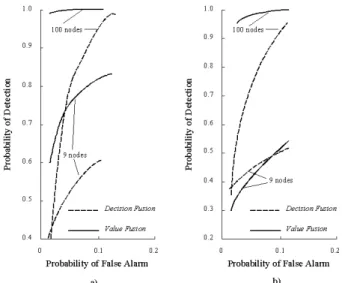
In this case, no values/decisions need to be dropped and n is set to zero. ThePDof both algorithms was measured for diffe- rent PF, number on nodes, maximum power, a decay factor as defined in (1). Figure 3 shows the averagePDfor value and decision fusion as a function of thePFforN =9and 100 and decay factors of 2 and 4. Comparison with results discussed in [10] allows us to note that under the use of the generalized ap- proach to signal processing in the presence of noise [4-8] we can get the same performance, but at low values of maximum power, as under the use of universally adopted signal process- ing algorithms. We see that the superiority of value fusion over decision fusion decreases as the decay factor increases.
Fig. 3. Performance of value and decision fusion without faul- ty nodes: power 5, a) decay factor 2, and b) decay factor 4.
Value fusion lets the nodes exchange more information about the target since all the nodes obtain all the energy mea- surements. Furthermore, for low decay factors, the target is detectable by all or most nodes over a large region and, there- fore, most of the nodes collect meaningful information about the presence of the object. Sharing this information benefits the overall performance and, therefore, value fusion is superi- or to decision fusion. As the energy decay factor increases, on- ly the nodes close to the target collect meaningful information and there is no benefit for other nodes to share their informati- on. Decision fusion becomes superior since it gives more weight to the nodes closest to the target, indeed, for the thre- shold parameter used, the final decision is “target present” as soon as one node locally decides that the target is present.
5.2 Faulty nodes
We assume that all nodes act consistently and the faulty no- des are consistent outliers defined as follows. In the absence of a target, a faulty node reports the highest permissible value in value fusion and a local detection in decision fusion. In the presence of a target, a faulty node reports the lowest permissi- ble value in value fusion and a “local no detection” in decision fusion. Again, thePDof both algorithms was measured for va- ryingPF, numbers of nodes, maximum power, decay factor, number of values dropped, and number of faults. Only results for constantPFof 5% are presented. Figure 4 shows the avera- gePDfor value and decision fusion as a function of the maxi- mum power for 9 and 100 nodes and decay factors 2 and 4. We can see again that under the use of the generalized appro- ach to signal processing in the presence of noise [4-8] we can get the same performance as in [10], but at low values of ma- ximum power, as under the use of universally adopted signal processing algorithms. For the simulation, the number of valu- es dropped is taken from the conditionN≥ n3 +1and the nu- mber of faults injected ism= . n
Fig. 4. Performance of value and decision fusion with faulty nodes: a) decay factor 2 and b) decay factor 4.
Analysis of performance shows that value fusion is superior to decision fusion for a small number of nodes, but decision fusion becomes superior as the number of nodes increases. For increasing decay factor, the superiority of decision fusion occ- urs for a large number of nodes. The difference in performan- ce of the value and decision fusion decreases as the decay fac- tor increases. Overall, faults have more impact on value fusion than on decision fusion. Unlike in the fault-free case, decision fusion performs better than value fusion when thePDis 0.8 or above. This is can be explained by the fact that the value fusi- on algorithm often forced to discard meaningful readings from the non-faulty sensor nodes since it does not know the identity of the faulty nodes. Although decision fusion may also discard decisions by non-faulty sensor nodes, decisions contain less information than energy readings and, therefore, dropping them does not adversely impact decision fusion as much as va- lue fusion.
6. CONCLUSIONS
We analyzed the problem of target detection by a wireless sensor network under the use of the generalized approach to
signal processing in the presence of noise in a region to be monitored. A wireless sensor network model for target detecti- on was developed, specifying the signal energy measured by the sensors, function of the target characteristics, and faulty sensor behavior. Two algorithms, value fusion and decision fusion, were identified to solve the problem. They were analy- zed for their robustness to sensor nodes failure and compared for their performance and communication overhead. The use of the generalized approach to signal processing in the presen- ce of noise allows us to obtain the same performance, but at low values of signal energy, as under the use of universally adopted signal processing algorithms. The performance com- parison was performed both in the presence and in the absence of faul- ty nodes. The scope of the comparison was limited to the worst-case scenario, where all faulty nodes act consistently. Value fusion algorithms were found to perform better than de- cision fusion algorithms in the absence of faults. However, va- lue fusion and decision fusion performance becomes compara- ble as faults are introduced in the system and decision fusion algorithm is then preferred for lower communication overhe- ad.
ACKNOWLEDGMENTS
This work was supported in part by participation within the limits of the project “A Study on Wireless Sensor Networks for Medical Information” sponsored by IITA, Korea.
REFERENCES
[1] J. Bray and C.F. Sturman, Bluetooth: Connect without
Cables. Prentice Hall PTR, Englewood Cliffs, NJ, 2000.
[2] IEEE Std 802.11-1997, Wireless LAN Medium Access Control (MAC) and Physical Layer (PHY) Specificati- ons, 1997.
[3] R.R. Brooks and S.S. Iyengar, Multi-Sensor Fusion: Fu-
ndamentals and Application with Software. Prentice Hall,
Englewood Cliffs, NJ, 1998.
[4] V. Tuzlukov, Signal Processing in Noise: A New Metho- dology, IEC Minsk, 1998.
[5] V. Tuzlukov, “A new approach to signal detection”, Di-
gital Signal Processing: A Review Journal, Vol. 8, No. 3,
pp. 166–184, 1998.
[6] V. Tuzlukov, Signal Detection Theory, Springer-Verlag,
New York, 2001.
[7] V. Tuzlukov, Signal Processing Noise, CRC Press, Boca
Raton, London, New York, Washington D.C., 2002. [8] V. Tuzlukov, Signal and Image Processing in Navigatio-
nal Systems, CRC Press, Boca Raton, London, New
York, Washington D.C., 2004.
[9] V. Tuzlukov, W.-S. Yoon, and Y.D. Kim, “Distributed si- gnal processing with randomized data selection based on the generalized approach in wireless sensor net- works”, WSEAS Transactions on Computers, Issue 5, Vol. 3, pp. 1635–1643, November 2004.
[10] T. Clouqueur, K.K. Saluja, and P. Ramanathan, “Fault tolerance in collaborative sensor networks for target de- tection”, IEEE Trans.Computers, Vol. 53, No. 3, pp. 320 –333, March 2004.
[11] I.F. Akyildiz, W. Su, Y. Sankarasubramaniam, and E.Ca- yirci, “A survey on sensor networks”, IEEE Comm. Ma-
gazine, Vol. 40, No. 8, pp. 102–114, Aug. 2002.
[12] R. Brooks and S. Iyengar, “Robust distributed comput- ing and sensing algorithms”, Computer, Vol. 29, No. 6, pp. 53–60, June 1996.
[13] L. Lamport, R. Shostak, and M. Pease, “The Byzantine generals problem”, ACM Trans. Programming Langua-
ges and Systems, Vol. 4, No. 3 pp. 382–401, July 1982.
[14] M. Hata, “Empirical formula for propagation loss in land mobile radio services”, IEEE Trans.Vehicular Tech-
nology, Vol. 29, No. 4, pp. 317–325, Aug. 1980.
[15] D.L. Hall, Mathematical Techniques in Multisensor Da- ta Fusion. Artech House, Norwood, MA, 1992.
[16] P. Varshney, Distributed Detection and Data Fusion. Springer-Verlag, New York, 1996.
[17] R. Viswanathan and P. Varshney, “Distributed detection with multiple sensors: Part I – Fundamentals”, Proc.
IEEE, pp. 54–63, Jan., 1997.
[18] L.L. Scharf, Statistical Signal Processing: Detection,
Estimation, and Time Series Analysis, Addison-Wesley,
Cambridge, MA, 1991.
[19] C. Lee and J. Chao,”Optimum local decision space par- titioning for distributed detection”, IEEE Trans. Aero-
space and Electronic Systems, Vol. 25, No. 4, pp. 536–
544, July 1985.
[20] M. Barboak, M. Malek, and A. Dahbura, “The consen- sus problem in fault-tolerant computing”, ACM Compu-
ting Surveys, Vol. 25, No. 2, pp. 171–220, June 1993.
[21] M.J. Fischer, “The consensus problem in unreliable dis- tributed systems (a brief survey)”, Fundamentals of Co-
mputation Theory, pp. 127–140, 1983.
[22] J. Shao, Mathematical Statistics, Springer-Verlag, New York, 1999.
[23] I.S. Gradshteyn and I.M. Ryzhik, Table of Integrals, Se-
ries, and Products, 5th ed., Academic Press, San Diego,