Association between Maternal Characteristics and Neonatal
Birth Weight in a Korean Population Living in the Seoul
Metropolitan Area, Korea: A Birth Cohort Study (COCOA)
Previous studies suggest that maternal characteristics may be associated with neonatal outcomes. However, the influence of maternal characteristics on birth weight (BW) has not been adequately determined in Korean populations. We investigated associations between maternal characteristics and BW in a sample of 813 Korean women living in the Seoul metropolitan area, Korea recruited using data from the prospective hospital-based COhort for Childhood Origin of Asthma and allergic diseases (COCOA) between 2007 and 2011. The mean maternal age at delivery was 32.3 ± 3.5 yr and prepregnancy maternal body mass index (BMI) was 20.7 ± 2.5 kg/m2. The mean BW of infant was 3,196 ± 406 g.
The overall prevalence of a maternal history of allergic disease was 32.9% and the overall prevalence of allergic symptoms was 65.1%. In multivariate regression models,
prepregnancy maternal BMI and gestational age at delivery were positively and a maternal history of allergic disease and nulliparity were negatively associated with BW (all P < 0.05). Presence of allergic symptoms in the mother was not associated with BW. In conclusion, prepregnancy maternal BMI, gestational age at delivery, a maternal history of allergic disease, and nulliparity may be associated with BW, respectively.
Key Words: Cohort Studies; Birth Weight; Infant, Newborn; Mothers; Family Characteristic; Body Mass Index; Allergy and Immunology
Youn Ho Shin,1* Suk-Joo Choi,2*
Kyung Won Kim,3 Jinho Yu,4
Kang Mo Ahn,5 Hyung Young Kim,4
Ju-Hee Seo,6 Ji-Won Kwon,7
Byoung-Ju Kim,8 Hyo-Bin Kim,9
Jung Yeon Shim,10 Woo Kyung Kim,11
Dae Jin Song,12 So-Yeon Lee,13
Soo Young Lee,14 Gwang Cheon Jang,15
Ja-Young Kwon,16 Kyung-Ju Lee,17
Hee Jin Park,17 Pil Ryang Lee,18
Hye-Sung Won,18 and Soo-Jong Hong4
1Department of Pediatrics, CHA Medical Center, CHA
University School of Medicine, Seoul; 2Department of
Obstetrics and Gynecology, Samsung Medical Center, Sungkyunkwan University School of Medicine, Seoul;
3Department of Pediatrics, Yonsei University College of
Medicine, Seoul; 4Department of Pediatrics, Childhood
Asthma Atopy Center, Research Center for Standardization of Allergic Diseases, Asan Medical Center, University of Ulsan College of Medicine, Seoul; 5Department of Pediatrics,
Samsung Medical Center, Sungkyunkwan University School of Medicine, Seoul; 6Department of Pediatrics, Korean
Cancer Hospital, Seoul; 7Department of Pediatrics, Seoul
National University Bundang Hospital, Seongnam;
8Department of Pediatrics, Inje University Haeundae Paik
Hospital, Busan; 9Department of Pediatrics, Inje University
Sanggye Paik Hospital, Seoul; 10Department of Pediatrics,
Kangbuk Samsung Hospital, Sungkyunkwan University School of Medicine, Seoul; 11Department of Pediatrics, Inje
University Seoul Paik Hospital, Seoul; 12Department of
Pediatrics, Korea University College of Medicine, Seoul;
13Department of Pediatrics, Hallym Sacred Heart Hospital,
Hallym University College of Medicine, Anyang;
14Department of Pediatrics, Ajou University School of
Medicine, Suwon; 15Department of Pediatrics, National
Health Insurance Corporation Ilsan Hospital, Goyang;
16Department of Obstetrics and Gynecology, Yonsei
University College of Medicine, Seoul; 17Department of
Obstetrics and Gynecology, CHA University School of Medicine, Seoul; 18Department of Obstetrics and
Gynecology, Asan Medical Center, University of Ulsan College of Medicine, Seoul, Korea
* Youn Ho Shin and Suk-Joo Choi contributed equally to this work.
Received: 2 July 2012 Accepted: 25 January 2013 Address for Correspondence: Soo-Jong Hong, MD
Department of Pediatrics, Childhood Asthma Atopy Center, Research Center for Standardization of Allergic Diseases, Asan Medical Center, University of Ulsan College of Medicine, 88 Olympic-ro 43-gil, Songpa-gu, Seoul 138-736, Korea Tel: +82.2-3010-3379, Fax: +82.2-473-3725 E-mail: [email protected]
*This research was supported by a grant (2009-E33033-00) from the research fund of the Korea Centers for Disease Control and Prevention.
http://dx.doi.org/10.3346/jkms.2013.28.4.580 • J Korean Med Sci 2013; 28: 580-585
INTRODUCTION
Birth weight (BW) has long been recognized as a good surro-gate marker for fetal well-being (1) as well as a key determinant of neonatal mortality, morbidity, subsequent growth and de-velopment, and an early onset of adulthood disease (2). Low birth weight (LBW) is associated with inadequate fetal nutri-tional status and growth restriction, and increases the risk of se-rious neonatal morbidity or death (1), whereas macrosomia is associated with an increased risk of obstetric complications, such as birth injury and cesarean section (3). BW is also a pre-dictor of allergic diseases, obesity, diabetes mellitus, and car-diovascular disease in later life (4-7).
Previous studies have demonstrated direct and indirect in-fluences of genetic-, socio-cultural-, demographic-, and behav-ioral maternal factors on BW (8-10). For example, advanced maternal age (11), parity (12), and prepregnancy body mass in-dex (BMI) (13) have a substantial impact on BW. Maternal edu-cation, household income, and smoking and drinking habits also impact on BW (8). However, these associations have not been adequately determined in Korean populations. Such re-search is important, since modern Korean society is rapidly adopting Western patterns of food consumption and lifestyle, which has a substantial influence on weight.
The aim of the present study was to determine the effects of specific maternal characteristics on BW in a Korean population. The null hypothesis was that maternal characteristics are not correlated with BW in the Korean population.
MATERIALS AND METHODS
Study design, population, data sources, and management The COhort for Childhood Origin of Asthma and allergic dis-eases (COCOA) is an ongoing prospective hospital-based birth cohort study. Its aim is to examine the relationship between maternal lifestyle and the subsequent development of allergic disease in the child in the Korean population. The present study investigated 1,294 unselected pregnant women from this co-hort, who attended four different hospitals and seven Public Health Centers for antenatal care located in the Seoul metro-politan area, Korea between November 2007 and September 2011. Subjects with diabetes, preeclampsia, anemia, severe in-fections, etc. during pregnancy that might have an effect on the development of allergic disease were excluded from recruiting. Each subject completed a modified version of the International Study of Asthma and Allergies in Childhood (ISAAC) question-naire (14) at 36 weeks gestation. The questionquestion-naire items con-cerned the demographic data and medical histories of the preg-nant women, including any history of allergic disease, and en-vironmental factors and dietary patterns. The newborns were measured stretched in supine position using an infant
anthro-pometer by trained nurses in the delivery room, as described previously (15). Details of the subsequent delivery were record-ed at birth. During the study period, 1,111 neonates were born. Among them, fifty nine subjects withdrew their consent, 22 were lost to follow-up, and 11 dropped out, yielding 1,019 neo-nates (Fig. 1). The statistical analyses of the present study in-cluded the data of all the mother and infant for whom both a completed ISAAC questionnaire and delivery records such as birth weight were available (n = 813; 62.8%). The mother was asked to report her height (in cm) and asked ‘Do you know how much you weighed before you became pregnant?’ She could answer ‘I do not know’ or report her weight (in kg). Prepreg-nancy BMI was calculated as prepregPrepreg-nancy body weight in ki-lograms divided by height in meters squared (kg/m2).
Ethics statement
This study was approved by the institutional review board of the Asan Medical Center (IRB No. 2008-0616), the Samsung Medi-cal Center (IRB No. 2009-02-021), the Severance Hospital (IRB No. 4-2008-0588) and the CHA Medical Center (IRB No. 2010-010). Informed consent was confirmed by each IRB and ob-tained from the parents of each infant.
Statistical analysis
The data were analyzed by SAS package (SAS Institute, Cary, NC, USA) for Windows. Analyses included frequencies and cross-tabulations for categorical data, and means and standard deviation for continuous data. Univariate and multivariate re-gression analyses were computed in order to test the impact of maternal characteristics on newborn BW. Type of occupation was classified into expert (assemblymen, executives, or admin-istrators), non-expert (repairmen, clerks, service industry work-ers, retailwork-ers, farmwork-ers, forestry technicians, fishermen, assembly technicians, unskilled workers, professional soldiers, etc.) and
Fig. 1. Flow chart of study population. Pregnant women recruited
(n=1,294) Infants born (n=1,111) Withdrawn=59, Follow-up loss=22, Dropped-out=11
Missing birth weight=206 Enrollment of infants
(n=1,019)
Infants with identified birth weight (n=813)
jobless (full-time homemaker). In univariate and multivariate regression analyses, jobless (full-time homemaker) was reclas-sified as non-expert. Maternal education was clasreclas-sified into high school or less, college graduate, and university graduate or higher.
RESULTS
Characteristics of the study population
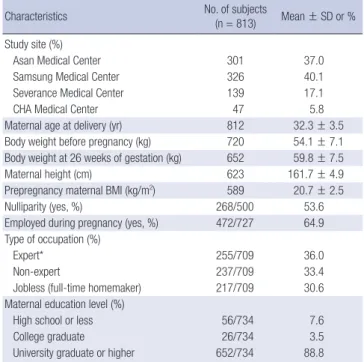
Data on BW were available for 813 neonates (62.8%). Table 1 shows the characteristics of the women in the study sample.
The mean maternal weight before pregnancy and at 26 weeks of gestation was 54.1 ± 7.1 kg and 59.8 ± 7.5 kg, respectively. Ta-ble 2 shows the prevalence of allergic disease and lifestyle fac-tors of the women in the study. The percentages of subjects with a history of asthma, allergic rhinitis, allergic conjunctivitis, atopic dermatitis, and food allergy were 2.0%, 22.0%, 9.9%, 7.9%, and 5.8%, respectively, thereby yielding the overall prevalence of a history of allergic disease of 32.9%. The percentages of sub-jects with symptoms of asthma, allergic rhinitis, allergic con-junctivitis, atopic dermatitis, and food allergy during pregnancy were 5.1%, 58.7%, 8.3%, 12.6%, and 4.6%, respectively, thereby yielding the overall prevalence of allergic symptoms of 65.1%. A total of 6.6% of the women had smoked until pregnancy, 0.4% had smoked during pregnancy, and 62.7% had been exposed to passive smoking during pregnancy. The percentage of women who had drunk alcohol during pregnancy was 11.2%. Table 3 shows the neonatal outcomes including gender, gestational age (GA), BW, length, and head circumference at delivery. A total of 48.2% of the infants were male. Mean GA at delivery was 39.2 ± 1.2 weeks, mean BW was 3,196 ± 406 g, mean length was 49.5 ± 1.9 cm, and mean head circumference was 34.3 ± 1.3 cm. The per-centages of offspring with a BW of < 2,500 g, 2,500-4,000 g, and ≥ 4,000 g were 5.0%, 92.6%, and 2.4%, respectively.
Predictors of birth weight in the study population
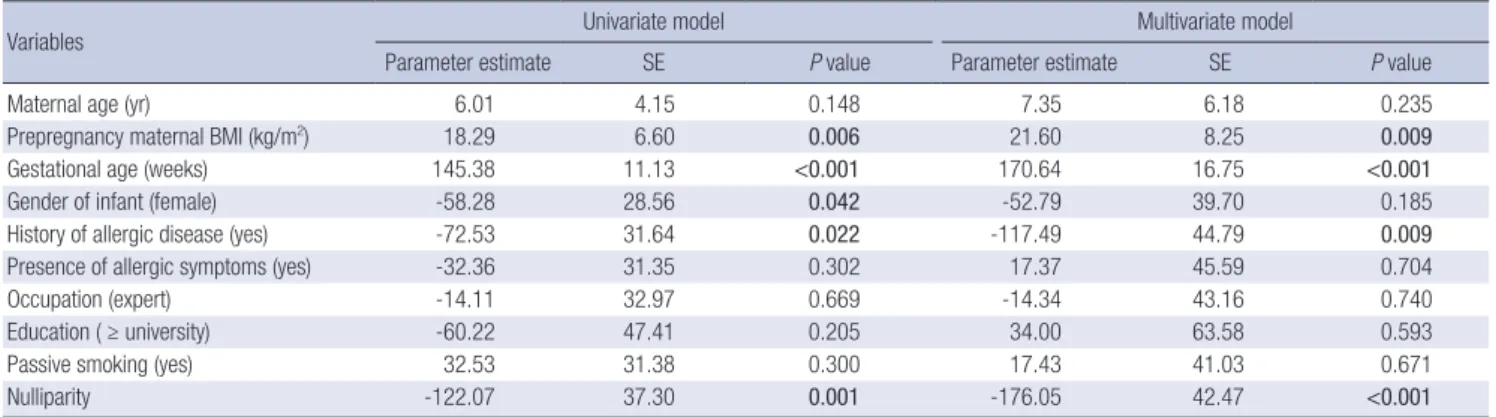
Univariate linear regression analysis showed that prepregnancy maternal BMI and GA were positively associated with BW (β = 18.29, P = 0.006 for BMI and β = 145.38, P < 0.001 for GA, re-spectively) and gender (female), a maternal history of allergic disease, and nulliparity were negatively associated with BW (β = -58.28, P = 0.042 for gender [female], β = -72.53, P = 0.022 for a history of allergic disease, and β = -122.07, P = 0.001 for nulliparity, respectively) (Table 4). Multivariate linear regres-sion analysis showed that prepregnancy maternal BMI and GA were positively associated with BW (β = 21.60, P = 0.009 for BMI and β = 170.64, P < 0.001 for GA, respectively) and a ma-ternal history of allergic disease and nulliparity were negatively associated with BW (β = -117.49, P = 0.009 for maternal history of allergic disease and β = -176.05, P < 0.001 for nulliparity, re-spectively) (Table 4).
Table 1. Characteristics of the pregnant women in the present study
Characteristics No. of subjects(n = 813) Mean ± SD or % Study site (%)
Asan Medical Center 301 37.0
Samsung Medical Center 326 40.1
Severance Medical Center 139 17.1
CHA Medical Center 47 5.8
Maternal age at delivery (yr) 812 32.3 ± 3.5 Body weight before pregnancy (kg) 720 54.1 ± 7.1 Body weight at 26 weeks of gestation (kg) 652 59.8 ± 7.5
Maternal height (cm) 623 161.7 ± 4.9
Prepregnancy maternal BMI (kg/m2) 589 20.7 ± 2.5
Nulliparity (yes, %) 268/500 53.6
Employed during pregnancy (yes, %) 472/727 64.9 Type of occupation (%)
Expert* 255/709 36.0
Non-expert 237/709 33.4
Jobless (full-time homemaker) 217/709 30.6 Maternal education level (%)
High school or less 56/734 7.6
College graduate 26/734 3.5
University graduate or higher 652/734 88.8 *Assemblymen, executives, or administrators.
Table 2. Prevalence of allergic disease and lifestyle factors in the pregnant women in the present study
Characteristics No. of subjects %
Maternal history of allergic diseases 242/736 32.9
History of asthma 15/736 2.0
History of allergic rhinitis 162/736 22.0 History of allergic conjunctivitis 73/736 9.9 History of atopic dermatitis 58/736 7.9
History of food allergy 43/736 5.8
Presence of allergic symptoms 478/734 65.1 Presence of asthma symptoms 37/730 5.1 Presence of allergic rhinitis symptoms 430/733 58.7 Presence of allergic conjunctivitis symptoms 61/734 8.3 Presence of atopic dermatitis symptoms 92/733 12.6 Presence of food allergy symptoms 34/734 4.6 Smoking history (≥ 20 packs in total before pregnancy) 48/730 6.6
Smoking during pregnancy 3/728 0.4
Passive smoking during pregnancy 452/721 62.7
Drinking during pregnancy 82/733 11.2
Table 3. Clinical characteristics of offspring
Characteristics No. of subjects Mean ± SD or % (Min, Max)
Gender (male) 412/813 48.2
Gestational age at delivery 755 39.2 ± 1.2 (34.0, 43.0) Birth weight (g) < 2,500 2,500-4,000 ≥ 4,000 813 41/813 753/813 19/813 3,196 ± 406 5.0 92.6 2.4 (1,770, 4,600) Length (cm) 766 49.5 ± 1.9 (42.0, 59.0) Head circumference (cm) 730 34.3 ± 1.3 (28.9, 39.5)
DISCUSSION
The aim of this large prospective hospital-based birth cohort study was to determine the effect of maternal characteristics such as maternal age, prepregnancy BMI, smoking, parity, and allergy on BW in a Korean population living in the Seoul metro-politan area, Korea. In multivariate regression models, prepreg-nancy maternal BMI and GA were positively associated with BW (β = 21.60, P = 0.009 for BMI and β = 170.64, P < 0.001 for GA, respectively) and a maternal history of allergic disease and nulliparity were negatively associated with BW (β = -117.49,
P = 0.009 for a maternal history of allergic disease and β = -176.05,
P < 0.001 for nulliparity).
The present results correspond well with those of previous studies, which reported a significant association between pre-pregnancy BMI and adiposity in the offspring (13). Several un-derlying mechanisms have been proposed. First, maternal size may determine fetal size via protein-energy availability (16). If a prepregnancy energy deficiency persists during early pregnan-cy—when energy requirements are at their greatest—the sub-strates necessary to maintain appropriate fetal tissue growth will be unavailable, thereby resulting in LBW. Second, poor ma-ternal nutritional status during pregnancy is associated with re-duced placental weight and surface area (17), which may limit nutrient transfer from the maternal circulation to the fetus, de-spite increased dietary intake later in pregnancy. Whether a smaller placenta is a direct result of maternal malnutrition or whether the effect is mediated through disruption of endocrine function remains unknown. However, reduced concentrations of hormones such as leptin and estrogen may contribute to fe-tal growth restriction (18). Third, protein-energy malnutrition may not entirely explain the association between prepregnancy BMI and BW (19). A previous study suggested that underweight women have a lower total plasma volume during early and late pregnancy compared with normal and overweight women, which results in a proportionately reduced cardiac output. This
would result in lower uteroplacental blood flow and, hence, a decrease in the transfer of nutrients to the fetus and a reduction in fetal growth (19). Fourth, in underweight women, inade-quate micronutrient intake during pregnancy may be associat-ed with rassociat-educassociat-ed maternal plasma volume and BW. Fifth, there is evidence suggesting that intrinsic maternal control of fetal size correlates with maternal size (20).
The prevalence of allergic disease is increasing worldwide (21, 22). However, no previous study has focused on the impact of allergic disease during pregnancy on BW in Korean popula-tions. We found that a maternal history of allergic disease may be negatively associated with BW. Previous studies have found conflicting results concerning the impact of maternal allergic diseases on BW (1, 23-27). Asthma during pregnancy is associ-ated with physiological changes in the expectant mother (28). However, the effect of asthma during pregnancy on BW is poor-ly characterized. Although some studies found no association between maternal asthma and BW (25), others reported lower BW in infants born to asthmatic women (26). Severe exacerba-tions of asthma or moderate to severe asthma during pregnan-cy have been shown to increase the risk of LBW (29), while ma-ternal forced expiratory volume in one second is directly posi-tively associated with BW (23). Chronic hypoxia secondary to uncontrolled asthma and the impact of corticosteroids may ex-plain LBW in infants born to asthmatic mothers (24). The asso-ciation between atopic dermatitis in pregnancy and BW is com-plex. Pregnant women may avoid certain foods in the misap-prehension that they might cause atopic dermatitis in their off-spring, thereby resulting in LBW of their offspring. Severe exac-erbations of atopic dermatitis during pregnancy may also in-crease the risk of LBW. A recent study reported that although the use of potent or super potent topical corticosteroids during pregnancy was not associated with severe neonatal outcomes such as orofacial cleft, preterm delivery, or fetal death, it was as-sociated with a significantly increased risk of LBW (30). There are several possible mechanisms for this. Topical
corticoste-Table 4. Results of univariate and multivariate linear regression analysis to assess relationships between birth weight and clinical variables such as maternal and neonatal characteristics
Variables Univariate model Multivariate model
Parameter estimate SE P value Parameter estimate SE P value
Maternal age (yr) 6.01 4.15 0.148 7.35 6.18 0.235
Prepregnancy maternal BMI (kg/m2) 18.29 6.60 0.006 21.60 8.25 0.009
Gestational age (weeks) 145.38 11.13 <0.001 170.64 16.75 <0.001
Gender of infant (female) -58.28 28.56 0.042 -52.79 39.70 0.185
History of allergic disease (yes) -72.53 31.64 0.022 -117.49 44.79 0.009
Presence of allergic symptoms (yes) -32.36 31.35 0.302 17.37 45.59 0.704
Occupation (expert) -14.11 32.97 0.669 -14.34 43.16 0.740
Education ( ≥ university) -60.22 47.41 0.205 34.00 63.58 0.593
Passive smoking (yes) 32.53 31.38 0.300 17.43 41.03 0.671
Nulliparity -122.07 37.30 0.001 -176.05 42.47 <0.001
Multivariate linear regression analysis included maternal age, prepregnancy maternal BMI, gestational age, gender of infant, a history of allergic disease, the presence of aller-gic symptoms, occupation, education, passive smoking, and nulliparity. SE, standard error; BMI, body mass index.
roids affect the insulin-like growth factor system, and may thus result in fetal growth restriction (31). Corticosteroids also in-duce dysregulation of placental hormone/cytokine gene ex-pression and downregulation of the insulin-like growth factor-II/Akt signaling pathway, which may result in increased placen-tal apoptosis, placenplacen-tal insufficiency, and feplacen-tal growth restric-tion (32). Although some studies showed that the prevalence of allergic rhinitis was lower in mothers of extremely LBW ( < 1,000 g) pre-term infants compared with mothers of full-term babies (33), others reported no association between maternal allergic rhinitis during pregnancy and BW (27). The association between maternal allergic disease and BW of infant may be explained by the Developmental Origins of Health and Disease (DOHaD) theory (34). The concept of this theory is that human develop-ment in utero or during the early phases of extrauterine life af-fects risk of noncommunicable diseases (NCDs), such as car-diovascular diseases, diabetes, chronic lung disease, allergy, some forms of cancer, cognitive decline, osteoporosis, sarcope-nia, and effective disorders in later life (34). According to this theory, an insult such as maternal allergic disease at a critical time of fetal growth and development may have a permanent impact on the body’s structure, physiology, and metabolism, thereby resulting in a certain BW, which is considered a predic-tor of many NCDs (4-7).
An important finding worth mentioning in this study is that a maternal history of allergic disease was associated with BW, whereas the presence of allergic symptoms was not associated with BW. Possible explanations are as follows: 1) Maternal his-tory of allergic disease itself may have a significantly greater im-pact on the fetal development in utero or it may be the result of prolonged effect imposed on the fetus by maternal allergic dis-ease through immunological or unknown mechanisms. On the contrary, the presence of allergic symptoms refers to the pres-ence of allergic symptoms in the past 12 months, which thefore may have a different effect on the fetus in utero, thereby re-sulting in disparate perinatal outcomes: 2) Pregnant women with controlled allergic disease may have reported no presence of allergic symptoms: and 3) Also, there is a possibility that a large number of vasomotor rhinitis, intrinsic asthma, infectious conjunctivitis, and seborrheic dermatitis cases may have been misinterpreted to be atopic diseases by the mother. In fact, 65.1% of the women reported to have the presence of allergic symp-toms, whereas merely 32.9% of the women reported to have a history of allergic disease.
The present study demonstrated that nulliparity was associ-ated with lower birth weight. This finding is in line with a meta-analysis of 41 studies (12) reporting that nulliparity was associ-ated with increased odds of low birth weight and small-for-ges-tational-age and reduction in birth weight. This may be due to a reduced uterine capacity and blood supply, and the consequent reduction in the delivery of oxygen and nutrients to the
devel-oping fetus (35).
The strengths of the present study are its longitudinal design and the large study population. The observed associations are not explained by confounding factors such as maternal educa-tion and types of occupaeduca-tion, since these variables were includ-ed in all analyses.
The present study has a few limitations. First, prepregnancy weight was self-reported at recruitment, which occurred at 26 weeks gestation. Women are likely to underreport having been overweight (36). The fact that weight was reported retrospec-tively may have further contributed to this underestimation of prepregnancy weight. This bias may have attenuated the asso-ciation between high prepregnancy BMI and BW. A second limitation is that postpartum weight was not measured and consequently weight gain during the entire pregnancy was not assessed.
In conclusion, the present results confirm the hypothesis that prepregnancy maternal BMI and GA are positively and nulliparity is negatively associated with BW, and expand previ-ous findings by showing that a maternal history of allergic dis-ease has a negative effect on BW. Maintaining maternal BMI in the normal range during the preconception period may ensure good neonatal outcomes such as normal BW.
ACKNOWLEDGMENTS
The authors declared no potential conflicts of interest with re-spect to the research, authorship, and/or publication of this ar-ticle.
REFERENCES
1. Aly H, Nada A, Ahmad T, Mohamed M, Massaro AN, Bathgate S, Macri CJ, Larsen JW Jr. Maternal asthma, race and low birth weight deliveries. Early Hum Dev 2011; 87: 457-60.
2. Elizabeth KE, Krishnan V, Zachariah P. Auxologic, biochemical and clin-ical (ABC) profile of low birth weight babies- a 2-year prospective study. J Trop Pediatr 2007; 53: 374-82.
3. Heslehurst N, Simpson H, Ells LJ, Rankin J, Wilkinson J, Lang R, Brown TJ, Summerbell CD. The impact of maternal BMI status on pregnancy outcomes with immediate short-term obstetric resource implications: a meta-analysis. Obes Rev 2008; 9: 635-83.
4. Dratva J, Breton CV, Hodis HN, Mack WJ, Salam MT, Zemp E, Gilliland F, Kuenzli N, Avol E. Birth weight and carotid artery intima-media thick-ness. J Pediatr 2012. doi: 10.1016/j.jpeds.2012.10.060.
5. Lau C, Rogers JM, Desai M, Ross MG. Fetal programming of adult dis-ease: implications for prenatal care. Obstet Gynecol 2011; 117: 978-85. 6. Tedner SG, Örtqvist AK, Almqvist C. Fetal growth and risk of childhood
asthma and allergic disease. Clin Exp Allergy 2012; 42: 1430-47. 7. Lundholm C, Ortqvist AK, Lichtenstein P, Cnattingius S, Almqvist C.
Impaired fetal growth decreases the risk of childhood atopic eczema: a Swedish twin study. Clin Exp Allergy 2010; 40: 1044-53.
8. Emanuel I, Kimpo C, Moceri V. The association of maternal growth and socio-economic measures with infant birthweight in four ethnic groups. Int J Epidemiol 2004; 33: 1236-42.
9. Astone NM, Misra D, Lynch C. The effect of maternal socio-economic status throughout the lifespan on infant birthweight. Paediatr Perinat Epidemiol 2007; 21: 310-8.
10. Jackson DJ, Batiste E, Rendall-Mkosi K. Effect of smoking and alcohol use during pregnancy on the occurrence of low birthweight in a farming region in South Africa. Paediatr Perinat Epidemiol 2007; 21: 432-40. 11. Ludford I, Scheil W, Tucker G, Grivell R. Pregnancy outcomes for
nullip-arous women of advanced maternal age in South Australia, 1998-2008. Aust N Z J Obstet Gynaecol 2012; 52: 235-41.
12. Shah PS; Knowledge Synthesis Group on Determinants of LBW/PT births. Parity and low birth weight and preterm birth: a systematic re-view and meta-analyses. Acta Obstet Gynecol Scand 2010; 89: 862-75. 13. Liu Y, Dai W, Dai X, Li Z. Prepregnancy body mass index and gestational
weight gain with the outcome of pregnancy: a 13-year study of 292,568 cases in China. Arch Gynecol Obstet 2012; 286: 905-11.
14. Worldwide variation in prevalence of symptoms of asthma, allergic rhi-noconjunctivitis, and atopic eczema: ISAAC. The International Study of Asthma and Allergies in Childhood (ISAAC) Steering Committee. Lancet 1998; 351: 1225-32.
15. Laron Z. The diagnostic and prognostic importance of neonatal length measurements. Isr Med Assoc J 2000; 2: 84-5.
16. Neggers Y, Goldenberg RL. Some thoughts on body mass index, micro-nutrient intakes and pregnancy outcome. J Nutr 2003; 133: 1737S-1740S 17. Lechtig A, Yarbrough C, Delgado H, Martorell R, Klein RE, Béhar M. Ef-fect of moderate maternal malnutrition on the placenta. Am J Obstet Gynecol 1975; 123: 191-201.
18. Mantzoros CS. Role of leptin in reproduction. Ann N Y Acad Sci 2000; 900: 174-83.
19. Rosso P, Salas SP. Nutrient regulation during pregnancy, lactation, and infant growth. New York: Plenum Press, 1994.
20. Sebire NJ, Jolly M, Harris J, Regan L, Robinson S. Is maternal underwei-ght really a risk factor for adverse pregnancy outcome? a population-based study in London. BJOG 2001; 108: 61-6.
21. Hong SJ, Lee MS, Sohn MH, Shim JY, Han YS, Park KS, Ahn YM, Son BK, Lee HB; Korean ISAAC Study Group. Self-reported prevalence and risk factors of asthma among Korean adolescents: 5-year follow-up study, 1995-2000. Clin Exp Allergy 2004; 34: 1556-62.
22. Yu JS, Lee CJ, Lee HS, Kim J, Han Y, Ahn K, Lee SI. Prevalence of atopic dermatitis in Korea: analysis by using national statistics. J Korean Med Sci 2012; 27: 681-5.
23. Schatz M, Dombrowski MP, Wise R, Momirova V, Landon M, Mabie W, Newman RB, Rouse DJ, Lindheimer M, Miodovnik M, et al. Spirometry is related to perinatal outcomes in pregnant women with asthma. Am J Obstet Gynecol 2006; 194: 120-6.
24. Dombrowski MP. Outcomes of pregnancy in asthmatic women. Immu-nol Allergy Clin North Am 2006; 26: 81-92.
25. Kelly YJ, Brabin BJ, Milligan P, Heaf DP, Reid J, Pearson MG. Maternal asthma, premature birth, and the risk of respiratory morbidity in school-children in Merseyside. Thorax 1995; 50: 525-30.
26. Firoozi F, Lemière C, Beauchesne MF, Perreault S, Forget A, Blais L. Im-pact of maternal asthma on perinatal outcomes: a two-stage sampling cohort study. Eur J Epidemiol 2012; 27: 205-14.
27. Somoskövi A, Bártfai Z, Tamási L, Kocsis J, Puhó E, Czeizel AE. Popula-tion-based case-control study of allergic rhinitis during pregnancy for birth outcomes. Eur J Obstet Gynecol Reprod Biol 2007; 131: 21-7. 28. Belanger K, Hellenbrand ME, Holford TR, Bracken M. Effect of
preg-nancy on maternal asthma symptoms and medication use. Obstet Gy-necol 2010; 115: 559-67.
29. Namazy JA, Murphy VE, Powell H, Gibson PG, Chambers C, Schatz M. Effects of asthma severity, exacerbations and oral corticosteroids on peri-natal outcomes. Eur Respir J 2012. doi: 10.1183/09031936.00195111. 30. Chi CC, Mayon-White RT, Wojnarowska FT. Safety of topical
corticoste-roids in pregnancy: a population-based cohort study. J Invest Dermatol 2011; 131: 884-91.
31. Randhawa R, Cohen P. The role of the insulin-like growth factor system in prenatal growth. Mol Genet Metab 2005; 86: 84-90.
32. Ain R, Canham LN, Soares MJ. Dexamethasone-induced intrauterine growth restriction impacts the placental prolactin family, insulin-like growth factor-II and the Akt signaling pathway. J Endocrinol 2005; 185: 253-63.
33. Savilahti E, Siltanen M, Pekkanen J, Kajosaari M. Mothers of very low birth weight infants have less atopy than mothers of full-term infants. Clin Exp Allergy 2004; 34: 1851-4.
34. Hanson M, Gluckman P. Developmental origins of noncommunicable disease: population and public health implications. Am J Clin Nutr 2011; 94: 1754S-1758S.
35. Zhang X, Mumford SL, Cnattingius S, Schisterman EF, Kramer MS. Re-duced birthweight in short or primiparous mothers: physiological or pathological? BJOG 2010; 117: 1248-54.
36. Scholtens S, Wijga AH, Brunekreef B, Kerkhof M, Postma DS, Olden-wening M, de Jongste JC, Smit HA. Maternal overweight before preg-nancy and asthma in offspring followed for 8 years. Int J Obes (Lond) 2010; 34: 606-13.