© 2015 The Korean Ophthalmological Society
This is an Open Access article distributed under the terms of the Creative Commons Attribution Non-Commercial License (http://creativecommons.org/licenses /by-nc/3.0/) which permits unrestricted non-commercial use, distribution, and reproduction in any medium, provided the original work is properly cited.
Original Article
Surgical Results of Trabeculectomy and Ahmed Valve Implantation
Following a Previous Failed Trabeculectomy in Primary
Congenital Glaucoma Patients
Naeun Lee1,2, Kyoung Tak Ma3, Hyoung Won Bae1, Samin Hong1, Gong Je Seong1, Young Jae Hong4,
Chan Yun Kim1
1Institute of Vision Research, Department of Ophthalmology, Yonsei University College of Medicine, Seoul, Korea 2Department of Ophthalmology, Hallym Hospital, Incheon, Korea
3Jeil Eye Clinic, Suwon, Korea 4Noone Eye Hospital, Seoul, Korea
Purpose: To compare the surgical results of trabeculectomy and Ahmed glaucoma valve implantation after a previous failed trabeculectomy.
Methods: A retrospective comparative case series review was performed on 31 eye surgeries in 20 patients with primary congenital glaucoma who underwent trabeculectomy or Ahmed glaucoma valve implantation af-ter a previous failed trabeculectomy with mitomycin C.
Results: The preoperative mean intraocular pressure was 25.5 mmHg in the trabeculectomy group and 26.9 mmHg in the Ahmed glaucoma valve implantation group (p = 0.73). The 48-month postoperative mean intra-ocular pressure was 19.6 mmHg in the trabeculectomy group and 20.2 mmHg in the Ahmed glaucoma valve implantation group (p = 0.95). The 12-month trabeculectomy success rate was 69%, compared with 64% for Ahmed glaucoma valve implantation, and the 48-month success rates were 42% and 36% for trabeculectomy and valve implantation, respectively. The success rates following the entire follow-up period were not signifi-cantly different between the two groups (p > 0.05 by log rank test). Postoperative complications occurred in 25% of the trabeculectomy-operated eyes and 9% of the Ahmed-implanted eyes (p = 0.38).
Conclusions: There was no significant difference in surgical outcome between the trabeculectomy and Ahmed glaucoma valve implantation groups, neither of which had favorable results. However, the trabeculectomy group demonstrated a higher prevalence of adverse complications such as post-operative endophthalmitis.
Key Words: Ahmed valve implantation, Congenital glaucoma, Surgical outcomes, Trabeculectomy
The incidence of congenital glaucoma is low, but it is the most common form of pediatric glaucoma and an
import-ant cause of blindness [1]. The treatment of choice for con-genital glaucoma is surgery, with angle surgery usually being performed first, followed by trabeculectomy or Ahmed glaucoma valve implantation, if the angle surgery fails [1,2]. However, even these interventions are not al-ways effective for controlling intraocular pressure (IOP), and, when they fail, it can be difficult to decide on a next step. The aim of this study was to investigate and compare Received: July 14, 2014 Accepted: August 18, 2014
Corresponding Author: Chan Yun Kim, MD, PhD. Department of Oph-thalmology, Yonsei University College of Medicine, 50 Yonsei-ro, Seo-daemun-gu, Seoul 120-749, Korea. Tel: 82-2-2228-3570, Fax: 82-2-312-0541, E-mail: [email protected]
the surgical results of trabeculectomy with those of Ahmed glaucoma valve implantation following a previous trabe-culectomy failure in patients with primary congenital glaucoma.
Materials and Methods
With institutional review board approval, we completed a retrospective chart review of 167 congenital glaucoma patients who had undergone glaucoma surgery. Thirty-one eyes of 20 patients with primary congenital glaucoma who underwent trabeculectomy with mitomycin C (n = 20) or Ahmed glaucoma valve implantation (n = 11) after a previ-ous failed trabeculectomy between June 1990 and April 2007 were included in this study. This study followed the tenets of the Declaration of Helsinki.
Diagnoses were confirmed with clinical features and signs, such as gonioscopic angle abnormality, enlargement of the corneal diameter, increase in axial length, optic nerve change, and persistently elevated IOP. Patients with other ocular or systemic abnormalities that could result in glaucoma, such as Axenfeld-Rieger syndrome, were ex-cluded, as were patients with less than six months fol-low-up time. All patients had a history of previous failed trabeculectomy. The following data were analyzed be-tween the two groups: 1) preoperative and postoperative IOP, 2) number of glaucoma medications used during the preoperative and postoperative periods, 3) surgical compli-cations, and 4) achievement of surgical success.
IOP was measured with a tonopen or, when possible, with a Goldmann applanation tonometer (GAT). Visual acuity was determined with a Teller acuity card or a Snel-len acuity chart, when possible. A successful operation was defined as 1) intraocular ocular pressure between 5 and 21 mmHg, 2) no decrease in vision due to complica-tions or changes in IOP, and 3) no need for an additional glaucoma operation. Postoperative use of antiglaucoma medication was not a criterion of success or failure.
All surgeries were performed by a single surgeon (YJH). For trabeculectomy, a limbus-based conjunctival flap was prepared, followed by a rectangular half-thickness scleral flap measuring 4 × 4 mm. A sponge soaked in mitomycin C at a concentration of 0.25 mg/mL was applied intraoper-atively on the sclera and underneath the conjunctiva for 3.9 ± 1.6 minutes, according to the patient’s condition. When
the time since previous glaucoma surgery was less than three months, mitomycin C was not applied. After careful rinsing with saline, trabeculectomy and peripheral iridec-tomy were performed. The scleral flap was closed with two to four 10-0 nylon sutures, and the Tenon capsule and con-junctiva were sutured ensuring a watertight closure. Ahmed glaucoma valve implantation was performed fol-lowing the conventional method. Briefly, a fornix-based conjunctival incision was made, and the Tenon capsule was dissected with spring scissors. A rectangular-shaped half-thickness scleral flap was made in the supratemporal position of the limbus. The Ahmed glaucoma valve (S2 or S3 model; New World Medical Inc., Rancho Cucamonga, CA, USA) was secured to the sclera in the superotemporal quadrant 8-mm posterior to the limbus. An entrance site into the anterior chamber was made under the scleral flap with a 23-G needle. After temporary ligation using an absorbable suture, the tube of the valve was then passed through this 23-G opening into the anterior chamber, and a donor sclera was used to cover the flap and tube.
Kaplan-Meier survival curves and log rank test were used to investigate and compare the success rates between the two procedures. To compare between the two groups, we used the Mann Whitney U-test or χ2 test. Statistical analyses were carried out using SPSS ver. 18.0 (SPSS Inc., Chicago, IL, USA).
Results
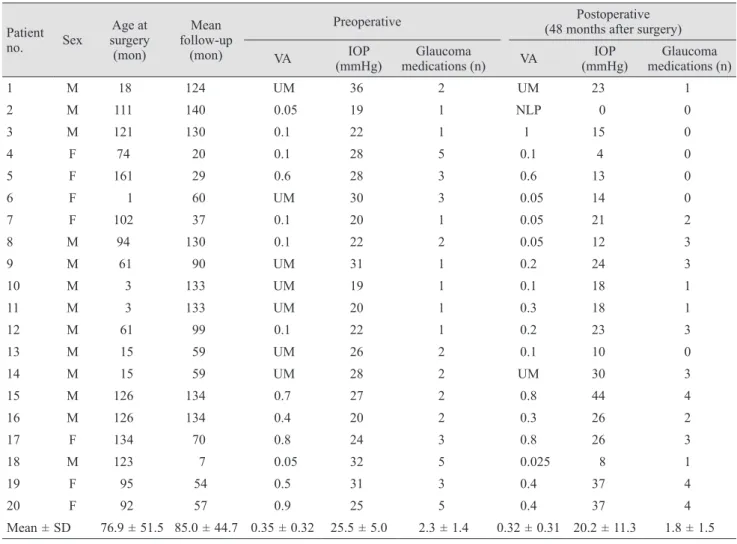
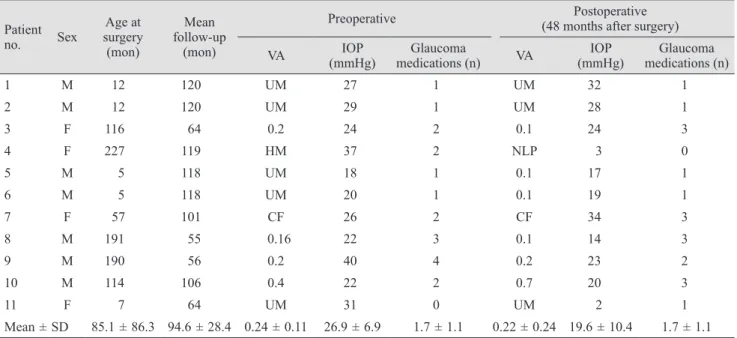
The mean follow-up period between the two groups was not significantly different; 85.0 months (range, 7 to 140 months) for the trabeculectomy group and 94.6 months (range, 55 to 120 months) for the Ahmed glaucoma valve implantation group (p > 0.05 by Mann-Whitney U-test). The mean age of the patients at the time of surgery was 86.3 months (range, 1 to 162) in the trabeculectomy group and 85.1 months (range, 5 to 227) in the valve implantation group. This difference was not statistically significant (p > 0.05 by Mann-Whitney U-test). Both the preoperative IOP (trabeculectomy, 25.5 mmHg; valve implantation, 26.9 mmHg) and the 48-month postoperative IOP (20.2 vs. 19.6 mmHg in the trabeculectomy group and the Ahmed glau-coma valve group, respectively) were similar in the two groups (p > 0.05, Mann-Whitney U-test). There was no significant difference between the two groups in the
num-ber of glaucoma medications used either preoperatively or postoperatively (1.7 ±1.1 vs. 2.3 ±1.4, p=0.25; 1.7 ±1.1 vs. 1.8 ±1.5, p = 0.97, respectively). Preoperative IOP, 48-month postoperative IOP, visual acuity, and glaucoma medica-tions are summarized in Tables 1 and 2.
Table 3 presents the observed postoperative complica-tions, which occurred in five (25%) of the trabeculecto-my-operated eyes and one (9%) of the Ahmed-implanted eyes (p = 0.38). We observed one case of bleb-related en-dophthalmitis in a trabeculectomy with mitomycin C pa-tient (5%), which improved with injection of intravitreal antibiotics. In the Ahmed glaucoma valve group, we ob-served one case of tube-cornea contact due to tube migration (9%), which required surgical repositioning. Ad-ditionally, we saw two cases of shallow anterior chamber in the trabeculectomy group (10%), one of which required
surgical intervention.
The success rates at one year intervals following the proce-dures were as follows (reported as trabeculectomy vs. Ahmed valve implantation): 69% vs. 64% (12 months), 59% vs. 46% (24 months), and 42% vs. 36% (48 months). Additionally, the trabeculectomy group showed a 34% success rate after 96 months of follow-up, while the valve implantation group showed a 24% success rate after 62 months. However, no sig-nificant difference in the time to failure was observed be-tween the groups (p = 0.529 by log rank test) (Fig. 1).
Discussion
While angle surgery, with a success rate of 70% to 90% [3-5], is the primary surgical procedure utilized for congenital
Table 1. Preoperative and postoperative characteristics of the trabeculectomy group
Patient no. Sex Age at surgery (mon) Mean follow-up (mon)
Preoperative (48 months after surgery)Postoperative VA (mmHg)IOP medications (n)Glaucoma VA (mmHg)IOP medications (n)Glaucoma
1 M 18 124 UM 36 2 UM 23 1 2 M 111 140 0.05 19 1 NLP 0 0 3 M 121 130 0.1 22 1 1 15 0 4 F 74 20 0.1 28 5 0.1 4 0 5 F 161 29 0.6 28 3 0.6 13 0 6 F 1 60 UM 30 3 0.05 14 0 7 F 102 37 0.1 20 1 0.05 21 2 8 M 94 130 0.1 22 2 0.05 12 3 9 M 61 90 UM 31 1 0.2 24 3 10 M 3 133 UM 19 1 0.1 18 1 11 M 3 133 UM 20 1 0.3 18 1 12 M 61 99 0.1 22 1 0.2 23 3 13 M 15 59 UM 26 2 0.1 10 0 14 M 15 59 UM 28 2 UM 30 3 15 M 126 134 0.7 27 2 0.8 44 4 16 M 126 134 0.4 20 2 0.3 26 2 17 F 134 70 0.8 24 3 0.8 26 3 18 M 123 7 0.05 32 5 0.025 8 1 19 F 95 54 0.5 31 3 0.4 37 4 20 F 92 57 0.9 25 5 0.4 37 4 Mean ± SD 76.9 ± 51.5 85.0 ± 44.7 0.35 ± 0.32 25.5 ± 5.0 2.3 ± 1.4 0.32 ± 0.31 20.2 ± 11.3 1.8 ± 1.5 VA = visual acuity; IOP = intraocular pressure; UM = unmeasurable; NLP = no light perception.
glaucoma, congenital glaucoma is not always successfully controlled using this technique. Therefore, when an unaccept-able increase in IOP occurs after angle surgery, trabe c ul-ectomy with or without mitomycin C is usually the next treatment choice. The reported success rates of treatments for refractory congenital glaucoma show wide variation (39% to 94%) according to the study group, surgeon, success criteria, and follow-up period [6-13]. However, when trabeculectomy performed as a second operation also fails, it is unclear
whether an additional trabeculectomy or implantation of a glaucoma drainage device is a better choice as the next in-tervention. Re-trabeculectomy might be more effective than
Table 2. Preoperative and postoperative characteristics of the Ahmed glaucoma valve group
Patient no. Sex Age at surgery (mon) Mean follow-up (mon)
Preoperative (48 months after surgery)Postoperative VA (mmHg)IOP medications (n)Glaucoma VA (mmHg)IOP medications (n)Glaucoma
1 M 12 120 UM 27 1 UM 32 1 2 M 12 120 UM 29 1 UM 28 1 3 F 116 64 0.2 24 2 0.1 24 3 4 F 227 119 HM 37 2 NLP 3 0 5 M 5 118 UM 18 1 0.1 17 1 6 M 5 118 UM 20 1 0.1 19 1 7 F 57 101 CF 26 2 CF 34 3 8 M 191 55 0.16 22 3 0.1 14 3 9 M 190 56 0.2 40 4 0.2 23 2 10 M 114 106 0.4 22 2 0.7 20 3 11 F 7 64 UM 31 0 UM 2 1 Mean ± SD 85.1 ± 86.3 94.6 ± 28.4 0.24 ± 0.11 26.9 ± 6.9 1.7 ± 1.1 0.22 ± 0.24 19.6 ± 10.4 1.7 ± 1.1 VA = visual acuity; IOP = intraocular pressure; UM = unmeasurable; HM = hand motion; NLP = no light perception; CF = counting finger.
Table 3. Postoperative complications
Trabeculectomy ( n = 20) Ahmed glaucoma valve implantation ( n = 11) Shallow anterior chamber 2 (10) 0 (0) Lenticular opacity 1 (5) 0 (0) Endophthalmitis 1 (5) 0 (0) Choroidal detachment 1 (5) 0 (0) Tube-cornea contact 0 (0) 1 (9) Total 5 (25) 1 (9)
Data are shown as number (%).
Fig. 1. Kaplan-Meier survival curve showing the proportion of
eyes in which the operation was successful over time after trabe-culectomy or Ahmed glaucoma valve implantation.
1.0 0.8 0.6 0.4 0.2 0.0 0.00 20.00 40.00 60.00 80.00 100.00 120.00 140.00 Follow-up (mon) Cumulative survival
the first surgery, but use of a glaucoma drainage device may also be an option when a previous trabeculectomy has failed. The efficacy of Ahmed glaucoma valve implantation, which is one of the most widely used glaucoma drainage devices, as the surgical choice for treatment of refractory congenital glaucoma has recently been reported and showed similar success rates to trabe culectomy (53% to 88%) [1,2]. However, studies comparing the results of those two surg eries in refractory congenital glaucoma after failure of the first trabeculectomy surgery have not yet been performed because of the rarity of the occurrence. There fore, we evaluated the success rates and complications of a second trabeculectomy versus those of an Ahmed glaucoma valve implantation fol-lowing a failed first trabeculectomy.
Using the log rank test, we found that the two had com-parable success rates. Although the trabeculectomy group showed slightly higher success rates than the Ahmed glau-coma valve group, there was no significant difference between the two groups (p = 0.529). However, with respect to postoperative complications, trabeculectomy led to more complications; five cases (25%) in the trabeculectomy group showed complications, while tube migration (9%) was the only observed complication in the Ahmed glauc oma valve implantation group.
The success rate we observed was lower than that found by others for this type of primary surgery. This may be due to the fact that all subjects included in this study had already experienced failures of the angle surgery and trabeculectomy, and previous failure of surgery is known to be a poor prognostic factor for subsequent surgery. To the best of our knowledge, this is the first report of success rates of additional surgical intervention (trabeculectomy or Ahmed glaucoma valve implantation) for refractory congenital glaucoma in patients who underwent a previous failed trabeculectomy. Therefore, the findings of this study will inform the choice of surgery for repeatedly uncon-trolled congenital glaucoma.
The main limitations of our study were the small num-ber of participants and the fact that it was a retrospective study. Because congenital glaucoma has such a low preva-lence, it was difficult to find patients who had undergone primary operations followed by re-operation, and this lim-ited our sample size. On the other hand, the long follow-up period was one of the major strengths of our study.
In conclusion, this study revealed that both trabeculecto-my and Ahmed glaucoma valve implantation resulted in
unsatisfactory IOP control in the majority of cases of pri-mary congenital glaucoma in patients who had previously undergone trabeculectomy with mitomycin C. There was no significant difference in surgical outcome between the two groups. Both groups experienced complications follow-ing their respective procedures, although the complications arising from trabeculectomy were more frequent and seri-ous than those arising from Ahmed glaucoma valve implantation. Additional research is needed to find a more successful method for treating primary congenital glaucoma patients who have previously undergone glaucoma surgery.
Conflict of Interest
No potential conflict of interest relevant to this article was reported.
Acknowledgements
This study was supported by a grant from the Korea Health Technology R&D Project, Ministry of Health & Welfare, Republic of Korea (A101727).
References
1. Ho CL, Walton DS. Primary congenital glaucoma: 2004 update. J Pediatr Ophthalmol Strabismus 2004;41:271-88. 2. Tanimoto SA, Brandt JD. Options in pediatric glaucoma
after angle surgery has failed. Curr Opin Ophthalmol 2006; 17:132-7.
3. Meyer G, Schwenn O, Grehn F. Trabeculotomy in congenital glaucoma: comparison to goniotomy. Ophthalmologe 2000; 97:623-8.
4. McPherson SD Jr, Berry DP. Goniotomy vs external trabec-ulotomy for developmental glaucoma. Am J Ophthalmol 1983;95:427-31.
5. Anderson DR. Trabeculotomy compared to goniotomy for glaucoma in children. Ophthalmology 1983;90:805-6. 6. Fulcher T, Chan J, Lanigan B, et al. Long-term follow up of
primary trabeculectomy for infantile glaucoma. Br J Oph-thalmol 1996;80:499-502.
7. Ozkiris A, Tamcelik N. Long-term results of trabeculecto-my with different concentrations of mitotrabeculecto-mycin C in
refrac-tory developmental glaucoma. J Pediatr Ophthalmol Stra-bismus 2005;42:97-102.
8. Mandal AK, Prasad K, Naduvilath TJ. Surgical results and complications of mitomycin C-augmented trabeculectomy in refractory developmental glaucoma. Ophthalmic Surg Lasers 1999;30:473-80.
9. Mandal AK, Walton DS, John T, Jayagandan A. Mitomy-cin C-augmented trabeculectomy in refractory congenital glaucoma. Ophthalmology 1997;104:996-1001.
10. Beck AD, Wilson WR, Lynch MG, et al. Trabeculectomy with adjunctive mitomycin C in pediatric glaucoma. Am J
Ophthalmol 1998;126:648-57.
11. Al-Hazmi A, Zwaan J, Awad A, et al. Effectiveness and complications of mitomycin C use during pediatric glauco-ma surgery. Ophthalmology 1998;105:1915-20.
12. Sidoti PA, Belmonte SJ, Liebmann JM, Ritch R. Trabe-culectomy with mitomycin-C in the treatment of pediatric glaucomas. Ophthalmology 2000;107:422-9.
13. Azuara-Blanco A, Wilson RP, Spaeth GL, et al. Filtration procedures supplemented with mitomycin C in the man-agement of childhood glaucoma. Br J Ophthalmol 1999;83: 151-6.