Simulation of the interaction between Fe impurities and point defects in V
Mikhail I. Mendelev
Materials and Engineering Physics, Ames Laboratory, Ames, Iowa 50011, USA Seungwu Han
Department of Physics, Ewha Womans University, Seoul 120-750, Korea Won-joon Son
School of Chemistry, Seoul National University, Seoul 151-742, Korea Graeme J. Ackland
School of Physics, University of Edinburgh, Edinburgh EH9 3JZ, Scotland, United Kingdom David J. Srolovitz
Department of Physics, Yeshiva University, New York, New York 10033, USA 共Received 19 June 2007; published 11 December 2007兲
We report improved results of atomistic modeling of V-Fe alloys. We introduced an electronic structure embedding approach to improve the description of the point defects in first-principles calculations, by includ-ing the semicore electrons in some V atoms共those near the interstitial where the semicore levels are broad-ened兲 but not those further from the point defect. This enables us to combine good accuracy for the defect within large supercells and to expand the data set of first-principles point defect calculations in vanadium with and without small amounts of iron. Based on these data, previous first-principles work, and new calculations on the alloy liquid, we fitted an interatomic potential for the V-Fe system which describes the important configu-rations likely to arise when such alloys are exposed to radiation. This potential is in a form suitable for molecular dynamics共MD兲 simulations of large systems. Using the potential, we have calculated the migration barriers of vacancies in the presence of iron, showing that these are broadly similar. On the other hand, MD simulations show that V self-diffusion at high temperatures and Fe diffusion are greatly enhanced by the presence of interstitials.
DOI:10.1103/PhysRevB.76.214105 PACS number共s兲: 61.72.⫺y, 34.20.Cf, 66.30.Fq, 61.80.⫺x I. INTRODUCTION
Future fusion reactors will require advanced materials to cope with high temperatures, neutron irradiation, and contact with liquid lithium. Although long industrial experience with steel makes it the current material of choice, the costs of replacing fusion reactor components makes longer-lived ma-terials especially attractive as structural blanket mama-terials. Vanadium-based alloys1–13 such as VCrTi are an attractive possibility on account of their good high-temperature strength and absence of radioactive products in a 14 MeV neutron flux. Swelling of materials, from void or vacancy trapping in the bulk, is one of the limiting features in such radiation environments, and one of the largest swelling ma-terials reported is V-Fe.14–17 It is of interest to understand which properties of this material are responsible for the swelling.
Experience shows that the behavior of pure materials un-der irradiation can be radically altered by even small quan-tities of alloying elements. One such dramatic case is that of iron or chromium which, in small quantities, can radically increase the rate of swelling of vanadium. Since swelling can produce large stresses, it is important to identify the mecha-nisms behind such effects. Molecular dynamics共MD兲 is the method of choice for studying damage caused by neutron irradiation. The strong correlation between atomic size and vulnerability to swelling in vanadium alloys suggests that
molecular dynamics provides a reasonable approach for ex-ploring this mechanism. The relatively short time scale of damage cascade formation means that following atom trajec-tories in reasonable simulation time is possible, and the likely importance of crystal defects advocates for the em-ployment of an off-lattice simulation method. Reasonable atomistic simulations require descriptions of the interaction between atoms that yield reasonable properties for the mate-rial of interest. Interatomic potentials of the embedded atom method18 共EAM兲 or Finnis-Sinclair19 共FS兲 form are widely used to describe metals because they provide an excellent tradeoff between computational speed and accurate repro-duction of key materials properties. For example, such po-tentials can accurately describe atomic size, elastic strain, the effects of change in atomic coordination around vacancies and interstitials, etc.
We have previously performed first-principles calcula-tions and constructed interatomic potentials for pure vanadium20and for pure iron,21which accurately reproduce many perfect crystal and crystal defect properties. In general, defect formation energies can be predicted reliably only by first-principles methods, and not by the embedded atom method; however, if these energies are fitted, simulation us-ing the embedded atom method can give a reliable descrip-tion of their interacdescrip-tions and assembly into voids or disloca-tion loops.
In this paper we present further first-principles data on self-interstitials in V and Fe impurities in V. We also present a semiempirical potential that reproduces the main first-principles results. The potential has an analytic many-body form, making it suitable for application in existing large-scale MD codes. Using this semiempirical potential, we have studied vacancy and interstitial diffusion in V in the presence of Fe impurities.
II. FIRST-PRINCIPLES CALCULATIONS
All first-principles calculations were carried out using the density functional theory and plane-wave pseudopotential methods with the exchange-correlation potential described by the generalized gradient approximation,22 which is re-quired to get the correct magnetic moment for iron. In all static simulations the atomic positions were relaxed accord-ing to the Hellmann-Feynman forces and the unit cell relaxed according to the stresses. For a consistency check, we have used bothVASP 共Ref. 23兲 andPWSCF 共Ref. 24兲 codes in the
smaller simulations, and, as has been demonstrated previ-ously, the results agree. The energy cutoff of 40 Ry was used to expand the plane wave basis. For the conventional unit cell of V or Fe, 8⫻8⫻8 k-point mesh was used while equivalent densities were chosen for supercell structures.
We have generated two pseudopotentials for vanadium.25 One includes semicore states 共3s3p兲 as valence electrons, while the other treats them as part of the frozen core. We apply the pseudopotential including semicore states to atoms when the bond length between them is compressed by more
than 10% compared to the bond length in a perfect vanadium crystal at zero pressure. The improved transferrability of the semicore pseudopotential ensures the computational accu-racy, while the high computational cost associated with cal-culating semicore states is avoided, since relatively few bonds are sufficiently compressed to meet the 10% compres-sion condition 共e.g., in the vicinity of self-interstitials兲. For Fe, the same pseudopotential, including semicore states, is used throughout.
Since only nonsemicore potentials were used in Ref.20, in the present study we recalculated the self-interstitial for-mation energies in pure V. The new values presented in Table
Iare slightly smaller than those reported in Ref. 20but the relative differences between intersitital configurations agree well with previous results共to within 0.05 eV兲.
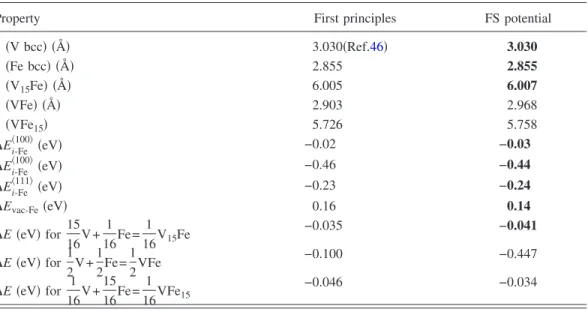
We considered several V-Fe compound structures that are based on the bcc structure—V15Fe, VFe, VFe15. We consid-ered VFe in the CsCl structure. For V15Fe and VFe15, we replaced one of the atoms in 2⫻2⫻2 bcc supercell with the counterpart atom. We then calculated the lattice parameters and formation energies for each of these systems. The results are presented in TableII.
The vacancy-Fe interaction energy can be defined as ⌬Evac-Fe= Evac关1Fe兴 + Ep关0Fe兴 − Evac关0Fe兴 − Ep关1Fe兴,
共1兲 where Ep关nFe兴 is the energy of a system containing N
body-centered-cubic lattice sites of which n sites are occupied by Fe atoms, and Evac关nFe兴 is the energy of a system containing TABLE I. Physical properties of V calculated using FS potentials共The properties used in the fitting procedure are printed in bold.兲
Property Target value Potential from Ref.20 New potential
a共bcc兲 共Å兲 3.039共Ref.37兲 3.030 3.030
Ecoh共bcc兲 共eV/atom兲 −5.31共Ref.38兲 −5.300 −5.016
C11共GPa兲 229共Ref.39兲 228 228
C12共GPa兲 119共39兲 119 119
C44共GPa兲 43共Ref.39兲 4.3 42
Evacf 共unrelaxed bcc兲 共eV/atom兲 2.91共Ref.40兲 2.91 2.75
Evacf 共relaxed bcc兲 共eV/atom兲 2.48共Ref.40兲 2.62 2.49
Emvac共bcc兲 共eV/atom兲 0.52 0.78
ED共bcc兲 共eV/atom兲 共Efvac+ Emvac兲 3.19共Ref.41and42兲
4.08共Ref.41and43兲
3.14 3.27
Eif共bcc 具100典兲 共eV/atom兲 3.22共Ref.40兲 3.540共Ref.45兲 3.21
Eif共bcc 具110典兲 共eV/atom兲 3.09共Ref.40兲 3.739 3.09
Eif共bcc 具111典兲 共eV/atom兲 2.81共Ref.40兲 3.280 2.81
Eif共bcc crowdion兲 共eV/atom兲 2.81共Ref.40兲 3.300 2.83
Eif共bcc octahedral兲 共eV/atom兲 3.27共Ref.40兲 4.266 3.24
d具100典共Å兲 2.170共Ref.40兲 2.106 2.022
d具110典共Å兲 2.108共Ref.40兲 2.186 2.224
d具111典共Å兲 2.151共Ref.40兲 2.238 2.192
a共fcc兲 共A兲 3.861共Ref.40兲 3.947 3.863
⌬Ebcc→fcc共eV/atom兲 0.247共Ref.40兲 0.158 0.214
N body-centered-cubic lattice sites, where one site is a
va-cancy and n nearest-neighbor sites of the vava-cancy are occu-pied by Fe atoms共all remaining sites are V atoms兲. In order to calculate the vacancy-Fe interaction energy we performed first-principles calculations using simulation cells consisting of 127 atoms 共i.e., 4⫻4⫻4 supercell with one vacancy兲, from which one V atom was replaced by one Fe atom and the internal coordinates relaxed at fixed supercell shape and vol-ume.
Next, we studied the mixed interstitial dumbbell configu-rations in V in the presence of Fe impurities. We used the following definition for the interaction energy between an interstitial and Fe impurity:
⌬Ei-Fe= Ei关1Fe兴 + Ep关0Fe兴 − Ei关0Fe兴 − Ep关1Fe兴, 共2兲
where Ei关nFe兴 is the energy of a system containing N
body-centered-cubic lattice sites, where one site is occupied by a dumbbell, one of the atoms of which is replaced by n atoms of Fe. We have performed first-principles calculations using simulation cells consisting of 129 atoms and the internal co-ordinates were relaxed at fixed supercell shape and volume.
III. DEVELOPMENT OF A SEMIEMPIRICAL POTENTIAL
A. Semiempirical potentials
While first-principles calculations provide an accurate and fundamental method to obtain the data necessary to describe the dynamics of defects, they are very computationally ex-pensive to employ for large simulation cells and/or long simulation times. Similarly, ab initio molecular dynamics is restricted to sizes and time scales much smaller than the cascade events, which are the cause of radiation damage.
Clearly, we can analyze only a very limited set of atomic configurations with a fully first-principles approach. There-fore, we follow this strategy: we perform first-principles cal-culations on an extensive set of atomic configurations and employ these results in the development of a set of semi-empirical interatomic potentials that can be used for large-scale atomistic simulations.
In this work, we develop potentials of the Finnis-Sinclair form, the parameters of which are fitted to the first-principles data following the methodology of Refs.21and26. The total potential energy is written as the sum of two contributions: a pairwise part and a local density part:
U =
兺
i=1 N−1兺
j=i+1 N titj共r ij兲 +兺
i=1 N ⌽ti共 i兲, 共3兲where the subscripts i and j label distinct atoms, N is the number of atoms in the system, rijis the separation between
atoms i and j,
i=
兺
jtitj共r
ij兲, 共4兲
and ti is the element type of atom i. The binary alloy FS
potential consists of eight functions, six of which can be determined using properties of the pure components. The cross functions共12 and⌿12兲 should be fitted to alloy prop-erties. Note that for a single-component system the FS form coincides with the EAM form, but for a binary alloy, an EAM potential consists of seven functions, six of which de-scribes pure components and one is the pairwise cross func-tion.
TABLE II. The properties of V-Fe alloys obtained from the first-principles calculations and with the new FS potential. The propertial. The properties used in the fitting procedure are printed in bold. a is the lattice parameter of the supercell with two or 16 atoms,⌬Ei-Fe具100典is the interstitial-Fe interaction energy and⌬Evac-Fe
共eV兲 is the vacncy-Fe interaction energy. As we see. the iron is bound to the various interstitials but repelled by the vacncy. The strong binding of Fe in the 具110典 mixed interstitial conformation brings it to within 0.07 eV of that of the具111典 mixed interstitial.
Property First principles FS potential
a共V bcc兲 共Å兲 3.030共Ref.46兲 3.030 a共Fe bcc兲 共Å兲 2.855 2.855 a共V15Fe兲 共Å兲 6.005 6.007 a共VFe兲 共Å兲 2.903 2.968 a共VFe15兲 5.726 5.758 ⌬Ei-Fe 具100典共eV兲 −0.02 −0.03 ⌬Ei-Fe 具100典共eV兲 −0.46 −0.44 ⌬Ei-Fe 具111典共eV兲 −0.23 −0.24
⌬Evac-Fe共eV兲 0.16 0.14
⌬E 共eV兲 for 1516V + 1 16Fe=
1 16V15Fe
−0.035 −0.041
⌬E 共eV兲 for 1 2V + 1 2Fe= 1 2VFe −0.100 −0.447
⌬E 共eV兲 for 1 16V + 15 16Fe= 1 16VFe15 −0.046 −0.034
B. Semiempirical potential for pure V
A FS potential for pure Fe was developed in Ref.21and improved in Ref.27. A FS potential for V was developed in Ref. 20. Some properties calculated with this potential are presented in Table I in comparison with the target values obtained from either experiment or first-principles calcula-tion. This potential provides correct perfect crystal properties 共the first five lines in TableI兲, and was fitted to the unrelaxed
vacancy formation energy taken from first-principles data. However, it is the relaxed vacancy formation energy which is physically important, and this value is overestimated by this potential. To find the vacancy migration energy, we moni-tored the energy of the crystal as an atom was translated from its initial equilibrium position into an empty nearest-neighbor site共i.e., a vacancy兲 along a path drawn from the initial equilibrium position to its final equilibrium position 共the system is relaxed at each step along this path and three atoms located far away from the migration atoms were fixed to prevent the whole cell moving兲. The change of energy versus distance is shown in Fig.1. The potential from共Ref.
20兲 demonstrates rather complex behavior, which is probably
related to the fact that there are several paths共obviously each point for this potential in Fig.1corresponds to one of these paths chosen by the algorithm兲. It is interesting that the most stable atom position in the vicinity of a vacancy is located 0.05 nm from the equilibrium lattice site. This is probably an unrealistic artifact of the fitted, semiempirical FS potential. The potential from共Ref.20兲 overestimates all self-interstitial
formation energies, which is not surprising since it was fitted to earlier first-principles data. This potential indicates that the 具111典 dumbbell and crowdion are the most stable self-interstitials, in agreement with the first-principles results, but the next stable self-interstitial具110典 has an energy that is too large共with respect to first-principles calculations兲. This is a potential problem since this can affect self-interstitial kinet-ics at high temperatures共see Ref.20for more detailed
dis-cussion兲. The potential also predicts a very high melting tem-perature 共the melting temperature was calculated using the coexistence method28 with accuracy not worse than 5 K兲.
While the potential developed in Ref. 20 allowed some insight to be obtained into the self-interstitial kinetics in V, before fitting an alloy potential, it behooves us to improve the initial V potential, focusing on properly reproducing the expanded point defect formation energy data set obtained from the present first-principles calculation. In fitting the pre-vious V potential,20 we determined the potential parameters by the fitting to the cohesive energy and lattice parameter of the equilibrium crystalline phase, unrelaxed vacancy forma-tion, and elastic constants. However, interstitial energies are also affected by the short-range part of the potential: MD simulations of interstitials suggest that the atomic separation near an interstitial can be compressed by 20% relative to that in the equilibrium perfect crystal. Clearly, we need to include information about atomic interactions at small atomic sepa-rations. In fitting the earlier potentials,21,29 we found that using the universal binding energy relation is not appropriate since it does not properly distinguish between changes in density and compression of just a few bonds with only a small change in local density. To address this, we also fitted the potential to atomic forces in a liquid共where a variety of interatomic spacings occur兲, as determined from first-principles calculations共as originally suggested in Ref. 30兲.
In addition, we explicitly included in the fitting procedure the formation energies of five self-interstitials. Since it is the relaxed formation energies which are important for applica-tion, the differences between energies of the perfect crystal and relaxed defect configurations were included in the fitting procedure.
The parameters for the new potential are presented in TableIII. TableIdemonstrates that this potential adequately describes the main properties of defects in pure V. It is espe-cially important that it completely reproduces all interstitial formation energies. It is interesting to note that while the potential gives poor predictions for the metastable具100典 and 具110典 dumbbell separations, it gives the correct predictions for the ground state具111典 dumbbell separation 共the dumbbell separation obtained with the FS potential is larger than the first-principles value by just 2% and the first-principles cal-culations underestimate the lattice parameter by 1%兲. The vacancy migration energy calculated with the new potential, shown in Fig.1, appears to be much more reasonable that obtained using the FS potential from Ref.20. The sum of the vacancy formation and migration energies gives the activa-tion energy for self-diffusion via a vacancy mechanism. As can be seen from TableI, the new potential predicts the ac-tivation energy for self-diffusion in good agreement with low-temperature experimental data. Overall, we conclude that the new potential provides much more reliable predic-tions for the point defects in V than the previous V potential from Ref.20.
C. Semiempirical potential for dilute solutions of Fe in V Although potentials for pure ferromagnetic iron and vana-dium already exist, the interactions between Fe and V in the FIG. 1. Vacancy migration energy in V.
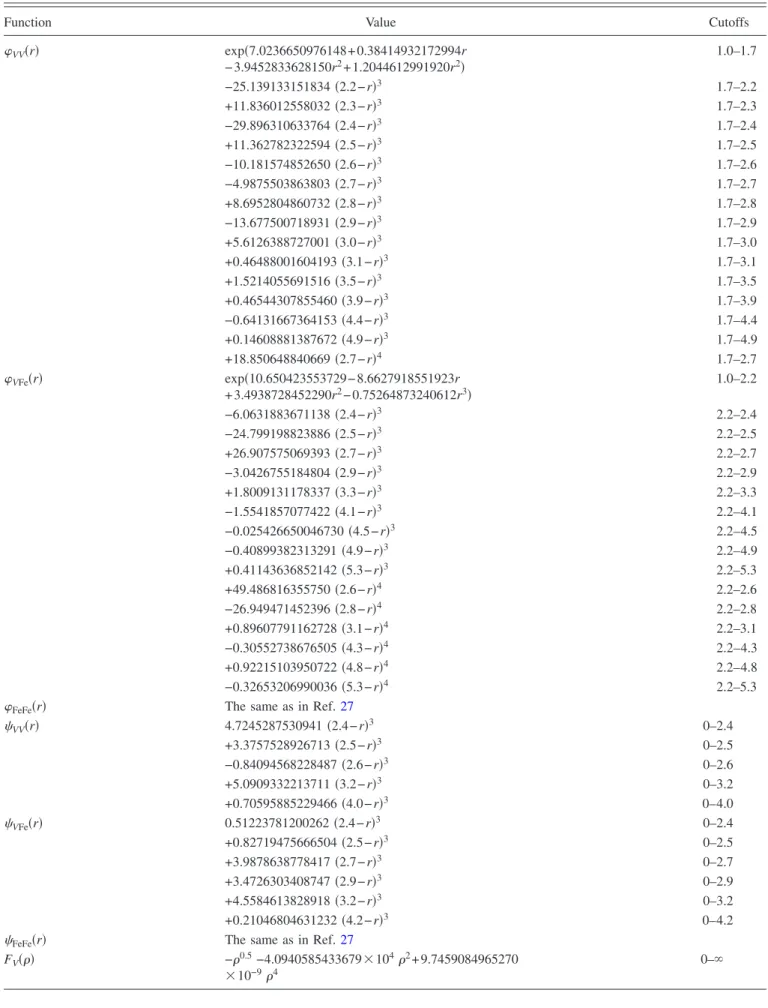
TABLE III. Parameters for the analytical form of the V-Fe potential共Ref.47兲.
Function Value Cutoffs
VV共r兲 exp共7.0236650976148+0.38414932172994r − 3.9452833628150r2+ 1.2044612991920r2兲 1.0–1.7 −25.139133151834共2.2−r兲3 1.7–2.2 +11.836012558032共2.3−r兲3 1.7–2.3 −29.896310633764共2.4−r兲3 1.7–2.4 +11.362782322594共2.5−r兲3 1.7–2.5 −10.181574852650共2.6−r兲3 1.7–2.6 −4.9875503863803共2.7−r兲3 1.7–2.7 +8.6952804860732共2.8−r兲3 1.7–2.8 −13.677500718931共2.9−r兲3 1.7–2.9 +5.6126388727001共3.0−r兲3 1.7–3.0 +0.46488001604193共3.1−r兲3 1.7–3.1 +1.5214055691516共3.5−r兲3 1.7–3.5 +0.46544307855460共3.9−r兲3 1.7–3.9 −0.64131667364153共4.4−r兲3 1.7–4.4 +0.14608881387672共4.9−r兲3 1.7–4.9 +18.850648840669共2.7−r兲4 1.7–2.7 VFe共r兲 exp共10.650423553729−8.6627918551923r + 3.4938728452290r2− 0.75264873240612r3兲 1.0–2.2 −6.0631883671138共2.4−r兲3 2.2–2.4 −24.799198823886共2.5−r兲3 2.2–2.5 +26.907575069393共2.7−r兲3 2.2–2.7 −3.0426755184804共2.9−r兲3 2.2–2.9 +1.8009131178337共3.3−r兲3 2.2–3.3 −1.5541857077422共4.1−r兲3 2.2–4.1 −0.025426650046730共4.5−r兲3 2.2–4.5 −0.40899382313291共4.9−r兲3 2.2–4.9 +0.41143636852142共5.3−r兲3 2.2–5.3 +49.486816355750共2.6−r兲4 2.2–2.6 −26.949471452396共2.8−r兲4 2.2–2.8 +0.89607791162728共3.1−r兲4 2.2–3.1 −0.30552738676505共4.3−r兲4 2.2–4.3 +0.92215103950722共4.8−r兲4 2.2–4.8 −0.32653206990036共5.3−r兲4 2.2–5.3
FeFe共r兲 The same as in Ref.27
VV共r兲 4.7245287530941共2.4−r兲3 0–2.4 +3.3757528926713共2.5−r兲3 0–2.5 −0.84094568228487共2.6−r兲3 0–2.6 +5.0909332213711共3.2−r兲3 0–3.2 +0.70595885229466共4.0−r兲3 0–4.0 VFe共r兲 0.51223781200262共2.4−r兲3 0–2.4 +0.82719475666504共2.5−r兲3 0–2.5 +3.9878638778417共2.7−r兲3 0–2.7 +3.4726303408747共2.9−r兲3 0–2.9 +4.5584613828918共3.2−r兲3 0–3.2 +0.21046804631232共4.2−r兲3 0–4.2
FeFe共r兲 The same as in Ref.27
FV共兲 −0.5−4.0940585433679⫻1042+ 9.7459084965270
⫻10−94
alloy have not previously been described. In order to con-struct an interatomic potential to describe interactions be-tween Fe solutes and point defects in V, two cross functions VFe and VFe were developed. The parameters of these functions were fitted to some of our first-principles data. Since the goal of this work is to develop a semiempirical potential for very dilute solutions of Fe in V, we used the first-principles data共lattice parameter and formation energy兲 obtained on a bcc structure where one of 16 V atoms was replaced by Fe. The interaction energies between Fe and point defects 关see Eqs. 共1兲 and 共2兲兴 were included in the
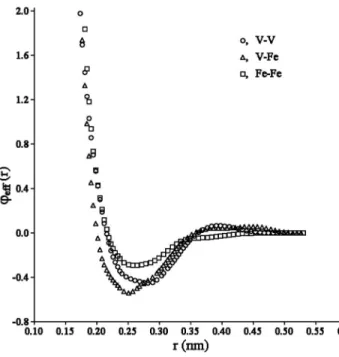
fitting procedure. Finally, we created a representative liquid configuration containing 120 V and 30 Fe atoms. The atomic forces determined for this configuration from the first-principles calculations were also used in the fitting proce-dure. In all of these configurations, the local magnetic mo-ment on the iron atoms was found to be small. The parameters of the optimized cross-functions are provided in Table III. Figure 2 shows the effective pair potentials, de-fined as eff t1t2共r兲 = t1t2共r兲 +
冉
冏
⌽ t1 冏
0t1+冏
⌽t2 冏
0t2冊
t1t2共r兲, 共5兲where the superscripts refer to the atom type and 0t is the value offor atoms of type t in the equilibrium V15Fe lattice at T = 0. This is a mean-field approximation to the EAM, which can be related to the alloying energy.31,32 Since the V-Fe function is shifted to smaller atomic separations with
respect to both V-V and Fe-Fe functions, we conclude that there is a strong attraction between V and Fe atoms. This is in agreement with the formation energies of V-Fe alloys be-ing negative共see Table II兲. On the other hand, examination
of TableIIshows that the potential provides accurate predic-tions for dilute solupredic-tions of Fe in V and, surprisingly, for small amounts of V in Fe. Information on the latter was not included in the fitting procedure共one may appropriately have concerns about transferrability when moving from a para-magnetic to a ferropara-magnetic environment兲. There is a consid-erable overestimate of the absolute value of the formation energy of the B2 structure due to the strong nearest-neighbor attraction.
Examination of TableIIshows that the new Fe-V poten-tial yields very good agreement with most of the first-principles data on the interaction energy between Fe atoms and point defects in V. This makes this potential especially suitable for the simulation of radiation damage in 共dilute兲 V-Fe alloys.
D. Lattice parameter and bulk modulus
There is considerable scatter in the experimental measure-ments of the lattice parameter of V-Fe bcc alloys 共e.g., see the review in Ref.33兲. Nonetheless, it is clear from the
ex-periments that increasing Fe content leads to a decrease in the V-Fe alloy lattice parameter. Figure 3 shows the data obtained via analysis of different room-temperature experiments.33 In order to test our potential, we created TABLE III. 共Continued.兲
Function Value Cutoffs
FFe共兲 The same as in Ref.27
FIG. 2. Effective pair potentials.
FIG. 3. Lattice parameter as a function of Fe concentration at room temperature.
model V-Fe alloys at room temperature. First, we took our model of pure V at T = 0 consisting of 5000 atoms and ran-domly replaced V atoms with Fe to achieve the desired com-position. Next we heated the alloys up to T = 300 K and found the pressure as a function of the atomic density共using
NVT molecular dynamics simulations兲. These calculations
provided both equilibrium lattice parameters and bulk moduli. As can be seen from Fig.3, our potential properly describes the effect of Fe on the lattice parameter at low Fe concentration. The deviation from the experimental data at
xFe= 0.5 is more pronounced.
The dependence of the bulk modulus on the Fe concen-tration is shown in Fig.4. It is interesting that introduction of small quantities of Fe into V or V into Fe both increase the bulk moduli of the pure systems.共Note: no elastic constant data were used to fit the alloy cross functions in the present work.兲 Unfortunately, we known of no experimental data to validate our elastic modulus versus composition results. However, based on the analysis of a Finnis-Sinclair-type band filling model made in Ref.34, we can speculate that the bulk modulus and cohesive energy contributions from the many-body term should increase as the d band approaches half filling, while the atomic radius should decrease with increasing d electron count for metals in the same row of the periodic table. The pairwise contribution to the bulk modulus will be greatest when the number of V-Fe bonds is maxi-mized, since the V-Fe potential has the highest curvature. Alloying V in Fe or vice versa increases the modulus, so by this measure our semiempirical potential gives reasonable predictions. In order to test this qualitative picture we per-formed additional first-principles calculations to obtain the lattice parameters of several V-Fe compounds at T = 0. The results are presented in TableIV. Comparison of the results of the first-principles calculations with the predictions based upon the new, semiempirical potential shows that the
poten-tial provides the correct qualitative picture, even though it greatly overestimates the first-principles elastic constants.
IV. POINT DEFECT PROPERTIES IN V-Fe
Figure 5 shows the vacancy migration energy in the vi-cinity of a single Fe atom. In order to compare different mutual vacancy-Fe locations, all energies are calculated with respect to the state where one Fe atom is located far away from the vacancy. Therefore, the initial and final points of each curve in Fig. 5 show the vacancy-Fe binding energy. The vacancy is not bound to nearest-neighbor Fe atoms. There is, however, a very weak binding to Fe atoms at other nearby sites. This effect is largest for the Fe atom at the second-neighbor site 共0.03 eV兲, presumably due to elastic interactions. Each peak on the curves in Fig.5shows a bar-rier for migrating atoms. The migration barbar-riers are broadly similar, around 1 eV, with the exception of the motion of the iron atom, which is strongly suppressed. We can anticipate FIG. 4. Bulk modulus as a function of Fe concentration at room
temperature.
TABLE IV. The bulk moduli of V-Fe compounds at 0 K.
Compound
B共GPa兲
First principles FS potential
V共bcc兲 187 156
V3Fe共D03兲 216 285
VFe共B2兲 190 398
VFe3共D03兲 186 288
Fe共bcc兲 169 178
FIG. 5.共Color online兲 Vacancy migration energy with nearby Fe atoms. We identify each vacancy hop as A-nFe兵h,k,l其, where A is the type of migrating atom initially at兵0,0,0其 and n Fe atoms are lo-cated at position兵h,k,l其 共coordinates are expressed in units of the bcc lattice parameter兲. The vacancy is initially at 兵1/2,1/2,1/2其.
that vacancies will not be trapped by iron atoms under irra-diation conditions. It is interesting to note that one of the curves shown in Fig.5has a double peak. The same feature was observed for several Fe potentials considered in Ref.21. Although calculation of static barriers along a transition path is often used to determine how point defects migrate, this approach can be incomplete because the point defect formation energies themselves may depend on temperature 共e.g., see Refs.29 and35兲. The situation can be even more
complicated because migration mechanisms may change with increasing temperature.29 In order to more accurately determine diffusivities, we performed a series of molecular dynamics simulations of point defect migration at elevated temperature. First, however, we note that the V potential yields a rather high melting temperature as compared with experiment. This can lead to an underestimate of the magni-tude of the changes in the vacancy formation and migration energies at elevated temperature. Nonetheless, the simula-tions should be able to correctly produce the main trends in the diffusivity, which are the focus of the present study.
First we determined the atomic density as function of temperature for pure V and 2% Fe solution in V. Next we performed MD relaxation of the models consisting of 2000 atoms at each temperature for 5.9 ns共in 2 fs MD time steps兲. Finally we introduced either one vacancy共by removing a V atom兲 or one interstitial 共adding a single V atom兲. All models were first equilibrated for 40 ps and then data were collected for 5.9 ns. The model energies averaged over 5.9 ns allowed us to accurately calculate the temperature-dependent point defect formation energies 共note that at a finite temperature this value is not equal to the defect formation free energy
Gf= Ef− TSf, where Sf is the defect formation entropy兲. The
results for pure V are shown in Fig.6. The vacancy forma-tion energy increases with temperatures up to T = 2800 K and then suddenly drops. The increase of the vacancy formation with temperature is not unusual; similar results were found
for pure Al共Ref.35兲 and Zr.29 The interstitial formation en-ergy is more complex; as the temperature is raised, it first increases, then plateaus between 1000 and 2600 K and then drops sharply.
The diffusivity can be determined directly from the MD simulations in terms of the mean square displacement of at-oms具⌬r2典,
D =具⌬r
2典
6t , 共6兲
where t is the simulation time over which the mean square displacement is averaged. It is interesting that atoms can dif-fuse even in a “perfect” bcc lattice 共i.e., one in which no point defects were introduced兲 close to the melting tempera-ture 共see Figs. 7 and 8兲. We refer to this as the intrinsic
mechanism of diffusion. This mechanism was also observed for Zr,29which is also bcc at high temperature. Of course the activation energy for such a diffusion mechanism is ex-tremely high 共see TableV兲 such that it makes a significant
contribution to the diffusivity only near the melting tempera-ture. The intrinsic mechanism of diffusion is likely associ-ated with the production of Frenkel pairs. Insofar as we are aware, significant intrinsic diffusion has not been observed in either fcc and hcp metals. Because of the existence of this intrinsic mechanism, we exclude for the high-temperature data共where intrinsic diffusion is significant兲 from our deter-mination of the activation energy for point-defect-based dif-fusion.
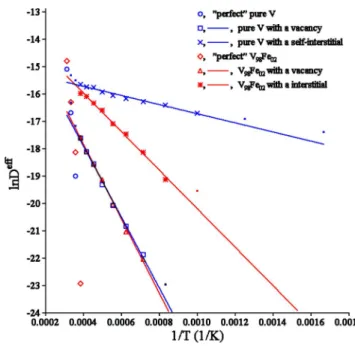
Figure 7 shows the V self-diffusion data in the models containing either one vacancy or interstitial. Except for high temperatures共where the intrinsic mechanism of diffusion be-comes important兲 and low temperatures 共where diffusion is too slow to yield sufficient statistics from the MD simula-FIG. 6. 共Color online兲 Point defect energies as a function of
temperature in pure V.
FIG. 7. 共Color online兲 Temperature dependence of the V self-diffusivity calculated with a fixed point defect concentration共see text兲. The data points shown by the small symbols were excluded from the Arrhenius fit and calculation of the migration energy.
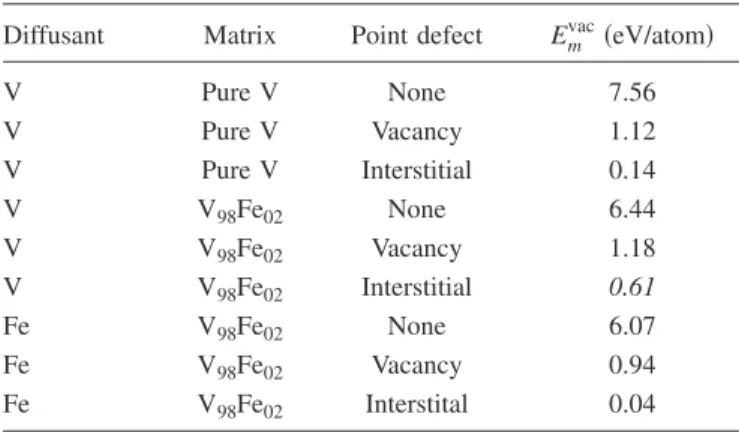
tions兲, the data were well fitted by an Arrhenius expression. Since the point defect concentration was the same at all tem-peratures, the slopes of the Arrhenius plots are the vacancy and interstitial migration energies共divided by the Boltzmann constant兲. These values are shown in Table V. It is interest-ing that the vacancy migration energy appears to be larger than the barrier obtained from static calculation. The intersti-tial migration energy is much smaller than the vacancy mi-gration energy, while interstitial formation energy is higher than the vacancy formation energy. Thus under thermal con-ditions, self-diffusion in pure V proceeds via the vacancy mechanism at low temperatures and via the interstitial mechanism at high temperatures, where the transition is at ⬃1200 K. Note that, in our analysis, we ignored the effect of the entropy part of the activation free energy.
The additional increase in the activation energy observed in experiment at high temperature may be associated with the contribution of the intrinsic mechanism of self-diffusion, as discussed above. Under irradiation conditions, similar
num-bers of vacancies and interstitials are produced athermally. In such cases, defect formation energies are irrelevant and dif-fusion will be dominated by interstitials at all temperatures. While our simulations focus on high temperatures, an ear-lier simulation study36examined self-interstitial diffusion in pure V starting from T = 100 K. In that study, the authors found that the diffusivity data do not lie on a straight line in Arrhenius coordinates and a sharp change in the slope was observed around T = 700 K. This effect was attributed to the rotation of the self-interstitial between具111典 directions via a barrier at具110典. These results do not contradict our data since we consider diffusion only starting from T = 600 K and data at T艌1000 K were used to determine the migration energy. We anticipate that for the new potential the transition asso-ciated with the self-interstitial rotation will occur at lower temperature since the new potential yields a difference be-tween the具110典 and 具111典 self-interstitial formation energies of 0.28 eV 共in accordance with the first-principles data兲 vs 0.46 eV found from the potential used in Ref. 36. The mi-gration barrier of the 具111典 crowdion is 0.02 in each case. The authors of Ref.36correctly note that when the migration energy is smaller than kT, diffusion is not thermally activated 共i.e., it is athermal兲. Indeed our data for the self-diffusivity in the interstitial mechanism also fall on the straight line in the
D vs T coordinates as was suggested in Ref.36共see Fig.8兲.
We now consider the effect of Fe on point defects in V. Figure 7 shows that the addition of Fe accelerates V diffu-sion via the intrinsic mechanism. This may be associated with two facts:共i兲 Fe decreases the melting temperature of V and 共ii兲 Fe has a smaller atomic radius than V 共leading to smaller migration barriers兲. Since Fe is repelled from vacan-cies, it does not significantly affect vacancy diffusion, as seen in Fig.7and TableV. However, since Fe is attracted to interstitials, addition of Fe dramatically decreases the V dif-fusion via the interstitial mechanism共see Fig.7兲. The
appar-ent fourfold increase of the V migration energy in the inter-stitial mechanism is due not to a real increase in barrier energy, rather it shows that the interstitial spends most of its time associated with Fe, enhancing Fe diffusion and reducing V self-diffusion. Interstitial diffusion in pure vanadium is especially fast on account of the possibility of multiple cor-related jumps for 1D migration along具111典. The iron impu-rities disrupt this motion in two ways, first by direct pinning of the具111典 interstitial if the Fe lies in the path of the inter-stitial, and second by forcing the具111典 dumbbells to reorient away from the fast具111典 direction into the slower 具110典 di-rection. This rotation restores the Arrhenius behavior.
Figure9shows the results of the simulation for Fe diffu-sion. Of course, these data contain more noise since the mod-els contained only 40 Fe atoms. However, the trends are quite clear. Fe atoms diffuse faster than V atoms via the intrinsic mechanism. The diffusivities of the Fe and V atoms in the V-rich alloy via the vacancy mechanism are very simi-lar. Finally, Fe atoms diffuse very much faster than V atoms in the V-rich alloy via the interstitial mechanism; the Fe mi-gration energy is very low and the Fe diffuses athermally. TablesIandIIshow that the lowest mixed interstitial forma-tion energy 共which is the sum of the self-interstitial forma-tion energy and the self-interstitial–substituforma-tional interacforma-tion energy兲 at T=0 is 2.81–0.24=2.57 eV. This value is just a FIG. 8. 共Color online兲 Temperature dependence of the V
self-diffusivity in the interstitial mechanism.
TABLE V. Point defect migration energies inferred from MD diffusivity calculations.
Diffusant Matrix Point defect Emvac共eV/atom兲
V Pure V None 7.56 V Pure V Vacancy 1.12 V Pure V Interstitial 0.14 V V98Fe02 None 6.44 V V98Fe02 Vacancy 1.18 V V98Fe02 Interstitial 0.61 Fe V98Fe02 None 6.07 Fe V98Fe02 Vacancy 0.94 Fe V98Fe02 Interstital 0.04
little smaller than the energy of formation of the vacancy-Fe pair, which is 2.49+ 0.14= 2.63 eV. Since the Fe migration barrier in the vacancy mechanism is much higher than that in the interstitial mechanism, this is consistent with our MD result that Fe diffuses in V via an interstitial mechanism.
V. CONCLUSIONS
To summarize, we have performed a series of first-principles point defect calculations in vanadium with and without small amounts of iron to expand the existing point defect data base. We have introduced an electronic structure embedding approach to improve the description of point de-fects by including semicore electrons for some V atoms 共those near to the interstitial where the semicore levels are broadened兲 but not those further from the point defect. This enables us to combine good accuracy at the defect with large supercells to correctly describe the short-range electronic ef-fects and the long-range strain fields. Our first-principles cal-culations show that vacancies are not attracted to Fe
impuri-ties, but that interstitials are, and the configuration of the interstitial can be changed from具111典 to 具110典 by the pres-ence of Fe.
Based on these data, previous first-principles work, and new calculations of model liquid structures, we have fitted an interatomic potential for the V-Fe system that describes the important configurations likely to arise when such alloys are exposed to neutron radiation. This potential is in a form suit-able for molecular dynamics simulations of large systems.
Using the potential, we have calculated the migration bar-riers of vacancies in the presence of iron, showing that these are broadly similar, and that iron and vacancies do not comi-grate, but that iron migration is greatly enhanced by the pres-ence of interstitials. Vanadium self-diffusion via an intersti-tial mechanism is dramatically slowed by the presence of small quantities of iron, which traps and rotates the dumbbell interstitial. Escape from the pinned configuration becomes the barrier to this mechanism. It is not clear how or even whether this is connected with the dramatic increase in irra-diation swelling observed when Fe is added to vanadium.14,15 Although the trends are the same, there is a marked nu-merical discrepancy in each case between migration barriers calculated from molecular dynamics and those evaluated from static barrier calculations. Since this appears in the ex-ponent of the diffusion rate, it suggests that simply employ-ing static migration barriers in, for example, a kinetic Monte Carlo approach, may give aging processes in error by an order of magnitude.
Although the focus of this study has been Fe in V, it illustrates the dramatic effects that even a small amount of alloying material can have on diffusion properties. While we have concentrated on the dilute iron limit here, it is likely that at higher concentrations other considerations, such as migration of interstitial clusters with multiple Fe atoms, may become important.
ACKNOWLEDGMENTS
Work at the Ames Laboratory was supported by the De-partment of Energy, Office of Basic Energy Sciences, under Contract No. DE-AC02-07CH11358. Work at Edinburgh was supported by EPSRC under Grant No. S81186 and the Euro-pean Union under the PERFECT project. This work was also supported by Department of Energy, Office of Fusion Energy Sciences共Contract No. DE-FG02-01ER54628兲.
1H. Nakajima, S. Yoshida, Y. Kohno, and H. Matsui, J. Nucl.
Mater. 191, 952共1992兲.
2F. A. Garner, D. S. Gelles, H. Takahashi, S. Ohnuki, H. Kinoshita,
and B. A. Loomis, J. Nucl. Mater. 191, 948共1992兲.
3K. Fukumoto, H. Matsui, Y. Candra, K. Takahashi, H. Sasanuma,
S. Nagata, and K. Takahiro, J. Nucl. Mater. 283, 535共2000兲.
4H. Tsai, T. S. Bray, H. Matsui, M. L. Grossbeck, K. Fukumoto, J.
Gazda, M. C. Billone, and D. L. Smith, J. Nucl. Mater. 283, 362 共2000兲.
5N. Nita, T. Iwai, K. Fukumoto, and H. Matsui, J. Nucl. Mater.
283, 291共2000兲.
6T. Hayashi, K. Fukumoto, and H. Matsui, J. Nucl. Mater. 283,
234共2000兲.
7R. J. Kurts, K. Abe, V. M. Chernov, V. A. Kazakov, G. E. Lucas,
H. Matsui, T. Muroga, G. R. Odette, D. L. Smith, and S. J. Zinkle, J. Nucl. Mater. 283, 70共2000兲.
8T. Hayashi, K. Fukumoto, and H. Matsui, J. Nucl. Mater. 307,
930共2002兲. FIG. 9. 共Color online兲 Temperature dependence of the Fe
diffu-sivity in V calculated under the condition of a fixed defect concen-tration 共see text兲. The data points shown by small symbols were excluded from the Arrhenius fit calculation of the migration energy.
9T. Muroga, T. Nagasaka, K. Abe, V. M. Chernov, H. Matsui, D. L.
Smith, Z. Y. Xu, and S. J. Zinkle, J. Nucl. Mater. 307, 547 共2002兲.
10N. Nita, T. Yamamoto, T. Iwai, K. Yasunaga, K. Fukumoto, and
H. Matsui, J. Nucl. Mater. 307, 398共2002兲.
11N. Nita and H. Matsui, Mater. Trans. 46, 522共2005兲.
12K. Fukumoto, H. Matsui, T. Muroga, S. J. Zinkle, D. T. Hoelzer,
and L. L. Snead, J. Nucl. Mater. 329, 472共2004兲.
13S. Konishi, A. Kimura, M. Akiba, H. Nakamura, T. Nagasaka, T.
Muroga, A. Hasegawa, and H. Matsui, Nihon Genshiryoku Gak-kaishi 46, 311 共2004兲 关J. Atomic Energy Soc. Jpn. 46, 311 共2004兲兴.
14B. A. Loomis, D. L. Smith, and F. A. Garner, J. Nucl. Mater. 179,
771共1991兲.
15K. Fukumoto, A. Kimura, and H. Matsui, J. Nucl. Mater. 258,
1431共1998兲.
16H. M. Chung, B. A. Loomis, and D. L. Smith, J. Nucl. Mater.
239, 139共1996兲.
17H. Matsui, H. Nakajima, and S. Yoshida, J. Nucl. Mater. 205, 452
共1993兲.
18M. S. Daw and M. I. Baskes, Phys. Rev. B 29, 6443共1984兲. 19M. W. Finnis and J. E. Sinclair, Philos. Mag. A 50, 45共1984兲. 20S. Han, L. A. Zapeda-Ruiz, G. J. Ackland, R. Car, and D. J.
Srolovitz, J. Appl. Phys. 93, 3328共2003兲.
21M. I. Mendelev, S. Han, D. J. Srolovitz, G. J. Ackland, D. Y. Sun,
and M. Asta, Philos. Mag. A 83, 3977共2003兲.
22J. P. Perdew, K. Burke, and M. Ernzerhof, Phys. Rev. Lett. 77,
3865共1996兲.
23G. Kresse and J. Hafner, Phys. Rev. B 47, R558 共1993兲; 49,
14251共1994兲.
24S. Baroni et al., http://www.pwscf.org 25D. Vanderbilt, Phys. Rev. B 43, 6796共1991兲.
26M. I. Mendelev, D. J. Srolovitz, G. J. Ackland, and S. Han, J.
Mater. Res. 20, 208共2005兲.
27G. J. Ackland, M. I. Mendelev, D. J. Srolovitz, S. Han, and A. V.
Barashev, J. Phys.: Condens. Matter 16, S2629共2004兲.
28J. R. Morris, C. Z. Wang, K. M. Ho, and C. T. Chan, Phys. Rev.
B 49, 3109共1994兲.
29M. I. Mendelev and G. J. Ackland, Philos. Mag. Lett. 87, 349
共2007兲.
30F. Ercolessi and J. B. Adams, Europhys. Lett. 26, 583共1994兲. 31G. J. Ackland and V. Vitek, Phys. Rev. B 41, 10324共1990兲. 32G. J. Ackland and V. Vitek, Philos. Mag. B 62, 149共1990兲. 33J. F. Smith, Bull. Alloy Phase Diagrams 5, 184共1984兲. 34G. J. Ackland and S. K. Reed, Phys. Rev. B 67, 174108共2003兲. 35M. I. Mendelev and B. S. Bokstein, Mater. Lett. 61, 2911共2007兲. 36L. A. Zepeda-Ruiz, J. Rottler, S. Han, G. J. Ackland, R. Car, and
D. J. Srolovitz, Phys. Rev. B 70, 060102共R兲 共2004兲.
37W. B. Pearson, Handbook of Lattice Spacings and Structures of
Metals and Alloys共Pergamon Press, Oxford, 1967兲.
38C. Kittel, Introduction to Solid State Physics共Wiley, New York,
1986兲.
39G. Simmons and H. Wang, Single Crystal Elastic Constants and
Calculated Aggregate Properties: A Handbook 共MIT Press, Cambridge, MA, 1971兲.
40First-principles calculations performed as part of this work. 41I. S. Grigorev and E. Z. Meilihova, Fizicheskie Velichiny
共Ener-goatomizdat, Moscow, 1991兲 共in Russian兲.
42The data for the temperature interval from 1150 to 1600 K共Ref. 41兲.
43The data for the temperature interval from 1600 to 2100 K共Ref. 41兲.
44A. I. Efimov, L. P. Belorukova, I. V. Vasilkova, and V. P.
Chechev, Svoistva Neorganicheskih Soedinenii共Himiia, Lenin-grad, 1983兲 共in Russian兲.
45The self-interstitial formation energies were fitted to earlier
first-principles data共see the text兲.
46The target values for the lattice parameters were obtained by the
rescaling of the first-principles data to take into account that the first-principles calculations underestimate the V lattice param-eter by 1% and the EAM potential for V was fitted to the ex-perimental lattice parameter.
47All distances are expressed in Å and energies in eV. The two
numbers listed as “cutoff” indicate the range of the adjacent basis function: a function with cutoff x – y should be multiplied by H共r−x兲H共y−r兲 where H is the Heaviside step function. The potential functions are available in a tabulated format at http:// lammps.sandia.gov