100 Korean J. Pl. Taxon. 51(1): 100−102 (2021) https://doi.org/10.11110/kjpt.2021.51.1.100 SHORT COMMUNICATION pISSN 1225-8318 eISSN 2466-1546 Korean Journal of Plant Taxonomy
Chromosome number of myoga ginger (Zingiber mioga: Zingiberaceae)
in Korea
Hiroshi IKEDA
*, Bo-Mi NAM
1, Nobuko YAMAMOTO
2, Hidenobu FUNAKOSHI
3,
Atsuko TAKANO
4and Hyoung-Tak IM
5The University Museum, The University of Tokyo, Tokyo 113-0033, Japan
1International Biological Material Research Center, Korea Research Institute of Bioscience & Biotechnology, Daejeon 34141, Korea 2Natural History Museum and Institute, Chiba 260-0852, Japan
3Botanical Research Institute of Chiba, Chiba 290-0053, Japan 4Museum of Nature and Human Activities, Hyogo 669-1546, Japan
5Department of Biological Sciences, Chonnam National University, Gwangju 61186, Korea
(Received 2 February 2021; Revised 11 March 2021; Accepted 12 March 2021)
ABSTRACT: The chromosome number of myoga ginger (Zingiber mioga (Thunb.) Roscoe: Zingiberaceae) has been reported as 2n = 22 for Chinese plants and 2n = 55 for Japanese plants. We checked the chromosome num-ber of Z. mioga in plants collected in Jeollabuk-do and Jeollanam-do, Korea, and counted 2n = 44, the first report of this number for the species. As the basic chromosome number of Z. mioga is thought to be x = 11, Z. mioga plants in China, Korea, and Japan appear to be diploids, tetraploids, and pentaploids, respectively. In find-ing the tetraploid race of Z. mioga in Korea, we can hypothesize that the pentaploid race in Japan is derived through the fertilization of reduced gametes of the diploid race and unreduced gametes of the tetraploid race.
Keywords: chromosome number, edible plant, Korea, myoga ginger, tetraploid, Zingiber mioga, Zingiberaceae
Myoga ginger (Zingiber mioga (Thunb.) Roscoe: Zingiberaceae) is a perennial herb, native to tropical Asia (Makino et al., 1961). It is cultivated for its edible flowers (inflorescences) in Japan and edible and medicinal use in China (Wu and Larsen, 2000; Ohba 2016). In Korea, however, it is only occasionally cultivated, and naturalized, mainly on the southern peninsula and on Jeju Island (Lee, 1996, 2006; Jung et al., 2016; Korea National Arboretum, 2016; Kim and Kil, 2016).
The chromosome number of Z. mioga has been reported to be 2n = 55 in Japanese plants (Morinaga et al., 1929; Takenaka, 1932; Sato, 1960; Suzuka and Mitsuoka, 1968) while 2n = 22 has been reported for the species in China (Chen et al., 1982). As the basic chromosome number of Z. mioga may be x = 11, the plants in Japan are pentaploids, while those in China are diploids. We were therefore intrigued to know the ploidy level of Z. mioga in Korea, an area between the diploid and pentaploid races.
Materials and Methods
We collected plants of Z. mioga at two localities in Korea and transplanted them to the nurseries of the Korea Research Institute of Bioscience & Biotechnology (Daejeon, Korea) and to the University of Tokyo (Tokyo, Japan) to be used for cytological investigation (Table 1).
Root tips were pretreated with a 2 mM 8-hydroxyquinoline solution at 20oC for 1 h and consequently at 4oC for 15 h before being fixed with Newcomer's fluid (see Sharma and Sharma, 1980). Fixed root tips were macerated in 1 N HCl for 10 min at 60oC. After washing with distilled water, they were stained with 2% lacto-propionic orcein. Slide preparations were made by the conventional squash method.
Results and Discussion
The chromosomes of Z. mioga in Korea were counted as
*Author for correspondence: [email protected]
http://e-kjpt.org, © 2021 the Korean Society of Plant Taxonomists. This is an open-access article distributed under the terms of the Creative Commons Attribution Non-Commercial License (http://creativecommons.org/licenses/by-nc/4.0) which permits unrestricted non-commercial use, distribution, and reproduction in any medium, provided the original work is properly cited.
Korean Journal of Plant Taxonomy Vol. 51 No. 1 (2021)
Chromosome number of Zingiber mioga 101
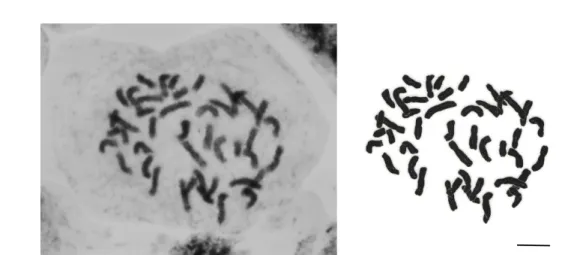
2n = 44 (Fig. 1). Counts of 2n = 22 (Chen et al., 1982) and 2n = 55 (Morinaga et al., 1929; Takenaka, 1932; Sato 1960; Suzuka and Mitsuoka, 1968) have been reported for Z mioga. The report of 2n = 44 is therefore the first for this species. As the basic chromosome number of Z. mioga is thought to be x = 11, 2n = 44 for Z. mioga in Korea may be a tetraploid.
Polyploidization plays an important role in the diversification of plants (Grant, 1981; Soltis and Soltis, 2009; Soltis et al., 2009), and also impacts crop domestication and establishment of important agronomic traits (Hancock, 2005; Renny-Byfield and Wendel, 2014; Zhang et al., 2019). Therefore, Z. mioga is thought to have been improved through polyploidization from the diploid race in China to a pentaploid race in Japan. It has been difficult, however, to explain the process of establishment of pentaploids directly from diploids, since additional steps are needed in the polyploidization process. In finding the tetraploid race of Z. mioga in Korea, we can hypothesize that the pentaploid race is derived through fertilization of reduced gametes of the diploid race and unreduced gametes of the tetraploid race. Although it is just a hypothesis, we may be able to clarify the process of the establishment of the pentaploid race of Z. mioga through further cytological and molecular investigations of these cytotypes.
ORCID: Hiroshi IKEDA
https://orcid.org/0000-0001-8130-5129; Bo-Mi NAM https://orcid.org/0000-0002-6769-9317; Nobuko YAMAMOTO https://orcid.org/0000-0002-0227-991X;
Hidenobu FUNAKOSHI https://orcid.org/0000-0003-4577-7158; Atsuko TAKANO https://orcid.org/0000-0002-8345-5080; Hyoung-Tak IM https://orcid.org/0000-0002-6333-6244
Acknowledgments
We appreciate Dr. David E. Boufford, Harvard University, for checking the English manuscript. This study was partly supported by JSPS KAKENHI Grant Number 17K07527 for H.I.
Conflict of Interest
The authors declare that there are no conflicts of interest.
Literature Cited
Chen, Z.-Y., S.-J. Chen and S.-F. Hwang. 1982. Preliminary report of chromosome numbers on Chinese Zingiberaceae. Guihaia 2: 153–157. (in Chinese)
Grant, V. 1981. Plant Speciation. 2nd ed. Columbia University Press, New York, 563 pp.
Hancock, J. F. 2005. Contributions of domesticated plant studies to our understanding of plant evolution. Annals of Botany 96: 953–963.
Jung, S. Y., J. W. Lee, Y. H. Kwon, H. T. Shin, S. J. Kim, J. B. An and T. I. Heo. 2016. Invasive Alien Plants in South Korea.
Table 1. List of voucher specimens for this study.
Locality Collection no. (Herbarium) Korea. Jeollabuk-do, Jeonju-si, Haksan Mt. B.-M. Nam 200926ZM01 (KRIB) Korea. Jeollanam-do, Muan-gun, Mongtan-myeon, Dalsan-ri, Beopcheon-sa Temple H. Ikeda 18101801 (TI)
Korean Journal of Plant Taxonomy Vol. 51 No. 1 (2021)
102 Hiroshi Ikeda et al.
Korea National Arboretum, Pocheon, 265 pp. (in Korean) Kim, C.-G. and J. Kil. 2016. Alien flora of the Korean Peninsula.
Biological Invasions 18: 1843–1852.
Korea National Arboretum. 2016. Distribution Maps of Vascular Plants in Korea. Korea National Arboretum, Pocheon, 809 pp. Lee, Y. N. 1996. Flora of Korea. Kyo-Hak Publishing, Seoul, 1247
pp. (in Korean)
Lee, Y. N. 2006. New Flora of Korea, Vol. 2. Kyo-Hak Publish-ing, Seoul, 885 pp. (in Korean)
Makino, T., F. Maekawa, H. Hara and T. Tuyama. 1961. Makino's New Illustrated Flora of Japan. Rev. ed. Hokuryukan, Tokyo, 1057 pp. (in Japanese)
Morinaga, T., E. Fukushima, T. Kano, Y. Maruyama and Y. Yama-saki. 1929. Chromosome numbers of cultivated plants. II. Botanical Magazine (Tokyo) 43: 589–594.
Ohba, H. 2016. Zingiberaceae. In Flora of Japan, Vol. IVb. Angio-spermae Monocotyledoneae. Iwatsuki, K., D. E. Boufford and H. Ohba (eds.), Kodansha, Tokyo. Pp. 187–191.
Renny-Byfield, S. and J. F. Wendel. 2014. Doubling down on genomes: polyploidy and crop plants. American Journal of Botany 101: 1711–1725.
Sato, D. 1960. The karyotype analysis in Zingiberales with special reference to the protokaryotype and stable karyotype. Science Papers of the College of General Education, University of Tokyo 10: 225–243.
Sharma, A. K. and A. Sharma. 1980. Chromosome Techniques: Theory and Practice. 3rd ed. Butterworths-Heinemann, Lon-don. P. 55.
Soltis, D. E., V. A. Albert, J. Leebens-Mack, C. D. Bell, A. H. Pat-erson, C. Zheng, D. Sankoff, C. W. de Pamphilis, P. K. Wall and P. S. Soltis. 2009. Polyploidy and angiosperm diversifica-tion. American Journal of Botany 96: 336–348.
Soltis, P. S. and D. E. Soltis. 2009. The role of hybridization in plant speciation. Annual Review of Plant Biology 60: 561– 588.
Suzuka, O. and S. Mitsuoka. 1968. Zingiber mioga Roscoe, a ster-ile plant. Report of Kihara Institute for Biological Research 20: 103–107.
Takenaka, Y. 1932. Further reports of the cytological investiga-tions on the sterile plants. V. On the chromosome of Zingiber mioga Roscoe. Journal of Chosen Natural History Society 13: 25–41.
Wu, T.-L. and K. Larsen. 2000. Zingiberaceae. In Flora of China, Vol. 24. Flagellariaceae through Marantaceae. Wu, Z.-Y. and P. H. Raven (eds.), Science Press, Beijing and Missourie Botanical Garden, St. Louis, MO. Pp. 322–377.
Zhang, K., X. Wang and F. Cheng. 2019. Plant polyploidy: origin, evolution, and its influence on crop domestication. Horticul-tural Plant Journal 5: 231–239.