한국정밀공학회 2013 년도 춘계학술대회논문집
1. Introduction
Inkjet printing is a very useful technology for micro scale patterning of line or dot by ejecting tiny droplets of 10–100 µm diameters onto a substrate. It does not require a mask for direct patterning and can be easily applied to large-size substrates. Materials are used effectively in inkjet printing with short processing time.
In inkjet printing technology, the characteristics of ink are very important to determine the quality of conductive electrodes as well as the process performance. In terms of conductivity and stability, metals are still superior in performance. Therefore, metal-based conductive inks have recently been introduced in research. Ko et al. [1] reported the sintering condition of gold conductive ink using a 520-nm laser and found the resistivity of 5.41×10⁻⁶ Ω-cm. Kim et al. [2] successfully measured the resistivity of a copper based conductive ink after sintering using intense pulsed light (IPL) from a xenon flash lamp as 5.0×10⁻⁶ Ω-cm. Though gold and silver are comparable due to their higher conductivities and thermal stabilities, silver has added advantage over gold in terms of cost. Thus, recent researches are intended to synthesis process of conductive silver ink which can be used in inkjet printing at room temperature.
In this work, silver nanoparticle of less than 50 nm size was first prepared by modified polyol method and then conductive silver ink was prepared from silver nanoparticle. After that, this ink was used in an inkjet printer to print electrode on cellulose EAPap, which is biodegradable and biocompatible.
2. Experimental Setup and Synthesis
Silver ink was prepared by the method described elsewhere [3]. In short, 1.02 g of Silver nitrate and 10.2 g of PVP dissolved separately in EG were mixed together slowly with heating. This step results the formation of PVP capped silver nanoparticles. The resulting solution was then dispersed in ethanol through sonication. Finally, the dispersed solution was centrifuged and the final residue of silver nanoparticle with size less than 50 nm was obtained.
Then viscosifier, HEC [4] and surfactant, DEG were added. Finally, the conductive silver ink was achieved by sonicating for 1 hour and subsequent ultrasonic homogenizing for 10 minutes with power level at 30%.
A FUJIFILM Dimatix (Santa Clara, USA) DMP-2800 series inkjet printer was used in this work. At first, printer cartridge with silver ink was kept in refrigerator for at least 2 hours to make sure that there is no tiny air bubble inside that ink. Some printing criterions (firing voltage, nozzle number etc.) were changed to the optimal conditions to get better printed electrodes. After printing, silver electrodes underwent through heat treatment process at different temperatures for different time lengths to check the effect of sintering time and temperature on electrical resistivity.
3. Result and Discussion
The synthesized silver nanoparticles as well as printed electrodes were characterized by scanning electron microscope and atomic force microscope. The size of the silver nanoparticles was determined
셀룰로오스 Electro-Active Paper 에 잉크젯 프린팅을 위한
도전성 은 잉크
Conductive Silver Ink Customized for Inkjet Printing on Cellulose
Electro-Active Paper
*아부 하산1, 압둘라힐 카피1, 모히우딘1, 김주형1, #김재환1
*M. A. H. Khondoker1, A. Kafy1, M. Mohiuddin1, J. H. Kim1, #J. Kim([email protected])1 1
인하대학교 기계공학과
Key words : Conductive silver ink, Inkjet printing, Cellulose EAPap, Electrical resistivity
한국정밀공학회 2013 년도 춘계학술대회논문집
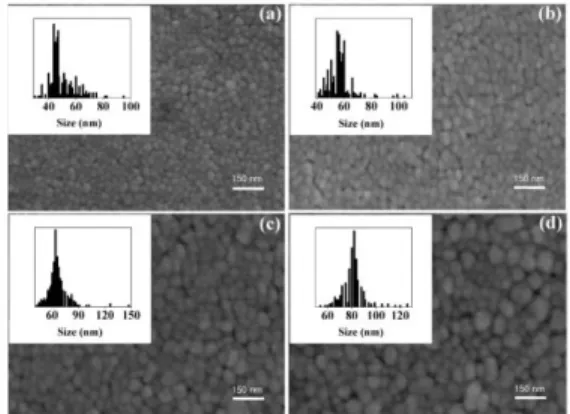
from SEM micrographs. The dependence of the size of silver particle on the reaction temperature was checked with four different temperatures: 100°C, 120°C, 140°C and 160°C. The SEM images of silver nanoparticles synthesized with different reaction temperatures are shown in figure 1.
Fig. 1 SEM images (with size distributions) of Ag nanoparticles synthesized from PVP with molecular weight of 10000 and reaction temperature at (a) 100°C, (b) 120°C, (c) 140°C and (d) 160°C.
The effect of the number of printing on printed electrodes was also examined. After printing one time, each electrode was dried with hand drier and again another electrode was printed on exactly same position. By doing so, single layered, double layered, triple layered and quadruple layered electrodes were prepared. All those electrodes were characterized carefully. The thickness of all those electrodes was evaluated by taking SEM images. The average thicknesses of single and double layered electrodes are 0.25 µm and 0.6 µm, respectively. In addition, the thickness of triple layered electrode is around four times thicker than single layered electrode, namely 0.95 µm.
4. Conclusions
Conductive silver ink was successfully prepared and used in inkjet printing to print silver micro electrodes. After sintering, the resistivity of
electrodes was measured and found to be 23.5×10⁻⁶ Ω-cm. Further research can be conducted to print complex electrical patterns on cellulose EAPap for sensor/actuator applications.
ACKNOWKEDGEMENT
This research was supported by National Research Foundation / Ministry of Education, Science and Technology, Republic of Korea.
REFERENCES
1. Ko, S. H., Pan, H., Grigoropoulos, C. P., Luscombe, C. K., Frechet, M. J., Poulikakos, D., “Air stable high resolution organic transistors by selective laser sintering of ink-jet printed metal nanoparticles,” Appl. Phys. Lett., Vol. 90, No. 14, 141103, 2007.
2. Kim, H. –S., Dhage, S. R., Shim, D. –E., Hahn, H. T., “Intense pulsed light sintering of copper nanoink for printed electronics,” Appl. Phys. A-Mater., Vol. 97, No. 4, pp. 791-798, 2009. 3. Khondoker, M. A. H., Mun, S. C., Kim, J.,
“Synthesis and characterization of conductive silver ink for electrode printing on cellulose film,” Appl. Phys. A-Mater., DOI 10.1007/s00339-012-7419-z, 2012.
4. Russo, A., Ahn, B. Y., Adams, J. J., Duoss, E. B., Bernhard, J. T., Lewis, J. A., “Pen-on-Paper Flexible Electronics,” Adv. Mater., Vol. 23, No. 30, pp. 3426-3430, 2011.