© Korean Powder Metallurgy Institute 1052 -1. Introduction
Among fabrication methods for MMCs, powder
metallurgy is particularly attractive since it is relatively cheap and can accommodate a wide range of materials and processing conditions. Reducing the particle size of reinforcement results in better machinability and mechanical properties of MMCs [2]. Machining tests have
been carried out on Al-based composite by using poly crystalline diamond (PCD) and tungsten carbide (K10) tools and have been found that PCD exhibited better properties with respect to tool life and surface quality [3-6].
2. Experimental Procedure
Materials. In this study, Al powders (-200 µm) and α-Si3N4 powders (0.1 - 0.3 µm) were used to produce the
samples. Al and α-Si3N4 (5, 10 and 15 wt. %) powders were
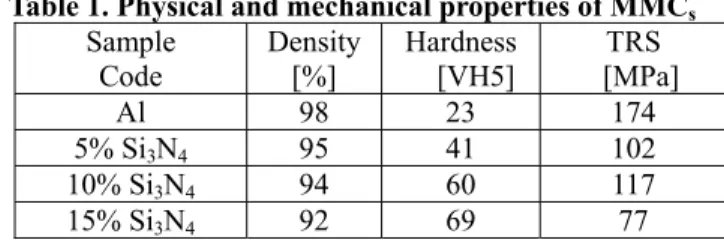
mixed in an attritor for 1 hour. Mixed powders were compacted at 800 MPa. Sintering was performed at 650°C for 2 h in N2. Physical properties of the samples are given in
Table 1.
Table 1. Physical and mechanical properties of MMCs
Sample Code Density [%] Hardness [VH5] TRS [MPa] Al 98 23 174 5% Si3N4 95 41 102 10% Si3N4 94 60 117 15% Si3N4 92 69 77
Machining Test. Ring-shaped MMC blocks were machined by dry turning on a CNC lathe with an uncoated tungsten carbide (K10) and PCD cutting tools. Table 2 summarizes the details of the machining conditions.
Table 2. Details for machining tests Tool holder CSBPR 25x25 R12
Tool inserts K10 and PCD / SPGN 120304 Cutting
parameters Cutting speed (V): 50-200 m/min Feed rate (f): 0.12 mm/rev Depth of cut (a): 1 mm
3. Experimental Results
Surface Roughness. High Ra values were obtained during machining of MMCs with K10 cutting tool (Fig. 1). With
increasing the cutting speed up to 150 m/min surface roughness decreased significantly. This feature was attributed to large built-up edge (BUE) formation which particularly formed at lower cutting speeds. Formation of minimum Ra value on
Fig. 1. Effect of cutting tool material and cutting speed on surface roughness. 2006 POWDER METALLURGY World Congress PC03-W-02 K10 PCD 1 2 3 4 5 6 7 0 50 100 150 200
Cutting speed - m/min
S u rf ace r ough ness R a ( µ m ) 15% 10% 5% Al K10 PCD
Effect of Cutting Tool Materials on Surface Roughness and Cutting Forces in
Machining of Al-Si
3N
4Composite Produced by Powder Metallurgy
Yusuf Ozcatalbas a, Ersin Bahceci b and Mehmet Turker c
Gazi University, Technical Education Faculty, 06500-Besevler, Ankara, Turkey
a
[email protected], b[email protected],
c
[email protected] Abstract
Aluminum-based composites reinforced with various amounts of α-Si3N4were produced by powder metallurgy (P/M). The machinability properties of MMCswere determined by means of cutting forces and surface roughness. Machining tests were carried out by using PCD and K10 tools. Increasing of Si3N4 volume fraction in the matrix resulted in a decrease of the surface roughness and turning forces. PCD cutting tools showed better cutting performance than K10 tools.
© Korean Powder Metallurgy Institute 1053
-pure Al and the sample containing 15% Si3N4 was probably
due to the formation of built up layer (BUL) or formation of small amount of BUE. During the machining of ductile and pure materials, BUL generally forms instead of BUE formation [8]. Surface roughness difference value of about 0.5 Ra was obtained on the sample machined between 50-200 m/min speed with PCD tool. This value is quite lower than the one with the K10 cutting tool. There was no evidence of BUE formation on the sample at the lowest cutting speed with PCD cutting tool.
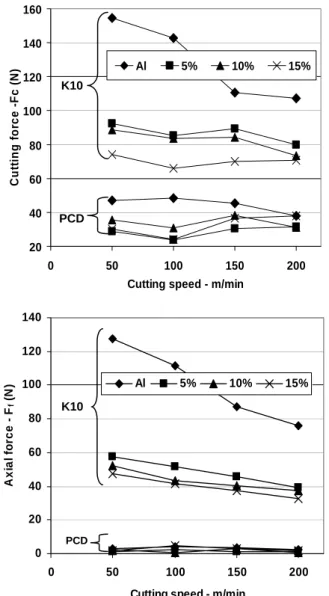
Fig. 2. Effect of cutting tool and cutting speed on turning forces (Fc, Ff).
Turning Forces. K10 tool generated high forces compared with PCD tool (Fig. 2). Forces generated by K10 tools showed a decreasing tendency with increasing material hardness and decreasing transverse rupture strength (TRS) value. High volume fraction of porosity in the matrix reduces the TRS value however; those pores or particles in
the cutting plane increases stress concentration which facilitates the chip braking and consequently reduces the cutting forces [9, 10].
During machining with K10 tool, both forces (Fc and Ff)
decreased with increasing cutting speed. This can be explained by low yield strength of MMCs due to high
cutting temperature caused by high cutting speeds. Turning forces generated during the machining of MMCs with PCD
tool were very low and axial force was negligibly small. 4. Conclusion
The following results were concluded:
- PCD tools exhibited very low surface roughness compared to K10 tools. Surface quality increased with increasing the cutting speeds when machining with K10 tool. Large BUE formed at low cutting speeds was found to increase the surface roughness.
- Minimum turning forces were obtained in machining with PCD tools were not related to cutting speeds. Turning forces generated by K10 tools were considerably higher compared to PCD tools at lower cutting speeds.
5. References
1. S.C. Lim, M. Gupta, L. Ren, and J.K.M Kwok, Journal of Materials Processing Technology, Vol. 89-90, p. 591-596, (1999).
2. Y.M. Quan, Z.H. Zhou, and B.Y. Yue, Journal of Materials Processing Technology, Vol. 91, p. 231-235, (1999).
3. I.E Clark, Machining Guide, IDR3, p.135-138,(1994). 4. Q. Yanming and Z. Zehua, Journal of Materials
Processing Technology, Vol. 100, p.194-199, (2000). 5. K. Weinert and W. König, Annals of the CIRP, Vol.
42-1, p. 95-98, (1993).
6. C. J. E. Andrewes, H.Y. Feng and W.M Lau, Journal of Materials Processing Technology, Vol. 102, p. 25-29, (2000).
7. E. Akoral, M. Turker and Y. Ozcatalbas, RoPM 2005, Third Conference on Powder Metallurgy, Vol. 1, p.369-375, (2005).
8. S. Katayama and M. Hashımura, ISIJ International, Vol. 30, No.6, p.457-463, (1990).
9. Y. Ozcatalbas, Composites Science and Technology, Vol.63, p.53-61, (2003).
10. A. Manna, B. Bhattacharya, Journal of Materials Processing Technology Vol.140 p. 711–716, (2003). 0 20 40 60 80 100 120 140 0 50 100 150 200
Cutting speed - m/min
A x ia l fo rce F f (N ) Al 5% 10% 15% K10 PCD 20 40 60 80 100 120 140 160 0 50 100 150 200
Cutting speed - m/min
C u tt in g fo rc e -F c (N ) Al 5% 10% 15% K10 PCD