Spontaneous and induced micronucleus frequencies in low dose
radiation-exposed worker’s peripheral blood lymphocytes
Hee-Kyung Kwon, Hye-Jin Lee, Mi-Young Park, Hyun-Jin Park, Tae-Hwan Kim*, Young-Hoon Ji,
Ki-Sup Kim, Su-Jae Lee, Yun-Sil Lee, Chul-Koo Cho, Soo-Yong Choi, Chang-Mo Kang**
Laboratory of Radiation Cytogenetics and Epidemiology, Korea Institute of Radiological & Medical Sciences, 215-4, Gongneung-Dong, Nowon-Gu, Seoul 139-706, Korea, [email protected]
*Kyungpook National University, Daegu, 702-701, Korea
1. Introduction
Many studies have been performed to assess the development and application of potentially useful biodosimetry. At present, although chromosome dicentric assay is a sensitive method for dose estimation, it is laborious and requires enough experience for estimation, and without automation its scope for population screening is limited. Therefore, we need an alternative cytogenetic dosimetry to estimate the absorbed dose of victims after low dose exposure such as radiation accidents in hospital workers and workers of radiation related facilities1. An alternative and simple
cytogenetic technique is the measurement of the micronucleus frequency in cultured human lymphocytes. The reliability of conventional micronucleus (MN) assays is diminished owing to the inclusion of non-dividing cells in the estimate, but this problem has been overcome by the development of the cytokinesis-blocked (CB) MN assay. The reliable and ease assays of the cytokinesis blocked-approach are obvious advantages in biological monitoring, but there are no developed recognizable and reliable techniques for biological dosimetry of a low dose exposure until recently2.
Adaptive response is important in determining the biological responses at low doses of radiation and has the potential to impact the shape of the dose-response relationship.
We analyzed the frequency of both spontaneous and in
vitro 137Cs γ-rays-induced MNs to estimate the low
dose radiation-exposed workers as a screening test.
2. Methods and Results
The subject: The subjects were composed of the low
dose radiation-exposed workers aged between 26 years and 46 years. These low dose radiation-exposed workers exposed that subject A was 5.38, B was 11.78, C was 1.48, D was 3.64, E was 24.79, and F was 6.83 mSv total effective dose during last 1 year. These subjects were all hospital workers and their life style was disregarded in MN data.
Irradiation condition: The blood samples were
irradiated with 0 - 2Gy of 137Cs γ-rays was
98.2cGy/min.
Cell culture and cytokinesis-block methods: Whole
blood was cultured in RPMI 1640 containing a Hepes buffer, 15 % heat inactivated fetal calf serum, L-glutamine and antibiotics. Cytochalasin-B was added 44 h after commencement of the culture at a concentration of 3.0µg/ml. After an incubation period of 72 h, the cells were collected by centrifugation. Collected samples were resuspended in KCl hypotonic solution and a mixture of methanol and glacial acetic acid. The fixed cells were air-dried and stained with 10% Giemsa for 10 min.
Scoring of the MN and data analysis: The MNs were
Transactions of the Korean Nuclear Society Autumn Meeting Busan, Korea, October 27-28, 2005
scored in over 1000 binucleated CB cells using a 1000X magnification. All the statistical analyses were performed using a Graph PAD in a Plot computer program and Excel program.
Results: For the study of the adative response of the MN
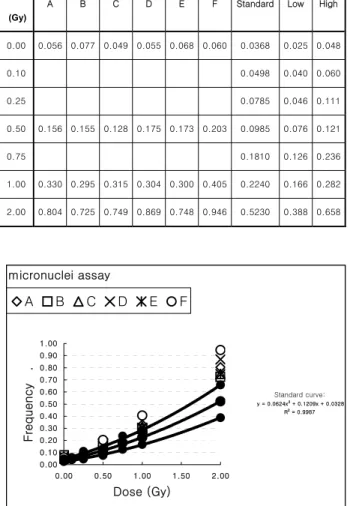
frequency, 6 low dose radiation-exposed workers were selected. Micronucleus per 1000 binucleated cells was counted for the low dose radiation-exposed worker and their age was 40, 26, 46, 29, 33, 26 years old, respectively,
Table 1. Micronucleus frequency of peripheral
lymphocytes according to irradiated dose, respectively.
micronuclei assay Standard curve: y = 0.0624x2 + 0.1209x + 0.0328 R2 = 0.9987 0.00 0.10 0.20 0.30 0.40 0.50 0.60 0.70 0.80 0.90 1.00 0.00 0.50 1.00 1.50 2.00 Dose (Gy) Frequency . A B C D E F
Figure 1. Dose-response relationship in micronucleus frequency of peripheral lymphocytes according to irradiated dose, respectively.
The frequency was not followed with age in the spontaneous MN frequency of low dose radiation-exposed workers as shown in Table 1. And the effect of low dose radiation-exposed was not shown in dose-dependent MN frequency, either, as shown in Figure 1.
3. Conclusion
We think that in estimating the genetic hazards of environmental mutagens there are major problems in applying them from the epidemiological data to a biodosimetry in the low dose radiation exposed person. The occupational, medical and population exposures of various forms of ionizing radiation may have the ability to alter DNA without affecting other cellular functions and these toxic effects are deterministic or stochastic effects. Therefore, if genetic effects are to be manifested from very low-dose exposure to ionizing radiation through epidemiological and in vitro studies, the risks have to be considerably larger than the risks from non-ionizing radiation or other environmental mutagens. In this experiment, we could not observed the adaptive response of low dose radiation with MN frequency, although the subject number is only six. In next research, we will try out the MN assay and dicentric assay together in low dose radiation-exposed workers with age, sex and life-style factors.
REFERENCES
[1] Almassy Z, Kanyar B, Koteles GJ. Frequency of micronuclei in X-irradiated human lymphocytes. Int J
Radiat Biol, 49: 719-723, 1986.
[2] Thierens H, Vral A, De Ridder L. Biological dosimetry using the micronucleus assay for lymphocytes: interindividual differences in does-response. Health Phys, 61: 623-630, 1991
Dose (Gy)
A B C D E F Standard Low High
0.00 0.056 0.077 0.049 0.055 0.068 0.060 0.0368 0.025 0.048 0.10 0.0498 0.040 0.060 0.25 0.0785 0.046 0.111 0.50 0.156 0.155 0.128 0.175 0.173 0.203 0.0985 0.076 0.121 0.75 0.1810 0.126 0.236 1.00 0.330 0.295 0.315 0.304 0.300 0.405 0.2240 0.166 0.282 2.00 0.804 0.725 0.749 0.869 0.748 0.946 0.5230 0.388 0.658