측면 연마 광섬유를 이용한 UV 센서
UV sensor based on side-polished fiber
문남일, 강지훈, 조규정, 김인수, 김광택*
*호남대학교 광전자공학과세대학교
The sensor application using side-polished fibers is strongly related to the optical sensing properties of the covering medium placed on the top surface of a side-polished fiber. Recently, a semi-interpenetrating polymer network (semi-IPN) film with a rapid photomechanical switch has been reported[[1-2].
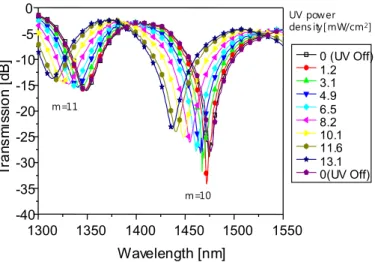
In this paper, we demonstrate a UV controllable and UV sensing device based on side-polished fiber incorporating an azobenzene dye-doped polycarbonate(Azo-PC) film. Our idea is that the volume change of the Azo-PC film by exposure to UV is accompanied by a change of the refractive index of the film. This change of refractive index of the Azo-PC film by UV exposure results in a shift of the transmission spectrum of side-polished fiber. We found that the optical property of the film can be controlled by UV and the film would exhibit reversible properties. Although a fiber-optic UV sensor[8] using another UV sensitive polymer was reported previously, there is still a need to enhance the performance of the UV sensor, especially in regard to sensitivity and response time. We will present the evaluation method regarding the UV sensitive property of the Azo-PC and the experimental results including an improved sensitivity and faster response time. The schematic structure of the proposed sensor is shown in Fig. 1. The chemical structue of the polymer is shown in Fig. 2. The proposed sensor, composed of a side-polished single mode fiber covered Azo-PC film, plays both roles as a multimode planar waveguide(PWG). The resonance wavelengths of the device after UV exposure shifted to a short wavelength region. It can be attributed to a decrease of the refractive index of the Azo-PC film after UV exposure. When the UV LED was turned off again the resonance wavelength returned to its original point as shown in Fig 3. The resonance wavelength shifted with an average sensitivity of 2.64nm/( mW/cm2). After UVexposure with a power density of 13.1mW/cm2,therefractive index change of the
Azo-PC film was approximately 0.0035.
In conclusion, we have demonstrated a UV sensor based on the side-polished fiber. This Azo-PC film is expected to have various fiber optic applications because of its high UV sensitivity and fast response time.
Reference
[1] H. K. Kim, X. S. Wang, Y. Fujita, A. Sudo, H, Nishida, M, Fujii, T. Endo,
Macromilecularrapidcommunications,26(2005)1032-1036.
[1] H. K. Kim, X.S. Wang, Y. Fujita, A. Sudo, H, Nishida, M, Fujii, T. Endo, Macromol. Chem. Phys. 206(2005) 2106-2111.
ACKNOWLEDGEMENT
This research was also partially supported by the program for the Training of Graduate Students in Regional Innovation and the program for Regional Strategic Industries which was conducted by the Ministry of Commerce Industry and Energy, Korea.
Fig. 1. structure of UV sensor
N
N C
O
O (CH2)2 O CH2CH3
Fig. 2 chemical structure of Azo-PC film.
UV power dens ity[mW/cm2] m=10 m=11 1300 1350 1400 1450 1500 1550 -40 -35 -30 -25 -20 -15 -10 -5 0 Tr an sm is si on [ dB ] Wavelength [nm] 0 (UV Off) 1.2 3.1 4.9 6.5 8.2 10.1 11.6 13.1 0(UV Off)
Fig. 3. Response of UV sensor.