Epidemiological and clinical characteristics of COVID-19 variants of concern in
the Republic of Korea
From January 20, 2020 to March 1, 2021, a total of 90,029 cases of coronavirus disease 2019 (COVID-19) emerged after the first confirmed case was reported in Korea. In total, 162 patients with variants of concern (VOCs) have been confirmed since the first case of a VOC was confirmed in Korea in December 2020. The purpose of this paper is to analyze and share the epidemiological and clinical characteristics of VOC patients in Korea, as well as to offer suggestions on how to respond to VOCs, which can affect transmissibility and severity.
The epidemiological and clinical characteristics of 162 VOC cases in Korea were analyzed using initial and in-depth epidemiological investigation results reported through the Korea Disease Control and Prevention Agency (KDCA) COVID-19 information management system for managing confirmed patients (HIRAe).
The 162 VOC cases were divided into 3 groups: 501Y.V1, 501Y.V2 and 501Y.V3. There were 127 imported cases (78.4%) and 35 locally acquired cases (21.6%), and 106 male cases (65.4%) and 56 female cases (34.6%). The patients’ average age was 36.4 years. People aged 30 to 39 accounted for 25.9% of cases. The majority of cases (105; 64.8%) were Korean nationals, and 100 cases (61.7%) were symptomatic at diagnosis. Thirty-seven cases (22.8%) involved mild respiratory symptoms without fever, and 27 (16.7%) had mild respiratory symptoms with fever. Most symptoms of VOC patients in Korea were mild, but 5 patients with the 501Y.V1 variant (the variant originating from the United Kingdom) were severe/critical (including 1 death). The rate of severe/critical symptoms was 3.09%, and the fatality rate was 0.6%.
However, since research on VOCs is continuing worldwide and the number of VOCs detected in Korea is increasing, it is important to establish a strategy for managing patients with variants through ongoing monitoring and analysis.
Keywords: Covid-19, Variant of Concern (VOC), Clinical characteristic
Jia Kim, Jung Yeon Kim, Jin Gwack
Case Management Team, Response Coordination Task Force, Central Disease Control Headquarters, Korea Disease Control and Prevention Agency (KDCA)
Introduction
In total, 93,217,287 cases of coronavirus disease-19 (COVID-19), which emerged in Wuhan, Hubei Province, China and was first announced on December 31, 2019, have been reported worldwide as of January 19, 2021 [3]. In Korea, from January 20, 2020 (when the first confirmed case was reported) to March 1, 2021, 90,029 COVID-19 patients have been recorded.
Approximately 1 year since COVID-19 first emerged, the world is facing a new stage of the pandemic due to variants. The first infection with variant originating from the United Kingdom (UK) was reported on September 20, 2020 [1], and variants of SARS-CoV-2, the virus that causes COVID-19, have since spread rapidly around the world. In Korea, the first patient infected with the variant originating from the UK was first found at entry screening in December 2020, and 162 patients with COVID-19
variants have been reported since. Increased transmissibility (1.5 times higher) has been reported for the variant originating from the UK [1,4]. The possibility of higher transmissibility has been suggested for the variant originating from the South Africa, Brazil [5,8], as well as the possibility that the variants may evade antibodies depending on the site of variant Spike protein in the virus [6,7]. The situation requires further research.
In order to respond the spread of SARS-CoV-2 variants in Korea, individuals who are entering from high-risk countries with outbreaks of variants of concern (VOCs) are required to submit the result of a PCR negative and go through a strengthened quarantine process after testing [2]. Moreover, an enhanced patient management protocol has been applied to individuals who are diagnosed with COVID-19 after entering from high-risk countries affected by VOCs and to patients who are confirmed to have VOCs. In the enhanced patient management protocol, patients who are suspected or confirmed to have been infected with a VOC are isolated in a separate room and the enhanced case management guidelines is implemented. According to the temporary test-based guideline for quarantine release, individuals with 2 consecutive negative PCR tests are released. However, research on VOCs is ongoing; thus, once scientific evidence on the transmission period of VOCs becomes available, an evidence-based guidance on discharging patients with VOCs will be prepared.
This study aimed to analyze the epidemiological and clinical characteristics of patients with VOC in Korea in order to establish a response strategy and VOCs patient management policy based on regular monitoring.
Methods
This study conducted a frequency analysis and used
the chi-square test to analyze data from initial and in-depth epidemiological investigation results and clinical information from 162 patients infected with the VOCs originating from the UK, South Africa, and Brazil (confirmed in South Korea from December 28, 2020 to March 1, 2021) using R. Epidemiological and clinical characteristics of the 162 patients (138 with the VOCs originating from the UK, 18 with the VOCs originating from the South Africa, and 6 with the VOCs originating from the Brazil) were analyzed.
Results
1. Route of infection and detection
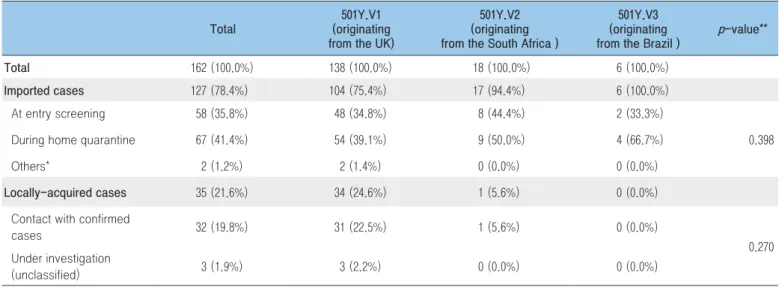
In total, 162 patients infected with the VOCs originating from the UK, South Africa, and Brazil were confirmed in Korea from December 28, 2020 to March 1, 2021. Of these cases, 127 (78.4%) were imported cases, among which cases confirmed during home quarantine were most frequent (n=67, 41.4%), followed by cases confirmed at entry screening (n=58, 35.8%) and cases exempt from quarantine and confirmed with tests after entry (n=2, 2.1%). Thirty-five cases (21.6%) were locally acquired, among whom 32 cases (19.8%) had contact with confirmed cases and the remaining 3 cases (1.9%) were under investigation (Table 1).
2. Epidemiological characteristics
A. 501Y.V1
Most VOCs patients in Korea had the VOCs originating from the UK (138 out of 162, 85.2%). There were more male (n=91, 65.9%) than female (n=47, 34.1%), and most patients
were in their 30s (n=34, 24.6%), followed by those in their 20s (n=28, 20.3%) and 40s (n=26, 18.8%). The majority of patients were isolated in hospitals (n=73, 52.9%), followed by residential treatment centers (n=63, 45.7%) and home (n=1, 0.7%). Thirty-six patients were released from isolation in accordance with the test-based guidance on discharging patients in the enhanced case management guidelines. The average length of isolation was 25.9 days (Table 2).
B. 501Y.V2
Eighteen of the 162 (11.1%) VOC patients in Korea had the VOCs originating from the South Africa . There were more male (n=11, 61.1%) than female (n=7, 38.9%), and most patients were in their 30s (n=6, 33.3%), followed by those in their 20s and 40s (n=4, 22.2%, respectively). Most patients were isolated in residential treatment centers (n=11, 61.1%), followed by hospitals (n=6, 33.3%) and home (n=1, 5.6%). There were no severe/ critical cases, including death. Seven patients were released from isolation in accordance with the test-based guidance on discharging patients in the enhanced patient management guidelines. The average length of isolation was 25.9 days,
which was identical to the average for patients with the VOCs originating from the UK (Table 2).
C. 501Y.V3
Six of the 162 (3.7%) VOC patients in Korea had the VOCs originating from the Brazil. There were more male (n=4, 66.7%) than female (n=2, 33.3%), with 2 patients (33.3%) each in their 30s and 60s and 1 patient (16.7%) each in their 20s and 60s. Most patients were isolated in residential treatment centers (n=4, 66.7%), followed by hospitals (n=2, 33.3%). There were no severe/critical cases, including death. Two patients were released from isolation in accordance with the test-based guidance on discharging patients in the enhanced patient management guidelines. The average length of isolation was 22.0 days, which was 3 days shorter than the average of patients with the VOCs originating from the UK, South Africa (Table 2).
3. Clinical characteristics
More than half of the VOC patients in Korea reported symptom (n=100, 61.7%), while 62 patients were asymptomatic
Table 1. Route of infection and detection of VOCs in Korea
Total
501Y.V1 (originating from the UK)
501Y.V2 (originating from the South Africa )
501Y.V3 (originating
from the Brazil ) p-value**
Total 162 (100.0%) 138 (100.0%) 18 (100.0%) 6 (100.0%)
Imported cases 127 (78.4%) 104 (75.4%) 17 (94.4%) 6 (100.0%) At entry screening 58 (35.8%) 48 (34.8%) 8 (44.4%) 2 (33.3%)
0.398 During home quarantine 67 (41.4%) 54 (39.1%) 9 (50.0%) 4 (66.7%)
Others* 2 (1.2%) 2 (1.4%) 0 (0.0%) 0 (0.0%)
Locally-acquired cases 35 (21.6%) 34 (24.6%) 1 (5.6%) 0 (0.0%) Contact with confirmed
cases 32 (19.8%) 31 (22.5%) 1 (5.6%) 0 (0.0%)
0.270 Under investigation
(unclassified) 3 (1.9%) 3 (2.2%) 0 (0.0%) 0 (0.0%)
(38.3%). When the reported symptoms were categorized (excluding asymptomatic cases), the most frequent symptom was mild respiratory symptoms without fever (e.g., coughing) (n=37, 22.8%), followed by mild respiratory symptoms with fever (n=27, 16.7%), fever (n=18, 11.1%), other symptoms (e.g., chills, stomachaches) with (n=8, 4.9%) and without fever (n=8, 4.9%), and an acute loss of sense of smell or taste (n=2, 1.2%) (Table 3).
In Korea, patients who are isolated and treated with high-flow oxygen therapy, ventilator, ECMO (extracorporeal membrane oxygen) or CRRT (continuous renal replacement therapy) are classified as severe/critical cases. The main
symptoms reported by VOCs patients in Korea were mostly mild, but 5 patients with the VOCs originating from the UK were classified as severe/critical cases (including 1 death). The proportion of severe/critical cases among VOCs patients in Korea was 3.09%, and the fatality rate was 0.6% (Table 3). Comparing the proportion of severe/critical cases and fatality rate of VOC patients and non-VOC patients, no major difference was observed. However, since research on VOCs is continuing and the number of VOCs patients in Korea is increasing, ongoing monitoring and data analysis are necessary.
Table 2. Epidemiological characteristics of VOCs in Korea
Total
501Y.V1 (originating from the UK)
501Y.V2 (originating from the South Africa )
501Y.V3 (originating
from the Brazil ) p-value
** Total 162 (100.0%) 138 (85.2%) 18 (11.1%) 6 (3.7%) Gender Male 106 (65.4%) 91 (65.9%) 11 (61.1%) 4 (66.7%) 0.919 Female 56 (34.6%) 47 (34.1%) 7 (38.9%) 2 (33.3%) Nationality Koreans 105 (64.8%) 90 (65.2%) 9 (50.0%) 6 (100.0%) 0.082 Foreigners 57 (35.2%) 48 (34.8%) 9 (50.0%) 0 (0.0%)
Age group (yrs)
0-9 10 (6.2%) 9 (6.5%) 1 (5.6%) 0 (0.0%) 0.878 10-19 11 (6.8%) 10 (7.2%) 1 (5.6%) 0 (0.0%) 20-29 33 (20.4%) 28 (20.3%) 4 (22.2%) 1 (16.7%) 30-39 42 (25.9%) 34 (24.6%) 6 (33.3%) 2 (33.3%) 40-49 30 (18.5%) 26 (18.8%) 4 (22.2%) 0 (0.0%) 50-59 18 (11.1%) 17 (12.3%) 0 (0.0%) 1 (16.7%) 60-69 15 (9.3%) 11 (8.0%) 2 (11.1%) 2 (33.3%) 70-79 1 (0.6%) 1 (0.7%) 0 (0.0%) 0 (0.0%) 80+ 2 (1.2%) 2 (1.4%) 0 (0.0%) 0 (0.0%) Isolation place Residential treatment center 78 (48.1%) 63 (45.7%) 11 (61.1%) 4 (66.7%) 0.619 Hospital 81 (50.0%) 73 (52.9%) 6 (33.3%) 2 (33.3%) Home treatment 2 (1.2%) 1 (0.7%) 1 (5.6%) 0 (0.0%) Others* 1 (0.6%) 1 (0.7%) 0 (0.0%) 0 (0.0%)
Conclusion
The past year (2020) has been profoundly shaped by the COVID-19 pandemic, which started in Wuhan, Hubei Province, China and was first reported on December 31, 2019. Infection with a variant of COVID-19 was reported in the United Kingdom on September 20, 2020; since then, COVID-19 variants have spread around the world. A high transmissibility (1.5 times) has been reported for the VOCs originating from the UK [1,4], and the possibility of higher transmissibility has been suggested for the VOCs originating from the South Africa and Brazil [5, 8]. The possibility of antibody evasion depending on the site of variant Spike protein in the virus has been reported [6,7], but
more research is needed. Therefore, it is necessary to continue analyzing epidemiological and clinical information about VOC patients in Korea and to establish a VOCs patient management response strategy.
Acknowledgements
Conflict of Interest
No potential conflict of interest relevant to this article was reported.
Table 3. Clinical characteristics of VOCs in Korea
Total
501Y.V1 (originating from the UK)
501Y.V2 (originating from the South Africa )
501Y.V3 (originating from the Brazil )
p-value* Total 162 (100.0%) 138 (85.2%) 18 (11.1%) 6 (3.7%) Symptom Symptomatic 100 (61.7%) 85 (61.6%) 11 (61.1%) 4 (66.7%) 0.967 Asymptomatic 62 (38.3%) 53 (38.4%) 7 (38.9%) 2 (33.3%) Symptom classification Fever only 18 (11.1%) 11 (8.0%) 6 (33.3%) 1 (16.7%) 0.027 Fever and respiratory
symptoms 27 (16.7%) 27 (19.6%) 0 (0.0%) 0 (0.0%)
Fever and other symptoms 8 (4.9%) 6 (4.3%) 2 (11.1%) 0 (0.0%) Respiratory symptoms
without fever 37 (22.8%) 33 (23.9%) 2 (11.1%) 2 (33.3%)
Acute loss of sense of
smell or taste 2 (1.2%) 1 (0.7%) 1 (5.6%) 0 (0.0%) Others 8 (4.9%) 7 (5.1%) 0 (0.0%) 1 (16.7%) Asymptomatic 62 (38.3%) 53 (38.4%) 7 (38.9%) 2 (33.3%) Severity Severe/critical 4 (2.5%) 4 (2.9%) 0 (0.0%) 0 (0.0%) 0.924 Mild/asymptomatic 157 (96.9%) 133 (96.4%) 18 (100.0%) 6 (100.0%) Death 1 (0.6%) 1 (0.7%) 0 (0.0%) 0 (0.0%) * χ2 test
Correspondence to: Jin Gwack
Case Management Team, Response Coordination Task Force, Central Disease Control Headquarters, Korea Disease Control and Prevention Agency (KDCA)
E-mail: [email protected], Tel: +82-43-719-9100
Submitted: March 19, 2021; Revised: March 23, 2021; Accepted: March 23, 2021
① What was known?
Since the first patient with a COVID-19 variant was confirmed in Korea in December 2020, a total of 162 patients with VOCs have been confirmed as of March 1, 2021, with 138 patients having the VOCs originating from the UK, 18 having VOCs originating from the South Africa, and 6 having VOCs originating from the Brazil.
② What does this study add?
Among the 162 patients, there were more male (n=106, 65.4%) than female (n=56, 34.6%). Most patients were in their 30s (n=42, 25.9%), and the average age was 36.4 years. Among the VOCs patients in Korea, 100 (61.7%) were symptomatic, while 62 (38.3%) were asymptomatic. The main symptom reported was mild respiratory symptoms without fever (n=37, 22.8%). 5 severe/critical cases of the VOCs originating from the UK occurred, including 1 death. ③ What are the Implications?
Based on the ongoing monitoring of the clinical status of patients with VOCs, a response strategy for VOC patient management should be established according to the characteristics (severity and fatality) of VOCs.
References
1. WHO. COVID-19 Weekly Epidemiological Update, 2021.3.14. 2. KDCA. Introduction of the 9-5th Edition of the COVID-19
Response Guideline. 2020.
3. Kim YH, Kim YY, Yeom HS, Jang JW, Hwang IS, Park KS, et al. COVID-19 1-Year Outbreak Report as of January 19, 2021 in the Republic of Korea. Public Health Weekly Report. 2021;14(9):472-481.
4. Summer. E. Gallerway et al. Emergence of SARS-CoV-2 B.1.1.7 Lineage — United States, December 29, 2020–January 12, 2021. Morbidity Mortality Weekly Report (MMWR). 2020;70(3):95-99. 5. Emanuele Andreano, et al. SARS-CoV-2 escape in vitro from a
highly neutralizing COVID-19 convalescent plasma. bioRxiv. 2020.12.28. doi: https://doi.org/10.1101/2020.12.28.424451
6. Zhuoming Liu, et al. Landscape analysis of escape variants identifies SARS-CoV-2 spike mutations that attenuate monoclonal and serum antibody neutralization. bioRxiv. 2020.11.8. doi: https:// doi.org/10.1101/2020.11.06.372037
7. Gard Nelson, Oleksandr Buzko, et al. Molecular dynamic simulation reveals E484K mutation enhances spike RBD-ACE2 affinity and the combination of E484K, K417N, and N501Y mutations (501Y.V2 variant) induces conformational change greater than N501Y mutant alone, potentially resulting in a escape mutant. bioRxiv. 2021.1.13. doi: https://doi.org/10.1101/2021.01.13.426558 8. Nuno R. Faria, et al. Genomic characterization of an emergent
SARS-CoV-2 lineage in Manaus: preliminary findings. viological. org. 2021.1.20.
This article has been translated from the Public Health Weekly Report (PHWR) Volume 14, Number 13, 2021.