A study on development of VR-based tangible functional game for prevention of
dementia
Chun-Ok Jang
11
Assistant Professor., Department of Social Welfare, Honam University, Korea
E-mail: [email protected]
Abstract
Currently, as Korea enters into a fast aging society, the problem of dementia population is increasing. In this paper, we intend to contribute to the improvement of welfare for the elderly by developing virtual reality technology and related interface technology to effectively perform hand movements known as effective methods for preventing and treating dementia.
As the content of the research and development of this paper, it is designed to be easy for the elderly to use and stimulate brain function by applying VR technology using sensors, and to activate mental and physical activities for the elderly who are marginalized in terms of cultural welfare. We intend to develop by classifying the types of games and contents that can induce them.
As a result of this thesis, we developed contents using virtual reality to improve cognitive abilities for elderly people with poor cognitive ability to activate the brains of users' cognition, memory, and attention to prevent and treat dementia I want to contribute.
Keywords: Senile dementia, Functional dementia prevention game, Virtual reality content, Experienced functional game, Cognitive ability.
1. INTRODUCTION
As the modern society enters a rapidly aging society, the physical and mental health of the elderly is approaching not only as a problem for individuals and families, but also as a new crisis due to overall changes in society such as health care, politics, and economy.
Currently, in Korea, due to the increase in the elderly population, senile diseases are emerging as a new social problem [1]. These "senile diseases that are increasing with the elderly population" are "spreading and increasing to middle and elderly people" due to "the stress and social climate of the modern society." Countermeasures need to be prepared for this increasing senile disease, and various preventive programs that can slow the onset and progression of such senile diseases through prevention and treatment are urgently needed. Patients with dementia have weakened physical and mental abilities and self-reliance in daily life [2]. As a result, families and community groups of patients with dementia are experiencing serious economic and social suffering from their support.
According to these social changes, healthcare contents are being developed to help the elderly to prevent and treat dementia and depression due to the increase in smart seniors. One of the most effective ways to prevent dementia is hand movement, which creates a new synapse that connects brain nerve cells when you move your hand a lot. Accordingly, since the existing nerve connection becomes thick, brain function is improved and it can help to prevent dementia [3].
IJACT 21-3-27
Manuscript received: January 27, 2021 / revised: February 7, 2021 / accepted: February 16, 2021 Corresponding Author: [email protected]
Tel:+82-62-940-5244, Fax:+82-62-940-5244
However, the development of dementia prevention contents using virtual reality is lacking in preparation not only in Korea but also in other developed countries, so the VR healthcare market related to treatment and play culture has not been activated [4].
Therefore, the basic goal of this study is to analyze the needs of the elderly and to identify physical and mental characteristics to improve the quality of life of the elderly and to establish a cultural welfare for the elderly that can understand and respect the elderly creative games and contents that consider all of the convenience of use by applying VR interface technology [5-6], the appropriateness and entertainment of contents, appropriate hardware, the application of virtual reality technology, the effectiveness after using the contents, and the business and expandability of the development results.
This paper aims to develop games and contents that can induce activation of mental and physical activities for the elderly, who are marginalized in terms of cultural welfare, into two types. First, by making the most of VR characteristics, we design the system and select contents that can induce interest of the experiencers on the line of linking objects and contents, and second, a plan to finally optimize the functional game device for preventing dementia through user testing. When performing VR functional dementia prevention contents, the elderly create an easy and simple interface that stimulates the frontal lobe function and consists of functions such as memory enhancement and concentration enhancement, which induces mental and physical activation, and is expected to help prevent dementia.
2. RESEARCH CONTENT: FUNCTIONAL DEMENTIA PREVENTION GAME
In order to design and develop the functional dementia prevention game contents to be studied in this paper, the interaction function was first defined, and it was planned in a storytelling format in consideration of the expected effect, interest and immersion. First, the system was designed by maximizing the characteristics of virtual reality, and developed so as to induce interest of experiencers by linking objects and contents. Two tangible functional games were selected as the theme of development, such as adding fruits in order and protect the castle.
2.1 The composition of a tangible functional game of “adding fruits in order”
It is a game in which fruits that are easily accessible around us are shown to the user in order for 5 seconds, then remembered and placed in a basket in order. This game is structured so that you can feel a sense of accomplishment by providing hints in the middle of the game to increase concentration and rewarding items after completion.
The difficulty level was leveled in 3 stages considering the complexity through the number of fruits listed. The goal of the game is to match 5 of the 6 questions for 30 seconds in order, and if two times per problem is wrong, apart from the time limit, the game ends and the user's brain activity and hand movement are developed to be sufficient.
2.2 The composition of a tangible functional game of “Protect the castle”
"Protect the castle" tangible functional game is a "tower defense genre and a game to defeat enemies by using bows and arrows to invade enemy forces into the castle. This is a game that requires "physical activity" in which you have to use a wireless controller to handle the bow, "focus" to pull the bow and aim enemies, and "quickness" to shoot the enemies in motion.
Defeat all enemies for a given amount of time, or defend the castle until it is destroyed. Difficulty is a total of 3 levels, and the higher the level, the more the enemy's stamina and the number of enemies increase. When the game starts, the castle is protected for 60 seconds, and there are cases where the Health Point (HP) representing the castle's health is "0" and exceeds "0". Here, if the time is “0”, the game will fail, and if it exceeds “0”: If the number of enemies is “0”, the game is successful, and if it exceeds “0”, the sequence is
configured to repeat.
3. DEVELOPMENT OF S/W FOR VR CONTENTS BASED ON REAL-TIME 3D ENGINE
Using 3D engine programming, 3D objects are created in real time, and the game can be played in a form that minimizes obstacles in the virtual space. Through applying the user's camera point of view, the activated camera is changed" according to the user's selection and situation change. The game space was implemented by importing the assets of 3D objects from the Unity 3D engine, and the objects used inside each game were placed as 3D objects. In addition, by applying the ratio of the virtual space and the ratio between the characters, the space was created with the optimal ratio so that the user can feel a sense similar to the real space.
3.1 Virtual environment of “Adding fruits in order”
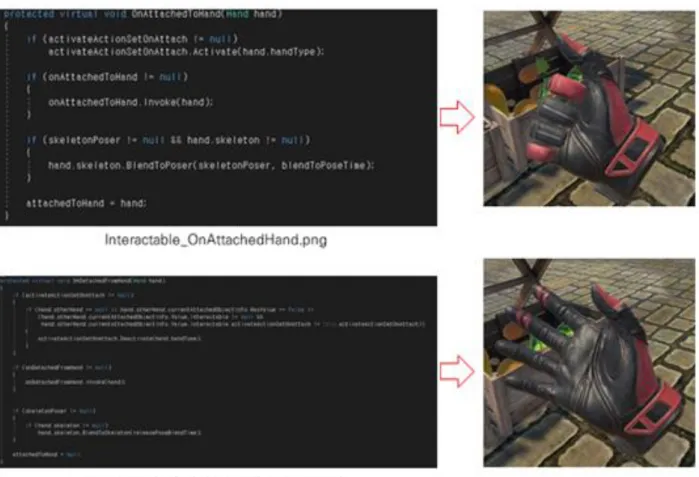
Figure 1 is rigging for each finger joint in order to synchronize the controller used by the user by hand in the game. Through this, when the user presses the controller button, the finger joint is implemented to move. In order to check the interaction by operating the controller in a virtual environment, when a user picks up an object, it is visually expressed in an animation in the form of holding a hand in the virtual environment.
Figure 1. Express controller interaction
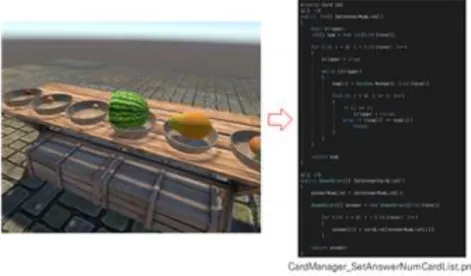
Figure 2 shows the contents of questioning and correct answer processing for a memory game with the game “Adding fruits in order. Each fruit is given an ID, and the fruit type and order are randomly created with an ID that does not overlap within the array variable. The fruit ID is assigned a number, and if the
number in the array variable matches the number assigned to the fruit objects, it is treated as a correct answer.
A collider that detects fruit objects is added to the basket in virtual reality. If the fruit object is placed in the basket, the ID of the contained fruit is stored. If the fruit object is out of the basket, the value is initialized to determine whether the fruit is contained in the basket and what kind of fruit. Also, when analyzing correct and incorrect answers through the ID of the stored fruit object, the value is referred to.
Figure 2. Problem questioning and correct answer processing process for memory games 3.2 The virtual environment of “Protect the Castle”
As shown in Figure 3, it is designed in the form of shooting arrows while holding a bow in the game of "Protect the Castle". The controller that the user holds in his hand is implemented in the form of catching the target colliding with the bow. This form sets the scope of each collider for objects that need to interact with the controller, and handles events when colliding with other colliders in the game. In order to synchronize the controller used by the user by hand in the game, rigging is performed with each finger joint, and through this, when the user presses the controller button, the corresponding finger joint is implemented in a form of movement.
Figure 3. Detailed function configuration to implement a bow that can be used in the game
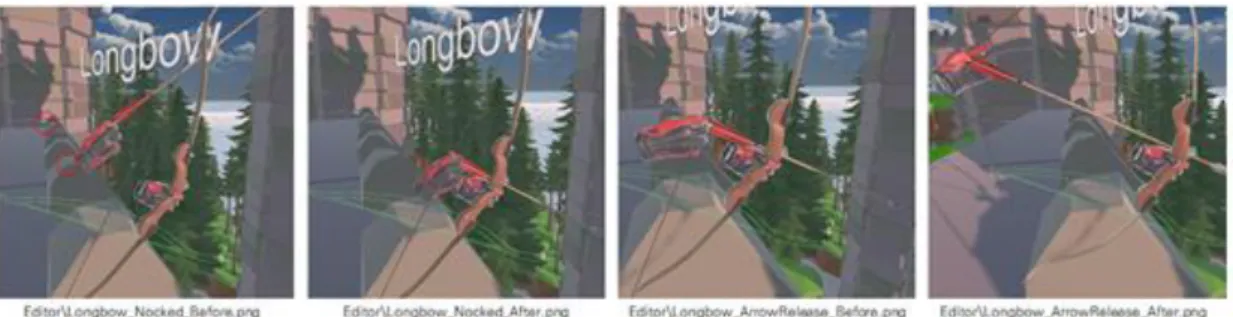
Figure 4 shows the implementation of the pulling bow and triggering the arrow feathers in the game of ‘Keep the Castle’.
When the arrow of the right hand reaches a certain distance from the bow of the left hand, the arrow is treated to be caught in a demonstration, and the angle is changed to the bow angle.
In general, when shooting a bow, the arrow is held by the collar of the arrow and hangs on the bow, so the distance is measured around the center of the bow and the collar in consideration of the user's behavior even during the game so that the arrow catches the bow.
The force that the arrow is fired and flying is moved using the “rigidbody” of the physical engine, and the “AddForce” function is applied to control the speed of the arrow by ignoring the mass and giving instantaneous force in Force Mode. The “AddTorque” function is applied to rotate around the axis of the arrow in the direction of flight, and the “useGravity” function applies gravity to the arrow to fall to the ground and fly by drawing a parabolic trajectory. Through exception processing, it judges whether there is an arrow on the bow and writes a code that generates when there is no arrow, and an arrow is generated 0.5 seconds after the arrow is fired.
Figure 4. Bow pull and feather trigger action
4. DEVELOPMENT OF AN INTERACTIVE SYSTEM FOR VIRTUAL REALITY
CONTENT EXPERIENCERS
The content to be developed in this paper uses HTC's VIVE, a virtual reality device, for game and interaction based on the Unity 3D engine. VIVE used HMD for 3D tracking of the camera in a 3D space and a display that can see the VR environment [7].
It consists of a controller, an interface device for interaction in a three-dimensional space. In order to use the VIVE device in Unity 3D engine, define the input value in the "Input Action" setting. Also, add an action value to the action list. In order to connect the VIVE controller with the input value and button in the game, upload the information added to the action list in "Controller Binding" to the Binding setting, and then connect the controller's input value to the desired action. By creating a VR Input class that receives the action value corresponding to the input, a new variable required for the controller input is created, and the corresponding action is mapped.
The configuration of the main system and object interaction module utilizes VIVE, a representative HMD device, and constitutes a player PC equipped with a graphics card of GTX 1070 or higher and an i7-class CPU so that VR contents can run smoothly. A display capable of 3D image output is mounted, and by using various sensors such as IR-based light house tracking and head tracker, it maximizes the user's immersion by providing position coordinates and rotation angle in 3D space.
Using a three-dimensional motion controller, we implement virtual reality content that enables interaction through motion recognition, and develops so that the motion of the experiencer and the reaction speed of the content correspond when the interaction proceeds.
The system is configured to design and manufacture a block set consisting of two curved displays as a set, and to embed H/W players, cables, speakers, etc. The H/W integrated control system composes the player so that it can be interconnected. Up to 4K, H.264 video can be output on the display, and the HMD and
synchronization (video, interface) S/W player are configured.
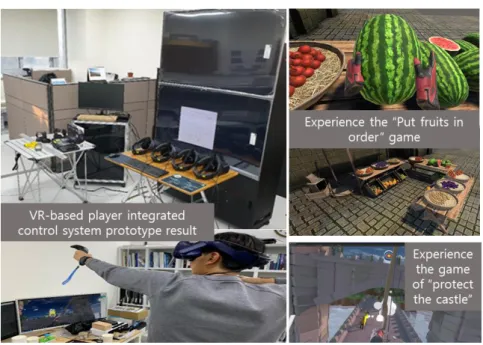
When making a prototype, it is manufactured in consideration of mobility, durability, design, and center of gravity in accordance with the characteristics of the variable case through design supplementation after testing for usability and performance. H/W system for configuring and controlling multiple media images, as shown in Figure 6, compose a VR-based player integrated control system.
Figure 6. Result of development of interactive system for virtual reality contents experiencers
5. CONCLUSION
Currently, the number of patients with dementia disease, and senile disease, is increasing in Korea due to an increase in the elderly population. Dementia patients have symptoms that weaken their physical and mental abilities and their degree of self-reliance in their daily lives, and as a result, families and community groups of patients with dementia suffer serious economic and social suffering from their support.
One of the most effective ways to prevent dementia is by hand movement, a synapse that connects cranial nerve cells is created when the hand moves a lot, and because the existing nerve connection thickens, brain function is improved to prevent dementia. Will be able to help you. The research contents presented in this paper include convenience of use by applying VR interface technology, appropriateness and entertainment of content contents, appropriate hardware and application of virtual reality technology, effectiveness after using contents, and business and expandability of development results. Considered creative games and contents
were developed.
The study of this paper was developed to induce mental and physical activation by consisting of three functions: stimulation of frontal lobe function, improvement of memory and concentration.
By making content available through game interaction in the future, it is possible to provide step-by-step brain activation education, and it can be expected to help prevent dementia.
REFERENCES
[1] Chulhee Lee, Sungin Hong and Seongah Chin, “Dementia-prevention serious game reflecting color context and finger motion for new silver generation,” The Institute of Electronics and Information Engineers, pp. 735-737, November, 2014.
[2] Sang-Won Kim, Young-Wan Kim and Min-Young Kim, Wuk-Ho Son, “Development of Functional Game Contents for Dementia Treatment and Prevention”, KORMARC NO4, June 2004.
[3] Yun-Hee Son, Ji-On Park and Hyun-Sook Hwang, Research on the Effects of the Dementia Prevention Program on the Retired Seniors in the Industrial Age”, JKIECS, Vol. 8, No.10, pp. 1601-1608, 2013.
https://doi.org/10.13067/JKIECS.2013.8.10.1601
[4] Cha-Hyun Kim and Jae-Ok Park, “A Study on the Consumer-required Attributes of Apparel Product for New Elderly Women,” Journal of the Korea Fashion & Costume Design Association, Vol. 15, No. 1, pp. 123~138, 2013.
[5] Sang-Hyun Lee, “Research and development of haptic simulator for Dental education using Virtual reality and User motion,” The International Journal of Advanced Culture Technology (IJACT), Vol. 6, No. 4, pp. 52-57, 2018. https://doi.org/10.17703//IJACT2018.6.4.52
[6] Kyu-Ha Kim and Sang-Hyun Lee, “Research and development of haptic simulator for Dental education using Virtualreality and User motion,” The International Journal of Internet, Broadcasting and
Communication (IJIBC), Vol. 11, No. 4, pp. 43-48, 2019.
https://doi.org/10.17703//IJACT2018.6.4.52
[7] Sang-Hyun Lee, “Development of Structured Light 3D Scanner Based on Image Processing,” The
International Journal of Advanced Smart Convergence (IJASC), Vol. 7, No. 4, pp. 114-120, 2018.