Asian Pacific J Cancer Prev, 12, 725-730
Introduction
Cancer is one of the major cause of death, and primary and secondary prevention have been suggested for preventing and reducing the mortality of cancer (Adami et al, 2001). The Papanicolaou (Pap) test was introduced into cervical cancer screening in the late 1950s (Konno et al, 2008). With the development of mammography, the cancer screening test was disseminated, and randomized clinical trials were introduced (Andersson et al, 1988; Kerlikowske et al, 1995).
Meanwhile, there was a comprehensive effort to develop a council-driven recommendation for the examination of health including cancer, and the Canadian Task Force on the Periodic Health Examination (CTFPHE) was convened in 1976 (Canadian Task Force on the Periodic Health Examination, 1979). A similar effort was initiated in the US in the 1970s (Smith et al, 2000) and the US Preventive Services Task Force (USPSTF) developed comprehensive recommendations that address preventive services (U.S. Preventive Services Task Force, 2002). The recommendation for cancer screening suggested by the USPSTF is predominantly opportunistic screening. Operating an opportunistic or organised cancer screening program is a matter of the philosophy of health care provision or of the medical care system of each country (Miles et al, 2004). For decades, it has been proposed that organised cancer screening programmes can improve accessibility and promote quality and accountability (Hakama et al, 1985; Madlensky et al, 2003; Miles et al, 2004). In fact, there has been a growth of consensus on and activities of organised cancer screening programmes, and several countries in Europe, Asia and Canada have created an action plan in an effort to improve
1Division of Cancer Early Detection, 2Director, National Cancer Control Institute, National Cancer Center, Goyang, Korea *For
correspondence: [email protected]
Abstract
Organised cancer screening in Korea began in 1999. Operating system has been stabilised, target population have expanded and participation rate has been increased throughout its ten years. Here we present an overview of the organised cancer screening system in Korea and introduce the National Cancer Screening Programme including results from 2002 to 2008. Furthermore, we present the results of the Korea National Cancer Screening Survey, a survey that is representative of the population, from 2004 to 2009. Finally, we discuss our achievements and the future challenges.
Keywords: Cancer screening - National Program - survey - Korea
RESEARCH COMMUNICATION
Overview of the National Cancer Screening Programme and
the Cancer Screening Status in Korea
Yeonju Kim
1, Jae Kwan Jun
1, Kui Son Choi
1, Hoo-Yeon Lee
1, Eun-Cheol Park
2*
cancer screening programmes (Advisory Committee on Cancer Prevention, 2000; Anttila et al, 1999; Chen et al, 2002; Hamashima et al, 2008b; Konno et al, 2008; Lee, 2006; Miller, 2000; Smith-Bindman et al, 2003; Yeoh et al, 2006).
Korea introduced mandatory social health insurance for industrial workers in major companies in 1977, and it was expanded to the entire population until 1989. Since 2000, all public health insurance programmes have been merged into one single payer, the National Health Insurance (NHI) programme (Kwon, 2009). The Medical Aid program in Korea, which provides substantial medical services for low-income people, was initiated in 1979 after its promulgation of the Medical Aid Act in 1977. The Medical Aid programme provides beneficiaries with the same benefit package as that of the people insured by the NHI programme. Government supplies budget for Medical Aid programme and NHI Corporation (NHIC) which is responsible for operating the programme on behalf of the government. The NHIC reimburses providers for medical services provided to the Medical Aids (Yoo, 2008). In Korea, approximately 178,000 people are diagnosed with cancer annually and approximately 68,000 persons die from cancer (Jung et al, 2011). Cancer has been the leading cause of death in Korea since 1983 (National Statistical Office.2011). To reduce the burden of cancer in Korea, the Pap smear was first introduced in 1988 in a health examination for industrial workers. In 1999, the National Cancer Screening Programme (NCSP), which supplied Medicaid participants with stomach, breast and cervical cancer screening free-of-charge, was launched (Lee, 2006). The NCSP has been expanding benefit participants and target cancer sites, and now Medicaid recipients and those within the lower 50% of the NHIC
premium receive benefits for five cancer sites: the stomach, liver, colorectum, breast and uterine cervix. Those within the upper 50% of the NHIC premium who are not target population for the National Cancer Screening Programme, can receive cancer screening from the organized system of health screening with a 20% out-of-pocket expense. Structure and History
Mass screening of cancer was introduced in a social insurance programme for a limited number of recipients without financial support from the government. The Pap smear is a free service provided in the regular health check-up of the industrial workers and their supported family members since 1988. From 1990, for government employees and teachers who are willing to pay 50% of the fee for test, cancer screening for the five sites of the stomach, liver, colorectum, breast and cervix was provided as part of a biennial health examination. The government employees, teachers and their dependents were affiliated with a distinct insurance programme by a single insurance society. Given that the cancer screening programme targeted the all-insured people, the consensus is that organised screening was introduced in Korea in 1990. However, these programmes provided benefits to only a small number of persons. The target population should have been expanded, especially to include those with medical aid because lower social economic status is related to higher cancer mortality and morbidity. In 1996, the Korean government initiated a comprehensive ‘10-year Plan for Cancer Control’ through 2005. The aim of that period was to construct an infra-structure to conquer cancer by building the capacity of cancer control and creating programmes for cancer control. One of the four main programmes was secondary cancer prevention activities and research. To build capacity, the Division of Cancer Control was set up within the Ministry for Health, Welfare and Family Affairs Bureau of Health in 2000. Additionally, the research building and hospital of the National Cancer Center, and the National Cancer Control Institute, was founded in 2001.
In 1999, with financial support from the central government and local government by 50% each, the NCSP was launched, and public health centres offered
0 25.0 50.0 75.0 100.0 Newl y di agnosed wi thout tr eatment Newl y di agnosed wi th tr eatment Persi stence or recurr ence Remi ssi on None Chemother ap y Radi other ap y Concurr ent chemor adi ati on 10.3 0 12.8 30.0 25.0 20.3 10.1 6.3 51.7 75.0 51.1 30.0 31.3 54.2 46.8 56.3 27.6 25.0 33.1 30.0 31.3 23.7 38.0 31.3
free cancer screening for the stomach, breast and cervix to medical aid beneficiaries (Table 1). At that time, eligible population of medical aid beneficiaries was contacted by the public health centres. The target population of the NCSP was expanded to include NHI beneficiaries within the lower 20 percent income bracket in 2002, and it has further expanded to include those within the lower 50% of the NHIC premium since 2005. Medical Aids were supported by the government. For the lower 50% of NHI beneficiaries, 80% of the funds for stomach, liver, colorectum and breast screening were raised from the NHI finance, 10% from the central government, and 10% from the local government. For cervix screening, 100% was funded from the NHI finance. Since 2002, the eligible individuals of the NCSP are contacted by the NHIC and invited via a mailed letter. The NCSP is managed and monitored by the National Cancer Centre, in cooperation with the NHIC.
For those within the upper 50% of the NHIC premium, cancer screening for the stomach, liver, colorectum, breast and uterine cervix began in the biennial NHIC medical evaluation in 2001. Out-of-pocket expenses began as 50% of the fee for test, but were reduced to 20% in 2005. From 2010, for the upper 50% of NHI beneficiaries, 90% of the funds for stomach, liver, colorectum and breast screening are supported from the NHI finance and 10% is paid by the screenees. For cervix screening, 100% is funded by the NHI. Cancer screening for those within the upper 50% of the NHIC premium is managed and monitored by the NHIC.
A legal framework for controlling cancer, The Cancer Control Act, was legislated in 2003. The Ministry for Health and Welfare was authorised to formulate and implement cancer control programs by this law. Based on the Cancer Control Act, the Ministry for Health and Welfare was available to conduct organised cancer screening more systematically by cooperating with public institutions.
Guideline development
Although a nationwide population-based cancer screening program was initiated, it began as a supported programme of the medical service, and there were no consent guidelines. Two years after screening, it was recognised that a standardised protocol including concepts of cancer screening, sites of screening, screening methods and duration should be disseminated to local areas to prevent frequent screening, reduce the harm of screening and manage the program’s quality.
To develop guidelines for cancer screening, the National Cancer Screening Programme Support and Evaluation Council was constituted by the National Cancer Centre and the Ministry for Health, Welfare and Family Affairs in 2001 (Lee et al, 2002). The Guideline Developing Committee, under the National Cancer Screening Programme Support and Evaluation Council, consisted of gastroenterologists, gynaecologists, breast cancer surgeons, primary physicians, family medicine specialists, epidemiologists, and public health researchers. Health professionals who were representative of academic societies such as the Korean Gastric Cancer Association, Table 1. Brief History of the National Cancer
Screening Programme in Korea
Year Remarkable features
1996 First term of 10-Year Plan of Cancer Control was launched.
1999 The National Cancer Screening Programme launched for stomach, breast, and cervical cancer free-of-charge. Target population was Medical Aids.
2002 Target population expanded including the lower 20% of National Health Insurance beneficiaries.
2003 Liver cancer was additionally serviced and the target population expanded to the lower 30% of National Health Insurance beneficiaries.
2003 Cancer Control Act, a legal framework for controlling cancer in Korea, was legislated.
2004 Colon cancer screening was additionally serviced. 2005 Target population expanded to the lower 50% of National
Korean Association for the Study of the Liver, Korean Society of Coloproctology, and Korean Breast Cancer Society were included in the panel. A systematic review was conducted by the members of the Guideline Developing Committee for each of five screening sites, and the recommendation driven from the Guideline Developing Committee was evaluated by research groups of the academic societies for each of five cancers. Based on the cost-effectiveness, consideration of the budget, administrative capacity and capability of the professionals, guidelines for opportunistic and organised screening were produced. These guidelines modified the recommendations made by the academic societies and National Cancer Center of Korea.
To screen gastric cancer, a gastro-endoscopy or upper gastrointestinal series every 2 years is recommended to those aged 40 or over (Table 2). Liver cancer is recommended only to people aged 40 or over who are HBs-Antigen or anti-HCV positive or have liver cirrhosis. An ultrasonographic examination and α-feto-protein test is done every 6 months for these high risk groups. Colorectal cancer screening is done for those aged 50 or over, and the primary test is an annual faecal occult blood test. People with positive results from the faecal occult blood test can have a colonoscopy or double-contrast barium enema test, as well as a histological examination if needed. Mammography is recommended to women aged 40 or over. A Pap smear every 2 years is recommended to women aged 30 or over for cervical cancer screening. Here, we introduce the National Cancer Screening Programme in Korea and describe the history of the development of the guidelines and the practical procedures of the programme. We analysed the data from the National Screening Programme from 2002 to 2008, which is the period in which the data were entered into and managed by a computerised system. Moreover, to highlight the cancer screening status in Korea, we also report the cancer screening rate in Korea from 2004 to 2009 using a survey that is representative of the population.
Materials and Methods
National Cancer Screening Programme
All of the target population receives an invitation letter
from the NHIC at the beginning of the year (Table 3). The NHIC is responsible for sending the invitation letter, and the Public Health Centres are responsible for following-up on the participation rate and encouraging the target people. The Public Health Centres encourage the public to receive cancer screening by campaigning and also assure the target people individually by telephone or letter that they were selected and can receive the cancer screening programme.
Clinics, hospitals, and specific screening facilities voluntarily apply to be certified as an institution for the national cancer screening programme. They are permitted if their equipment satisfies the required criteria. Some institutions have mobile vans and visit small towns that do not have clinics certified as a NCSP hospital.
Target subjects voluntarily decide whether to make a reservation for screening. They can visit any clinic or hospital that is certified as a screening unit of the NCSP. They visit hospitals or clinics to receive screening, fill-out an information sheet for cancer screening, and are screened. After screening, their results are sent to them within 15 days. If someone is diagnosed with cancer or if there is a suspicion of cancer, he or she will be contacted by the public health centre for the follow-up process. Two years after the screened year, they will be selected as a target individual and may receive another invitation letter. Screening institutions enter the results into the web-based database of the NHIC and are paid for their screening services by the NHIC. The performance of the NCSP is monitored by the NCC. The NCC back up our NCSP data with the NHIC web database every month, and the results of the previous year are published every year.
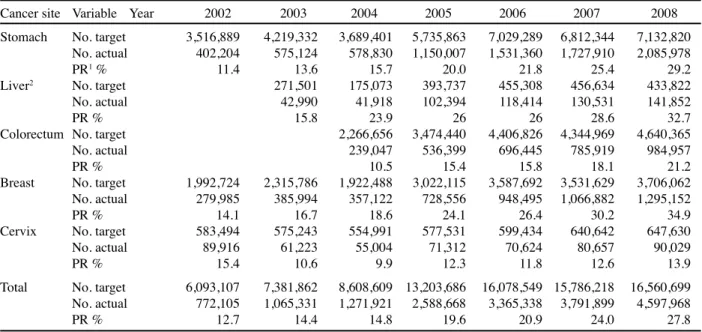
In this study, numbers of the target population, numbers of participants and participation rate by each type of cancer site of the national cancer screening programme in Korea from 2002 to 2008 , are presented. The numerator of the participation rates of the national cancer screening programme is the number of participants each year, and the denominator is the number of individuals within the target population each year. One person can be eligible for more than one site of cancer screening; therefore, we calculated the number of individuals within the target population, number of participants and participation rate for the ‘total’, which is the number of persons who had at least one site screened.
Korea National Cancer Screening Survey
To determine the current state of cancer screening in Korea, including not only organised screening but also individual screening, the Korea National Cancer Screening Survey has been conducted every year since 2004. To select representative people of the entire country, subjects are selected by a multi-stage random sampling method that is stratified by sex, age, and residence area, based on the population calculated from the National Statistical Office every year.
The inclusion criteria for the participants were women aged 30 or more or men aged 40 or more with no previous history of cancer. Participants were questioned about the cancer screening at several sites that are recommended by the NCSP guideline according to their Table 2. National Cancer Screening Programme
Guidelines in Korea
Cancer Target Pop Freq Test or Procedure Stomach ≥40yrs, m&f 2 y Gastric endoscopy or
upper gastro-intestinal
series
Liver ≥40yrs1, m&f 6 m US, serum alpha-feto
protein
Colo- ≥50yrs, m&f Yearly Faecal occult blood test,
rectum if positive then colonoscopy
or double-contrast barium
enema
Breast ≥40yrs, f 2 y Mammography± clinical
breast examination
Cervix ≥30yrs, f 2 y Pap smear
1with HBsAg positive or anti-HCV positive results or liver
age. Questions pertaining to methods, duration, payment system (organised or individual) for screening, and plans for future screening were asked. Data on socioeconomic factors including education level, income and marital status were collected. A history of chronic diseases, subjective health status, and history of familial cancer were reported. Information on health behaviours including smoking status, alcohol intake, vaccination history, physical activity, and regular health-exam history was also gathered. We interviewed more than 2,000 persons every year: 3,592 in 2004, 2,028 in 2005, 2,030 in 2006, 2,021 in 2007, 2,038 in 2008 and 2,000 in 2009. We conducted telephone surveys in 2004 and face-to-face interviews from 2005 to 2009.
We calculated ‘Cancer screening rates with recommendation’ for five types of cancer. This is defined
as the proportion of people that followed the cancer screening guideline in the nearest years (Table 2), such as the proportion of people who have received a gastric endoscopy or upper gastro-intestinal series in the latest two years among males and females aged 40 or more (in line with the recommendation for stomach cancer), proportion of females who have received a mammographic test in the latest two years among those aged 40 or more (in line with the recommendation for breast cancer), and proportion of females aged 30 and above who have received a Pap smear in the latest two years (in line with the recommendation for cervical cancer). For colorectal cancer, the national cancer screening guideline recommends the faecal occult blood test as the first choice, and if this shows positive results, a further exam with colonoscopy or double-contrast barium enema is recommended. From the ‘Cancer screening guideline for five common cancers’, colonoscopy is recommended every 10 years or barium enema is recommended every 5 years. Here we present colorectal cancer screening rates using both definitions. Liver cancer screening is suggested every 6 months for high risk groups, which are those aged 40 or over with HBsAg or anti-HCV positive results or liver cirrhosis.
Results
National Cancer Screening Programme in Korea, 2002-2008
The number of individuals within the target population and participants increased for all screening sites during the 2002 to 2008 period (Table 4). The target population for five sites was more than 6 million in 2002, and increased to more than 16 million in 2008. Participation rate also increased from 12.7% in 2002 to 27.8% in 2008. The participation rate for stomach cancer was 11.4% in 2002, and increased to 29.2% in 2008. For breast cancer, the participation rate was 14.1% in 2002 and 37.9% in 2008; Table 4. Number of Individuals within Target Population and Participation Rate of National Cancer Screening Programme in Korea, 2002-2008
Cancer site Variable Year 2002 2003 2004 2005 2006 2007 2008
Stomach No. target 3,516,889 4,219,332 3,689,401 5,735,863 7,029,289 6,812,344 7,132,820
No. actual 402,204 575,124 578,830 1,150,007 1,531,360 1,727,910 2,085,978
PR1% 11.4 13.6 15.7 20.0 21.8 25.4 29.2
Liver2 No. target 271,501 175,073 393,737 455,308 456,634 433,822
No. actual 42,990 41,918 102,394 118,414 130,531 141,852
PR % 15.8 23.9 26 26 28.6 32.7
Colorectum No. target 2,266,656 3,474,440 4,406,826 4,344,969 4,640,365
No. actual 239,047 536,399 696,445 785,919 984,957
PR % 10.5 15.4 15.8 18.1 21.2
Breast No. target 1,992,724 2,315,786 1,922,488 3,022,115 3,587,692 3,531,629 3,706,062
No. actual 279,985 385,994 357,122 728,556 948,495 1,066,882 1,295,152
PR % 14.1 16.7 18.6 24.1 26.4 30.2 34.9
Cervix No. target 583,494 575,243 554,991 577,531 599,434 640,642 647,630
No. actual 89,916 61,223 55,004 71,312 70,624 80,657 90,029
PR % 15.4 10.6 9.9 12.3 11.8 12.6 13.9
Total No. target 6,093,107 7,381,862 8,608,609 13,203,686 16,078,549 15,786,218 16,560,699
No. actual 772,105 1,065,331 1,271,921 2,588,668 3,365,338 3,791,899 4,597,968
PR % 12.7 14.4 14.8 19.6 20.9 24.0 27.8
1Participation rates are defined as number of participants divided by number within target population; 2Number of individuals
within target population includes participants of high risk group (Age 40 & over with HBsAg positive or anti-HCV positive results or liver cirrhosis) and people who are not aware of their antibody status among the Social Aids
Table 3. Process of the National Cancer Screening Programme in Korea in a Year
Steps
1. Target population selected by the National Health Insurance Cooperation and the National Cancer Centre at the beginning of the year
2. Invitation letters sent to selected people from the National Health Insurance Cooperation; Public health centres monitoring the procedure and receiving inquiries or questions from public
3. Subjects visit hospitals or clinics to receive cancer screening throughout the year
4. Test results sent to screened people within 15 days, and results entered into the Web Database of the National Health Insurance Cooperation within 30 days after the test by the hospitals or clinics
5. Hospitals or clinics send bills to the National Health Insurance Cooperation to claim the fee for test
6. Non-recipients encouraged to participate by public health centres in the third and fourth quarter of the year 7. The programme monitored by the National Cancer
therefore, the percent point increase between 2002 and 2008 was 20.8%, which was the highest among the five sites. Liver cancer screening for high risk groups began in 2003. The participation rate for this screening was 15.8% in 2002, but grew to 32.7% in 2008. Colorectal cancer screening, which began in 2004 showed the lowest participation rate in its first year (10.5%); however, it increased to 21.2% in 2008. The cervical cancer screening rate in NCSP includes only the medical aid people, and the target population and participation numbers are much lower than breast screening. Cervical cancer screening shows the lowest rates, which were 12.7% in 2002 and 27.8% in 2008.
Korea National Cancer Screening Survey, 2004-2009 The age-adjusted cancer screening rate with recommendations was 38.8% in 2004 and 53.3% in 2009, as calculated from the Korea National Cancer Screening Survey (Table 5). The cancer screening rate of stomach cancer was 56.9%, of the breast was 55.2%, and of the cervix was 63.9% in 2009. Liver cancer screening rate among high risk groups (those aged more than 40 years with HBsAg positive or anti-HCV positive results or liver cirrhosis) was 31.3% in 2009. Colorectal cancer screening rate with any test including colonoscopy, barium enema and faecal occult blood test was 36.7%. The stomach, liver, breast and cervical cancer screening rates increased over five years; however, colorectal cancer screening did not show this trend.
Discussion
An overview of the organised cancer screening programme in Korea and description of the National Cancer Screening Programme are presented in this study, including the volume outcome from 2002 to 2008. Moreover, to highlights the cancer screening status in Korea, we described the results of the Korea National Cancer Screening Survey from 2004 to 2009.
Organised cancer screening began as a government-driven policy as a public welfare to medical aids. In
the beginning, the system was not well structured and no standardised recommendations or guidelines were suggested. It was stably set up and expanded stably by the legal legislation, by a financial support from the national health insurance system and by the activities of working groups of professionals that were driven by the National Cancer Screening Program Support and Evaluation Council. To plant a successful evidence-based cancer control policy, it is essential to conduct a systematic review. Japan had a cancer screening guideline since 2001, which was suggested by a non-systematic and non-standardized reviewed research (Hamashima et al, 2008a). Recently they re-established a standardized guideline development process on cancer screening, and based on this method, colorectal, gastric and lung cancer screening in Japan was revised (Hamashima et al, 2008a). The administration system or health insurance system determines introduction and success of organised cancer screening. Korean has resident registration number which is an identical social number, and every administrative, medical and social services in Korea are performed based on this ID number. Every steps of performance of NCSP is managed by resident registration number; invitation letter is sent by extracting contact information from ID number, information of register in clinic, results of screening are managed by ID number through the NHIC database. National insurance system also contributed to the rapid stabilization and high efficiency of the NCSP.
After ten years of managing the organised cancer screening programme, we had several achievements. First, the programme covers the entire population with few personal expenses, and the number of people who receive cancer screening has increased. Participation rate of the organised cancer screening increased as well as cancer screening rate with recommendation including private screening has been increased. From the Korea National Cancer Screening Survey 2004-2009, proportion of people who used organised cancer screening not private screening increased from 45.7% in 2004 to 65.1% in 2009. In the NCSP, participation rate of low income people has been improved, but, cancer screening rate in high income people has also been increased. Although the total volume of screened people are increased, consistent effort on recruiting low income people to cancer screening is warranted to reduce the health inequality in cancer survival and mortality due to social economic status. Second, along with the advances of medical techniques and increased amount of advertisement of secondary prevention of cancer, concerns about early detection of cancer have increased. The increase in participation rate of the NCSP and increase in cancer screening rates with recommendations from the survey provides evidence. However, compared to participation rate of National Health Service Cancer Screening Program in United Kingdom, which is 73.8% in breast screening and 80.3% in cervix screening in 2008, we need much improvement.
The organised cancer screening program in Korea has many challenges. First, this programme was not initiated based on evidences revealed from our own country, but was based on the research or suggestions from other countries, mainly European countries and Table 5. Results of the Korea National Cancer
Screening Survey, 2004-2009
Cancer type Cancer screening rates (%) 2004 2005 2006 2007 2008 2009 Stomach 39.2 39.4 43.3 45.6 53.5 56.9 Liver1 20.0 16.3 16.5 22.7 19.7 31.3 Colorectum2 16.8 18.2 19.2 20.1 24.3 25.1 FOBT3 3.8 7.2 13.6 23.3 20.9 19.0 Any test4 19.9 25.4 29.4 34.1 37.9 36.7 Breast5 33.2 38.4 40.6 45.8 49.3 55.2 Cervix 58.3 57.0 54.9 57.0 59.9 63.9 Average6 38.8 40.3 42.3 45.6 50.7 53.3
1High risk group, Age 40 & over with HBsAg positive or
anti-HCV positive results or liver cirrhosis; 2Colonoscopy every 10
years or barium enema every 5 years, which is followed by Cancer screening guidelines for five common cancers; 3Faecal
occult blood test every year, which is followed by the National Cancer screening guidelines; 4Any test including colonoscopy,
barium enema or faecal occult blood test; 5Mammography; 6age-adjusted
References
Adami HO, Day NE, Trichopoulos D, et al (2001). Primary and secondary prevention in the reduction of cancer morbidity and mortality. Eur J Cancer, 37, 118-27.
Advisory Committee on Cancer Prevention (2000). Recommendations on cancer screening in the European Union. Eur J Cancer, 36, 1473-8.
Andersson I, Aspegren K, Janzon L, et al (1988). Mammographic
screening and mortality from breast cancer: the Malmo mammographic screening trial. BMJ, 297(6654): 943-8 Anttila A, Pukkala E, Soderman B, et al (1999 Effect of organised
screening on cervical cancer incidence and mortality in Finland, 1963-1995: Recent increase in cervical cancer incidence. Int J Cancer, 83, 59-65
Canadian Task Force on the Periodic Health Examination (1979). The periodic health examination. Can Med Assoc
J, 121, 1193-254.
Chen CJ, You SL, Lin LH, et al (2002). Cancer epidemiology and control in Taiwan: a brief review. Jpn J Clin Oncol, 32 Suppl, S66-81
Hakama M, Chamberlain J, Day NE, et al. (1985). Evaluation of screening programmes for gynaecological cancer. Br J
Cancer, 52, 669-73.
Hamashima C, Saito H, Nakayama T, et al (2008a). The Standardized Development Method of the Japanese Guidelines for Cancer Screening. Jpn J Clin Oncol, 38, 288-95
Hamashima C, Shibuya D, Yamazaki H, et al (2008b). The Japanese Guidelines for Gastric Cancer Screening. Jpn J
Clin Oncol, 38, 259-267
Kerlikowske K, Grady D, Rubin SM, et al (1995). Efficacy of Screening Mammography: A Meta-analysis. JAMA, 273, 149-54.
Konno R, Shin HR, Kim YT, et al (2008). Human papillomavirus infection and cervical cancer prevention in Japan and Korea.
Vaccine, 26 Supplement 12, M30-M42.
Jung K, Park S, HJ K, Won Y, Lee J, Park E, Lee J. Cancer statistics in Korea: Incidence, mortality, survival, and prevalence in 2008. Cancer Res Treat,43, 1-11.
Kwon S (2009). Thirty years of national health insurance in South Korea: lessons for achieving universal health care coverage. Health Policy Plan, 24, 63-71.
Lee WC (2006). Breast, stomach and colorectal cancer screening in Korea. J Med Screen, 13, 20-2.
Lee WC, Shin HR, Kim CM (2002). Establishing cancer screening recommendations for major cancers in Korea. J
Korean Med Assoc, 45, 959-63
Madlensky L, Goel V, Polzer J, et al (2003). Assessing the evidence for organised cancer screening programmes. Eur
J Cancer, 39, 1648-53.
Miles A, Cockburn J, Smith RA, et al (2004). A perspective from countries using organized screening programs. Cancer, 101 (5 Suppl), 1201-13
Miller AB (2000). Organized breast cancer screening programs in Canada. CMAJ, 163, 1150-1.
Ministry of Health and Welfare Republic of Korea (2008) Yearbook of health and welfare statistics. Seoul: Ministry of Health and Welfare Republic of Korea.
National Statistical Office. Annual Report of Causes of Death 2009. Daejeon: Statistics Korea, 2011. Available at http:// kostat.go.kr Smith-Bindman R, Chu PW, Miglioretti DL, et al (2003) ,Comparison of screening mammography in the United States and the United Kingdom. JAMA, 290, 2129-37.
Smith RA, Mettlin CJ, Davis KJ, et al (2000). American Cancer Society guidelines for the early detection of cancer. CA
Cancer J Clin, 50, 34-49.
U.S. Preventive Services Task Force (ed) (2002) Guide to Clinical Preventive Services. McLean, Virginia: International Medical Publishing.
Yeoh KG, Chew L, Wang SC (2006). Cancer screening in Singapore, with particular reference to breast, cervical and colorectal cancer screening. J Med Screen, 13, 14-9. Yoo KY (2008). Cancer Control Activities in the Republic of
Korea. Jpn J Clin Oncol, 38, 327-33.
northern America. We must produce evidences of cancer screening, even in the absence of a randomised clinical trial. With these efforts, we may review the frequency of screening and ages at which screening should begin and end. We just started to evaluate the effectiveness of the screening programme through measurement indicators such as cancer detection rates, interval cancer rates and comparison of five-year survival rates or mortality rates before and after the screening program began. These parameters should be calculated using the Korea Central Cancer Registry data as a gold standard of diagnosis of cancer.
Second, evaluating and improving the quality of screening is also needed. In this regard, Committee for Quality Assurance for each types of cancer screened have published a quality guideline for five types of cancer screening in 2008, which was revised in 2009. Additionally, increasing emphasis on quality assessment in screening should be followed. The structure and several performance indicators of the general hospitals and hospitals participating in the organised cancer screening programme have been evaluated since 2008. The third challenge is to modify the pitfalls in the management of the people with abnormal findings. We must reinforce the check-up system of referral for the people for whom there is a suspicion of cancer. The fourth challenge is to increase the screening rate. We need an individualised strategy to satisfy the detailed needs of each person. The fifth challenge is to assess the cost-effectiveness and to produce an evidence to improve our policy efficiently.
In summary, the National Cancer Screening Programme in Korea has been performed for 10 years (beginning in 1999), and the participation rate has increased. The cancer screening rates for five sites have also increased in Korea. Equality of access may have been increased, and cost of screening as a barrier may have been reduced. Infrastructure, resourced, public awareness is considered to be progressed. However, we face big challenges related to quality, adequacy of call-recall system, high risk group management and still low participation rate. We have great potential ability to reduce cancer incidence and mortality by this organised cancer screening system, which may balance in benefit and harm. In the near future, results of performance measurement and outcome measurement will be reported. Also, we expect to produce a combined result of the organised cancer screening programme including both NHIC data and NCSP data in Korea.
Acknowledgements
This study was supported by a grant from the National Cancer Centre Korea (Grant No. 1010200).