INTRODUCTION
Perineal trauma can occur spontaneously or as a result of ob-stetric interventions, such as an episiotomy or operative vagi-nal delivery.1,2 The reported incidence of perineal trauma dur-ing vaginal delivery is approximately 85%, but can vary in different settings, depending on clinical practice and condi-tions during vaginal delivery.2 Anal sphincter injuries, which are the most severe perineal trauma events, have gradually in-creased in number over the last several decades, with incidence rates ranging from 4.1% to 16.0% in several population-based studies.3,4 Perineal trauma during vaginal delivery has been
Randomized, Double-Blind, Placebo-Controlled
Trial on the Efficacy of Hyaluronidase in Preventing
Perineal Trauma in Nulliparous Women
Hayan Kwon
1,2, Hyun Soo Park
1, Jae-Yoon Shim
3, Kyo Won Lee
4, Suk-Joo Choi
5, and Gyu Yeon Choi
61Department of Obstetrics and Gynecology, Dongguk University Ilsan Hospital, Dongguk University College of Medicine, Goyang; 2Institute of Women’s Life Medical Science, Yonsei University College of Medicine, Seoul;
3Department of Obstetrics and Gynecology, Asan Medical Center, University of Ulsan College of Medicine, Seoul;
4Department of Obstetrics and Gynecology, Kangbuk Samsung Hospital, School of Medicine, Sungkyunkwan University, Seoul; 5Department of Obstetrics and Gynecology, Samsung Medical Center, School of Medicine, Sungkyunkwan University, Seoul; 6Department of Obstetrics and Gynecology, Soonchunhyang University Seoul Hospital, Seoul, Korea.
Purpose: Hyaluronidase (HAase) has many uses in medicine, and reports suggest that it affects perineal tissue during fetal passage through the vaginal canal. However, its potential use for preventing perineal trauma has yet to be determined. This study sought to evaluate the efficacy and safety of perineal HAase injections in reducing perineal trauma during vaginal delivery.
Materials and Methods: A multi-center, double-blind, placebo-controlled, randomized study was conducted from January 2016 to
March 2017. Nulliparous women who planned to undergo vaginal delivery were recruited, and the enrolled women were random-ly assigned to the HAase injection group (HAase injection, 5000 IU, n=75) or the control group (normal saline injection, n=73). The degree of perineal laceration, rate of episiotomy, and grade of perineal edema at 1 hour and 24 hours after spontaneous vaginal de-livery were compared between the two groups.
Results: A total of 148 women who underwent vaginal delivery were recruited. No significant differences were observed between
the HAase injection and control groups in the rates of perineal laceration (p=0.422). Perineal edema significantly decreased 24 hours after delivery in the women treated with perineal HAase injections, compared to women in the control group (p=0.008). The overall incidences of adverse events, such as redness of the injection site, infection, and wound dehiscence, were similar between the two groups.
Conclusion: HAase injections in nulliparous women afforded no reductions in the rates of perineal lacerations and episiotomy.
However, the use of perineal HAase injections did reduce perineal edema without severe adverse events.
Key Words: Vaginal delivery, nulliparity, perineal trauma, hyaluronidase, randomized controlled trial
pISSN: 0513-5796 · eISSN: 1976-2437
Received: July 23, 2019 Revised: November 13, 2019 Accepted: November 19, 2019
Corresponding author: Gyu Yeon Choi, MD, PhD, Department of Obstetrics and
Gynecology, Soonchunhyang University Seoul Hospital, 59 Daesagwan-ro, Yongsan-gu, Seoul 04401, Korea.
Tel: 82-2-709-9324, Fax: 82-2-709-9932, E-mail: [email protected]
The data in this study were presented at the 7th Japan-Korean-Taiwan Symposium on Maternal-Fetal Medicine, which was held in Takamatsu, Japan on August 25, 2017. •The authors have no potential conflicts of interest to disclose.
© Copyright: Yonsei University College of Medicine 2020
This is an Open Access article distributed under the terms of the Creative Com-mons Attribution Non-Commercial License (https://creativecomCom-mons.org/licenses/ by-nc/4.0) which permits unrestricted non-commercial use, distribution, and repro-duction in any medium, provided the original work is properly cited.
Yonsei Med J 2020 Jan;61(1):79-84 https://doi.org/10.3349/ymj.2020.61.1.79
shown to be associated with significant maternal morbidities, including blood loss, perineal pain, infection, dyspareunia, uri-nary incontinence, flatus, and fecal incontinence, and to lead to the development of comorbidities, including sexual dys-function, pelvic organ prolapse, and rectovaginal and vesico-vaginal fistulas.3,5,6 Thus, the prevention of perineal trauma is important because its associated morbidities have a profound effect on both the physical and psychological well-being of the mother, which may result in social isolation and the marginal-ization of those with ongoing morbidity.7
Hyaluronidase (HAase) is an enzymatic complex that depo-lymerizes and hydrolyzes hyaluronic acid, which reduces the viscosity of hyaluronic acid and improves both tissue diffusion and the resorption rate of excess fluids.8,9 HAase is involved in several physiological and pathological reactions and, there-fore, has been utilized in various fields of medicine, such as fertilization,10 wound healing,11 ophthalmic surgery,12 and local anesthesia.13 During the 1950s and 1960s, HAase was used to prevent perineal trauma and to reduce the need for an episiot-omy.14-22 Some studies have suggested a beneficial effect for perineal HAase injections during spontaneous vaginal deliv-ery: HAase injections reduced the frequency of episiotomy and severe perineal lacerations (third- or fourth-degree peri-neal lacerations) and increased the frequency of an intact perineum following delivery.21,22 However, no difference in the incidences of episiotomy and severe perineal lacerations has been reported in randomized trials.22,23 Although HAase is com-monly used in clinical practice, its potential use as a method to prevent perineal trauma is controversial. Therefore, we aimed to evaluate whether perineal HAase injections during vaginal deliveries reduce perineal trauma in nulliparous women.
MATERIALS AND METHODS
Study design and participantsThis multi-center, double-blind, placebo-controlled, random-ized study included women undergoing vaginal delivery from January 2016 to March 2017 at five university-based clinical centers in Korea. Inclusion criteria were a maternal age between 19 and 40 years, gestational age between 37 weeks, 0 days and 41 weeks, 6 days, nulliparous women with no previous record of vaginal birth, vertex presentation, and singleton pregnancy. Exclusion criteria were multifetal gestations, non-vertex pre-sentation, fetal congenital anomaly, estimated birth weight ≥4000 g, abnormal placental implantation, hypersensitivity to HAase, and women in whom vaginal delivery was not feasible. Eligible women were randomly assigned to one of two groups (HAase injection and control group) using a permuted block randomization method previously generated by a statistician. To calculate the sample size, we presumed that the frequency of perineal injuries greater than or equal to first-degree lacera-tions in women without HAase treatment was 75.7%.15 If the
same number of women were enrolled in the study and con-trol groups, 73 women were needed in each group to detect a 31% risk reduction in perineal injury, with a type I error rate of 5% and a power of 80%.24 Therefore, considering a drop-out rate of 20%, we enrolled 184 women.
Procedures and perineal management
The HAase injection group was injected with 3 mL of 5000 IU HAase (Hirax®, BMI Korea, Seoul, Korea) mixed with 3 mL of 1% lidocaine hydrochloride solution, and the control group was treated with a combination of 3 mL of normal saline and 3 mL of 1% lidocaine hydrochloride solution. They received in-jections with their treatment solutions in the perineal subcuta-neous tissue at the center and in the left and right of the perine-um within 1 hour before fetal expulsion through the vagina. An episiotomy was performed upon each clinician’s judgment with indications including a rigid perineum or fetal distress. Study outcomes
Data were collected during labor and at 1 hour and 24 hours after delivery. All deliveries and postpartum evaluations were conducted by one of the authors according to the research protocol and described procedures.
The primary outcomes were perineal lacerations (greater than or equal to a first-degree laceration). Secondary outcomes were perineal edema and episiotomy. Perineal laceration was classified according to the classification originally described by Sultan and Fernando25: 1) a first-degree laceration is that of either the vaginal epithelium or perineal skin only; 2) a second-degree laceration involves the perineal muscles, but not the anal sphincter; 3) a third-degree laceration exhibits disruption of the anal sphincter muscles; and 4) a fourth-degree lacera-tion is a third-degree tear with disruplacera-tion of the anal epitheli-um. Severe perineal lacerations were defined as third- and fourth-degree lacerations. If an episiotomy was performed and no evidence of a third- or fourth-degree lacerations was ob-served, the event was categorized as a first- or a second-degree laceration. Perineal edema was identified by the application of pressure to the swollen skin of the perineum with a finger and categorized into five grades: 1) Grade 0 showed no change in pre-delivery contour; 2) Grade 1 had mild pitting and slight in-dentation with a depth within 2 mm; 3) Grade 2 had moderate pitting edema, and the indentation subsided rapidly (10–15 seconds) with a depth of 4 mm; 4) Grade 3 had deep pitting, and the indentation remained for a short time (about 1 minute) with a depth of 6 mm and appeared swollen; and 5) Grade 4 had deep pitting, the indentation subsided over 2–5 minutes with a depth of about 8 mm, and the perineum was very swol-len.26 Perineal edema was evaluated at 1 hour and 24 hours after delivery. Information on side effects, such as fever, infec-tion, and pain, were evaluated in both groups to determine the safety of HAase.
Statistical analysis
Analyses were performed according to the intention-to-treat principle. We compared continuous variables using the two-sample t-test or Wilcoxon rank-sum test and categorical vari-ables using the χ2 test or Fisher’s exact test. All statistical analy-ses were performed using SAS version 9.4 (SAS Institute, Inc., Cary, NC, USA). p values <0.05 were considered statistically significant.
Ethical approval
Ethical approval was obtained from the institutional review boards of Dongguk University Ilsan Hospital (reference 2015-132), Asan Medical Center (reference 2016-0087), Kangbuk Samsung Hospital (reference KBSMC 2015-12-017), Samsung Medical Center (reference SMC 2015-11-039), and Soonchun-hyang University Seoul Hospital (reference SCHUH 2015-10-014). Written informed consent was obtained from all partici-pants. This study was retrospectively registered at the Clinical Research Information Service (CRIS, http://cris.nih.go.kr) in Korea on May 9, 2018 (KCT0002855, URL: https://cris.nih. go.kr/cris/en/search/search_result_st01.jsp?seq=11421).
RESULTS
A total of 215 eligible women were screened, and 148 women were enrolled and underwent randomization. 75 women were assigned to the HAase injection group, and 73 women were as-signed to the control group (Fig. 1). One woman in the control group was not evaluated after delivery, because she delivered by emergency cesarean section after perineal injection.
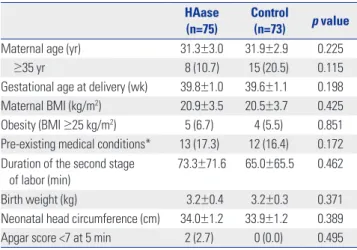
A total of 84 women (56.8%) underwent an episiotomy, and 13 women (8.8%) had an intact perineum. First-, second-, third-, and fourth-degree lacerations were observed in 34 women (23.0%), 88 women (59.5%), 11 women (7.4%), and one wom-an (0.7%), respectively. Maternal variables wom-and newborn out-comes, including maternal age, gestational age at delivery, maternal body mass index (BMI), birth weight, and head cir-cumference of newborns, were similar in the HAase injection and control groups (Table 1).
We compared perineal lacerations between the HAase in-jection group and the control group (Table 2). No significant differences were found in the degree of perineal laceration be-tween the groups. Intact perineum was observed in 10.7% of the women in the HAase injection group and 6.8% of the wom-en in the control group. However, the differwom-ence therein betwewom-en the two groups was not statistically significant (p=0.422).There
Enrollment Allocation Analysis Follow-up 1–2 hr after delivery 24 hr after delivery Assessed for eligibility (n=215)
Allocated to HAase injection (n=75) Received HAase injection (n=75)
Allocated to placebo (n=73) Received placebo injection (n=73) Excluded (n=67)
• Not meeting inclusion criteria (n=49) • Declined to participate (n=14) • Positive skin test to HAase (n=1) • Delivery in other hospitals (n=3)
Lost to follow-up (n=0)
Analysed (n=75) Analysed (n=73)
Lost to follow-up (n=0) Randomized (n=148)
were also no significant differences in the incidence of severe perineal lacerations between the two groups (p=0.498). Even when analysis was conducted among women without episiot-omy, there were no statistically significant differences in the de-grees of perineal laceration between the two groups (p=0.574). We compared perineal edema at 1 hour and 24 hours after vaginal delivery between the HAase injection and control groups (Table 3). The women who received HAase injections showed significantly improved perineal edema at 24 hours. compared to women in the control group who received a pla-cebo (p=0.008).
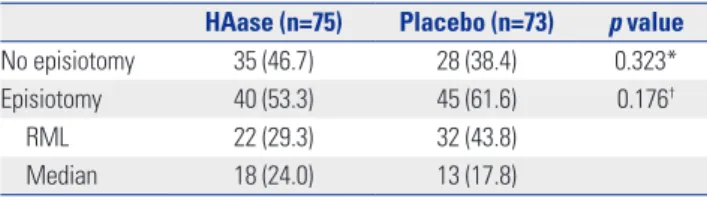
We compared the rates and types of episiotomy between the HAase injection and the control groups (Table 4). Episiotomy was more frequently performed in the control group than in the HAase injection group (61.6% vs. 53.3%, p=0.323, respec-tively); however, the difference was not statistically significant.
There was also no significant difference in the types of episiot-omy between the two groups (p=0.176).
Neither group reported serious adverse events. However, mild adverse events were reported in two women in the HAase injection group: One woman complained of fever after delivery, but recovered before discharge from the hospital. We confirmed that the fever was not related to HAase. The other woman com-plained of perineal pain at the injection site, but recovered be-fore discharge from the hospital. Other mild adverse events, in-cluding changes in blood pressure, pulse rate, white blood cell count, and platelet count, were observed, although the differ-ences between the two groups were not significant.
Table 1. Characteristics of Mothers, Newborns, and Deliveries
HAase (n=75)
Control
(n=73) p value
Maternal age (yr) 31.3±3.0 31.9±2.9 0.225 ≥35 yr 8 (10.7) 15 (20.5) 0.115 Gestational age at delivery (wk) 39.8±1.0 39.6±1.1 0.198 Maternal BMI (kg/m2) 20.9±3.5 20.5±3.7 0.425
Obesity (BMI ≥25 kg/m2) 5 (6.7) 4 (5.5) 0.851
Pre-existing medical conditions* 13 (17.3) 12 (16.4) 0.172 Duration of the second stage
of labor (min) 73.3±71.6 65.0±65.5 0.462 Birth weight (kg) 3.2±0.4 3.2±0.3 0.371 Neonatal head circumference (cm) 34.0±1.2 33.9±1.2 0.389 Apgar score <7 at 5 min 2 (2.7) 0 (0.0) 0.495 HAase, hyaluronidase; BMI, body mass index.
Data are presented as a mean±standard deviation or n (%) unless otherwise indicated.
*Pre-existing medical conditions include underlying diseases, such as mater-nal hypertension, diabetes, and hypothyroidism, or diseases during pregnan-cy, such as hepatitis, nephritis, and pneumonia.
Table 2. Comparison of Perineal Lacerations between the Group Treat-ed with Hyaluronidase Injections and the Control Group
HAase (n=75) Control(n=73) p value Total 75 73 Intact perineum 8 (10.7) 5 (6.8) 0.422† 1st-degree laceration 14 (18.7) 20 (27.4) 2nd-degree laceration 48 (64.0) 40 (54.8) 3rd-degree laceration 5 (6.7) 6 (8.2) 4th-degree laceration 0 (0.0) 1 (1.4)
Severe perineal laceration* 5 (6.7) 7 (9.6) 0.498‡
No episiotomy 35 27 Intact perineum 2 (5.7) 0 (0.0) 0.574† 1st-degree laceration 8 (22.9) 6 (22.2) 2nd-degree laceration 22 (62.9) 18 (66.7) 3rd-degree laceration 3 (8.6) 2 (7.4) 4th-degree laceration 0 (0.0) 1 (3.7)
Severe perineal laceration* 3 (8.6) 3 (11.1) 0.737‡
HAase, hyaluronidase.
Data are presented as n (%) unless otherwise indicated. The control group had data missing from one woman due to an emergency cesarean delivery. *Severe laceration was defined as a 3rd-/4th-degree laceration; †Greater than
or equal to first-degree; ‡Severe perineal lacerations were compared using χ2
test and Fisher’s exact test.
Table 3. Comparison of Degrees of Perineal Edema between the Group Treated with Hyaluronidase Injections and the Control Group
HAase (n=75) Control (n=73) p value PP 1 h PP 24 h PP 1 h PP 24 h Grade 0.787*/0.063† Grade 0 5 (6.7) 13 (17.3) 9 (12.3) 8 (11.0) Grade 1 40 (53.3) 53 (70.7) 32 (43.8) 45 (61.6) Grade 2 26 (34.7) 6 (8.0) 27 (37.0) 17 (23.3) Grade 3 3 (4.0) 3 (4.0) 3 (4.1) 2 (2.7) Grade 4 1 (1.3) 0 (0.0) 1 (1.4) 0 (0.0)
Interval change during 24 h 0.008
No change 44 (58.7) 53 (72.6)
Get better 31 (41.3) 16 (21.9)
Get worse 0 (0.0) 3 (4.1)
HAase, hyaluronidase; PP 1 h, postpartum 1 hour; PP 24 h, postpartum 24 hours.
Data are presented as n (%) unless otherwise indicated. The control group had data missing from one woman due to an emergency cesarean delivery.
DISCUSSION
Perineal trauma after vaginal delivery, especially third- and fourth-degree lacerations, can result in substantial morbidities that negatively affect a mother’s quality of life. HAase was used during childbirth in the 1950s and 1960s to prevent perineal trauma, but was gradually replaced with episiotomy. However, many reports have demonstrated that an episiotomy is a risk factor for perineal trauma.27 Therefore, the utilization of HAase injections into the perineum during labor to prevent perineal trauma and to decrease the frequency of episiotomies is im-portant and is the focus of our study. In our study, there were no significant differences in the frequencies of perineal lacer-ations and episiotomy, although perineal edema was signifi-cantly improved in the HAase injection group, compared to the control group.
There are several possible reasons for the observed lack of difference in the incidences of severe perineal lacerations and episiotomy between HAase and control groups despite a low-er rate of sevlow-ere plow-erineal laclow-erations and episiotomy in the HAase injection group. Several studies have reported a reduc-tion of perineal trauma using HAase injecreduc-tions; however, most of these studies are case series, and the number of stud-ies was small.15,23,28 Randomized controlled trials have found no statistically significant differences in severe perineal out-comes between women who received perineal HAase injec-tions and those who received placebo injecinjec-tions15,24,28; howev-er, the women who received perineal HAase injections during the second stage of labor had a lower incidence of perineal laceration.15,28 Notwithstanding, the techniques used, the tim-ing of the injections, and the doses of HAase administered var-ied in each study, which makes it difficult to compare results among the studies. The HAase injections in our study did not prevent severe perineal trauma, which may have been the re-sult of an inadequate drug effect duration or drug dosage. We used 5000 IU of HAase within 1 hour within fetal expulsion through the vagina. However, it may not have allowed enough time for HAase to soften and relax the perineal tissue and in-crease tissue elasticity. In addition, the low incidence in severe perineal lacerations between the HAase injection and control groups may explain the lack of difference. It is also possible that
HAase has no effect on perineal tissue elasticity or that local infiltration may make the perineum thicker and may interfere with perineal elasticity.
HAase injections in our study were found to be effective in the reduction and recovery of perineal edema during the first 24 hours after delivery. Perineal edema is associated with per-ineal pain and postpartum discomfort after vaginal delivery. Rapid recovery from perineal edema allows for the resumption of maternal activities of daily living, such as lying down, sitting, walking, infant care, breastfeeding, and urination.4,29 Our study showed that a high percentage of women in the HAase injec-tion group had improved perineal edema at 24 hours, which suggests that HAase injections improve tissue diffusion and the resorption rate of excess fluid.
In our study, episiotomy was performed slightly less in the HAase injection group than in the control group, although the difference was not statistically significant. Among women with episiotomies, right mediolateral episiotomy was performed more frequently in both groups. Since episiotomy is known to be a risk factor for severe perineal laceration, many research-ers have recommended selective episiotomy during vaginal delivery. The type of episiotomy can affect the incidence of se-vere perineal lacerations. As for perineal edema, although there are few studies about the relationship between the types of episiotomy and perineal edema and HAase injections, the performance of episiotomy or types of episiotomy could affect the degree of perineal edema and recovery. In this study, we performed selective episiotomy, which was performed when it was indicated for reducing the confounding effect of routine episiotomy to perineal trauma. Further study is needed to identify the association between HAase injections and episiot-omy (performance and type) and perineal laceration or edema after delivery. No HAase injection-related severe complica-tions in the mothers and newborns were observed, which sug-gests that HAase injections during labor are safe.
The strength of our study is its double-blind, placebo-con-trolled, randomized design. As a limitation, our study was a multi-center study, which can introduce measurement bias. Further research with a larger sample cohort is recommended to elucidate the appropriate dose of HAase and the optimal in-jection time to prevent perineal lacerations during vaginal de-livery.
In conclusion, although there were no significant differenc-es in the frequencidifferenc-es of severe perineal lacerations, perineal HAase injections during delivery in nulliparous women sig-nificantly reduced perineal edema, compared to the placebo group, and are safe for both the mother and fetus.
ACKNOWLEDGEMENTS
Hyaluronidase injection and this study was supported by BMI Korea, Seoul, Republic of Korea (Hirax®, 5000 IU).
Table 4. Comparison of Rates and Types of Episiotomy between the Group Treated with Hyaluronidase Injections and the Control Group
HAase (n=75) Placebo (n=73) p value
No episiotomy 35 (46.7) 28 (38.4) 0.323* Episiotomy 40 (53.3) 45 (61.6) 0.176†
RML 22 (29.3) 32 (43.8) Median 18 (24.0) 13 (17.8) HAase, hyaluronidase; RML, right mediolateral. Data are presented as n (%) unless otherwise indicated.
*The incidences of episiotomy and no episiotomy; †The types of episiotomies
AUTHOR CONTRIBUTIONS
Conceptualization: Hyun Soo Park, Jae-Yoon Shim, Kyo Won Lee, Suk-Joo Choi, and Gyu Yeon Choi. Data curation: All authors. Formal analysis: Hayan Kwon, Hyun Soo Park, and Gyu Yeon Choi. Funding acquisition: Gyu Yeon Choi. Investigation: All authors. Methodology:
All authors. Project administration: All authors. Resources: Gyu Yeon Choi. Supervision: Hyun Soo Park, Jae-Yoon Shim, Kyo Won Lee, Suk-Joo Choi, and Gyu Yeon Choi. Validation: Hyun Soo Park, Jae-Yoon Shim, Suk-Joo Choi, and Gyu Yeon Choi. Visualization: Hayan Kwon.
Writing—original draft: Hayan Kwon. Writing—review & editing: All authors.
ORCID iDs
Hayan Kwon https://orcid.org/0000-0002-5195-7270 Hyun Soo Park https://orcid.org/0000-0002-7873-3234 Jae-Yoon Shim https://orcid.org/0000-0003-1881-8436 Kyo Won Lee https://orcid.org/0000-0001-9920-5433 Suk-Joo Choi https://orcid.org/0000-0002-8946-4789 Gyu Yeon Choi https://orcid.org/0000-0001-8636-4849
REFERENCES
1. Baumann P, Hammoud AO, McNeeley SG, DeRose E, Kudish B, Hendrix S. Factors associated with anal sphincter laceration in 40,923 primiparous women. Int Urogynecol J Pelvic Floor Dysfunct 2007;18:985-90.
2. Fernando RJ, Sultan AH, Kettle C, Thakar R. Methods of repair for obstetric anal sphincter injury. Cochrane Database Syst Rev 2013; (12):CD002866.
3. Frohlich J, Kettle C. Perineal care. BMJ Clinl Evid 2015;2015. pii: 1401. 4. Marschalek ML, Worda C, Kuessel L, Koelbl H, Oberaigner W, Leit-ner H, et al. Risk and protective factors for obstetric anal sphincter injuries: a retrospective nationwide study. Birth 2018;45:409-15. 5. Pauls RN, Silva WA, Rooney CM, Siddighi S, Kleeman SD, Dryfhout
V, et al. Sexual function following anal sphincteroplasty for fecal in-continence. Am J Obstet Gynecol 2007;197:618.
6. Bagade P, Mackenzie S. Outcomes from medium term follow-up of patients with third and fourth degree perineal tears. J Obstet Gynaecol 2010;30:609-12.
7. Priddis H, Schmied V, Dahlen H. Women’s experiences following severe perineal trauma: a qualitative study. BMC Womens Health 2014;14:32.
8. Menzel EJ, Farr C. Hyaluronidase and its substrate hyaluronan: biochemistry, biological activities and therapeutic uses. Cancer Lett 1998;131:3-11.
9. Lv SH, Rong SF, Cai BG, Guan SM, Li QQ. Property and current clinical applications of mammal hyaluronidase. Eur Rev Med Phar-macol Sci 2015;19:3968-76.
10. Brown CR. Distribution of hyaluronidase in the ram
spermatozo-on. J Reprod Fertil 1975;45:537-9.
11. Yuda Y, Kasashima Y, Kuwano A, Sato K, Hattori S, Arai K. Active hyaluronidase 2 expression in the granulation tissue formed in the healing process of equine superficial digital flexor tendonitis. J Vet Med Sci 2013;75:219-23.
12. Narayanan R, Kuppermann BD. Hyaluronidase for pharmacologic vitreolysis. Dev Ophthalmol 2009;44:20-5.
13. Wohlrab J, Finke R, Franke WG, Wohlrab A. Clinical trial for safety evaluation of hyaluronidase as diffusion enhancing adjuvant for infiltration analgesia of skin with lidocaine. Dermatol Surg 2012;38: 91-6.
14. Scarabotto LB, Riesco ML. Use of hyaluronidase to prevent perineal trauma during spontaneous delivery: a pilot study. J Midwifery Wo-mens Health 2008;53:353-61.
15. Zhou F, Wang XD, Li J, Huang GQ, Gao BX. Hyaluronidase for re-ducing perineal trauma. Cochrane Database Syst Rev 2014;(2): CD010441.
16. Digonnet L, Cahn J, Roy J, Boucet J. [Effect of local injection of hyal-uronidase on perineal distention in labor in primiparas]. Therapie 1952;7:388-91.
17. Frenzel KH. Protection of the perineum with hyaluronidase. Zentral-bl Gynakol 1954;76:1602-4.
18. Mink E. [Experience with the softening effect of hyalurodase on high and rigid perineum in primiparas]. Geburtshilfe Frauenheilkd 1955;15:246-58.
19. Rimbach E, Griefahn S. Critical evaluation of perineum protection with hyaluronidase. Zentralbl Gynakol 1955;77:546-8.
20. Patrini G. [Usefulness of hyaluronidase in labor as protector of the perineum]. Riv Ostet Ginecol Prat 1956;38:710-4.
21. Petronio G. [Protective action of hyaluronidase on vaginoperineal lesions from spontaneous and surgical labor]. Minerva Med 1956; 47:2071-3.
22. Chatfield WR, Moir DD. The effect of hyaluronidase on the perine-um. A controlled trial of 200 primigravid patients in labour. J Ob-stet Gynaecol Br Commonw 1966;73:670-1.
23. Colacioppo PM, Gonzalez Riesco ML, Koiffman MD. Use of hyal-uronidase to prevent perineal trauma during spontaneous births: a randomized, placebo-controlled, double-blind, clinical trial. J Midwifery Womens Health 2011;56:436-45.
24. Hulley SB, Cummings SR, Browner WS, Grady DG, Newman TB. Designing clinical research. 3rd ed. Philadelphia (PA): Lippincott Williams & Wilkins; 2007.
25. Sultan AH, Fernando R. Maternal obstetric injury. Curr Obstet Gyn-aecol 2001;11:279-84.
26. Hogan MA, Madayag T. Medical-surgical nursing: reviews and ra-tionales. 2nd ed. Salt Lake City (UT): Prentice Hall; 2007. 27. Kwon HY, Park HS. Episiotomy and the risk of severe perineal
in-juries among Korean women. J Matern Fetal Neonatal Med 2017; 30:1745-9.
28. O’Leary JA, Erez S. Hyaluronidase as an adjuvant to episiotomy. Obstet Gynecol 1965;26:66-9.
29. Senol DK, Aslan E. The effects of cold application to the perineum on pain relief after vaginal birth. Asian Nurs Res 2017;11:276-82.