Fig. 1. in-situ UV-Vis spectrophotometry measurement system for molten chloride sample(cooling channel is hidden in the left hand schematic for simplicity)
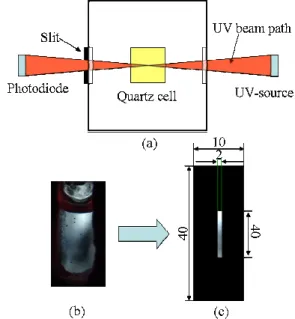
Fig. 2. Configuration of in-situ UV-cell(a) and before(b) and after(c) slit installation
Development of in-situ UV-vis technique for the molten salt electrorefining process of
uranium
J.H. Lee, S.C. Hwang, Y.H. Kang, J.B. Shim, B.G. Ahn, S.W. Kwon, M.S. Woo, B.J. Lee, E.H. KIM, and S.W. Park Korea Atomic Energy Research Institute, P.O. Box 105, Yuseong, Daejeon, 305-600, Korea.
E-mail:[email protected]
1. Introduction
During the last decade, interest in the pyrometallrugical treatment of spent nuclear fuel has been drastically increased because of its relatively low processing cost as well as its proliferation resistance of the nuclear fuel cycles[1,2]. Similar but unique researches have been conducted by several institutions in various countries using their own strategies, i.e. IFR fuel cycle in ANL, DOVITA process in RIAR and ,OMEGA program in JAERI [3]. The Korea Atomic Energy Research Institute (KAERI) is developing an electrorefining process using PWR surrogate spent fuels. In this fuel cycle, uranium and TRU oxides are electrochemically reduced while the rare earth oxides are intact. Thus, the prepared ingot consists of metallic uranium, TRU and rare earth oxides. The main scientific and technological interests in the electrorefining process using the electrochemically reduced fuel ingot are how to effectively partition a spent fuel into Uranium, TRU and fission products (FPs). Furthermore a systematic consideration for a series of pyrochemical treatments of the spent fuel which includes not only an electrorefining but also a cathode process has not been reported. Hence in this study, we would like to report on the methodology to recycle PWR fuel for a future use and some important results in the electrorefining of the uranium and the cathode process of the deposit. Also, in-situ UV-vis absorption spectrometry was adopted to observe the behavior of Nd2O3 in molten salt encouraged by the
recent results of Yamana et. al.[4~6].
2. Experimental
The electrorefining apparatus was installed in a glove box filled with high-purity Ar gas. The solid cathode with a rugged groove can be rotated during an electrodeposition to achieve a better recovery and the molten salt itself is also agitated by means of a crucial anode. The material of the anode and cathode was STS 304L and the reference electrode was iron. High purity LiCl-KCl eutectic(41.5-58.2 mol%, Tm:355 oC) and rare
earth salts of a 99.9% purity were purchased from Sigma-Aldrich. The chloride of the trivalent uranium was extracted as molten LiCl-KCl by an oxidation reaction between the depleted uranium metal in the anode basket and CdCl2. All the chemicals were
handled in a glove box in which both the oxygen and moisture contents in the argon atmosphere were
maintained at lower than 10 ppm. The SUS 304 cell with a proper insulation device was located in a stainless steel thermowell which was heated externally with an electric furnace attached to the floor of a glove
box, and the temperatures were controlled at 500 oC. Electrodeposition tests were performed by the use of an Ecohemie Autolab 30 potentiostat controlled by a computer system. In the case of the partitioning experiment, LiCl-KCl eutectic salt containing uranium and three REs(Gd, Dy and Ce) or Nd2O3 with a 10 wt%
ratio to the uranium were used on the assumption that the REs were fully reduced to a metallic form or not, respectively, during the electroreduction step. Three REs which have similar electrochemical characteristics
Transactions of the Korean Nuclear Society Autumn Meeting Busan, Korea, October 27-28, 2005
560 570 580 590 600 610 620 630 0 1 2 0.2% Nd2O3 LiCl-KCl eutectic 500 o C air blank Ab so rb a nce Wavelength (nm) 0.06% NdCl3 0.04% NdCl3
with TRU were formulated as the spent fuel surrogate, since there are difficulties in a handling of the TRU in Korea. In the case of Nd2O3, it was added to the anode
basket as a sintered pellet to observe the dissolution behavior during an electrorefining. The concentration of the uranium and REs in the molten salt and the deposits were determined by ICP-AES. Also, in-situ UV-vis absorption spectrometry was used to directly observe the behavior of Nd2O3 in the molten salt at a
high temperature as shown in Fig. 1. Unlike Yamana’s optical fiber system, we introduced a specially designed electrolysis cell into the UV-vis sample compartment. The overexposure originated from the heating element was removed by the installation of a slit in front of photodiode as shown in Fig. 2. The morphologies of the micro deposits were analyzed by a Scanning Electron Microscope (Philips XL30) after removing the attached salt from them.
3. Results and discussion
In order to estimate the rare earth oxide contamination for the deposit, the concentrations of Nd2O3 put into the anode basket were measured
according to the current density. Significant dissolution of Nd2O3 to an electrolyte was observed, while the
concentration in the U deposit was negligible as shown in Fig. 3. From the result of the irregularity of the Nd content with the current density, Nd2O3 might not be
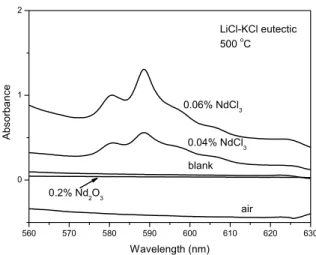
deposited electrochemically into the cathode deposit but physically incorporated into the uranium dendrite during a crystal growth. It was reported that dissolved NdCl3 shows intensive hypersensitive absorption peaks
at 580 and 589 nm of a wave length. In this research, absorption peaks were also observed at the same places as shown in Fig. 4. In contrast to the NdCl3, there is no
evidence of a dissolution of Nd2O3 from the UV-vis
absorption spectra. Hence, RE oxide powders should be removed prior to electrorefining step in order to
minimize a contamination to the U deposit through the
molten salt.
4. Conclusions
Nd(III) in molten LiCl-KCl was successfully detected by the in-situ UV-vis system with the help of a slit. The solubility of Nd2O3 was found to be negligible.
It was found that the partitioning behavior of the elemental REs(Gd, Nd and Ce) are similar to each other according to the applied voltage or current and the REs can be successfully portioned, provided the initial UCl3
concentration is more than ~6 wt%.
REFERENCES
[1] Burris, L., Steunenberg, R. K., Miller, W. E.: The application of electrorefining for recovery and purification of fuel discharged from the Integral Fast Reactor. In:AICHE Symposium Series, Electrochemical Engineering Series 83, 135 (1987).
[2] Chow, L. S., Basco, J. K., Ackerman, J. P., Johnson, T. R.: Continuous extraction of molten chloride salt with liquid cadmium alloys. In:Global '93 1993, p. 1080. [3] Members of Pyrochemistry Working Group :
Pyrochemical Separations in Nuclear Applications, Nuclear Energy Agency, Organization for Economic Co-operation and Development, Paris 2004.
[4] Fujii, T., H. Moriyama, H. Yamana, Electronic absorption spectra of lanthanides in a molten chloride, I. Molar absorptivity measurement of neodymium(III) in molten eutectic mixture of LiCl-KCl, J. Alloys Compd, 351, L6 (2003).
[5] Fujii, T., T. Nagai, N. Sato, O. Shirai, H. Yamana, Electronic absorption spectra of lanthanides in a molten chloride, II. Absorption characteristics of neodymium(III) in various molten chlorides, J. Alloys Compd, 393, L1 (2005).
[6] Nagai, T., T. Fukii, O. Shirai, H. Yamana, Study on Redox Equilibrium of UO22+/UO2+ in Molten NaCl-2CsCl
by UV-Vis Spectrophotometry, J. Nucl. Sci. Technol, 41, 690 (2004).
Fig. 4. Absorption Spectra of NdCl3 and Nd2O3 at 500 oC in LiCl-KCl eutectic molten salt according to its
concentration.
Current density, mA/cm2
0 100 200 300 400 500 N d c on tent, p pm 0 20 40 60 80 100 1000 1200 1400 1600 in salt in U deposit
Fig. 3. Variation of Nd content in salt and uranium deposit according to current density at 500 oC and