Development of OPR1000 RCP Coast Down Flow Calculation Methodology with RETRAN
Dong Hyuk Lee, Hye Jeong Yoon, Yo Han Kim, Chang Kyung Sung
Korea Electric Power Research Institute, 103-16, Munji-Dong, Yuseong-Gu, Daejeon, KOREA, 305-380 [email protected]
1. Introduction
KEPRI (Korea Electric Power Research Institute) has been developing safety analysis methodology for non-LOCA (Loss Of Coolant Accident) analysis of OPR1000 (Optimized Power Reactor 1000, formerly KSNP). The new methodology, named KNAP (Korea Non-LOCA Analysis Package), uses RETRAN as the main system analysis code. The new methodology will replace existing CE (Combustion Engineering) supplied codes and methodologies currently used in non-LOCA analysis of OPR1000.
One of the CE codes that is used in non-LOCA analysis is the COAST code. This code is used to calculate RCP (Reactor Coolant Pump) coast down flow for “loss of flow” transients. In this study, RETRAN code is used to calculate RCP coast down flow and the results are compared with those of COAST code. Simplified RETRAN input, corresponding to COAST code model was developed. The reference plant for this calculation was Ulchin Units 3/4. The results from two different codes show good agreement. From this study, we can conclude that RETRAN based RCP coast down flow calculation is reasonable and can be an alternative option to use of COAST.
2. Methods and Results
In this section, the models used in COAST code and RETRAN coast down calculation is compared, and calculation results are also compared.
2.1 Description of COAST Code
The COAST code is developed by ABB-CE(now merged to Westinghouse Electric Corporation) and used to calculate RCP coast down flow for “loss of flow” transients. Detailed description of COAST code can be found in Ref. [1].
The code models RCS (reactor coolant system) of CE-type plants: it models 2 Hotlegs, 4 Coldlegs and RCPs. The COAST code has detailed model for the RCP, but other components of the RCS are represented with simple models. The RCS is modeled using 7 volumes. The COAST code uses loop friction and RCP performance data to calculate reactor coolant flow for each loop.
The coast code is used to evaluate time of reactor trip for “loss of flow” transients such as FSAR 15.3.1 “Complete Loss of Flow” and FSAR 15.3.2 “Locked Rotor” events. COAST is used to calculates short term
RCP coast down flow rates(usually less than 10 sec). It was not intended to calculate long term reactor coolant flow rates such as natural circulation flow after of RCP trip.
2.2 Description of RETRAN Code
The RETRAN code is a best-estimate system analysis code for non-LOCA analysis of PWRs and BWRs. It was developed under the funding of EPRI (Electric Power Research Institute).
Unlike COAST, which is a fixed node code, RETRAN is a flexible node code with volumes and junctions defined by user input. RETRAN also has detailed pump model using homologous pump characteristic data.
RETRAN is the main system analysis code for KNAP non-LOCA methodology developed by KEPRI.
The version of RETRAN used in this analysis is RETRAN-3D MOD3.1.
2.3 Simplified RETRAN input for RCP coast down flow Since COAST code is very simple in terms of system modeling, RETRAN input for full system is not needed. Instead, simplified RETRAN input comparable to those used in the COAST code is developed to calculate RCP coast down flow. The reference plant for the calculation is Ulchin Units 3/4.
Vol 2 Vol 1
Vol 3 Vol 4
Vol 6 Vol 5 Vol 7
Vol 8 Vol 13 Vol 14 Vol 15 Vol 16 Vol 10 Vol 9 Vol 12 Vol 11 Vol 17 Vol 18 Vol 19 Vol 20
Figure 1. RETRAN nodalization for RCP coast down flow
The simplified input uses 20 volumes and 24 junctions to model the RCS and steam generator secondary side. 4 RCPs were modeled using RETRAN pump model. Pump performance was simulated with pump homologous curve data. To reduce the effect of RCS heat up during “loss of flow” transients, the core power was set to a small value, much smaller than heat addition from the RCP. At full power, the RCS heat up occurs due to imbalance of heat generation rate in the core and the heat removal rate in the steam generators. Since reduced primary coolant flow rate leads to reduced heat transfer in the steam generator primary
Transactions of the Korean Nuclear Society Autumn Meeting Busan, Korea, October 27-28, 2005
side, heat removal through steam generator is reduced. The core power is assumed to be constant regardless of transient, resulting in overall RCS heat up and surge flow from and to the pressurizer occurs, resulting in different RCS flow rates than expected. Although core power is assumed to be near zero, the primary coolant temperature was assumed to be at full power Tavg value.
2.4 Results for Locked Rotor
The RCS loop flow rates were calculated for the locked rotor event. The initial RCS flow is assumed to be 95% of nominal flow. For the initiating event, the rotor of RCP in loop 1A is assumed to lock up. The resulting loop flows from RETRAN and COAST calculations are compared in Figure 2. For the locked loop, RETRAN results show slightly faster flow reduction. The stabilized reverse flow, which occurs in about t = 1 second, is almost the same for COAST and RETRAN. The flow rates in other loops show similar flow rates for RETRAN and COAST.
0 1 2 3 4 -0.8 -0.6 -0.4 -0.2 0.0 0.2 0.4 0.6 0.8 1.0 1.2 1.4 1.6 RETRAN Loop 1A Loop 1B Loop 2A Loop 2B COAST Loop 1A Loop 1B Loop 2A Loop 2B Loop F low [ N orm a liz ed ] Time [s]
Figure 2. Normalized loop flow for locked rotor event.
2.5 Results for 4 Pump Coast Down
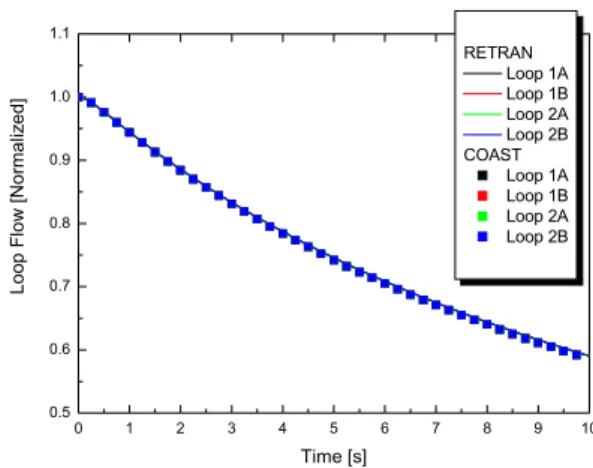
The RCS loop flow rates were calculated for 4 pump coast down. The initial RCS flow rate is assumed to be 95% of nominal flow. For the initiating event, all 4 RCPs were tripped. The resulting loop flows from RETRAN and COAST calculations are compared in Figure 3. Since all of the RCPs are tripped, this is a symmetric event and all loops show same flow rates. The RCP inertia for RETRAN was slightly adjusted to get same the results with COAST. The results from two codes show almost the same results.
Since the coast down flow rates are almost the same, the time of reactor trip predicted by COAST code and RETRAN code is almost the same.
0 1 2 3 4 5 6 7 8 9 10 0.5 0.6 0.7 0.8 0.9 1.0 1.1 RETRAN Loop 1A Loop 1B Loop 2A Loop 2B COAST Loop 1A Loop 1B Loop 2A Loop 2B Loo p F low [N ormali zed] Time [s]
Figure 3. Normalized loop flow for 4 pump cost down.
3. Conclusion
The OPR1000 RCP coast down flow calculation methodology using RETRAN has been developed. To demonstrate applicability of new methodology, the RCP coast down flow rates for Ulchin Units 3/4 were calculated using RETRAN-3D. The results were compared with those of COAST code. The results from two codes show good agreement. From the results above, we can conclude that RETRAN based RCP coast down flow calculation is reasonable and can be an alternative option to use of COAST.
REFERENCES
[1] CENPD-98-A, COAST Code Description, Combustion Engineering, 1973
[2] M.P. Paulsen et al, “RETRAN-3D – a Program for Transient Thermal-Hydraulic Analysis of Complex Fluid Flow Systems,” EPRI, July 2001
[3] RETRAN Basedeck, “Generation of the RETRAN-3D Basedeck for Ulchin Units 3&4,” FNC-CN-02-D013 Rev. 05, FNC Technology Co.
[4] FSAR, “Final Safety Analysis Report, Ulchin Units 3&4,” Vol.15, KEPCO, KOREA, 1998