Effects of Complex Probiotics on Productivity Index,
Fatty Acid Composition and Immune
Response in Broilers
1)Siddiqui, Sharif Hasan*․Hwang, Chae Yeon**․ Choe, Ho-Sung***․Shim, Kwan-Seob****
복합 생균제가 육계의 생산성, 육질,
지방산 조성 및 면역 반응에 미치는 영향
시딕 샤리프 하산․황채연․최호성․심관섭
This study was conducted to investigate the efficacy of mixed probiotic on the immunity, productivity index and mortality rate in the broiler. Total of 120 one-day-old Ross broilers chicks were randomly assigned into two treatments (control dietary group and probiotic-treated group) with three replications of each treatment. The probiotic group broiler had a lower mortality rate than control during the experimental period. The productivity index in the probiotic group increased significantly than the control group. The weight of the bursa of fabricius was high in the probiotic-treated group than the control group. Activated the immunity level after fed the probiotic mixed diet compared to the control group. Furthermore, the probiotic diet significantly decreased the saturated fatty the control group. Whereas the probiotic mixed diet increased the unsaturated fatty acid than the control group. Afterward, the diet including probiotic induced positive impact on broilers immunity level. This indicates that a probiotic mixed diet could be protecting the intestine from the invasion of a pathogenic organism. It would be beneficial to the poultry industries by decrease the broiler mortality rate with elevated the immunity.
Key words : broiler, intestine, probiotic, mortality, immunity
****전북대학교 축산학과 박사과정
****전북대학교 축산학과 석사과정
****전북대학교 동물생명공학과 교수
Ⅰ. Introduction
The excessive use of dietary anti-biotics in broilers to enhance their growth performances as well as inhibit intestinal infections have become a rising concern for bacterial resistance (Dibner et al., 2005). Therefore, it has been an increasing interest among researchers to find alternatives to antibiotics in the poultry industry. Up to date, there are many dietary alternatives, including probiotics, prebiotics, and bacteriophage have been identified to replace these anti-biotics (Patterson et al., 2003; Sims et al., 2004; Huff et al., 2005; Borsoi et al., 2011). Among these, probiotics have been used most extensively for poultry production due to their potential ability to decrease intestinal disease in poultry as well as poultry product contamination (Upadhaya et al., 2016).
Probiotics are the mono or mixed cultures of beneficial micro-organisms which helps to keep up the well-being of digestive health as well as boost the immune system. However, some probiotics exerts an adverse effect on the animal. However, modern researches have been identi-fied specific strains (Lactobacillus, Bifidobacterium, Saccharomyces, Enterococcus, Streptococcus, Pediococcus, Leuconostoc, Bacillus, Escherichia coli) probiotics which show a positive effect on the animal (Fijan, 2014). Bacteria, including Bacillus subtilis and Lactobacillus plantarum are considered as effective probiotic because of producing antimicrobial substances, modulating immune response as well as the metabolic activity of animal (Kossin et al., 2006). Particularly, Bacillus subtilis has been well known to show numerous beneficial health effects, including regulating the intestinal microbiota, favoring a condition for the growth of lactic acid bacteria, increasing feed efficiency, improving nutrients digestibility and broiler performance (Knarreborg et al., 2008). On the other hand, Lactobacillus plantarum is a kind of lactic acid bacterium which reduces disease severity by triggering the immune system (de Vries et al., 2006). It has been reported that Lactobacillus plantarum stimulated the M cells in Peyer’s patches which ultimately increased the intestinal immunity by the synthesis of T cells (Perdigon et al., 1999). Furthermore, Saccharomyces cerevisiae (Yeast) also has been used widely as a probiotic in the poultry industry. Studies have revealed that Saccharomyces cerevisiae showed probiotic effects on broiler by regulating the metabolic activities of digestion and utilizing the nutritional com-ponents (Abbott et al., 2009). It produces lactic acid in the digestive tract which increases the acidity as well as reduces the pH, thereby inhibiting the growth of pathogens and regulating enzymatic activity in the intestine of chicken. Recent studies showed that mixed probiotics are more effective than the use of individual probiotic (Chapman et al., 2011). Considering the beneficial effects of using mixed probiotics, the aim of our study was to evaluate the effect of
mixed probiotics (Bacillus subtilis, Lactobacillus plantarum and Saccharomyces cerevisiae) on the broiler.
To our knowledge, there no study about the mixed probiotic (HAPPY ZYME®) supplementa-tion for reducing the mortality by enhancing the immunity level in broiler in the poultry industry. Therefore, we investigated the effect of the mixed probiotic on the mortality rate, fatty acid composition, immune response and inflammatory response of broiler chicken.
Ⅱ. Materials and Methods
1. Probiotic Products
In our present experiment was used commercial probiotic (HAPPY ZYME®), which was manufacture by Seed Bio Co., Ltd., Republic of Korea. This probiotic contained Lactobacillus plantarum (2.0 × 10¹⁰ cfu/g), Bacillus subtillis (3.0 × 10⁹ cfu/g) and Saccharomyces cerevisiae (7.0 × 10⁹ cfu/g).
2. Broiler and Experimental Design
Birds rearing and handling system for this study was in accordance in the Institutional Animal Care and Use Committee, Chonbuk National University, (No.2012-1-0014) in succession with the Korean National Law on Animal Care and Use.
A total 1-d-old of 120 Ross broilers chicks were collected from a local hatchery. Initial body weight was around 45 g and 43 g per chicks. All birds were reared in a commercial control farm and were provided 24 h lighting. The farm temperature was controlled at 34±10C for the first 3 d and then gradually decreased 240C until the final day of the experiment. The experimental broiler was allocated into 2 groups (control group and probiotic group) in 1 d of age. Each group had 3 replications and 20 birds allotted in each replication. The broiler had open access for ad libitum feed and water during the experimental period. The control group was only commercial basal diet which contains well nutrition (Table 1) and the probiotic treatment group was a basal diet with 0.5% probiotic. The dietary period was divided by three different phases (starter, grower and finisher). In this study, we little have modified the Ross 308 catalog, starter phase was from d 1 to d 21, grower phase was 22 to 28 d and 29 to 35 d were finisher phase (Anonymous, 2007).
Table 1. Chemical composition of commercial broiler feed
Feed nutrition
Ingredients Starter Grower Finisher Metabolic energy (Mcal/kg) 3.03 3.08 3.2
Crude protein (%) 21 19 18.5 Crude fat (%) 4 4.5 5 Crude fiber (%) 3 3 3 Crude ash (%) 6.5 6 6 Calcium (%) 0.6 0.6 0.4 Salt (%) 0.8 0.75 0.7 Methionine +Cystine (%) 1 0.95 0.9
3. Sample Collection
After the experimental period, the body weights of the birds were measured. The sample birds (10 birds per replication, n = 30 per group) randomly selected after weighing. Than dislocation the neck and collect the breast muscle, intestine (ileum) and different organs (heart, liver, kidney, abdominal fat and bursa of fabricius). Ileum put immediately in liquid nitrogen and the store at -80℃ for a long time. The muscle and internal organs immediately weight and keep at -80℃ for further study.
4. Growth Performance
The body weight of experimental birds and feed was measured at 1 d old and frequently every week of age until the final day of the experiment. At the final day of the experiment calculated the total body weight gain and the total feed intake. Calculated the feed efficiency from the body weight gain and the feed intake (feed efficiency = body weight / feed intake). Internal organ heart, liver, kidney, abdominal fat and bursa of fabricius were collected and weighed and calculated as a percentage of live body weight.
5. Mortality
birds transfer from the crowd and reared separately otherwise mortality may increase (Awobajo et al., 2007). After treatment count all dead birds and calculated the mortality rate.
Mortality (%) = Total number of dead birds × 100 Total number live birds in case
This study follows the previous method for calculation of productivity index (PI) (Martins et al., 2016). It was calculated from broiler growth performance and mortality rate.
PI (%) = Body weight (kg) × total body weight - mortality age (days) × feed conversion
6. Meat Quality Analysis
The pH values were measured at 24 h postmortem of the broiler chicken breast muscle by a portable pH meter (pK21 pH meter, NWK - Binar GmbH, landsberg, Germany).
Meat color was measured by Minolta chromameter (CR-300, Minolta camera Co., Osaka, Japan) and followed by Commission International de 1´ Eclairage (CIE). According to the CIE system, measured the three dimensional color L*, a*, b* values, whereas L* is expressed lightness and its ranges 0 to 100 (from black to white), a* is expressed redness (green if negative to white red if positive) and b* expressed yellowness (blue if negative to yellow if positive) its ranges from -120 to +120 (Girolami et al., 2013).
Shear force was measured by the method which was described in recent research (Chen et al., 2007). The muscle samples were thawed at environmental temperature for 24 h. After wrapping with boilable bags and cook until internal temperature 70℃. After reaching the desired tem-perature, samples were taken out and cooled at room temperature. From the core of the muscle, 1.27 cm diameter myofiber collect and used Digital Meat Tenderness Meter of Model C-LM3 (Northeast Agricultural University, Harbin, China) for Shear force measure. During the experi-ment test speed was 5 mm/s. The value of the shear force represents by Newtons as the unit. Determine the water holding capacity (WHC) according to previous method (Grau and Hamm, 1953). Weigh 300 mg of homogenized chicken breast muscle. Place a rectangle of Whatman paper 2 (100 × 100 mm) on a glass board and face the paper with the meat sample on the plastic foil. Cover the foil with another glass board and weigh exactly 5 minutes with a 1 kg weight. Then take the set apart and measure the area of the stains being pressed. Cover the foil
with another glass board and weight down with a 1kg weight for exactly 5 minutes. Then take the set apart and measure the areas of pressed stains. Measure the areas with a planimeter, i.e. measure the smaller stain, corresponding to pressed meat and the bigger stain, corresponding to the pressed water (meat exudate). Cooking loss was measured by previous method (Honikel, 1998). Firstly, a certain amount of sample weighted and put in a plastic bag, which was heated by a water bath at 80℃. When the internal temperature was reached at 75℃ meat sample was make cooled and weighted. Cooking loss calculated by difference sample weight between before and after boiled weight and is expressed as the percentage cooking loss.
The breast muscles were used to determinate moisture, fat, and protein. Determined the moisture by air drying followed to the Association of Official Analytical Chemists (AOAC 1984; procedure 24.003) and Soxhlet extraction used ether (AOAC 1984; procedure 13.032) for fat measurement. Total protein measured by the used Kjeldahl procedure (AOAC 1984; procedure 2.057) and the level of ash was determined according to AOAC (1984; procedure 14.066).
7. Measurement of Fatty Acid
The fatty acid composition was measured by gas chromatography (GC). Freeze- dried meat sample weighted 0.5 g in glass tubes add 2 mL of boron - trifluoride and 2 mL of methanol. The glass tube was capped with Teflon-lined caps to prevent evaporation and sample were put on a heat block at 80℃ for 2 h and vortex every 5 min interval from after 10 min. Finally, after 2 h mix well the sample using vortex, and allowed to normal temperature at room tempera-ture and immediately add 3 mL distilled water and 3 mL of hexane. The glass caped again tube and vortexed for 15 s for mixing well. Centrifugation (2000 rpm, 5 min) and transferred the supernatant into GC vials for analysis. The Shimadzu GC - 2014 instrument (Shimadzu co., MD, USA) used a FAMEWAX column (30 m × 0.32 mm i. d., 0.25 µm; column temperature, 250℃) and nitrogen or air as a carrier gas at 53.8 mL/min (split ratio 30:1) for GC with 1 µl samples. The temperature started from 150℃ and increased 250℃.
8. RNA Extraction and qRT-PCR
Extracted the RNA from the intestine (ileum) by using TRIzol Reagent (Invitrogen, NY, USA), following the manufacturer instructions. Nanodrop (Thermo Fisher Scientific) was used for the total RNA quantifies at 230 nm and 260 nm / 280 nm absorbance used for RNA quality. iScriptTM cDNA synthesis kit used and follow the manufacturer instruction (BIO-RAD, Hercules,
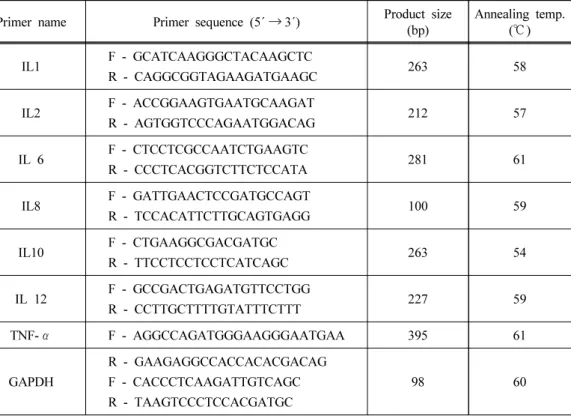
CA, USA) for make cDNA from total RNA and followed the thermal cycling temperature was 25℃ for 10 min, 37℃ for 120 min and 85℃ for 5 min. Real-time PCR was performed by using the SYBER® Green Real-time PCR Master Mix (TOYOBO). Amplified the cDNA for each gene was carried out by manufacturers instruction (TOYOBO). The primers for different interleukins and Tumor necrosis factor alpha (TNF-α), their sequence with annealing tempera-ture are listed (Table 2). The thermal cycling temperatempera-ture and duration were 95℃ for 30 s, 95℃ for 5 s and 59℃ for 5 s finally followed by 40 cycles. To determine the relative fold-changes and all data were normalized with the housekeeping gene GAPDH by the used 2∆∆CT method. The result of the qPCR was calculated by ∆Ct value (Ct gene of interest - Ct house-keeping gene). The conversion between ∆∆CT relative gene expression level are Fold induction = 2−∆∆Ct. Here, where 2−∆∆Ct is the relative gene expression which followed the preceding method (Livak and Schmittagen, 2001).
Table 2. Polymerase chain reaction primers for real time quantitative polymerase chain reaction
Primer name Primer sequence (5´→ 3´) Product size (bp) Annealing temp. (℃) IL1 F - GCATCAAGGGCTACAAGCTC R - CAGGCGGTAGAAGATGAAGC 263 58 IL2 F - ACCGGAAGTGAATGCAAGAT R - AGTGGTCCCAGAATGGACAG 212 57 IL 6 F - CTCCTCGCCAATCTGAAGTC R - CCCTCACGGTCTTCTCCATA 281 61 IL8 F - GATTGAACTCCGATGCCAGT R - TCCACATTCTTGCAGTGAGG 100 59 IL10 F - CTGAAGGCGACGATGC R - TTCCTCCTCCTCATCAGC 263 54 IL 12 F - GCCGACTGAGATGTTCCTGG R - CCTTGCTTTTGTATTTCTTT 227 59 TNF-α F - AGGCCAGATGGGAAGGGAATGAA 395 61 GAPDH R - GAAGAGGCCACCACACGACAG F - CACCCTCAAGATTGTCAGC R - TAAGTCCCTCCACGATGC 98 60 IL, Interleukin.
TNF-α, Tumor Necrosis Factor Alpha. bp, Base pair of DNA.
9. Statistical Analysis
Student T-test was employed in evaluation of treatment effect. SAS software version 9.3 (SAS Institute Inc., Cary, NC, USA) was used.
Ⅲ. Results
1. Mortality Rate and Productivity Index
The effect of probiotic mixed diet on mortality rate and productivity index of broiler is illustrated in Table 3. The mortality rate in the probiotic group significantly (p < 0.01) reduced as well as the productivity index also significantly increased (p < 0.05) than the control group. This experimental data has shown that the mortality was significantly decreased at 1st, 2nd (p < 0.01), 3rd and 4th (p < 0.05) weeks in the probiotic group than the control. It is clear from this experiment that this experimental probiotic has a positive impact on mortality in the broiler.
Table 3. Mortality (%) and productivity index of the broiler chicken during mixed probiotic use as a feed supplement
Control Probiotic 1 week 5.14 ± 0.17 2.26 ± 0.61** 2 Week 2.27 ± 0.15 0.76 ± 0.28** 3 week 0.99 ± 0.14 0.43 ± 0.03** 4 Week 0.83 ± 0.15 0.49 ± 0.06* 5 Week 1.07 ± 0.62 0.66 ± 0.22 All 9.96 ± 0.71 4.52 ± 1.03** Productivity index 239.58 ± 2.37 252.55 ± 7.08*
Mean ± standard deviation (n=10).
Astric mark denote the significance between control and Probiotic (**p < 0.01; *p < 0.05).
2. Growth Performance
The effect of the diet including probiotics did not change the body weight and feed efficiency with the control group during the experimental period (Table 4).
Table 4. Broiler chickens body Weight (g) and feed efficiency for use mixed probiotic as a feed supplement
Control Probiotic Starting weight 45.00 ± .05 43.00 ± .05 Final weight (31 days) 1656.67 ± 24.55 1640.00 ± 12.58 Feed efficiency (gain/feed) 0.54 ± 0.01 0.53 ± 0.01
Mean ± standard deviation (n=10).
Astric mark denote the significance between control and Probiotic (**p < 0.01; *p < 0.05).
3. Organs Weight Changed
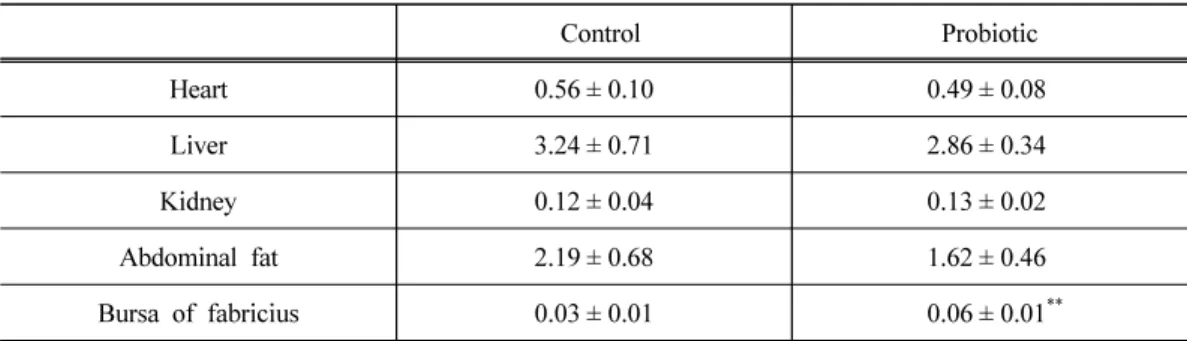
The effect of probiotic mixed diet on organ weight of broiler is illustrated in Table 5. The absolute weights of different organs did not show the significantly changed, but the weight of bursa of fabricius was increased in the probiotics group than the control group.
Table 5. Organ weight (% per body weight) of the broiler chicken mixed probiotic treated group and control diet group of broiler chicken
Control Probiotic Heart 0.56 ± 0.10 0.49 ± 0.08 Liver 3.24 ± 0.71 2.86 ± 0.34 Kidney 0.12 ± 0.04 0.13 ± 0.02 Abdominal fat 2.19 ± 0.68 1.62 ± 0.46 Bursa of fabricius 0.03 ± 0.01 0.06 ± 0.01**
Mean ± standard deviation (n=10).
Astric mark denote the significance between control and Probiotic (**p < 0.01; *p < 0.05).
4. Meat Quality
The effect of the diet including probiotic did not alter the meat quality (Table 6). This data recommended that this experimental probiotic don’t have any effect on broiler meat quality.
5. Free Fatty Acid Level
Table 6. Meat quality parameters of broiler chickens in mixed probiotics used as a feed supplement and control diet
Control Probiotic Meat L 57.06 ± 2.70 55.73 ± 2.30 a 3.89 ± 0.94 5.11 ± 1.86 b 2.94 ± 0.86 3.79 ± 0.56 Shear force 2.82 ± 0.80 2.20 ± 0.56 Cooking loss 15.64 ± 1.34 15.09 ± 1.29 pH 5.73 ± 0.06 5.79 ± 0.11
Water holding capacity 61.22 ± 0.69 62.40 ± 1.10
moisture 74.15 ± 0.35 74.81 ± 1.09
Fat 1.26 ± 0.13 1.03 ± 0.38
protein 23.89 ± 0.23 24.10 ± 0.49
Crude Ash 1.11 ± 0.03 1.11 ± 0.02
Mean ± standard deviation (n=10).
Astric mark denote the significance between control and Probiotic (**p < 0.01; *p < 0.05).
Table 7. Fatty acid in chicken meat (%) in mixed probiotics used as a feed supplement and control diet
Control Probiotic Myristic acid (C14:0) 0.84 ± 0.03 0.86 ± 0.03 Palmitic acid (C16:0) 25.62 ± 0.49 25.22 ± 0.74 Palmitoleic acid (C16:1n7) 6.95 ± 0.29 7.46 ± 0.48 Stearic acid (C18:0) 7.07 ± 0.28 6.08 ± 0.32* Oleic acid (C18:1n9) 43.99 ± 0.69 44.50 ± 0.42 Linoleic acid (C18:2n6) 13.87 ± 0.70 4.12 ± 1.07** γ-Linoleic acid (C18:3n6) 0.13 ± 0.02 0.15 ± 0.03 Linolenic acid (C18:3n3) 0.62 ± 0.03 0.61 ± 0.04 Eicosenoic acid (C20:1n9) 0.53 ± 0.01 0.48 ± 0.02* Arachidonic acid (C20:4n6) 0.37 ± 0.05 0.31 ± 0.04
Saturated fatty acid 33.53 ± 0.47 30.36 ± 0.80* Unsaturated fatty acid 66.47 ± 0.47 69.64 ± 0.80*
n3 0.62 ± 0.03 0.61 ± 0.04
n6 14.36 ± 0.70 14.58 ± 1.11
Mean ± standard deviation (n=10).
(UFA) and significantly decreased the saturated fatty acid (SFA), stearic acid (C18:0), linoleic acid (C18:2n6) and eicosenoic acid (c20:4n6) than the control group (Table 7). This result recommended that this probiotic treated broiler meat not harmful to human health.
6. Immunity Level of Broiler
The effect of probiotic mixed diet on the cytokine levels in the broiler intestine (ileum) illustrated in Fig. 1. The expression of mRNA level of IL-2 was significantly decreased in the probiotic diet treated group than the control group (p < 0.01). Meanwhile, mRNA expression levels of IL-6 (p < 0.01) and IL-10 (p < 0.05) significantly increased the probiotic dietary group than the control group. This result indicate that this mixed probiotic treatment increases the broiler immune function.
Fig. 1. Effect of probiotic on expression of cytokines (IL-1, IL-2, IL-6, IL-8, IL-10, IL-12 and TNF-α) in intestine (ileum) of broiler chicken. Expression of cytokines was quantified by real-time quantitative polymerase chain reaction (qPCR). Mean arbitrary unit values were bar graphed and error bar were SD. Astric mark denote the significance between control and Probiotic (**p < 0.01; *p < 0.05).
Ⅳ. Discussion
It is obvious from our study that the mixed probiotic has a positive effect on the broiler. We agree with the previous study that reported multispecies probiotics (MSPB) reduce overall mortality rate than the control group (Timmerman et al., 2006). Moreover, probiotics enhance the intestinal epithelial barrier, adhesion to the intestinal mucosa and exclusion of the pathogenic bacteria by releasing antimicrobial substance (Bermudez-Brito et al., 2012). Many researchers reported that lactic acid bacteria containing probiotics produce antimicrobial substances which have decreased the mortality rate due to prevent the severity of pathogenic bacteria (Reis et al., 2012). The similar mechanism would be occurred in the treatment with mixed probiotic decreased the mortality through produce antimicrobial substance which prevent the pathogenic bacteria.
A previous study reported that Lactobacillus sp. had no significant effects on the growth performance and gut development of birds (Olnood et al., 2015). In the meantime, there are many studies reported the positive impact of different probiotics on chicken bird’s performance. Other study also found that the final body weight gain was significantly increased by using culture Lactobacillus sp. in diet (Jin et al., 2000). Moreover, the growth performance was signi-ficantly higher for using higher amount (1.5%, 2% and 2.5%) of yeast (Saccharomyces cerevisiae) as a diet supplement of broiler than 0.5% and 1% of yeast (Shareef and Al-Dabbagh, 2009). In our study, the growth performance did not significantly increase, maybe, the root cause was used the low dose (0.5%) of probiotic as a feed supplement. Here seems, growth performance and feed efficiency depend on management of farm, probiotic strains and the amount of probiotic added with the feed.
In this study, we were assessed the probiotic supplemented feed will increase the primary immune organ. Our result showed that this experimental probiotic increased only the weight of bursa of fabricius, but this probiotic did not affect other organs, maybe this probiotic is not related to body weight gain. Previous study reported that Lactobacillus sp. (1 × 10⁸ cfu/kg) did not show a remarkable change of organ weight (Awad et al., 2009). However, bursa of fabricius of the probiotic treated diet group was significantly increased (p < 0.01) from the control group. The preceding study illustrated that Bacillus subtilis PB6 treated birds had significantly higher bursa of fabricius weight than the control group birds (Teo and Tan, 2007). The probiotic may be increased the primary lymphoid organ weight by increased the number of the lymphocyte.
The characteristics of probiotics-fed broiler meat quality have been evaluated to ensure natural and wholesome advents. The normal pH value of the chicken breast muscle is around 6 (Hertanto et al., 2018). Meat color and pH are correlated each other. The pH of the meat was regulating
the meat color. Light color meat contains low pH, normal color meat contains moderate pH and dark meat contain the highest level of pH (Fletcher et al., 2000). Moisture content and water holding capacity (WHC) have a positive correlation with the pH. If pH increases in the meat, the moisture content and the WHC also increase (Qiao et al., 2001). Myosin and actomyosin show maximum gel strength at a pH of 6.0 and gradually reduce at lower pH (Yasui et al., 1980). Also, Bacillus subtilis do not affect on chicken meat pH as well as meat color, WHC, cooking loss, and shear force (Pelicano et al., 2003). Our result represented that minerals (Moi-sture, fat, protein and crude Ash) in chicken meat did not influenced by probiotic. Though, previous study found that probiotic (Streptococcus faecium and Bacillus cereus) influenced the chicken meat protein, total ash, fat and water (Ivanovic et al., 2012).
The bacterial activity increases almost 15 essential free fatty acids (Haščík et al., 2014; Kankaanpää et al., 2004). Previous study reported probiotic (Lactobacillus amylovorus and Enterococcus faecium) reduce the saturated fatty acid and increased the unsaturated fatty acid in pork (Ross et al., 2012). The meat fatty acid composition is an important factor for the poultry meat quality and for human health (Rahimi et al., 2011). Moreover, probiotic treated meat reduces the lipid level in plasma, improve glucose tolerance and reduce the obesity (Jung et al., 2006).
Probiotic promote endogenous host defense mechanisms. Therefore, probiotics enhance humoral immune response in the intestine. IL-2 has been shown to reduce the virulence of pathogens by activation T cell proliferation (Hoyer et al., 2008). A previous study reported that Lactobacillus plantarum induce the IL-6 and protect the host from pathogenic bacteria by making intestinal barrier (Wang et al., 2018). However, our result IL-6 was high in probiotic treated group. In this study IL-6 was characterized as anti-inflammatory cytokines. This result indicates that IL-6 decrease the inflammation and infection in ileum (Adhikari et al., 2018). A previous study reported that IL-10 expression level significantly high in probiotic (BS15 diet) treated group than the control group birds (Wang et al., 2017). This study revealed this probiotic may have anti- inflammatory effects and as well as prevent the inflammatory action in the intestine.
Ⅴ. Conclusion
In conclusion, this experiment indicates that probiotic supplement had remarkable positive impact on the mortality and productivity index during the experimental period. The weight of bursa of fabricius (primary lymphoid organ) increased for using probiotics, as well as this probiotic increase the immunity in broiler. Moreover, unsaturated fatty acid increased in probiotics
diet broilers muscles. Eventually, our result suggests this probiotic could be used at the farm level for its positive impact without any adverse effects.
[Submitted, July. 15, 2020 ; Revised, August. 6, 2020 ; Accepted, August. 11, 2020]
References
1. Abbott, D. A., R. M. Zelle, J. T. Pronk, and A. J. van Maris. 2009. Metabolic engineering of Saccharomyces cerevisiae for production of carboxylic acids: current status and chall-enges. FEMS Yeast Res. 9: 1123-1136.
2. Adhikari, P., D. E. Cosby, N. A. Cox, M. S. Franca, S. M. Williams, Jr. R. M. Gogal, C. W. and W. K. Ritz. 2018. Effect of dietary fructooligosaccharides supplementation on internal organs Salmonella colonization, immune response, ileal morphology, and ileal immunohisto-chemistry in laying hens challenged with Salmonella Enteritidis. Poult. Sci. 97: 2525-2533. 3. Anonymous. 2007. Ross 308 Broiler: Nutrition Specification. Aviagen. Scotland. UK. 4. AOAC. 1984. Official Methods of Analysis. Association of Official Analytical Chemists.
14th Edition, AOAC, Arlington.
5. Awad, W. A., K. Ghareeb, S. Abdel-Raheem, and J. Böhm. 2009. Effects of dietary inclusion of probiotic and synbiotic on growth performance, organ weights, and intestinal histomorphology of broiler chickens. Poult. Sci. 88: 49-55.
6. Awobajo, O. K., Y. M. Akintan, A. O. Igbosanu, A. A. mako, and O. T. Olatokunbo. 2007. The mortality rate in the two breeds of broiler on brooding stage. World Applied Sciences Journal. 2: 304-308.
7. Bermudez-Brito, M., J. Plaza-Díaz, S. Muñoz-Quezada, C. Gómez-Llorente, and A. Gil. 2012. Probiotic mechanisms of action. Ann. Nutr. Metab. 61: 160-174.
8. Borsoi, A., L. R. Santos, G. S. Diniz, C. T. P. Salle, H. L. S. Morales, and V. P. Nascimento. 2011. Salmonella fecal excretion control in broiler chickens by organic acids and essential oils blend feed added. Br. J. Poult. Sci. 13: 65-69.
9. Chapman, C. M. C., G. R. Gibson, and I. Rowland. 2011. Health benefits of probiotics: are mixtures more effective than single strains. Eur. J. Nutr. 50: 1-17.
10. Chen X. D., Q. G. Ma, M. Y. Tang, and C. Ji. 2007. Development of breast muscle and meat quality in Arbor Acres broilers, Jingxing 100 crossbred chickens and Beijing fatty
chickens. Meat Sci. 77: 220-227.
11. de Vries, M. C., E. E. Vaughan, M. Kleerebezem, and W. M. de Vos. 2006. Lactobacillus plantarum— survival, functional and potential probiotic properties in the human intestinal tract. Int. Dairy J. 16: 1018-1028.
12. Dibner, J. J. and J. D. Richards. 2005. Antibiotic growth promoters in agriculture: history and mode of action. Poult. Sci. 84: 634-643.
13. Fijan, S. 2014. Microorganisms with claimed probiotic properties: an overview of recent literature. Int. J. Environ. Res. Public Health. 11: 4745-4767.
14. Fletcher, D. L., M. Qiao, and D. P. Smith. 2000. The relationship of raw broiler breast meat color and pH to cooked meat color and pH. Poult. Sci. 79: 784-788.
15. Girolami, A., F. Napolitano, D. Faraone, and A. Braghieri. 2013. Measurement of meat color using a computer vision system. Meat Sci. 93: 111-118.
16. Grau, R. and R. Hamm. 1953. Eine einfache methode zur bestimmung der wasserbindung im muskel. Naturwissenschaften. 40: 29-30.
17. Haščík, P., I. Elimam, J. Garlík, M. Bobko, J. Tkáčová, L. Trembecká, and M. Kačániová. 2014. Fatty acid content in broiler’s Ross 308 meat muscles after using bee pollen and probiotic as supplementary diet into their feed mixture. J. Microbiol Biotech. Food Sci. 4: 67-69.
18. Hertanto, B. S., C. D. A. Nurmalasari, A. M. P. Nuhriawangsa, M. Cahyadi, and L. R. Kartikasari. 2018. The physical and microbiological quality of chicken meat in the different type of enterprise poultry slaughterhouse: a case study in Karanganyar District. International Symposium on Food and Agro-biodiversity (ISFA). IOP Conf. Series: Earth and Environ-mental Science. 102: 012051.
19. Honikel, K. O. 1998. Reference methods for the assessment of physical characteristics of meat. Meat Sci. 49: 447-457.
20. Hoyer K. K., H. Dooms, L. Barron, and A. K. Abbas. 2008. Interleukin-2 in the develop-ment and control of inflammatory disease. Immunol. Rev. 226: 19-28.
21. Huff, W. E., G. R. Huff, N. C. Rath, J. M. Balog, and A. M. Donoghue. 2005. Alternatives to antibiotics: utilization of bacteriophage to treat colibacillosis and prevent foodborne pathogens. Poult. Sci. 84: 655-659.
22. Ivanovic, S., B. Pisinov, D. Maslic-Strizak, B. Savic, and Z. Stojanovic. 2012. Influence of probiotics on quality of chicken meat. African Journal of Agricultural Research. 7: 2191- 2196.
activities in broilers eed diets supplemented with Lactobacillus cultures. Poult. Sci. 79: 886-891.
24. Jung, U. J., M. K. Lee, Y. B. Park, M. A. Kang, and M. S. Choi. 2006. Effect of citrus flavonoids on lipid metabolism and glucose-regulating enzyme mRNA levels in type-2 diabetic mice. Int. J. Biochem. Cell. Biol. 38: 1134-1145.
25. Kankaanpää, P., B. Yang, H. Kallio, E. Isolauri, and S. Salminen. 2004. Effects of poly-unsaturated fatty acids in growth medium on lipid composition and on physicochemical surface properties of Lactobacilli. Appl. environ. Microbial. 70: 129-136.
26. Knarreborg, A., E. Brockmann, K. Høybye, I. Knap, B. Lund, N. Milora, and T. D. Leser. 2008. Bacillus subtilis (DSM17299) modulates the ileal microbial communities and improves growth performance in broilers. Int. J. Probiotics Prebiotics. 3: 83-8.
27. Kossin, B. and S. K. Rakshit. 2006. Microbial and processing criteria for production of probiotics: a review. Food Technol. Biotechnol. 44: 371-379.
28. Livak, K. J. and T. D. Schmittgen. 2001. Analysis of relative gene expression data using real time quantitative PCR and the 2-∆∆CT method. Methods. 25: 402-408.
29. Martins, J. M. S., C. M. C. Carvalho, F. H. Litz, M. M. Silveira, C. A. Moraes, M. C. A. Silva, N. S. Fagundes, and E. A. Fernandes. 2016. Productive and economic performance of broiler chickens subjected to different nutritional plans. Br. J. Poult. Sci. 18: 209-216. 30. Olnood, C. G., S. S. Beski, M. Choct, and P. A. Iji. 2015. Novel probiotics: Their effects
on growth performance, gut development, microbial community and activity of broiler chickens. Anim. Nutrit. 1: 184-191.
31. Patterson, J. A. and K. M. Burkholder. 2003. Application of prebiotics and probiotics in poultry production. Poult. Sci. 82: 627-631.
32. Pelicano, E. R. L., P. D. Souza, de H. B. Souza, A. Oba, E. A. Norkus, L. M. Kodawara, and de T. M. A. Lima. 2003. Effect of different probiotics on broiler carcass and meat quality. Br. J. Poult. Sci. 5: 207-214.
33. Perdigon, G., E. Vintini, S. Alvarez, M. Medina, and M. Medici. 1999. Study of the possible mechanisms involved in the mucosal immune system activation by lactic acid bacteria. J. Dairy Sci. 82: 1108-1114.
34. Qiao, M., D. L. Fletcher, D. P. Smith, and J. K. Northcutt. 2001. The effect of broiler breast meat color on pH, moisture, water-holding capacity, and emulsification capacity. Poult. Sci. 80: 676-680.
35. Rahimi, S., S. K. Azad, and M. A. K. Torshizi. 2011. Omega-3 enrichment of broiler meat by using two oil seeds. J. Agr. Sci. Tech. 13: 353-365.
36. Reis, J. A., A. T. Paula, and S. N. Casarotti. 2012. Lactic acid bacteria antimicrobial compounds: characteristics and applications. Food Eng. Rev. 4: 124-140.
37. Ross, G. R., C. P. Van Nieuwenhove, and S. N. González. 2012. Fatty acid profile of pig meat after probiotic administration. Journal of agricultural and food chemistry. 60: 5974- 5978.
38. Shareef, A. M. and A. S. A. Al-Dabbagh. 2009. Effect of probiotic (Saccharomyces cere-visiae) on performance of broiler chicks. Iraqi Journal of Veterinary Sciences. 23: 23-29. 39. Sims, M. D., K. A. Dawson, K. E. Newman, P. Spring, and D. M. Hoogell. 2004. Effects
of dietary mannan oligosaccharide, bacitracin methylene disalicylate, or both on the live performance and intestinal microbiology of turkeys. Poult. Sci. 83: 1148-1154.
40. Teo, A. Y. and H. M. Tan. 2007. Evaluation of the performance and intestinal gut micro-flora of broilers fed on corn-soy diets supplemented with Bacillus subtilis PB6 (Clo-STAT). J Appl. Poult.Res. 16: 296-303.
41. Timmerman, H. M., A. Veldman, E. van den Elsen, F. M. Rombouts, and A. C. Beynen. 2006. Mortality and growth performance of broilers given drinking water supplemented with chicken-specific probiotics. Poult. Sci. 85: 1383-1388.
42. Upadhaya, S., A. Hossiendoust, and I. H. Kim. 2016. Probiotics in Salmonella - challenged Hy-line brown layers. Poult. Sci. 95: 1894-1897.
43. Wang, H., X. Ni, X. Qing, L. Liu, J. Lai, A. Khalique, G. Li, K. Pan, B. Jing, and D. Zeng. 2017. Probiotic enhanced intestinal immunity in broilers against subclinical necrotic enteritis. Front. Immunol. 8: 1592.
44. Wang, L., L. Li, Y. Lv, Q. Chen, J. Feng, and X. Zhao. 2018. Lactobacillus plantarum restores intestinal permeability disrupted by Salmonella infection in newly-hatched chicks. Sci. Rep. 8: 2229.
45. Yasui, T., M. Ishioroshi, and K. Samejima. 1980. Heat-induced gelation of myosin in the presence of actin. J. Food Biochem. 4: 61.