Fire Hazard Analysis for Turbine Building of NPPs
Seung-Jun Oh*,Jun-Hyun Park**
* KMENT, 10 Chang-dong, Dobong-gu, Seoul. [email protected] ** KEPRI, 103-16 Munji-dong, Yusong-gu, Daejon. [email protected] 1. Introduction
In order to prove fire safety of operating nuclear power plants, plant-specific fire hazard analysis should be performed. Furthermore the effect of design changes on fire safety should be reviewed periodically.
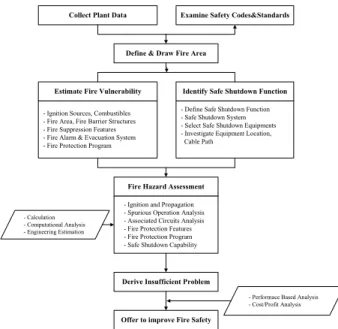
Figure 1 shows the general process of fire hazard analysis. At the estimating fire vulnerability stage, the factors that influence fire vulnerability include ignition sources, combustibles, fire barriers, fire protection features such as detection, alarm, suppression, evacuation are investigated. At the stage of fire hazard assessment, ignition and propagation hazard, passive and active fire protection features, and fire protection program such as pre-fire plan and related procedures are investigated. Based on the result of fire hazard analysis, reasonable improvement plan for fire protection can be established.
Collect Plant Data Examine Safety Codes&Standards
Define & Draw Fire Area
Estimate Fire Vulnerability
- Ignition Sources, Combustibles - Fire Area, Fire Barrier Structures - Fire Suppression Features - Fire Alarm & Evacuation System - Fire Protection Program
Identify Safe Shutdown Function
- Define Safe Shutdown Function - Safe Shutdown System - Select Safe Shutdown Equipments - Investigate Equipment Location, Cable Path
Fire Hazard Assessment
- Ignition and Propagation - Spurious Operation Analysis - Associated Circuits Analysis - Fire Protection Features - Fire Protection Program - Safe Shutdown Capability
Derive Insufficient Problem
Offer to improve Fire Safety
- Calculation - Computational Analysis - Engineering Estimation
- Performace Based Analysis - Cost/Profit Analysis
Figure 1 Process of fire hazard analysis
This paper describes the result of fire hazard analysis classified by fire area for turbine building of which fire hazards and fire frequencies are relatively high in operating nuclear power plant.
2. Methods and Results 2.1 Assessment items
Fire hazard analysis is performed to identify the validity of the “defense-in-depth” in fire protection. Considering their own characteristic, some items are assessed by each fire area and the others are assessed by whole unit. Items such as combustibles, fire loadings, fire barriers, detection, and suppression systems are assessed by each fire area. On the other hand, items such as water supplies systems, emergency communication, fire protection program, administrative control, related procedures are assessed by whole unit on account of common features.
○ Assessment items by each fire area - Quantification of combustibles - Ignition sources
- Fire barrier components: fire barrier, fire door, and fire damper
- Fire expansion in fire area
- Fire protection features: fire alarm, fixed suppression, and manual suppression systems
- Other fire protection features: smoke removal, evacuation, emergency lighting, emergency communication, and flooding protection
- Unexpected result by action of fire suppression systems
○ Assessment items for common - Fire protection program
- Administrative control of combustibles and ignition sources
- Water supplies systems
- Manual fire suppression features - Emergency communication - Safe shutdown capability
2.2 Fire hazard analysis for turbine building
The results of fire hazard analysis for turbine building classified by assessment items are as follows. ○ Fire areas
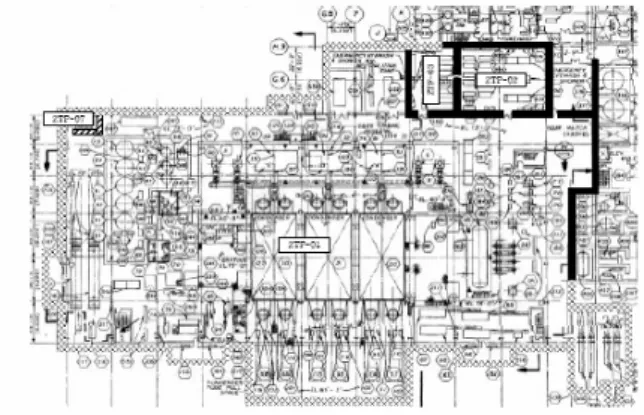
Turbine building has three fire areas. Table 1 shows those lists and fire loadings and figure 2 shows the fire area drawing.
Table 1 Fire areas and fire loadings of turbine building
No. Fire area number Fire area name Fire loadings(Btu/ft2)
1 ZTF-01 Turbine building 73,491
2 ZTF-07 Stair 8,249
3 ZTG-02 Lube oil reservoir 393,762
Transactions of the Korean Nuclear Society Autumn Meeting Busan, Korea, October 27-28, 2005
Figure 2 Fire area drawing of turbine building ○ Fire barriers
- Fire door
In the fire area ZTG-02, because of high temperature and frequently access, some fire doors are always open. Therefore, it needs to be improved that these fire doors should be closed automatically when fire detected.
- Penetration seals
In the fire area ZTF-01, because penetration seals are component of fire barriers, some unsealed or dissatisfied penetrations should be reconstructed.
○ Fire hazards - Combustibles
In the fire area ZTF-01, Transient combustibles releasing a lot of heat and toxic gas such as vinyl, rubber, and plastic should be eliminated or limited for storage.
- Temporary electric equipments
In the fire area ZTF-01, because electric equipments temporary installed have high hazards and operated at all times, they should be changed into standard equipment.
○ Fire protection features
In the fire area ZTF-01, because improper position of sprinkler nozzle and pipe supporter interferes with effective suppression, their position should be properly changed.
In the fire area ZTF-01, because several tip of water spray system is omitted, it needs to be complement and checked periodically.
○ Safe shutdown capability
Equipments in turbine building are non-safety related, so there is no problem of safe shutdown capability.
3. Conclusion
○ Based on the result of fire hazard analysis, reasonable improvement plan for fire protection can be established. ○ Considering their own characteristic, items such as combustibles, fire loadings, fire barriers, detection, and suppression systems are assessed by each fire area. On the other hand, items such as water supplies systems, emergency communication, fire protection program, administrative control, related procedures are assessed by whole unit.
○ As a result of fire hazard analysis for turbine building of which fire hazard and fire frequency are relatively high, several improvement plan can be derived and can be practically implemented.
○ Despite high hazards, there is no problem of safe shutdown capability for turbine building.
REFERENCES
[1] Korea Electric Association, Korea Electric Power Industry Code-Fire Prevention, 2000.
[2] USNRC, Fire Protection for Operating Nuclear Power Plants, Regulatory Guide 1.189, Apr. 2001.
[3] USNRC, Standard Review Plan 9.5.1 Fire Protection Program, Rev. 4, Oct. 2003.
[4] National Fire Protection Association, Fire Protection Handbook, Vol. 1&2, 19th ed., 2003.
[5] EPRI TR-100443, Methods of Quantitative Fire Hazard Analysis, May. 1992.
[6] EPRI TR-105928, Fire PRA Implementation Guide, Dec. 1995.
[7] Society of Fire Protection Engineers, The SFPE Handbook of Fire Protection Engineering, 3rd Ed., 2002