IWAIT
2016
January 6-8, 2016
Pukyong National University, Busan, Korea
Organized by
The Korean Institute of Broadcast and Media Engineers (KIBME), Korea
Co-Organized by Institute of Electronics Information and Communication Engineers (IEICE), Japan
Institute of Image Information and Television Engineers (ITE), Japan
Japanese Society of Precision Engineering (JSPE-IAIP), Japan
National Science Council (NSC), Taiwan
IEEE Broadcast Technology Society, Seoul Chapter
IEEE Consumer Electronics Society, Seoul Chapter
Electronics and Telecommunications Research Institute (ETRI), Korea
Supported by
LG Electronics, JINMYUNG BROADCAST, MPEG Forum
The Korean Federation of Science and Technology Societies (KOFST)
Busan Tourism Organization (BTO), Any Future Technology (AFT)
http://www.iwait2016.org
2016 International Workshop on
Advanced Image Technology
IWAIT 2016 21 P.2C-5 View synthesis using homography transformation for 360 VR service
Gun Bang, Gwhang soon Lee
ETRI, Korea
P.2C-6 Multiple Sensorial Media Application Format
Sang-Kyun Kim, Jung Yup Oh
Myongji University, Korea
P.2C-7 Standardization of Media-centric Internet of Things
Sang-Kyun Kim
Myongji Unversity, Korea
P.2C-8 Near-Duplicate Video Copy Detection with Multi-Modal Video Signature Matching
Jun-Tae Lee, Kyung-Rae Kim, Won-Dong Jang, Chang-Su Kim
Korea University, Korea
P.2C-9 BLE Beacon-based Position Tracking System in Android Platform
Dong-Kyu Choi, Joong-Hwa Jung, Sang-Il Choi, Seok-Joo Koh
Kyungpook National University, Korea
P.2C-10 Implementation of CoAP/6LoWPAN over BLE Network for IoT Services
Cheol-Min Kim, Hyung-Woo Kang, Seok-Joo Koh
Kyungpook National University, Korea
P.2C-11 LABORATORY MEASUREMENT TO PROVIDE THRESHOLD OF VISIBILITY FOR TERRESTRIAL 4K-UHDTV BROADCASTING BASED ON HEVC OVER DVB-T2 IN AWGN CHANNEL
Sungho Jeon, Junghyun Kim, Jaekwon Lee, Sanghun Kim, Jeong-Deok Kim, Young-Woo Suh, Zungkon Yim
KBS, Korea
P.2C-12 RGB-D Image Segmenation Based on Random Walk with Restart
Se-Ho Lee, Won-Dong Jang, Chang-Su Kim
Korea University, Korea
P.2C-13 Getting Higher Performance Using a Two-Layer Extreme Learning Machine
Junhyuk Hyun, Jeonghyun Baek, Jisu Kim, Peyman Hosseinzadeh Kassani, Euntai Kim
Yonsei University, Korea
P.2C-14 Implementation of Integrated multi-media measurement and monitoring system
Young-Woo Suh, Junghyun Kim, Sungho Jeon, Zungkon Yim, Sung-Choon Park
KBS, Korea
P.2C-15 Relaxation Based Matching of SIFT Keypoints Clustered by Gradients and Location
Sunmin Lee, Yong Cheol Kim
University of Seoul, Korea
P.2C-16 Toward 3D Object Tracking without Jittering
Minseok Kang, Jungsik Park, Jong-Il Park
Hanyang University, Korea
P.2C-17 The optimal bilateral remote control system under disaster environment
Sun Lim, Young Wook Kim
KETI, Korea
P.2C-18 Multiple Player Tracking in Indoor Sports with Multi-cameras
Yookyung Kim, Gi-Mun Um, Kwang-Yong Kim, Kee-Seong Cho, Hyungmin Kim*, Jong-Il Park*
ETRI, *Hanyang University, Korea
P.2C-19 Human Gait Prediction method using Microsoft Kinect
Junghwan Kim, Doyoung Kim, Inwoong Lee, Jongyoo Kim, Heeseok Oh, Sanghoon Lee
Yonsei University, Korea
P.2C-20 Copyright Protection and Compact- and Secure-Transmission of Diagnosed Fundus Images
Wannida SAE-TANG
King Mongkut’s University of Technology, Thailand
Implementation of CoAP/6LoWPAN over BLE
Network for IoT Services
Cheol-Min Kim
School of Computer Science and Engineering
Kyungpook National University Daegu, South Korea [email protected]
Hyung-Woo Kang
School of Computer Science and Engineering
Kyungpook National University Daegu, South Korea [email protected]
Seok-Joo Koh*
School of Computer Science and Engineering
Kyungpook National University Daegu, South Korea
Abstract—In recent years, Internet of Things (IoT) technology
has been growing rapidly. Current communication methods for this technology include HTTP, MQTT, ZigBee, Bluetooth, etc. The exhaustion of IPv4 address gave rise to an introduction of the new Internet protocol, IPv6. And its larger address space compared to IPv4 made us dream to connecting all the things in our daily life through the Internet, which is now called the IoT technology. Accordingly, the applications of IPv6 have been introduced on and on, and Constrained Application Protocol (CoAP) is one of those applications. In this paper, we introduce how to provide IP-based IoT service communication for the constrained devices in Bluetooth Low Energy (BLE) network.
Keywords—IoT; Bluetooth Low Energy; 6LoWPAN; CoAP; M2M
I. INTRODUCTION
Recently, the Internet of Things (IoT) technology has been focused on its widespread deployment to wearable devices which are used in various fields, such as smart home appliance, electronics, healthcare, remote meter, smart home, smart car, and so on. Google glass from Google, Inc. and Nike+ FuelBand from Nike, Inc. are great examples and so-called representatives of wearable devices. However, most of current wearable devices do not use the Internet Protocol (IP) for their communication. Instead of IP, they rely on the underlying link-layer technology, such as ZigBee, Bluetooth. Accordingly, those wearable devices are not suitable to provide the advanced IP-based IoT services, which require a direct connection of the device to Internet.
In this paper, we introduce an implementation of Constrained Application Protocol (CoAP) in IPv6 over Low Power Wireless Personal Area Networks (6LoWPAN) environment using Bluetooth Low Energy (BLE). By using 6LoWPAN, devices can use Internet Protocol (IP) and can be connected to public Internet directly. Therefore, this implementation makes the device able to utilize the advanced services such as Dash Button from Amazon.com, Inc. and products from Nest Labs.
This paper is organized as follows. In section 2, we introduce 6LoWPAN, which is a specification of constrained devices. In section 3, we explain The CoAP protocol, which is an application protocol for resource and communication management. In section 4, we suggest an implementation
example by using Bluetooth Low Energy (BLE). Finally, section 5 concludes this paper.
II. 6LOWPAN
IPv6 over Low Power Wireless Personal Area Networks (6LoWPAN) is a concept for Internet of Things [1] [2]. The name "6LoWPAN" is the name of working group in Internet Engineering Task Force (IETF). The devices which belong to the network, 6LoWPAN are called "constrained devices", because they are battery-powered and have limited capabilities in data processing. Since the constrained devices need to be optimized to communicate, IEEE 802.15 standards are used to optimize their communication, by implementing encapsulation and header compression.
III. COAP
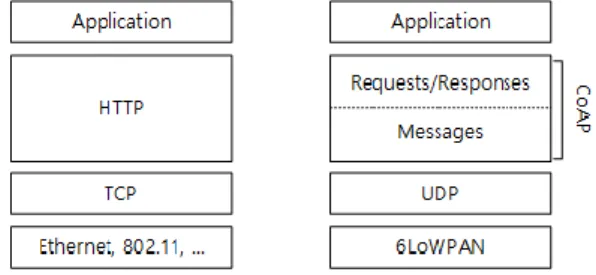
Constrained Application Protocol (CoAP) is an application protocol used in constrained devices [3]. It is lightweight, low power-consuming, and fast application protocol. The protocol is similar to Hypertext Transfer Protocol (HTTP) [4] application protocol except that CoAP uses UDP as underling protocol and runs on 6LoWPAN environment. The features of CoAP were shown in many works [5] [6]. CoAP uses server and client communication model. In this model, the client sends a request for a resource of server and the server receives requests from clients, then replies with a response message which contains the data of resource.
Fig. 1 Protocol stack (HTTP, CoAP)
Fig. 1 shows the similarity between HTTP and CoAP as
well as the key modules of CoAP. CoAP is composed of two big modules; messaging module and request/response module.
Messaging module provides a reliable messaging and unreliable messaging. Confirmable (CON) message is a message that provides reliable message transfer when constrained devices are connected by unreliable transfer method. Every CON messages should be responded with Acknowledgement (ACK) message. Unless the client receives ACK message after sending a CON message, it decides there was a problem during transmission and retransmit the request to server. Non-confirmable (NON) message is a message that every NON message should be replied with NON message. It is used when a value of resource does not require reliable transmission.
Request/Response module provides the following transmission method; piggy-backed response, separate response, and non-confirmable response.
Fig. 2 Piggy-backed response
Fig. 2 shows the transmission that uses piggy-backed
response. When a server receives CON message, it should send response in the ACK message.
Fig. 3 Separate response
Fig. 3 shows the transmission that uses separate response.
When a server receives CON request message and needs more time to get data of resources, it first replies with empty ACK message. And then it retrieves the required data. When it is done, the server sends a new CON message to its client, containing the data of the resource.
Fig. 4 Non-confirmable response
Fig. 4 shows the transmission that uses Non-confirmable
response. When a server receives NON message, it should reply with NON message.
Resources of CoAP can be accessed via Representational State Transfer (REST) architecture. REST architecture has the following commands: GET, POST, PUT, and DELETE. These commands retrieve, create, update, and remove the resource, respectively. The complete request form is “command coap://host address/resource”. For example, if there is a client trying to retrieve a temperature data from the sensor, the proper command is "GET coap://host address/temperature".
CoAP has several response codes that are used to know the status of request. They are similar to response codes of HTTP. A code which starts with 2.xx means “Success”, 4.xx means “Client Error”, and 5.xx means “Server Error”.
IV. IMPLEMENTATION
The Bluetooth specification that supports IP communication is Internet Protocol Support Profile (IPSP) which requires Bluetooth 4.1 [7]. Implementation of IPSP is done by Linux kernel 3.18. By enabling 6LoWPAN and Bluetooth module in Linux, we can use Internet Protocol Version 6 (IPv6) on BLE devices.
The CoAP protocol is implemented in many ways. In this paper, we used Californium CoAP framework, which is implemented as Java programming language and managed by Eclipse foundation.
Fig. 5 Test environment
We designed a test environment that represent general use of IoT environment. Fig. 5 shows the environment.
Network A is 6LoWPAN network, which is connected with public Internet that uses IPv4. It is composed of CoAP Server and 6LoWPAN gateway. Both of them are Raspberry pi and simulate constrained devices. The CoAP server has a humidity
and temperature sensor that provides a humidity and temperature of room. The 6LoWPAN gateway translates 6LoWPAN environment to Internet or Internet to 6LoWPAN as well.
Network B is a traditional Ethernet network which uses IPv4. It is made up of CoAP client. The CoAP client is a traditional desktop computer which is connected to public Internet.
Because public Internet uses IPv4 and both Network are connected to it, they need to be translated to IPv6. So, we used 6to4 translation method which translates IPv4 to IPv6 or IPv6 to IPv4 as well [8].
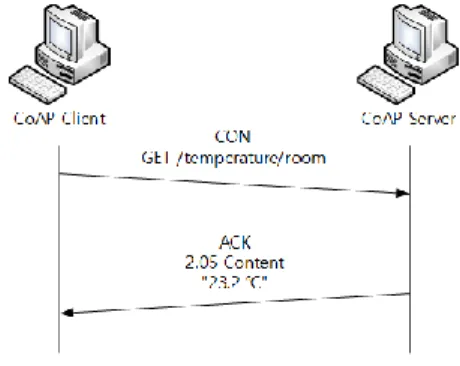
When the CoAP client wants to know the temperature of room, it sends CON request message to CoAP server. Then, the server reply with ACK message with the temperature of the room.
Fig. 6 The flow of getting the temperature of room
Fig. 6 shows the flow of getting the temperature of room.
Fig. 7 The CON message packet of request
The CoAP client sends the request packet to the server. Fig.
7 shows the packet of the request.
Fig. 8 The CON message packet of response
After the CoAP server receive the request, it responds with ACK message with the temperature data of room. Fig. 8 shows the packet of the response.
V. CONCLUSION
In this paper, we presented an Implementation of CoAP over BLE. CoAP is lightweight protocol and consumes less power, compared to HTTP in traditional communication, which is heavy and consumes more power than CoAP. These feature makes CoAP get famous especially in IoT Fields. In addition, as CoAP uses 6LoWPAN, devices are able to connect backend server in the Cloud network such as the service provided by Amazon and Google, and their data can be used for another applications. This paper introduces BLE as a bottom layer. However, another standard which meet IEEE 802.15 can be applied as well.
ACKNOWLEDGMENT
This research was supported by the MSIP (Ministry of Science, ICT and Future Planning), Korea, under the SW-Centered University Program (IITP-2015-R2215-15-1004) supervised by the IITP (Institute for Information& communications Technology Promotion) and by the BK21 Plus project (SW Human Resource Development Program for Supporting Smart Life) funded by the Ministry of Education, School of Computer Science and Engineering, Kyungpook National University, Korea (21A20131600005).
REFERENCES
[1] N. Kushalnagar, G. Montenegro and C. Schumacher, “IPv6 over Low-Power Wireless Personal Area Networks (6LoWPANs): Overview, Assumptions, Problem Statement, And Goals”, Internet Engineering Task Force (IETF) Request for Comments: 4919, 2015 Oct.
[2] S. Deering and R. Hinden, “Internet Protocol, Version 6 (IPv6) Specification”, Internet Engineering Task Force (IETF) Request for Comments: 2460, 1998 Dec.
[3] Z. Shelby, K. Hartke and C.Bormann, “The Constrained Application Protocol”, Internet Engineering Task Force (IETF) Request for Comments: 7252, 2014 June.
[4] R. Fielding, J. Gettys, J. Mogul, H. Frystyk and L. Masinter et al. “Hypertext Transfer Protocol – HTTP/1.1”, Internet Engineering Task Force (IETF) Request for Comments: 2616, 1999, June.
[5] M. Kovatsch, S. Duquennoy and A. Dunkels, “A Low-Power CoAP for Contiki”, Mobile Adhoc and Sensor Systems (MASS), 2011 IEEE 8th International Conference on, pp. 855 – 860, 2011 Oct.
[6] L. Alessandro, M. Pol and Anna Calveras, “TinyCoAP: A Novel Constrained Application Protocol (CoAP) Implementation for Embedding RESTful Web Services in Wireless Sensor Networks Based on TinyOS”, Journal of Sensor and Actuator Networks, pp. 288 - 315, 2013
[7] S. Teemu, K. kanji, B. Frank, D. Joe and H. Robin et al., “Internet Protocol Support Profile”, Bluetooth Specification, 2014 Dec.
[8] B. Carpenter and K. Moore, “Connection of IPv6 Domains via IPv4 Clouds”, Internet Engineering Task Force (IETF) Request for Comments: 3056, 2001 Feb.