저작자표시-비영리-변경금지 2.0 대한민국 이용자는 아래의 조건을 따르는 경우에 한하여 자유롭게 l 이 저작물을 복제, 배포, 전송, 전시, 공연 및 방송할 수 있습니다. 다음과 같은 조건을 따라야 합니다: l 귀하는, 이 저작물의 재이용이나 배포의 경우, 이 저작물에 적용된 이용허락조건 을 명확하게 나타내어야 합니다. l 저작권자로부터 별도의 허가를 받으면 이러한 조건들은 적용되지 않습니다. 저작권법에 따른 이용자의 권리는 위의 내용에 의하여 영향을 받지 않습니다. 이것은 이용허락규약(Legal Code)을 이해하기 쉽게 요약한 것입니다. Disclaimer 저작자표시. 귀하는 원저작자를 표시하여야 합니다. 비영리. 귀하는 이 저작물을 영리 목적으로 이용할 수 없습니다. 변경금지. 귀하는 이 저작물을 개작, 변형 또는 가공할 수 없습니다.
A THESIS FOR THE DEGREE OF MASTER OF SCIENCE
Effector-omics approaches for
identifying Phytophthora capsici effectors
inducing hypersensitive cell death
in Nicotiana benthamiana
Effector-omics 접근을 통한
Nicotiana benthamiana에서 과민성 세포 사멸
을 유도하는 고추역병균 effector 동정
AUGUST 2020
HAEUN KIM
MAJOR IN HORTICULTURAL SCIENCE AND BIOTECHNOLOGY DEPARTMENT OF PLANT SCIENCE
Effector-omics approaches for
identifying Phytophthora capsici effectors
inducing hypersensitive cell death
in Nicotiana benthamiana
UNDER THE DIRECTION OF DR. DOIL CHOI
SUBMITTED TO THE FACULTY OF THE GRADUATE SCHOOL
OF SEOUL NATIONAL UNIVERSITY
BY
HAEUN KIM
MAJOR IN HORTICULTURAL SCIENCE AND BIOTECHNOLOGY DEPARTMENT OF PLANT SCIENCE
THE GRADUATE SCHOOL OF SEOUL NATIONAL UNIVERSITY
AUGUST 2020
APPROVED AS A QUALIFIED DISSERTATION OF HAEUN KIM
FOR THE DEGREE OF MASTER OF SCIENCE
BY THE COMMITTEE MEMBERS
CHAIRMAN
Jin Hoe Huh, Ph.D.
VICE-CHAIRMAN
Doil Choi, Ph.D.
Effector-omics approaches for
identifying Phytophthora capsici effectors
inducing hypersensitive cell death
in Nicotiana benthamiana
HAEUN KIM
DEPARTMENT OF PLANT SCIENCE
THE GRADUATE SCHOOL OF SEOUL NATIONAL UNIVERSITY
ABSTRACT
Over time, plants and pathogens are engaged in arms race for survival. Pathogen secretes arsenals of effector proteins into the plant cells to manipulate the host defense. As a counterdefense, plants recruit nucleotide binding leucine rich repeat (NLR) proteins to recognize those effectors. The perception of an effector by a NLRs induces effector-triggered immunity (ETI) which is often accompanied by hypersensitive localized cell death (HR). To identify NLRs involved in ETI as a source of resistance, effector-omics approaches are employed. Particularly, much attention has been made on a large effector class with conserved RXLR domain. In this study, novel Phyophthora capsici RXLR effector candidates inducing
HR-mimic cell death were investigated. Total 25 putative P. capsici RXLR effectors were predicted by bioinformatic tools and subjected to analyze cell death-inducing activity in Nicotiana benthamiana. As a result, 9 P. capsici RXLR effector candidates were selected and further examined to characterize the cell death in N. benthamiana. The selected P. capsici effector candidates could induce defense-related gene expression upon ectopic expression in N. benthamiana indicating that the effector-induced cell death is a mimic of HR. Moreover, the induction of cell death by selected effectors required SGT1, a chaperone component of NLR signaling. These results suggest that the identified P. capsici RXLR effector candidates may act as novel avirulent factors that induce cell death through recognizing specific NLRs in N. benthamiana. Taken together, the newly identified P. capsici effector candidates could contribute to further understanding of the mode of action in effector-triggered HR cell death in plants as well as identifying corresponding NLR genes in N. benthamiana for further application to develop disease resistant crops.
Keywords: Effector-triggered immunity (ETI), Nucleotide-binding leucine rich
repeat (NLR), Hypersensitive response (HR), RXLR effector, Phytophthora capsici
CONTENTS
ABSTRACT ... i
CONTENTS ... iii
LIST OF TABLES ... v
LIST OF FIGURES ... vi
LIST OF ABBREVIATIONS ... vii
INTRODUCTION ... 1
MATERIALS AND METHODS ... 6
Plant materials and growth conditions ... 6
Identification of P. capsici RXLR effector candidates ... 6
Plasmid construction ... 7
In planta expression assay in N. benthamiana ... 8
Gene expression assay ... 9
RESULTS ... 12
P. capsici RXLR effector candidates were selected using
bioinformatic tools ... 12
Multiple P. capsici RXLR effector candidates induce cell death in N.
benthamiana ... 15
Cell death induced by P. capsici effector candidates mimics
hypersensitive cell death ... 18
Cell death mediated by P. capsici effector candidates are
SGT1-dependent ... 21
DISCUSSION ... 24
REFERENCES ... 28
LIST OF TABLES
LIST OF FIGURES
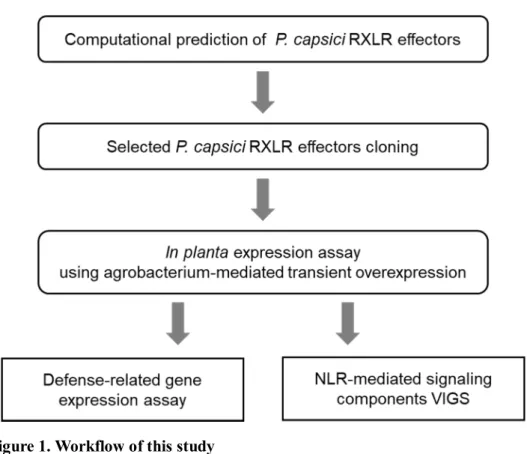
Figure 1. Workflow of this study ... 11
Figure 2. Putative P. capsici RXLR effectors are predicted by serial bioinformatic
analysis ... 13
Figure 3. Multiple P. capsici RXLR effector candidates induce cell death in N.
benthamiana ... 16
Figure 4. Defense-related genes are upregulated by several P. capsici RXLR effector
candidates ... 19
Figure 5. SGT1 is required for cell death triggered by P. capsici RXLR effector
LIST OF ABBREVIATIONS
PAMP
Pathogen-associated molecular patternPRR
Pattern recognition receptorsPTI
PAMP-triggered immunity R ResistanceNLR
Nucleotide-binding leucine rich repeat
ETIEffector-triggered immunity
NLR
Nucleotide-binding, leucine rich repeat
HR Hypersensitive responseROS
Reactive oxygen species
MAPK Mitogen-activated protein kinase
ORF
Open reading framePVX Potato virus X
INTRODUCTION
In nature, plants are constantly exposed to various pathogens. For plants, the recognition of ‘non-self’ is a much bigger issue compared to animals because of their lack of adaptive immune system. Plants have evolved a versatile, multi-layered immune system to protect themselves against pathogens. Along with preformed barriers, such as cell wall, cuticle, and phytoanticipin, plants employ a two-tier defense mechanism induced by pathogen attacks (Jones and Dangl, 2006; Dodds and Rathjen, 2010). The first layer is the perception of pathogen-associated molecular patterns (PAMPs) which are typical patterns of pathogens, such as bacterial flagellin or fungal chitin. At the plant cell surface, pattern recognition receptors (PRRs) recognize PAMPs and turn on immune responses called PAMP-triggered immunity (PTI) (Zipfel, 2014). As a counterdefense, pathogens exploit a large array of effector proteins to manipulate the host defense. To ward off the pathogen effectors, plants have recruited the second immune layer called effector-triggered immunity (ETI) which is a result of dynamic coevolution of plant and pathogen. In plants, resistance (R) proteins recognize the effectors and activate defense responses. Most of the R proteins are nucleotide-binding leucine rich repeat (NLR) proteins which act as intracellular receptors (Jones and Dangl, 2006). The effectors recognized by R proteins and involved in ETI are usually regarded as avirulent factors. ETI is often accompanied by hypersensitive response (HR), a localized cell death at the infection site. HR appears as superficial macroscopic cell death resulting in suppression of
disease progress (Balint-Kurti, 2019).
NLRs recognize effectors directly or indirectly in plant cells and become activated by conformational changes (Cui et al., 2015). NLR activation initiates immune signaling. Several components serve as nodes of NLR-mediated signal transduction pathways (Chiang and Coaker, 2015). A conserved chaperone complex plays an important role in resistance mediated by NLR proteins recognizing pathogen effectors. This molecular chaperone complex which is composed of Supressor of the G2 allele of SKP1 (SGT1), Heat shock protein 90 (HSP90) and
Required for MLA12 resistance 1 (RAR1) contributes to the stability of NLRs by
facilitating the folding of the proteins (Shirasu, 2009). Non-race specific disease resistance1 (NDR1), a plasma membrane integrin like protein, is known to be required for the activation of multiple NLR-mediated defense responses (Chiang and
Coaker, 2015). Some NLRs known as helper NLRs deliver the signals from other
NLRs sensing effector proteins. Activated disease resistance 1 (ADR1) and NB-LRR required for hypersensitive response-associated cell death (NRC) are widely known helper NLR groups. These helper NLRs also contribute to various NLR-dependent ETI responses (Baggs et al., 2017; Li et al., 2015; Chiang and Coaker, 2015). The perception of effectors by NLRs also activates various defense responses which are associated with HR. Complex defense signaling network is involved in ETI, including production of reactive oxygen species (ROS), calcium flux, mitogen-activated protein kinases (MAPKs) cascade activation, controlling homeostasis of plant defense hormones, and transcriptional reprogramming of defense-related genes.
All these concerted processes drive resistance against pathogens (Cui et al., 2015). Since progress in ‘effector’-triggered immunity has been made, much attention has been focused on effectors involved in ETI. Studies of effectors in all genus, including bacteria, fungi and oomycete, have been performed (Chisholm, 2006). Particularly oomycetes translocate a large class of effectors with conserved Arg-Xaa-Leu-Arg (RXLR) domain at N-termini into plant cells (Anderson et al.,
2015). It is known that the conserved RXLR domain followed by N-terminal signal
peptide, is required for the proper translocation into the host cell (Whisson et al., 2007). Variable C-terminal regions of RXLR effectors, so-called effector domains, exhibit the effector activity (Schornack et al., 2009). Comparative analysis based on RXLR domain has revealed that a large number of RXLR effectors are conserved in
Phytophthora and downy mildew lineage. Total 563 RXLR genes were predicted in Phytophthora infestans, 374 in Phytophthora sojae, and 134 in Hyaloperonospora arabidopsidis (Hpa), respectively (Anderson et al., 2015).
Many RXLR effectors have been identified as avirulent factors which activate ETI. Several RXLR effectors and their corresponding NLRs were elucidated
(Anderson et al., 2015). Avr1, Avr2, Avr3a, Avr4, Avrblb2, and IPI-O of P. infestans, Avr1a, Avr1b-1, Avr1c, Avr1d, Avr1k, Avr3b, and Avr3c of P. sojae, and ATR1, ATR5, ATR13, and ATR39 of Hpa were identified (Anderson et al., 2015). For example, P.
infestans RXLR effector Avrblb2, which has a canonical RXLR domain, induces HR
leads to resistance against P. infestans (Oh et al., 2009). With the revolution of genomics, novel effectors were identified using bioinformatic analysis. ATR39-1, a
Hpa RXLR effector, was identified based on the computational prediction.
ATR39-1 exhibited avirulence activity in one ecotype of Arabidopsis and its cognate NLR, RPP39, was identified in turn (Goritschnig et al., 2012).
Effector repertoires of oomycete pathogens, such as P. infestans and P. sojae, have been revealed substantially (Anderson et al., 2015). However, despite the destructiveness of P. capsici, little is known about the molecular mechanisms under
P. capsici effectors compared to other species. P. capsici causes blight and crown
and fruit rot on broad range of vegetables including all cucurbits, pepper, tomato, eggplants, and even lima beans. Over 1 billion dollars of worldwide vegetable production is threatened by P. capsici each year (Lamour et al., 2012a). After the first draft genome of P. capsici was completed, available sequenced genomes have been expanded (Lamour et al., 2012b; Reyes-Tena et al., 2019)and 357 candidate RXLR effectors were predicted from the reference genome by bioinformatic analysis. However, only one P. capsici RXLR effector, a homolog of P. infestans Avr3a, has been functionally characterized but the corresponding NLR gene is still undisclosed.
In this study, HR-like cell death inducing P. capsici RXLR effector candidates were investigated using effector-omics approaches. Total 25 putative P.
capsici RXLR effectors were selected using a newly devised bioinformatic pipeline.
degrees of cell death in N. benthamiana. To verify the activity of cell death-inducing
P. capsici effector candidates, effector-triggered induction of defense-related gene
expression were examined. In addition, silencing of downstream signaling components of NLR-mediated defense response was performed.The newly identified RXLR effector candidates may become a source of resistance against P. capsici.
MATERIALS AND METHODS
Plant materials and growth conditions
N. benthamiana seeds were sown in 200-plug form tray filled with
horticultural bed soil (Farmhannong, Seoul, Korea) and grown in a growth chamber under conditions of 16-h/8-h light/dark photoperiod, temperature of 23-24℃, and relative humidity of 60%. After two weeks, seedlings were transplanted into pots.
Identification of P. capsici RXLR effector candidates
Phyca11 scaffolds and proteins were obtained from the Phytophthora
capsici sequencing consortium website (https://mycocosm.jgi.doe.gov/Phyca11/
Phyca11.home.html). Two separate approaches were used to identify P. capsici RXLR effector candidates.
All open reading frames (ORFs) were extracted from Phyca11 scaffolds
(EMBOSS getORF; Rice et al., 2000). effectR was used to predict candidate RXLR effectors from the extracted ORFs (Tabima and Grünwald, 2019). Predicted RXLR effectors without signal peptide were filtered out using signalP5.0 (Armenteros et al., 2019).
Target Gene Family Finder (TGFam-Finder) was used to annotate P. capsici RXLR effectors (Kim et al., 2020). InterProsScan5 was used for domain identification (Jones et al., 2014). Target domain ID was set as PF16810 according to Pfam protein families database. Putative RXLR effectors of 20 oomycete species were used as resource proteins: including Phytophthora infestans, P. parasitica, P. halstedii, P. capsici, P. ramorum, P. sojae, P. kernoviae, Hyaloperonospora arabidopsidis, Phytopythium vexans, Pythium ultimum var. ultimum, P. irregulare, P. iwayamai, P. arrhenomanes, P. aphanidermatum, Albugo laibachii, A. candida, Saprolegnia diclina, S. parasitica, Aphanomyces astaci, and A. invadans. The 20 oomycete genome data was obtained from Oomycete Gene Order Browser (OGOB; McGowan et al., 2019). RXLR effector candidates were extracted from genome data using effectR as previously described.
Among the putative RXLR effectors of two separate data sets, candidates which were differentially expressed during early infection stage and biotrophic phase in the microarray expression profiles of a previous study were selected (Jupe et al., 2013).
Plasmid construction
Effector domain of 25 selected P. capsici RXLR effector candidates were synthesized artificially in pTwist cloning vectors (LNCbio, Seoul, Korea). Except
one failed sequence, a total of 24 effector fragments were amplified using gene-specific primers with adaptor sequences: 5’ – CCAATCCCTCTACG – gene gene-specific sequence – 3’ and 5’ – TATCCTCCTACG – gene specific sequence – 3’. Amplicons were cloned into potato virus X (PVX) based vector pICH31160 (pkw) by ligation-independent cloning (LIC) method(Oh et al., 2010).Each cloned effector candidate was transferred to Agrobacterium tumefaciens strain GV3101 for in planta expression assay.
In planta expression assay in N. benthamiana
A. tumefaciens GV3101 carrying various constructs were grown overnight
at 30℃ in LB medium. The cells were centrifuged and resuspended in infiltration buffer [10 mM MgCl2, 10 mM MES (pH5.6), and 150 uM acetosyringone] to an optical density at 600 nm (OD600) of 0.4 for P. capsici effector candudates. The
suspension was pressure-infiltrated into expanded leaves of four-week-old N.
benthamiana using needleless syringe. Inoculated leaves were harvested at 5-6 days
post infiltration (dpi) and cell death response was monitored. Cell death phenotype was detected under white light using FOBI (Neoscience, Seoul, Korea) and cell death-associated fluorescence was detected using Azure c400 fluorescent imaging system (Azure biosystem, Dublin, CA, USA).
Gene expression assay
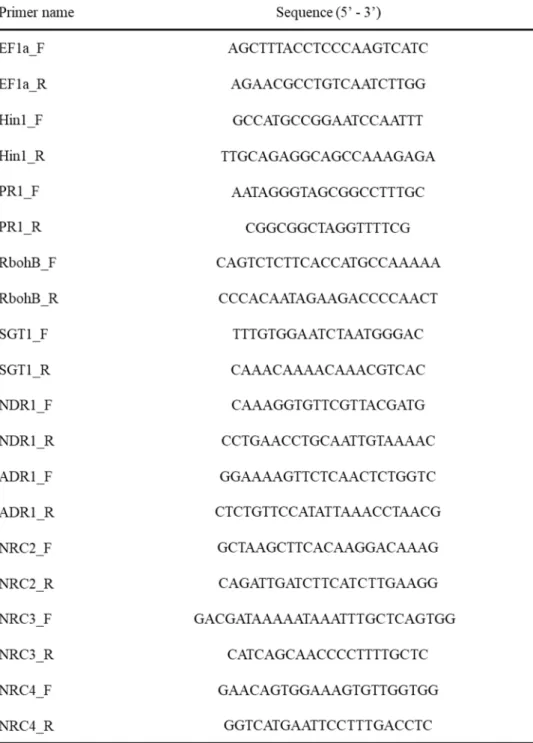
Total RNA was extracted using TRIZOL reagent (MRC, OH, USA), and cDNA was synthesized using Superscript III reverse transcriptase (Invitrogen, CA, USA). Quantitative RT-PCR at 95℃ for 5min, followed by 40 cycles of denaturation at 95℃ for 15 sec and 55℃ for 1 min with gene-specific primers was performed using CFX96 real-time PCR instrument (Bio-Rad, USA) and powerup SYBR green supermix (Applied Biosystems, MA, USA). NbEF1a was used to normalize gene transcripts level. Primers used in this study are listed in Table1.
Virus-induced gene silencing (VIGS) in N. benthamiana
Agrobacterium with pTRV1, pTRV2-GFP, pTRV2-SGT1, pTRV2-NDR1,
pTRV2-ADR1, pTRV2-NRC2/3/4 were constructed as previously described.
Agrobacterium carrying pTRV1 and pTRV2-target genes were prepared as
previously described in in planta expression assay. Suspension of pTRV1 and pTRV2-target gene were mixed in a 1:1 ratio to final OD600 as 0.15 each and
infiltrated into two leaves of two-week-old wild type N. benthamiana for VIGS. After 2-3 weeks of VIGS, upper leaves were used for subsequent inoculation of effector candidates-containing Agrobacterium and further experiments.
RESULTS
P. capsici effector candidates were selected using bioinformatic
tools
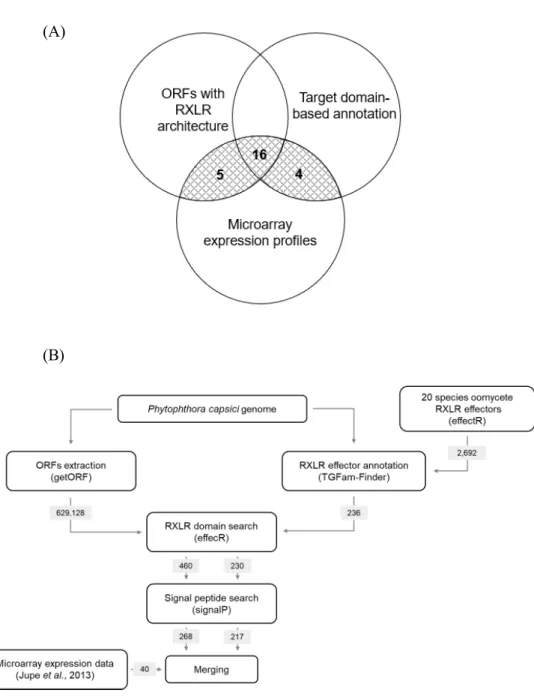
To identify P. capsici RXLR effector candidates, a new pipeline employing three data sets, including ORFs extraction, target domain-based annotation, and microarray expression profiles of a previous study, was devised (Figure 2A). In this pipeline, two separate bioinformatic approaches were used (Figure 2B). In first approach, 268 ORFs with RXLR effector architecture were extracted. In second approach, 217 putative P. capsici RXLR effectors were predicted using RXLR domain-based annotation. The 20 species of oomycete RXLR effector proteins were used as references. These two data sets were merged with the previous microarray expression data set. Total 25 P. capsici effector candidates were selected for further studies.
(A)
(B)
Figure 2. Putative P. capsici RXLR effectors are predicted by serial bioinformatic analysis.
(A) Three separate data sets used in RXLR effector identification pipeline. The number of selected effector genes are indicated in the stripped part of the venn
diagram. (B) Overall scheme of P. capsici effector candidate selection processes. Specific numbers of the genes in each step are shown in the gray boxes. Programs used in each step are given in parenthesis.
Multiple P. capsici RXLR effector candidates induce cell death
in N. benthamiana
To investigate the response of N. benthamiana to P. capsici RXLR effector candidates, 24 effector candidates were transiently overexpressed in N. benthamiana. Recombinant agrobacteria carrying the effector candidates cloned into PVX-based vector pICH31160 were infiltrated into four-week-old N. benthamiana. BCL2 associated X (BAX) and mCherry were used as a positive and a negative control respectively. As a result, P. capsici effector candidates induced varying degrees of cell death in N. benthamiana (Figure 3A). The intensity of cell death was estimated upon the arbitrary scale from 0 to 4 (Figure 3B and 3C). In total, 9 out of 24 P. capsici RXLR effector candidates triggered cell death. Pathogen effectors which act as avirulent factors usually interact with plant NLR proteins to induce HR cell death. These results suggest that the cell death inducing P. capsici RXLR effector candidates could be recognized by endogenous NLR of N. benthamiana and elicit HR phenotype.
(A)
(B) (C)
Figure 3. Multiple P. capsici RXLR effector candidates induce cell death in N.
benthamiana.
(A) Cell death responses triggered by P. capsici RXLR effector candidates. Cell death phenotype was visualized under white and UV light. Pictures were taken at 6 dpi. mCherry and BAX were used as a negative and positive control, respectively. The plus symbol (+) indicates that cell death was observed, and the minus symbol (-) indicates that cell death was not. (B) Cell death index. Intensity of cell death was estimated according to an arbitrary scale from 0 to 4. Index 0 indicates no cell death.
Index 1 indicates only weak glittered cell death observed at abaxial side. Index 2 indicates definite glittered cell death without observed signal under UV condition. Index 3 indicates necrosis-like cell death with weak detection under UV condition. Index 4 indicates a strong cell death similar to BAX. (C) Intensity of cell death induced by P. capsici RXLR effector candidates according to the cell death index. Bars represent mean ± SD of 14 infiltration sites.
Cell death induced by P. capsici effector candidates mimics
hypersensitive cell death
To verify whether cell death induced by the effectors is related to NLR– mediated defense responses, the transcript accumulation of known defense-related genes, including Harpin-induced 1 (Hin1), Pathogenesis-related gene 1 (PR1), and Respiratory burst oxidase homolog B (RbohB), was monitored by quantitative RT-PCR. Hin1 is a common gene used as a cell death marker. It is induced in response to HR-inducing elicitors (Gopalan et al., 1996). PR1 is a plant-inducible defense gene upon the activation of salicylic acid-dependent signaling (Glazebrook, 2005). RbohB is responsible for ROS production which plays a key role in resistance against plant pathogens (Adachi et al., 2015). Randomly selected 5 P. capsici effector candidates were examined. mCherry and a known avr gene, Avrblb2, and its corresponding R gene, Rpiblb2, were used as negative and positive control, respectively. P. capsici effector candidates, mCherry, and Avrblb2-Rpiblb2 were expressed using agrobacterium-mediated transient overexpression in N.
benthamiana leaves. Total RNA was extracted from N. benthamiana leaves at 24, 36,
and 48 hours after infiltration. Overexpression of several effectors resulted in higher transcription level compared to the negative control (Figure 4). Hin1 and RbohB were upregulated by all 5 effectors. In the case of PC12, it did not induce the accumulation of PR1 transcript. These results indicate that cell death induced by P.
Figure 4. Defense-related genes are upregulated by several P. capsici RXLR effector candidates.
Relative expressions of defense-related genes, Hin1, PR1, and RbohB, were examined by quantitative RT-PCR. mCherry and Rpiblb2-Avrblb2 pair were used as a negative and positive control, respectively. Randomly selected 5 P. capsici RXLR effector candidates were infiltrated into four-week-old N. benthamiana and collected at 24, 36, and 48 hours post infiltration (hpi). Transcript levels of the genes were normalized to that of N. benthamiana EF1α. Bars represent mean ± SD (n = 3).
Cell death mediated by P. capsici RXLR effector candidates
are SGT1-depedent
Recent studies show several signaling components are required for NLR-mediated responses. Chaperone, NLRs, and various other components have been identified as signaling nodes of NLR-mediated responses. Therefore, whether cell death induced by P. capsici RXLR effector candidates was dependent on these signaling components or not was tested. VIGS was performed using TRV system to silence NbSGT1, NbNDR1, NbADR1, and NbNRC2/3/4. Cell death-inducing P.
capsici effector candidates were agroinfiltrated in silenced N. benthamiana. In SGT1-silenced N. benthamiana, cell death induced by P. capsici effector candidates
except PC12 was compromised while in NDR1, ADR1, and NRC2/3/4-silenced plants was not (Figure 5A). SGT1, NDR1, ADR1, and NRC2/3/4 transcripts were estimated by qRT-PCR 3 weeks after VIGS (Figure 5B). These results suggest that
P. capsici RXLR effector candidates-mediated cell death is associated with
SGT1-mediated signaling pathway. In addition, these results present the possibility that HR-mimic cell death induced by P. capsici effector candidates are NLR-mediated defense responses.
(A)
Figure 5. SGT1 is required for cell death triggered by P. capsici RXLR effector candidates
(A) Cell death phenotype in signaling components silenced N. benthamiana. Components of NLR-mediated pathway, including SGT1, NDR1, ADR1, and
NRC2/3/4 were silenced. Agrobacteria carrying cell death inducing P. capsici RXLR
effector candidates were infiltrated into silenced N. benthamiana 2-3 weeks after VIGS. Pictures were taken at 6 dpi. The plus symbol (+) indicates that cell death was observed, and the minus symbol (-) indicates that cell death was not. (B) Relative transcript abundance of each gene in silenced N. benthamiana. Relative expression was measured by quantitative RT-PCR. Transcript levels of each gene were normalized to that of N. benthamiana EF1α. Transcript levels of each gene in GFP-silenced N. benthamiana was set as 1. Error bars represent mean ± SD (n = 3). Asterisks denote significant differences: ***P=0.0002, ****P<0.0001.
DISCUSSION
Globally plant diseases cause 220 billion dollars of crop yield losses annually (Chakraborty and Newton, 2011). Nowadays as genetic engineering has emerged as an effective strategy, efforts have been made to unveil the defense mechanisms of plants. Particularly, ETI accompanying HR, the robust defense response of plants, is activated by the perception of effectors by NLRs. Therefore, many attempts have been made to characterize avirulent effectors involved in ETI.
Traditionally, effectors were identified using biochemical and genetic strategies. In recent years, with the advent of genomics, effectors have been identified based on sequence analysis followed by functional studies (Kamoun, 2006). Putative P. capsici RXLR effector candidates were predicted using a newly devised effector identification pipeline (Figure 2). Among putative effectors with signal peptide and RXLR domain, 25 effector candidates which are differentially expressed during early infection stage and biotrophic phase were selected for further studies. The sequence alignment of the selected 25 P. capsici RXLR effector candidates showed low similarities with previous databases in most of the cases. Only two P. capsici RXLR effector candidates, PC21 and PC23, showed high similarities with a known avirulent effector, Avr3a. In addition, 20 candidates out of 25 are present in at least 4 isolates of P. capsici genomes (Reyes-Tena et al., 2019). This implies the potential of the identified P. capsici RXRL effector candidates to be
novel avirulent effectors.
In planta expression assay was performed to investigate whether P. capsici effector candidates induce cell death or not in N. benthamiana. As a result, 9 effector candidates triggered varying degrees of cell death in N. benthamiana (Figure 3). PC12 exhibited as strong cell death as BAX while other 8 effector candidates showed relatively weak cell death. In general, avirulent effectors are recognized by NLRs in plant cells and induce HR cell death in turn (Jones and Dangl, 2006). This suggests that the cell death-inducing P. capsici effector candidates might be recognized by endogenous N. benthamiana NLRs resulting in HR cell death at macroscopic level.
During ETI, defense-related genes are activated besides cell death. The expression of three defense-related marker genes, including Hin1, PR1, and RbohB, which are involved in three different defense-related pathways were examined (Figure 4). Except PC12, all three defense-related genes were upregulated by 4 P. capsici RXLR effector candidates among 5 randomly selected effector candidates. The relatively low expression levels of the 4 effector candidates might be correlated with the cell death intensities. PC6, PC9, PC20, and PC21 exhibited relatively weak cell death compared to Avrblb2-Rpiblb2-mediated cell death. Previous studies show NLR-mediated activation of defense-related genes is associated with HR (Cui et al., 2015). This indicates cell death induced by several P. capsici effector candidates might mimic HR cell death. In the case of PC12, PR1 was not upregulated and RbohB was induced at late time point despite it triggered strong cell death. This suggests
that PC12 might not be involved in defense responses and kill the cell via another mechanism.
Furthermore, HR cell death is the consequence of the series of signaling from the perception of effectors by NLRs. Various components are known to be involved in NLR-mediated signaling. Some NLRs do not perceive effectors directly but act as signaling nodes in downstream of other sensor NLRs (Baggs et al., 2017; Li et al., 2015; Chiang and Coaker, 2015). ADR1 and NRC2/3/4, well known helper NLRs, are required for HR or resistance signaling network (Jubic et al., 2019). There are also non-NLR components, such as NDR1 and SGT1, which are essential for NLR-mediated responses. (Shirasu, 2009; Chiang and Coaker, 2015). Silencing of these certain genes known as signaling components of NLR-mediated cell death was followed. In SGT1-silenced N. benthamiana, cell death induced by 8 out of 9 P. capsici RXLR effector candidates were compromised. SGT1, a molecular chaperone, forms a complex with HSP90 and RAR1 to stabilize NLR folding (Sun et al., 2020). VIGS of RAR1 and HSP90 could be done to understand more about the molecular mechanisms under the cell death. This provides the possibility that the perception of P. capsici RXLR effector candidates by endogenous N. benthamiana NLRs induced HR-mimic cell death. PC12 exhibited as strong cell death in SGT1-silenced N. benthamiana as in GFP-silenced N. benthamiana. This is in keeping with the precedent results. PC12 might not trigger NLR-mediated HR cell death but act as another factor, such as phytotoxin, which induces death in the plant cell.
Overall, in this study novel P. capsici RXLR effector candidates which could act as avirulent factors were identified. The P. capsici effector candidates contribute to the expansion of P. capsici RXLR effector repertoires and the understanding of the mode of action under HR. Identification of corresponding NLRs could be used as sources of the resistance against P. capsici.
REFERENCES
Adachi, H., Nakano, T., Miyagawa, N., Ishihama, N., Yoshioka, M., Katou, Y.,
et al. (2015). WRKY transcription factors phosphorylated by MAPK
regulate a plant immune NADPH oxidase in Nicotiana benthamiana. The Plant Cell, 27, 2645-2663.
Anderson, R. G., Deb, D., Fedkenheuer, K., McDowell, J. M. (2015). Recent progress in RXLR effector research. Mol. Plant Microbe Interact. 28, 1063-1072.
Armenteros, J. J. A., Tsirigos, K. D., Sønderby, C. K., Petersen, T. N., Winther, O., Brunak, S., et al. (2019). SignalP 5.0 improves signal peptide predictions using deep neural networks. Nat. Biotechnol. 37, 420-423. Baggs, E., Dagdas, G., Krasileva, K. V. (2017). NLR diversity, helpers and
integrated domains: making sense of the NLR IDentity. Curr. Opin. Plant Biol. 38, 59-67.
Balint‐Kurti, P. (2019). The plant hypersensitive response: concepts, control and consequences. Mol. Plant Pathol. 20, 1163-1178.
Chakraborty, S., Newton, A. C. (2011). Climate change, plant diseases and food security: an overview. Plant Pathol., 60, 2-14.
Chiang, Y. H., Coaker, G. (2015). Effector triggered immunity: NLR immune perception and downstream defense responses. The Arabidopsis Book. 2015.
Chisholm, S. T., Coaker, G., Day, B., Staskawicz, B. J. (2006). Host-microbe interactions: shaping the evolution of the plant immune response. Cell 124,
803-814.
Cui, H., Tsuda, K., Parker, J. E. (2015). Effector-triggered immunity: from pathogen perception to robust defense. Annu. Rev. Plant Biol. 66, 487-511. Dodds, P. N., Rathjen, J. P. (2010). Plant immunity: towards an integrated view of
plant–pathogen interactions. Nat. Rev. Genet. 11, 539-548.
Glazebrook, J. (2005). Contrasting mechanisms of defense against biotrophic and necrotrophic pathogens. Annu. Rev. Phytopathol. 43, 205-227.
Gopalan, S., Wei, W., & He, S. Y. (1996). Hrp gene‐dependent induction of hin1: a plant gene activated rapidly by both harpins and the avrPto gene‐mediated signal. Plant J. 10, 591-600.
Goritschnig, S., Krasileva, K. V., Dahlbeck, D., Staskawicz, B. J. (2012). Computational prediction and molecular characterization of an oomycete effector and the cognate Arabidopsis resistance gene. PLOS Genet. 8. Jones, P., Binns, D., Chang, H. Y., Fraser, M., Li, W., McAnulla, C., et al. (2014).
InterProScan 5: genome-scale protein function
classification. Bioinformatics 30, 1236-1240.
Jones, J. D., Dangl, J. L. (2006). The plant immune system. Nature 444, 323-329. Jubic, L. M., Saile, S., Furzer, O. J., El Kasmi, F., Dangl, J. L. (2019). Help
wanted: helper NLRs and plant immune responses. Curr. Opin. Plant Biol., 50, 82-94.
Kamoun, S. (2006). A catalogue of the effector secretome of plant pathogenic
oomycetes.Annu. Rev. Phytopathol. 44, 41-60.
Kim, S., Cheong, K., Park, J., Kim, M. S., Kim, J., Seo, M. K., et al. (2020). TGFam‐Finder: a novel solution for target‐gene family annotation in plants. New Phytol.
Lamour, K. H., Stam, R., Jupe, J., Huitema, E. (2012a). The oomycete broad‐ host‐range pathogen Phytophthora capsici. Mol. Plant Pathol. 13, 329-337. Lamour, K. H., Mudge, J., Gobena, D., Hurtado-Gonzales, O. P., Schmutz, J.,
Kuo, A., et al. (2012b). Genome sequencing and mapping reveal loss of heterozygosity as a mechanism for rapid adaptation in the vegetable pathogen Phytophthora capsici. Mol. Plant Microbe Interact. 25, 1350-1360.
Li, X., Kapos, P., Zhang, Y. (2015). NLRs in plants. Curr. Opin. Immunol. 32, 114-121.
McGowan, J., Byrne, K. P., Fitzpatrick, D. A. (2019). Comparative analysis of oomycete genome evolution using the Oomycete Gene Order Browser (OGOB). Genome Biol. Evol. 11, 189-206.
Oh, S. K., Young, C., Lee, M., Oliva, R., Bozkurt, T. O., Cano, L. M., et al. (2009). In planta expression screens of Phytophthora infestans RXLR effectors reveal diverse phenotypes, including activation of the Solanum bulbocastanum disease resistance protein Rpi-blb2. The Plant Cell 21, 2928-2947.
Oh, S. K., Kim, S. B., Yeom, S. I., Lee, H. A., Choi, D. (2010). Positive-selection and ligation-independent cloning vectors for large scale in planta expression for plant functional genomics. Mol. Cells., 30, 557-562.
Reyes-Tena, A., Huguet-Tapia, J. C., Lamour, K. H., Goss, E. M., Rodríguez-Alvarado, G., Vázquez-Marrufo, G., et al. (2019). Genome sequence data of six isolates of Phytophthora capsici from Mexico. Mol. Plant Microbe Interact. 32, 1267-1269.
Rice, P., Longden, I., Bleasby, A. (2000). EMBOSS: the European molecular biology open software suite.
Schornack, S., Huitema, E., Cano, L. M., Bozkurt, T. O., Oliva, R., Van Damme, M., et al. (2009). Ten things to know about oomycete effectors. Mol. Plant Pathol. 10, 795-803.
Segretin, M. E., Pais, M., Franceschetti, M., Chaparro-Garcia, A., Bos, J. I., Banfield, M. J., et al. (2014). Single amino acid mutations in the potato immune receptor R3a expand response to Phytophthora effectors. Mol. Plant Microbe Interact. 27, 624-637.
Shirasu, K. (2009). The HSP90-SGT1 chaperone complex for NLR immune sensors. Annu. Rev. Plant Biol. 60, 139-164.
Sun, Y., Zhu, Y. X., Balint-Kurti, P. J., Wang, G. F. (2020). Fine-tuning immunity: players and regulators for plant NLRs.Trends Plant Sci.
Tabima, J. F., & Grünwald, N. J. (2019). effectR: An expandable R package to predict candidate RxLR and CRN effectors in oomycetes using motif searches. Mol. Plant Microbe Interact. 32, 1067-1076.
Vega-Arreguín, J. C., Jalloh, A., Bos, J. I., Moffett, P. (2014). Recognition of an Avr3a homologue plays a major role in mediating nonhost resistance to Phytophthora capsici in Nicotiana species. Mol. Plant Microbe Interact. 27, 770-780.
Whisson, S. C., Boevink, P. C., Moleleki, L., Avrova, A. O., Morales, J. G., Gilroy, E. M., et al. (2007). A translocation signal for delivery of oomycete effector proteins into host plant cells. Nature 450, 115-118.
ABSTRACT IN KOREAN
오랜 시간동안, 식물과 병원균은 생존을 위해 끊임없이 싸워왔다. 병원균은 식물의 방어 기작을 조절하기 위해 effector 라는 단백질을 식물
세포 안으로 분비한다. 식물체 안에서는 이에 대한 방어 기작으로
nucleotide binding leucine rich repeat (NLR) 단백질이 effector를 인지하여 effector-triggered immunity (ETI)라는 면역 반응을 유도한 다. ETI는 과민성 세포 사멸 반응을 수반하는데, 이는 국소적인 세포 사멸 의 형태로 나타난다. 저항성 자원으로서 면역 반응에 관여하는 NLR을 찾 아내기 위해 effector를 재료로 한 많은 연구들이 진행되었다. 특히 난균 류에 보존되어 있는 RXLR 도메인을 바탕으로 effector-omics 접근이 이루어지고 있다. 본 연구에서는, 과민성 세포 사멸 반응을 보이는 새로운 고추역병균의 RXLR effector후보군을 동정했다. 생물정보학적 분석을 통 해 예측된 25개의 고추역병균 effector 후보군들 중 9개가 Nicotiana benthamiana에 세포 사멸 반응을 유도하였다. 세포 사멸 반응을 유도하 는 effector 후보군들에 의해 방어기작과 관련된 유전자들의 상향조절이 이루어질 뿐 아니라, 세포 사멸에 이르기 위해 과민성 세포 사멸의 하위 신
호 전달 과정중에 관여하는 Supressor of the G2 allele of SKP1
(SGT1)을 필요로 한다는 것을 통해 확인된 effector 후보군들이 N.
으키는데 관여할 것이라는 가능성을 보여주고 있다. 이는 과민성 세포 사멸 반응의 분자생물학적 기작에 대한 이해를 높이는 데에 기여할 뿐 아니라, 고추역병균의 effector 레퍼토리를 확장하는 데에 이바지 할 것이다.
주요어: Effector-triggered immunity (ETI), Nucleotide-binding leucine rich repeat (NLR), 과민성 세포 사멸, RXLR effector, 고추역병균