Besifovir Dipivoxil Maleate 144-Week Treatment of
Chronic Hepatitis B: An Open-Label Extensional Study of
a Phase 3 Trial
Hyung Joon Yim, MD1, Won Kim, MD2, Sang Hoon Ahn, MD3, Jin Mo Yang, MD4, Jae Young Jang, MD5, Yong Oh Kweon, MD6, Yong Kyun Cho, MD7, Yoon Jun Kim, MD8, Gun Young Hong, MD9, Dong Joon Kim, MD10, Young Kul Jung, MD1, Soon Ho Um, MD1, Joo Hyun Sohn, MD11, Jin Woo Lee, MD12, Sung Jae Park, MD13, Byung Seok Lee, MD14, Ju Hyun Kim, MD15, Hong Soo Kim, MD16, Seung Kew Yoon, MD17, Moon Young Kim, MD18, Kwan Sik Lee, MD3, Young Suk Lim, MD19, Wan Sik Lee, MD20and
Kwang-Hyub Han, MD3
INTRODUCTION: Chronic hepatitis B (CHB) remains a major worldwide public health concern. Besifovir dipivoxil maleate (BSV) is a new promising treatment for CHB. However, long-term efficacy and safety have not yet been evaluated. Therefore, the goal of the study is to determine the antiviral efficacy and safety of BSV treatment over a 144-week duration (BSV-BSV) in comparison with those of a sequential treatment with tenofovir disoproxil fumarate (TDF) followed by a 96-week duration BSV administration (TDF-BSV). METHODS: After 48 weeks of a double-blind comparison between BSV and TDF treatments, patients continued the
open-label BSV study. We evaluated antiviral efficacy and drug safety up to 144 weeks for BSV-BSV and TDF-BSV groups. The primary endpoint was a virological response (hepatitis B virus DNA< 69 IU/mL). RESULTS: Among the 197 patients enrolled, 170 and 158 patients entered the second-year and third-year open-label phase extensional study, respectively, whereas 153 patients completed the 144-week follow-up. The virological response rate over the 144-week period was 87.7% and 92.1% in BSV-BSV and TDF-BSV groups, respectively (P 5 0.36). The rates of ALT normalization and HBeAg seroconversion were similar between the groups. No drug-resistant mutations to BSV were noted. Bone mineral density and renal function were well preserved in the BSV-BSV group and were significantly improved after switching therapy in TDF-BSV patients.
DISCUSSION: This extensional study of a phase 3 trial (NCT01937806) suggests that BSV treatment is efficacious and safe for long-term use in treatment-na¨ıve and TDF-experienced patients with CHB.
SUPPLEMENTARY MATERIALaccompanies this paper athttp://links.lww.com/AJG/B485,http://links.lww.com/AJG/B491
Am J Gastroenterol 2020;115:1217–1225. https://doi.org/10.14309/ajg.0000000000000605
INTRODUCTION
Chronic hepatitis B (CHB) remains a major worldwide public health problem despite the presence of effective vaccines and potent antivirals (1,2). Although the prevalence of chronic
hepatitis B virus (HBV) infection was significantly reduced after the introduction of a universal HBV vaccination program in many Asian countries, new cases of HBV infection are still reported, even in low-prevalence areas (3–5). In South Korea,
1Department of Internal Medicine, Korea University College of Medicine, Seoul, Korea;2Department of Internal Medicine, Seoul National University College of Medicine, Seoul Metropolitan Government Boramae Medical Center, Seoul, Korea;3Department of Internal Medicine, Yonsei University College of Medicine, Seoul, Korea;4Department of Internal Medicine, Catholic University Medical College St. Vincent, Suwon, Korea;5Department of Internal Medicine, College of Medicine, Soonchunhyang University, Seoul, Korea;6Department of Internal Medicine, Kyungpook National University College of Medicine, Daegu, Korea;7Department of Internal Medicine, Kangbuk Samsung Hospital, Sungkyunkwan University School of Medicine, Seoul, Korea;8Department of Internal Medicine, Liver Research Institute, Seoul National University College of Medicine, Seoul, Korea;9
Department of Internal Medicine, Kwangju Christian Hospital, Gwangju, Korea; 10Department of Internal Medicine, Hallym University College of Medicine, Chuncheon, Korea;11Department of Internal Medicine, Hanyang University College of Medicine, Seoul, Korea;12
Department of Internal Medicine, Inha University College of Medicine, Incheon, Korea;13
Department of Internal Medicine, Paik Hospital, Inje University, Busan, Korea;14Department of Gastroenterology and Hepatology, Chungnam National University School of Medicine, Daejeon, Korea; 15
Department of Internal Medicine, Gacheon University College of Medicine, Incheon, Korea;16
Department of Internal Medicine, Soonchunhyang University College of Medicine, Cheonan, Korea;17Department of Internal Medicine, Catholic University of Korea, Seoul, Korea;18Department of Internal Medicine, Yonsei University Wonju College of Medicine, Wonju, Korea;19Department of Gastroenterology, Asan Medical Center, University of Ulsan College of Medicine, Seoul, Korea; 20Department of Internal Medicine, Chonnam University Medical School, Gwangju, Korea. Correspondence: Kwang-Hyub Han, MD. E-mail: [email protected]. Received October 25, 2019; accepted February 26, 2020; published online May 1, 2020
CHB still has a significant impact on public health, considering that the hepatitis B surface antigen (HBsAg) is detected in 60%–70% of patients with liver cirrhosis (5) and 65%–75% of patients with hepatocellular carcinoma (HCC) (6,7).
Currently, second-generation nucleos(t)ide analogs (NAs), such as entecavir, tenofovir disoproxil fumarate (TDF), and
tenofovir alafenamide fumarate (TAF), which have high genetic barriers to resistance and potent viral suppression activity, are used as primary treatments of CHB (8).
Besifovir dipivoxil maleate (BSV), an acyclic nucleotide phosphonate (a guanosine monophosphate), has been tested in several phase Ia/IIb studies and has shown potent suppression of
Not determined 1 (1.2) 0 (0.0)
HBV DNA (log10IU/mL) 6.3 (1.7) 6.5 (1.5) 0.62
ALT (U/L) 106.15 (101.6) 128.41 (141.8) 0.36
ALT. ULN by central lab criteriaa 78 (96.3) 71 (93.4) 0.48
ALT normalization by central lab criteria 3 (3.7) 5 (6.6)
eGFR by MDRD (mL/min) 89.74 (14.8) 91.97 (13.7) 0.36
Creatinine (mg/dL) 0.86 (0.2) 0.84 (0.1) 0.43
Phosphate (mg/dL) 3.54 (0.5) 3.44 (0.6) 0.29
Total hip bone mineral density clinical status, nb
70 58 0.80
Normal (T-score$ 21.0) 58/70 (82.9) 49/58 (84.5)
Osteopenia (22.5 # T-score , 21.0) 12/70 (17.1) 9/58 (15.5)
Osteoporosis (T-score, 22.5) 0 (0.0) 0 (0.0)
Data not collected 11 18
Spine bone mineral density clinical status, nc 73 62 0.67
Normal (T-score$ 21.0) 50/73 (68.5) 40/62 (64.5)
Osteopenia (22.5 # T-score , 21.0) 19/73 (26.0) 20/62 (32.3)
Osteoporosis (T-score, 22.5) 4/73 (5.5) 2/62 (3.2)
Data not collected 8 14
Concurrent history 64 (79.0) 50 (65.8) 0.06
Mild renal impairmentc 48 (59.3) 40 (52.6) 0.40
Cirrhosis 19 (23.5) 14 (18.4) 0.44
Cardiovascular disease 0 (0.0) 0 (0.0) —
Diabetes mellitus 12 (12.8) 4 (4.3) 0.05
Hypertension 11 (11.7) 10 (10.8) 0.94
Hyperlipidemia 2 (2.1) 2 (2.2) 1.00
Prior antiviral therapy 0 (0.0) 1 (1.1)a 0.48
Data are number (%), n/N (%), or mean (SD) unless otherwise stated.P value: 2-sample t test or Wilcoxon rank-sum test for continuous variables and x2test or Fisher exact test for categorical variables.
ALT, alanine aminotransferase; BMD, bone mineral density; BMD, bone mineral density; BSV, besifovir dipivoxil maleate; eGFR, estimated glomerular filtration rate; HBeAg, hepatitis B e antigen; HBV, hepatitis B virus; MDRD, modification of diet in renal disease; TDF, tenofivir disoproxil fumarate; ULN, upper limit of normal.
aThirty-three U/L for women, 41 U/L for men. bFor BMD, some data were not collected. c50
HBV replication (9–12). BSV was approved for the treatment of chronic HBV infection in May 2017 in South Korea after we performed a randomized, multicenter, double-blind phase 3 study comparing the efficacy and safety of once-daily treat-ment with BSV vs TDF for 48 weeks in na¨ıve patients with CHB (13). We reported that BSV elicited minor side effects on the kidneys and bones, with antiviral efficacy comparable with that of TDF over 48 weeks of treatment (13). This study was planned as an open-label follow-up study in which patients receive BSV for 7 years after initial treatment with BSV or TDF.
The aim of this study was to compare the antiviral efficacy and safety of a BSV solo treatment (BSV-BSV) over a 144-week period with a 48-week TDF treatment, followed by a 96-week BSV se-quential treatment (TDF-BSV).
METHODS Study design
This experimental study took over a 144-week period of treating patients with hepatitis B in South Korea. Thefirst 48 weeks cor-responded to a double-blind, randomized, multicenter,
noninferiority, controlled trial comparing BSV (Ildong Phar-maceutical, Seoul, Korea) with TDF (Gilead Sciences, Foster City, CA) treatments. Patients from that study who were suited to continue a single-arm, open-label trial received BSV for an ad-ditional 96 weeks. Written informed consent for both the 48-week initial phase and the open-label phase was obtained from all study participants. This study was conducted with the approval of the Human Research Ethics Committee in the 22 participating hos-pitals in the Republic of Korea, following the Declaration of Helsinki and all other applicable guidelines, laws, and regulations. Detailed descriptions of the study design, sample size estimates, eligibility criteria, and overall study population have been pre-viously reported (13).
Bone mineral density, noninvasive fibrosis test, and re-sistance surveillance were regularly performed (see Supple-mentary Material, SuppleSupple-mentary Digital Content 1, http:// links.lww.com/AJG/B491). Particularly, FIB-4 and aspartate aminotransferase-to-platelet ratio indexes (APRI) were an-nually estimated to assess liver fibrosis (see Table, Supple-mentary Digital Content 2 for formula used, http://links.lww. com/AJG/B485).
Figure 1.Patient disposition. BSV, besifovir dipivoxil maleate; CPK, creatinine phosphokinase; FAS, full analysis set; HBV, hepatitis B virus; HCC, hepatocellular carcinoma; IP, investigational product; PPS, per-protocol set; TDF, tenofovir disoproxil fumarate.
Subjects
Patients with CHB younger than 20 years of age and HBsAg-positive for at least 6 months before screening were eligible. Sub-jects with HBV DNA levels.17,241 IU/mL (1 3 105copies/mL)
and. 1,724 IU/mL (1 3 104copies/mL), who tested positive and
negative for hepatitis B e-antigen (HBeAg), respectively, were randomized 1:1 into BSV or TDF treatment groups for 48 weeks. To maintain blinding of investigators and subjects, subjects in the BSV group were given BSV 150 mg with L-carnitine 660 mg as a supplement and TDF placebo, whereas those in the TDF group were given TDF 300 mg with L-carnitine as a BSV placebo. After 48 weeks, the patients continued on BSV or were switched to BSV 150 mg with L-carnitine 660 mg during the open-label phase for up to 144 weeks. Endpoints
The efficacy endpoint was the proportion of subjects with a viro-logical response, defined as HBV DNA ,69 IU/mL at week 144. Other efficacy and safety endpoints, including the proportions of subjects with undetectable HBV DNA levels (,20 IU/mL),
changes of serum HBV DNA levels, HBsAg or HBeAg serocon-version, alanine aminotransferase (ALT) normalization, drug re-sistance, adverse events (AEs), bone mineral density (BMD), renal function-related parameters, fibrosis parameters, incidences of HCC, and other abnormalities, were assessed.
Laboratory tests and assessments
All laboratory data during the trial were collected at 12-week intervals via the Central Lab (GC abs, Yongin, Korea). HBV DNA quantification was performed using a COBAS AmpliPrep/ TaqMan test (Roche Diagnostics, Indianapolis, IN) with a lower detection limit of 20 IU/mL. Other laboratory methods were followed as previously reported (13).
Bone mineral density, non-invasivefibrosis test, and resistance surveillance were regularly performed (see Supplementary Material, Supplementary Digital Content 1, http://links.lww.com/ AJG/B491). Particularly, FIB-4 and aspartate aminotransferase-to-platelet ratio indexes (APRI) were annually estimated to assess liver
ALT normalization, n (%)c 69 (71.1) 71 (74.7) 0.57 66 (81.5) 67 (88.2) 0.25
Data are expressed as n (%), unless stated otherwise.P value: Pearson x2test/Fisher exact test.
ALT, alanine aminotransferase; BSV, besifovir dipivoxil maleate; HBeAg, hepatitis B e antigen; HBsAg, HBeAg, hepatitis B surface antigen; TDF, tenofovir disoproxil fumarate.
aAmong HBeAg-seropositive patients at baseline. bAmong HBsAg-seropositive patients at baseline.
cAmong patients with baseline ALT levels above the central lab normal range (0
–41 U/L for males and 0–33 U/L for females).
Figure 2.Viral suppression by study visit. (a) Proportions of patients with HBV DNA,69 IU/mL as determined by the FAS. (b) Proportions of patients with HBV DNA,20 IU/mL as determined by FAS. Bars represent 95% confidence intervals. BSV, besifovir dipivoxil maleate; FAS, full analysis set; HBV, hepatitis B virus; TDF, tenofovir disoproxil fumarate.
fibrosis (see Table, Supplementary Digital Content 2 for formula used, http://links.lww.com/AJG/B485).
Statistical analysis
For primary efficacy analysis, proportions of patients with HBV DNA,69 IU/mL were determined using the full analysis set (FAS), which included all patients who received at least one in-vestigational product and completed at least one efficacy evalu-ation. Per-protocol analysis was performed after excluding consent withdrawals and major protocol violators from the FAS population.
Differences in the baseline characteristics and secondary endpoints between the groups were tested using an independent 2-sample t test or Wilcoxon rank-sum test for continuous vari-ables and ax2test or Fisher exact test for categorical variables. We
followed the CONSORT guidelines for randomized controlled trials.
RESULTS Study population
Of 197 patients who were initially randomly assigned, 170 (86%) entered the second year, 158 (80%) entered the third year ex-tensional study, andfinally 153 completed all 144 weeks of follow-up (Figure 1). Of 157 patients (81 in BSV-BSV and 76 in TDF-BSV) who qualified for the FAS at 144 weeks, 145 were included for the PPS analysis. The baseline characteristics for both treat-ment groups were well-balanced (Table 1). Considering both the groups, 65.6% patients enrolled were men, with a mean age of 45 years. Subjects positive for HBeAg represented 63.0% in the BSV-BSV group and 56.6% in the TDF-BSV-BSV group, with the most common HBV genotype being C. For BSV-BSV and TDF-BSV groups, the means of HBV DNA at the baseline were 6.3 and 6.5 log10IU/mL, respectively. More than half of the patients showed
a normal T-score in the hip and/or spine at the baseline (64.5%–84.5%). Although the BSV-BSV group was more likely to have concurrent histories, including cirrhosis and diabetes mel-litus, at the baseline, no statistically significant differences were noted between the groups.
Efficacy
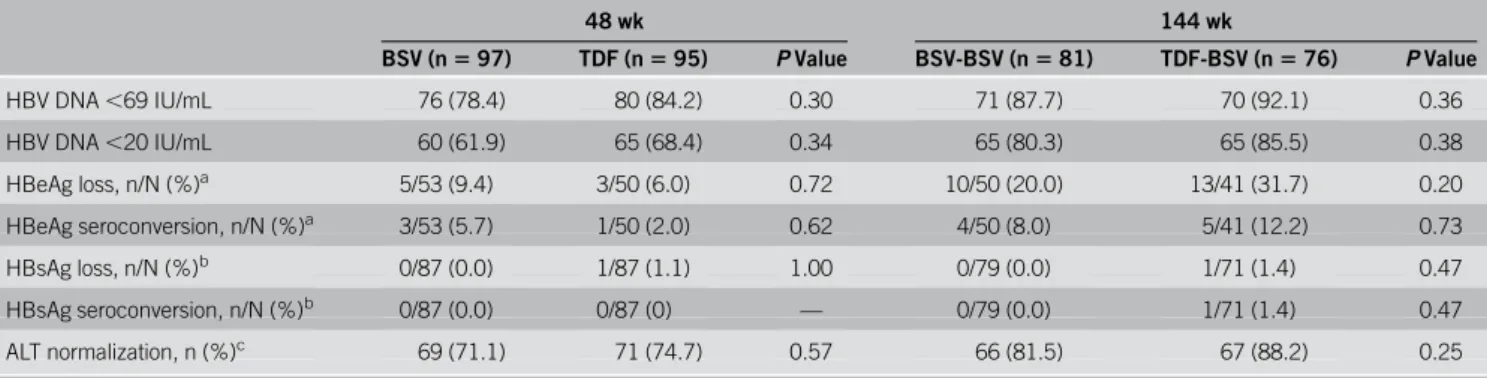
Virological response. The rate of virological response (HBV DNA, 69 IU/mL) in BSV-BSV was 87.7% (71/81), whereas 92.1% (70/76) of patients who switched the treatment from TDF to BSV responded up to 144 weeks, indicating that the BSV-BSV group met the efficacy endpoint of noninferiority with pre-determined215% margin to BSV-TDF according to the FAS (lower bound 95% CI 5 213.8%, P 5 0.36) (Table 2 and Figure 2a). The complete virological response with the lower limit of HBV DNA quantification (,20 IU/mL) was 80.3% (65/ 81) among the BSV-BSV patients and 85.5% (65/76) in the TDF-BSV group at week 144 (P5 0.38) (Table 2 and Figure 2b). Similar results were observed in the PPS (see Figure, Supple-mentary Digital Content 3A, 3B, http://links.lww.com/AJG/ B485) (HBV DNA, 69 IU/mL, 92.1% vs 95.7%, P 5 0.50; HBV DNA, 20 IU/mL, 84.2% vs 88.4%, P 5 0.46; in BSV-BSV vs TDF-BSV, respectively).
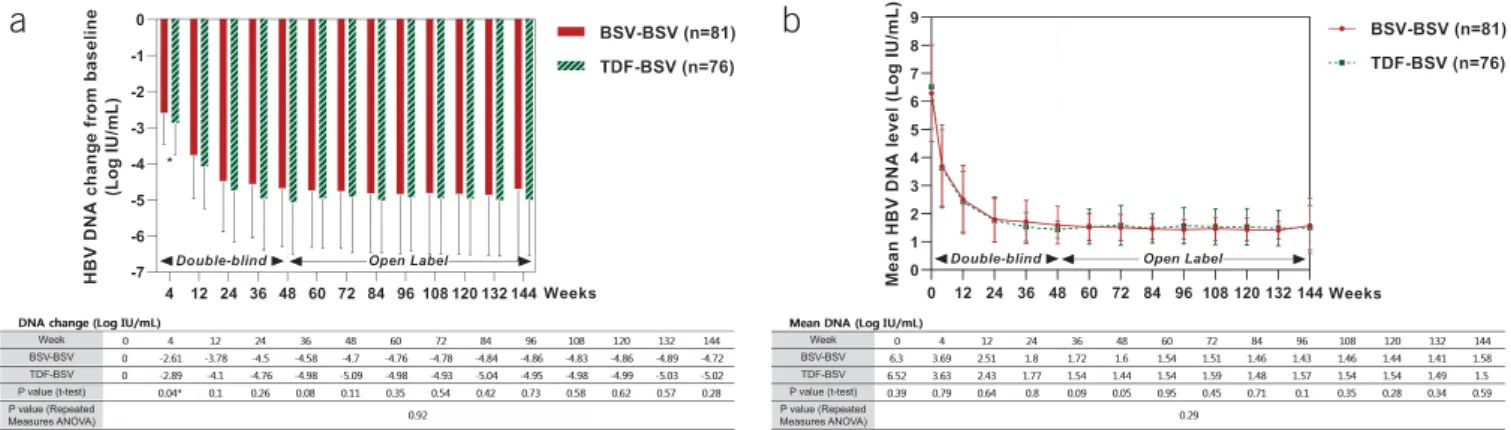
Antiviral responses from the baseline during every follow-up visit until week 144 are shown in Figure 3. During thefirst 48 weeks, the degree of HBV DNA reduction was not significantly different between the 2 groups (Figure 3a), except for at the end of thefirst month. Mean HBV DNA decreased to ,2 log10IU/mL
Figure 3.Antiviral responses by study visit (weeks). (a) Degree of HBV DNA reduction (log IU/mL). (b) Mean HBV DNA level (log IU/mL). ANOVA, analysis of variance; BSV, besifovir dipivoxil maleate; HBV, hepatitis B virus; TDF, tenofovir disoproxil fumarate.
Table 3. Improvements in noninvasive fibrosis markers FIB-4 and
APRI indexes at 144 weeks
BSV-BSV (n5 81) TDF-BSV (n 5 76) P valuea P valueb FIB-4 Baseline 2.12 (2.07) 1.92 (1.14) — — 144 wk 1.32 (0.76) 1.27 (0.83) — — Change 20.80 (1.77) 20.65 (0.92) 0.79 0.54 P valuec ,0.0001 ,0.0001 APRI Baseline 1.22 (1.31) 1.35 (1.32) — — 144 wk 0.40 (0.30) 0.39 (0.38) — — Change 20.82 (1.33) 20.97 (1.31) 0.30 0.29 P valuec ,0.0001 ,0.0001
Data are expressed as mean (standard deviation), unless otherwise stated. APRI, aspartate aminotransferase-to-platelet ratio index; BSV, besifovir dipivoxil maleate; TDF, tenofovir disoproxil fumarate.
aBetween-group: Wilcoxon rank-sum test.
bBetween-group: mixed model with repeated measures (every 12 weeks measurement).
cWithin-group: Wilcoxon signed-rank test.
levels at week 24 and remained stable for 144 weeks (Figure 3b). No significant differences between the 2 groups were observed during the 144 weeks (Figure 3b).
Biochemical and serological responses.Among HBeAg-positive patients, the cumulative incidences of HBeAg loss at 144 weeks were 20.0% (10/50) in the BSV-BSV group and 31.7% (13/41) in the TDF-BSV group (P5 0.20). The incidences of HBeAg sero-conversion were 8.0% (4/50) and 12.2% (5/41) in the BSV-BSV and TDF-BSV groups, respectively (P5 0.73). There was no significant difference in HBeAg serological responses between both groups (Table 2); only one patient (1.4%, 1/71) in the TDF-BSV group showed HBsAg loss during the 144 weeks (Table 2). ALT levels normalized in 81.5% (66/81) and 88.2% (67/76) subjects in the BSV-BSV and TDF-BSV groups after 144 weeks, with no significant difference between the groups (P 5 0.25) (Table 2).
Subgroup analysis. Biochemical, serological, and virological responses were separately evaluated in HBeAg-positive and HBeAg-negative patients according to the baseline HBeAg status for FAS and PPS (see Tables, Supplementary Digital Content 4 and 5, http://links.lww.com/AJG/B485; see Figure, Supplemen-tary Digital Content 6, http://links.lww.com/AJG/B485).
In the FAS, all HBeAg-negative patients reached HBV DNA ,69 IU/mL at week 144. Only one patient in each group did not achieve a complete virological response (HBV DNA, 20 IU/mL) by week 144. There was no difference in virological response rates among HBeAg-negative patients.
Among HBeAg-positive patients, the proportions who ach-ieved HBV DNA,69 IU/mL were 80.4% (41/51) in the BSV-BSV and 86.1% (37/43) in the TDF-BSV group (P5 0.47). The rates of HBV DNA,20 IU/mL were 70.6% (36/51) and 76.7% (33/43), respectively (P5 0.50). There was no difference in virological patients Nasopharyngitis 14 (17.3) 14 (18.4) 3 (3.7) 4 (5.3) Dyspepsia 8 (9.9) 10 (13.2) 1 (1.2) 1 (1.3) Headache 6 (7.4) 3 (4.0) 1 (1.2) 1 (1.3) Back pain 6 (7.4) 4 (5.3) 3 (3.7) 3 (4.0) Fatigue 5 (6.2) 5 (6.6) 1 (1.2) 2 (2.6) Pruritus 3 (3.7) 4 (5.3) 0 1 (1.3) Gastritis 2 (2.5) 9 (11.8) 1 (1.2) 8 (10.5) Nausea 5 (6.2) 1 (1.3) 0 0 ALT elevation 6 (7.4) 2 (2.6) 2 (2.5) 0 Diarrhea 3 (3.7) 5 (6.6) 2 (2.5) 0 Urticaria 1 (1.2) 5 (6.6) 0 0 Dizziness 8 (9.9) 0 3 (3.7) 0
Renal-related adverse events
Proteinuria 0 1 (1.3) 0 1 (1.3)
Phosphate, 2.5 mg/dL 9 (11.1) 16 (21.1) 6 (7.4) 5 (6.6)
eGFR, 50 mL/min 1 (1.2) 2 (2.6) 0 1 (1.3)
Bone related adverse events
Fracturea 2 (2.5) 1 (1.3) 1 (1.2) 0
Total-carnitine level at week 144
Decrease 1 (1.2) 1 (1.3) — —
Increase 31 (38.3) 28 (36.8) — —
Data are expressed as n (%), unless stated otherwise.
ALT, Alanine aminotransferase; BSV, besifovir dipivoxil maleate; eGFR, estimated glomerular filtration rate; TDF, tenofovir disoproxil fumarate. aAdverse event due to trauma or accident.
response rates between both the groups when considering HBeAg-positive patients.
Virological breakthrough and resistance surveillance. Both groups showed no antiviral resistance for 144 weeks. The pro-portions of patients who experienced virological breakthrough between 96 and 144 weeks were 4.9% (4/81) in the BSV-BSV group and 7.9% (6/76) in the TDF-BSV group, with no significant difference between the groups. However, serum HBV DNA be-came undetectable in all these patients without modifying the therapy during follow-up. DNA sequencing was performed for patients who experienced a virological breakthrough, confirming that new mutations that caused by amino acid substitutions were not detected in the HBV conserved sites.
Noninvasivefibrosis markers: FIB-4 and APRI. The FIB-4 and APRI indexes significantly improved at 144 weeks vs baseline in both groups (Table 3; see Table, Supplementary Digital Content 7, http://links.lww.com/AJG/B485). FIB-4 improved from 2.12 to 1.32 and APRI from 2.12 to 0.4 in the BSV-BSV group. Likewise, FIB-4 improved from 1.92 to 1.27 and APRI from 1.35 to 0.39 in the TDF-BSV group, respectively (all P, 0.001). According to
these results, the degree of hepaticfibrosis significantly decreased in both the BSV-BSV and TDF-BSV groups over the duration of drug administration. There was no significant difference in FIB-4 and APRI values between both the groups.
Safety
Adverse events.After reporting AEs during the 96-week study (13), 3 serious AEs occurred: HCC in one patient from the BSV-BSV group and HCC and type 2 diabetes mellitus in 2 patients of the TDF-BSV group (Table 4). However, the investigator con-firmed that all 3 patients could continue the study. No serious adverse drug reactions or death was newly reported during 96–144 weeks in the study. L-carnitine levels were measured during every follow-up visit. These levels were stably main-tained, with only one patient in each group exhibiting a de-creased level.
The median changes in eGFR from the baseline were20.5, 20.7, and20.5 mL/min at 48, 96, and 144 weeks, respectively, for the BSV-BSV group, indicating no effect of BSV-BSV on renal function. On the contrary, for the TDF-BSV group, the median changes in eGFR levels from baseline were27.8, 20.4, and 20.8 mL/min at 48, 96, and 144 weeks, respectively; therefore, the recovered renal function after switching to BSV at 49 weeks was maintained up to 144 weeks (Figure 4). There was no incidence of acute kidney injury in the 2 groups.
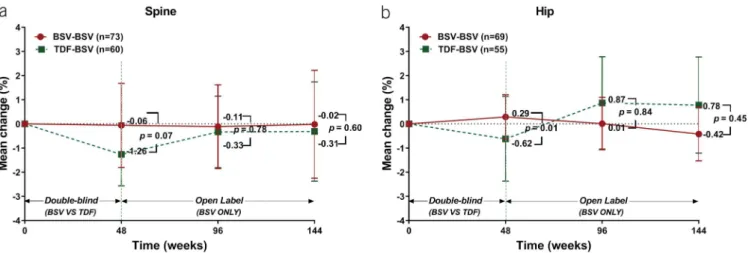
The mean percent change in spine BMD from the baseline to week 144 was20.02% (95% CI: 22.25 to 2.22) for the BSV-BSV (P5 0.59) and 20.31% (95% CI: 22.37 to 1.74) for the TDF-BSV (P5 0.93) group. This difference was not significant (Figure 5a). The mean percent change in hip BMD from the baseline to week 144 was20.42% (95% CI: 21.53 to 0.7) for the BSV-BSV (P5 0.10) and 0.78% (95% CI: 21.21 to 2.77) for the TDF-BSV group. This difference was not significant (Figure 5b).
DISCUSSION
The incidence of HBV infection is decreasing worldwide be-cause of improved socioeconomic status, universalization of vaccine programs, and effective antiviral treatments (1,4). However, population movements are now affecting the occur-rence and prevalence of HBV in several low-endemic countries
Figure 4.Median changes from baseline in eGFR (MDRD) by study week. Data are presented as median (Q1, Q3) values (mL/min). BSV, besifovir dipivoxil maleate; eGFR, estimated glomerular filtration rate; MDRD, modification of diet in renal disease; TDF, tenofovir disoproxil fumarate.
Figure 5.Changes in BMD. (a) Mean percentage changes in the spine at weeks 48, 96, and 144 of treatment. Bars represent 95% confidence interval. (b) Mean percentage changes in the hip at weeks 48, 96, and 144 of treatment. Bars represent 95% confidence intervals. BMD, bone mineral density; BSV, besifovir dipivoxil maleate; TDF, tenofovir disoproxil fumarate.
level after switching to BSV, and it was maintained up to 144 weeks. BSV treatment also showed a favorable safety profile regarding renal parameters. No viral resistance was detected during the course of the 144-week treatment. We also con-firmed the improvement of fibrosis applying the FIB-4 and APRI tests.
A recent 3–year study showed that TAF was associated with a lower risk of BMD decline and nephrotoxicity (20). The mean BMDs decreased from the baseline to week 144 of therapy (hip: 22.49 vs 20.41, P , 0.001; spine: 22.01 vs 20.51, P , 0.001; in TDF and TAF groups, respectively). We also observed a signif-icant decrease in BMD in the TDF group relative to that in the BSV group at 48 weeks. However, in the group of patients re-ceiving BSV for 144 weeks, the BMD mean changes from the baseline were 20.42 (hip) and 0.02 (spine), similar to those results obtained with TAF. Treatment with BSV and TAF also showed similar trends in eGFR changes over 3 years (eGFRMDRD
for BSV,20.5 vs eGFRCGfor TAF,21.2). Although it is difficult
to perform a direct comparison between BSV and TAF treat-ments, they seem to be similar for preserving renal function and bone density.
Improvements infibrosis after antiviral treatment have been previously reported by histology (21,22). Although liver biopsy is the accepted standard method for the assessment of hepatic fi-brosis, repeated evaluations are difficult to perform because of cost, the risk of life-threatening complications, and a lack of available expertise (23–25). Therefore, we analyzed the extent of liverfibrosis using FIB-4 and APRI as biomarkers, as indicated by previous studies (26–28). Importantly, in 2 noninvasive fibrosis tests, our results showed a clearfibrosis improvement on BSV administration.
Carnitine depletion was the most common side effect of BSV (11,12). Therefore, BSV was supplemented with 660 mg of L-carnitine. Carnitine concentrations were closely moni-tored during the study period and at week 144. Except for one patient in each group who evidenced an increase in carnitine levels, patients were generally stably maintained with the supplementation and none experienced clinical features of carnitine deficiency, such as hypoglycemia, hypoketosis, and encephalopathy.
This study has several limitations. Although the general safety concerns related to nephrotoxicity can be ignored in the BSV group considering the rate of decline of eGFR, additional markers related to renal function, such as urinary albumin, fractional excretion of uric acid, and urinary beta-2 micro-globulin, were not evaluated. Moreover, no assessments of bone turnover markers for the estimation of bone formation or re-sorption were performed, although it is recommended for
ACKNOWLEDGMENTS
We would like to thank Editage (www.editage.com) for English language editing and publication support.
CONFLICTS OF INTEREST
Guarantor of the article: Kwang-Hyub Han, MD.
Specific author contributions: H.J.Y. wrote the manuscript and performed the formal analysis and critical revision. K.H.H.: was in-volved in the study conception, design, and supervision. All the other authors contributed to data acquisition and revision of the manuscript.
Financial support: This work was supported by Ildong Pharmaceutical. This sponsor had a partial role in study design, collection, analysis, and interpretation of data.
Potential competing interests: K.H.H. received grants from the clinical trial sponsor Ildong Pharmaceutical. All the other authors declare no conflicts of interest.
REFERENCES
1. European Association for the Study of the Liver. EASL 2017 clinical practice guidelines on the management of hepatitis B virus infection. J Hepatol 2017;67:370–98.
2. Schweitzer A, Horn J, Mikolajczyk RT, et al. Estimations of worldwide prevalence of chronic hepatitis B virus infection: A systematic review of data published between 1965 and 2013. Lancet 2015;386:1546–55. 3. Nelson NP, Easterbrook PJ, McMahon BJ. Epidemiology of hepatitis B
virus infection and impact of vaccination on disease. Clin Liver Dis 2016; 20:607–28.
Study Highlights
WHAT IS KNOWN
3
BSV is a new treatment of chronic hepatitis B virus infection.3
BSV has an antiviral efficacy comparable with that of TDF over48 weeks.
3
BSV has a better safety profile than TDF in terms of bone and renal outcomes.WHAT IS NEW HERE
3
BSV demonstrated durable and potent antiviral activity over 144 weeks.3
Approximately 88% of subjects had HBV DNA,69 IU/mL without antiviral resistance mutations.3
Long-term BSV treatment for chronic hepatitis B is safe and improves fibrosis.4. Cho EJ, Kim SE, Suk KT, et al. Current status and strategies for hepatitis B control in Korea. Clin Mol Hepatol 2017;23:205–11.
5. Chae HB, Kim JH, Kim JK, et al. Current status of liver diseases in Korea: Hepatitis B. Korean J Hepatol 2009;15:S13–24.
6. Cheon JH, Park JW, Park KW, et al. The clinical report of 1,078 cases of hepatocellular carcinomas: National Cancer Center experience. Korean J Hepatol 2004;10:288–97.
7. Kim SR, Kudo M, Hino O, et al. Epidemiology of hepatocellular carcinoma in Japan and Korea. A review. Oncology 2008;75:13–6. 8. Buti M, Riveiro-Barciela M, Esteban R. Long-term safety and efficacy of
nucleo(t)side analogue therapy in hepatitis B. Liver Int 2018;38(Suppl 1): 84–9.
9. Yuen MF, Kim J, Kim CR, et al. A randomized placebo controlled, dose-finding study of oral LB80380 in HBeAg-positive patients with chronic hepatitis B. Antivir Ther 2006;11:977–83.
10. Yuen MF, Han KH, Um SH, et al. Antiviral activity and safety of LB80380 in hepatitis B e antigen-positive chronic hepatitis B patients with lamivudine-resistant disease. Hepatology 2010;51:767–76.
11. Lai CL, Ahn SH, Lee KS, et al. Phase IIb multicentred randomised trial of besifovir (LB80380) versus entecavir in Asian patients with chronic hepatitis B. Gut 2014;63:996–1004.
12. Yuen MF, Ahn SH, Lee KS, et al. Two-year treatment outcome of chronic hepatitis B infection treated with besifovir vs. entecavir: Results from a multicentre study. J Hepatol 2015;62:526–32.
13. Ahn SH, Kim W, Jung YK, et al. Efficacy and safety of besifovir dipivoxil maleate compared with tenofovir disoproxil fumarate in treatment of chronic hepatitis B virus infection. Clin Gastroenterol Hepatol 2019;17: 1850–9.
14. Coppola N, Alessio L, Gualdieri L, et al. Hepatitis B virus, hepatitis C virus and human immunodeficiency virus infection in undocumented migrants and refugees in southern Italy, January 2012 to June 2013. Euro Surveill 2015;20:30009.
15. Hampel A, Solbach P, Cornberg M, et al. Current seroprevalence, vaccination and predictive value of liver enzymes for hepatitis B among refugees in Germany. Bundesgesundheitsblatt Gesundheitsforschung Gesundheitsschutz 2016;59:578–83.
16. Levy V, Yuan J, Ruiz J, et al. Hepatitis B sero-prevalence and risk behaviors among immigrant men in a population-based household survey in low-income neighborhoods of northern California. J Immigr Minor Health 2010;12:828–33.
17. Coppola N, Alessio L, Gualdieri L, et al. Hepatitis B virus infection in undocumented immigrants and refugees in southern Italy: Demographic, virological, and clinical features. Infect Dis Poverty 2017;6:33.
18. Stanaway JD, Flaxman AD, Naghavi M, et al. The global burden of viral hepatitis from 1990 to 2013: Findings from the global burden of disease study 2013. Lancet 2016;388:1081–8.
19. Korean Association for the Study of the Liver (KASL). KASL clinical practice guidelines for management of chronic hepatitis B. Clin Mol Hepatol 2019;25:93–159.
20. Chan HLY, Lim YS, Seto WK, et al. 3-year efficacy and safety of tenofovir alafenamide compared with tenofovir disoproxil fumarate in HBeAg-negative and -positive patients with chronic hepatitis B. Hepatology 2018; 68(Suppl 1):227–8A.
21. Lai CL, Shouval D, Lok AS, et al. Entecavir versus lamivudine for patients with HBeAg-negative chronic hepatitis B. N Engl J Med 2006;354: 1011–20.
22. Marcellin P, Gane E, Buti M, et al. Regression of cirrhosis during treatment with tenofovir disoproxil fumarate for chronic hepatitis B: A 5-year open-label follow-up study. Lancet 2013;381:468–75.
23. Spinzi G, Terruzzi V, Minoli G. Liver biopsy. N Engl J Med 2001;344:2030. 24. Maharaj B, Maharaj RJ, Leary WP, et al. Sampling variability and its
influence on the diagnostic yield of percutaneous needle biopsy of the liver. Lancet 1986;1:523–5.
25. Seeff LB, Everson GT, Morgan TR, et al. Complication rate of percutaneous liver biopsies among persons with advanced chronic liver disease in the HALT-C trial. Clin Gastroenterol Hepatol 2010;8:877–83. 26. Kim WR, Loomba R, Berg T, et al. Impact of long-term tenofovir
disoproxil fumarate on incidence of hepatocellular carcinoma in patients with chronic hepatitis B. Cancer 2015;121:3631–8.
27. Lin CL, Liu CH, Wang CC, et al. Serum biomarkers predictive of significant fibrosis and cirrhosis in chronic hepatitis B. J Clin Gastroenterol 2015;49:705–13.
28. Sonneveld MJ, Brouwer WP, Chan HL, et al. Optimisation of the use of APRI and FIB-4 to rule out cirrhosis in patients with chronic hepatitis B: Results from the SONIC-B study. Lancet Gastroenterol Hepatol 2019;4:538–44. 29. Kim BK, Kim DY, Park JY, et al. Validation of FIB-4 and comparison with
other simple noninvasive indices for predicting liverfibrosis and cirrhosis in hepatitis B virus-infected patients. Liver Int 2010;30:546–53.
This is an open-access article distributed under the terms of the Creative Commons Attribution-Non Commercial-No Derivatives License 4.0 (CCBY-NC-ND), where it is permissible to download and share the work provided it is properly cited. The work cannot be changed in any way or used commercially without permission from the journal.