COVID-19 Variant Surveillance in the Republic of Korea
Coronavirus disease (COVID-19) variants originating from the United Kingdom (UK), South Africa, and Brazil have recently spread throughout the world, and these variants are known to be different from non-variants in their transmissibility and immune effect. Accordingly, the World Health Organization has recommended public health measures for variants and proposed working definitions of variants of concern (VOCs) and variants of interest (VOIs).
The Korea Disease Control and Prevention Agency (KDCA) has been regularly monitoring the genotype and mutations of SARS-CoV-2, the virus that causes 19, through whole-genome sequencing analysis from the initial outbreak of COVID-19 in the Republic of Korea on January 20, 2020 to the present. As a result, 162 cases of VOCs originating from the UK (138), South Africa (18), and Brazil (6) and 61 cases of VOIs originating from California, USA (55), New York, USA (3) and the UK/ Nigeria (3) were identified early, and the genomic information of the variants confirmed through surveillance were shared with the GISAID database for international collaboration. To cope with the continuing spread of COVID-19 variants, the KDCA is continuing to strengthen its surveillance system by expanding its analytical capacity. This report was intended to help establish countermeasures to prevent the spread of variants by providing information on the characteristics of variants occurring in the Republic of Korea and internationally, and by reporting the results of domestic surveillance.
Keywords: Coronavirus disease (COVID-19), Virus variant, Whole-genome sequencing analysis
Il-Hwan Kim, Ae Kyung Park, Jeong-Min Kim, Heui Man Kim, Nam-Joo Lee, SangHee Woo, Chae young Lee, Jaehee Lee, JeeEun Rhee, Eun-Jin Kim
Division of Emerging Infectious Diseases, Bureau of Infectious Diseases Diagnosis Control, Korea Disease Control and Prevention Agency (KDCA)
Introduction
The cause of the mysterious cases of pneumonia that occurred in Wuhan, China, in December 2019, was found to be infectious disease by SARS-CoV-2 virus (COVID-19). COVID-19 has spread worldwide, and as of March 1, 2021, it has infected nearly 114 million people and killed almost 2.5 million people. SARS-CoV-2, the causative pathogen of COVID-19, is an RNA virus that continuously mutates in the process of proliferation and transmission. Since most mutations confer disadvantages to viral survival or do not affect the characteristics
changes in the behavior of the virus; however, certain variants contribute to increased transmissibility or differences in other characteristics, such as changes in pathogenicity.
With the continuous spread of the COVID-19 pandemic, several variants originating in the UK and South Africa have recently spread to various countries, and these variants have also been detected in the Republic of Korea (hereafter, Korea) among incoming international travelers. Variants can be identified through genetic analysis (principally whole-genome sequencing), and genetic information related to variants is being shared worldwide through Global Initiative on Sharing All
GISAID defines and classifies SARS-CoV-2 into clades based on genetic variants and shares information on the clades of SARS-CoV-2 registered in each country. PANGO names SARS-SARS-CoV-2 lineages (UK variant: B.1.1.7, South Africa variant: B.1.351, etc.) based on the PANGOLIN program (Phylogenetic Assignment of Named Global Outbreak lineages), thereby providing information for genetics-based epidemiological surveillance and outbreak investigation.
The Korea Disease Control and Prevention Agency (KDCA) also analyzes the genetic characteristics of SARS-CoV-2 among confirmed COVID-19 cases in international travelers and large-scale domestic outbreaks using whole-genome analysis, monitors the influx of variants into Korea, and internationally shares the genomic sequences of isolated viruses through GISAID.
This report aims to present the trends and characteristics of COVID-19 variants and the KDCA’s results of surveillance of COVID-19 variants in Korea, based on genetic analyses.
Classification of variants
On February 25, 2021, the WHO proposed definitions of variants of concern (VOCs) and variants of interest (VOIs) as part of recommendations for public health interventions against variants [3].
1. Variants of concern (VOCs)
A VOC is defined as a variants which are associated with (1) increase in transmissibility or detrimental change in COVID-19 epidemics; and (2) increase in virulence or changes in clinical disease presentation; (3) decrease in effectiveness of public health, diagnostics, vaccines, and therapeutics; or (4)
classification as a VOC by the WHO in consultation with the SARS-CoV-2 Virus Evolution Working Group. For VOCs, the WHO coordinates laboratory research through the research group and conducts rapid risk assessments, communication of relevant information between member states, and revisions of guidelines as appropriate.
2. Variants of interest (VOIs)
A VOI is defined as a variant with (1) a mutation in an amino acid that can show or induce different traits compared to the reference isolate; and (2) community transmission, multiple infection cases, a massive outbreak, or detection in many countries; or (3) classification as a VOI by the WHO through consultation with the research group.
3. WHO recommendations
Member states are encouraged to provide information on VOI- and VOC-related cases occurring in each country to the WHO and to share genetic information obtained in each country through sequencing surveillance of positive samples on public databases such as GISAID. Furthermore, the WHO recommends that member states conduct laboratory evaluations for diagnosis and trait analysis, such as antibody immune response, along with field investigations to understand the epidemiology of VOIs and VOCs, their virulence, and public health impact, or that member states request support from the WHO if implementing such measures is challenging.
Characteristics of VOCs
1. 501Y.V1
On December 14, 2020, Public Health England reported that a new variant was identified during an investigation into the spread of COVID-19 in the southeastern region of the UK. Through a retrospective analysis, the first outbreak of the UK variant was confirmed to have taken place on September 20, 2020, and since then, it has now been identified in 106 countries. This variant, named VOC202012/01 or 501Y.V1, belongs to GISAID clade GR, B.1.1.7 lineage [4]. Recently, as the outbreak of 501Y.V1 has expanded, GISAID reclassified 501Y.V1, which belongs to the GR clade, into a separate GRY clade (2021.3.2.). The 501Y.V1 variant is characterized by mutations of the spike (S) protein (H69/V70 deletion, Y145 deletion, N501Y, A570D, D614G, P681H, T716I, S982A, and D1118H) and partial mutations of NSP6 (S106/G107/F108 deletion). Therefore, a diagnostic reagent targeting the S gene deletion site may produce a false negative result, but is also used to screen for mutations.
The 501Y.V1 variant is 1.5 times more transmissible than earlier variants of SARS-CoV-2 and has spread rapidly around the world, becoming the dominant variant in the UK. It was confirmed to raise the risk of death by 1.65 times compared to the non-mutant variant. A 2- to 3-fold reduction in the neutralizing capacity of naturally acquired or vaccine-induced immunity was confirmed, but the vaccine is still considered to be effective against the 501Y.V1 variant, and it is known to have no significant influence on the efficacy of monoclonal antibody therapy, which acts on the receptor binding domain (RBD).
At the end of December 2020, in addition to the existing 501Y.V1 variant, a variant with the E484K mutation was detected in the UK, and it was named VOC202012/02.
2. 501Y.V2
On December 21, 2020, the Africa Centers for Disease Control and Prevention reported that the 501Y.V2 variant was proliferating and spreading in South Africa after the second wave in early November. The variant was confirmed to have been registered for the first time on October 8, 2020, and it has been detected in 56 countries. The 501Y.V2 variant, which belongs to the B.1.351 lineage of the GH clade, is characterized by K417N, E484K, and N501Y mutations located in the RBD of the S protein, and it is believed to have a different origin from the 501Y. V1 variant [5].
The 501Y.V2 variant is reported to have a 1.5-fold increase in transmissibility according to incidence-based analyses, although no significant increase in virulence has been confirmed. The S protein E484K mutation of 501Y.V2 is considered to have a notable association with immune evasion, and it was confirmed that neutralizing capacity was lost in 27%-48% of serum samples from naturally infected people in the recovery period, and the reduction in the neutralizing capacity of the Moderna and Pfizer vaccines was 8.6-fold and 6.5-fold, respectively, raising concerns regarding the effectiveness of the vaccines. Furthermore, it was confirmed that the efficacy of monoclonal antibody therapy was also significantly reduced.
3. 501Y.V3
On January 6, 2020, a new variant was identified in Japan from a traveler arriving from Brazil on January 2. The variant was initially identified in Brazil on December 4, 2020, and it has been detected in 29 countries. The 501Y.V3 variant, which belongs to the P.1 lineage of the GR clade, contains the E484K and N501Y mutations of the S protein RBD region, as is the case
for 501Y.V2 [6].
Despite the high antibody positivity rate (approximately 75% in October 2020) in Manaus, Brazil, the sharp increase in the number of patients in mid-December 2020 and the detection of this variant suggests the possibility of immune escape, manifesting as increased transmissibility and re-infection. Compared to non-mutant variants, the 501Y.V3 variant is reported to be 1.4-2.2 times more transmissible, but no effect on virulence has been reported. A 6.5-fold reduction in neutralizing capacity was observed in the serum of naturally infected people during the recovery period, and a 2.2- to 2.8-fold reduction in neutralizing capacity was reported in the serum of vaccinated people. The effectiveness of monoclonal antibody therapy was also found to be greatly reduced.
Characteristics of VOIs
1. 452R.V1 and B.1.526
In January 2020, it was reported that a virus with an L452R mutation of the S protein, which is different from the existing UK and South African variants, was spreading in northern and southern California, USA. The 452R.V1 variant, which belongs to the B.1.429/B.1.427 lineage of the GH clade, is characterized by mutations of the S protein (S13I, W152C, and L452R) and has been identified in 22 countries [7].
It has been suggested that L452R.V1 may have increased transmissibility based on case occurrence, but further research is needed regarding virulence. In particular, the L452R mutation of the S protein is considered to affect vaccines’ efficacy, but further experimental studies and clinical efficacy evaluations are needed due to the lack of related research results other than
the experimental results of the reduced efficacy of monoclonal antibody therapy.
In addition, it was reported that a variant of the B.1.526 lineage including the E484K mutation of the S protein occurred in New York, USA, in February 2021 [8]. It is estimated that the transmission started in November 2020 from a variant identified in an AIDS patient infected with COVID-19 (August 2020), and the variant is characterized by six mutations of the S protein (L5F, D253G, E484K, and D614G). Risk assessment is difficult due to the lack of scientific evidence for transmissibility and virulence, but the possibility of antibody evasion capability, potentially leading to reduced effectiveness of monoclonal antibody therapy due to mutations of D253G and E484K located in the S protein RBD, has been suggested.
2. 484K.V3
February 16, 2021, Public Health England reported a new variant identified in the UK and Nigeria. The 484K.V3 variant, which belongs to the B.1.525 lineage of the G clade, is characterized by the E484K mutation of the S protein and has now been identified in 23 countries [9]. The B.1.525 variant also shares the E484K mutation found in 501Y.V2, P.1 variants, suggesting the possibility that it may evade the immune response.
Status of variant identification
in Korea
Since the initial COVID-19 outbreak in Korea in January 2020, the KDCA has been regularly conducting whole-genome analyses to confirm the genotypes and mutations of SARS-CoV-2 spreading in Korea. As of March 1, 2021, a total of 3,426
cases (2,462 domestic cases and 964 imported cases; 3.8% of all confirmed cases in Korea) were analyzed. In particular, since the UK variant was first identified in Korea in December 2020, the KDCA has been continuing to expand its analytical capacity.
1. The variant surveillance system in Korea
In order to monitor the outbreak of variants in Korea, genetic analyses are performed on representative specimens of domestic cases, considering the necessity of epidemiological analyses of massive outbreaks and sporadic outbreaks by region. For cases in international travelers, genomic analyses are prioritized according to the KDCA’s evaluation of the risk of each country based on the proportion of variants, countries where variants have been identified, and countries with community outbreaks, which can be identified on the GISAID database. In particular, in order to respond to the influx and spread of variants from abroad, the analysis of genetic mutations has been expanded to five regional response centers since February 2021, and partial genetic analysis targeting only the S gene is also performed to increase the analytical volume by rapidly deriving results. Genetic information on SARS-CoV-2 confirmed through surveillance is also shared on the GISAID database to actively participate in international collaboration on variants.
2. Domestic COVID-19 virus genotype analysis
and mutation monitoring
As a result of whole-genome analyses of SARS-CoV-2 in domestic cases, a number of S and V clades were identified until April 2020. After the Itaewon club outbreak in May 2020, the GH clade (89.8%) became the dominant type in Korea (Figure 1). However, since the emergence of the UK variant (501Y.V1), the
proportion of the corresponding clade (GRY) increased from 1.3% in December 2020 to 5.7% in February 2021. Various clades have been identified in cases in international travelers, but overall, GH was confirmed to be the most common with 38.2%, followed by GR (34.0%), G (10.9%), and GRY (9.4%). In cases in international travelers and their contacts, the proportion of the GRY clade increased significantly from 8.3% in December 2020 to 41.8% (Figure 2).
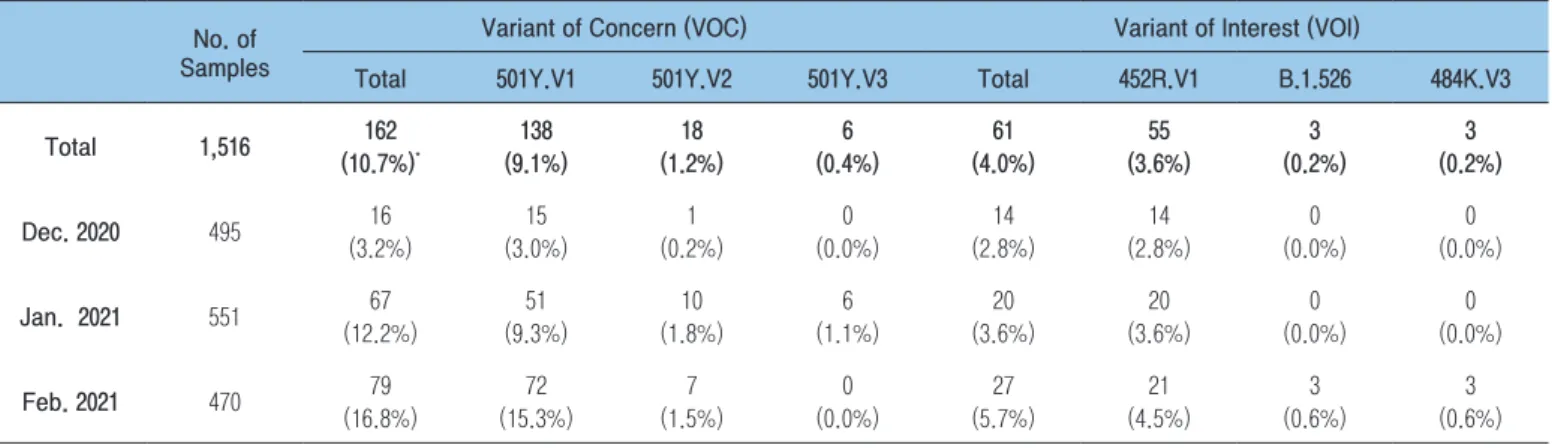
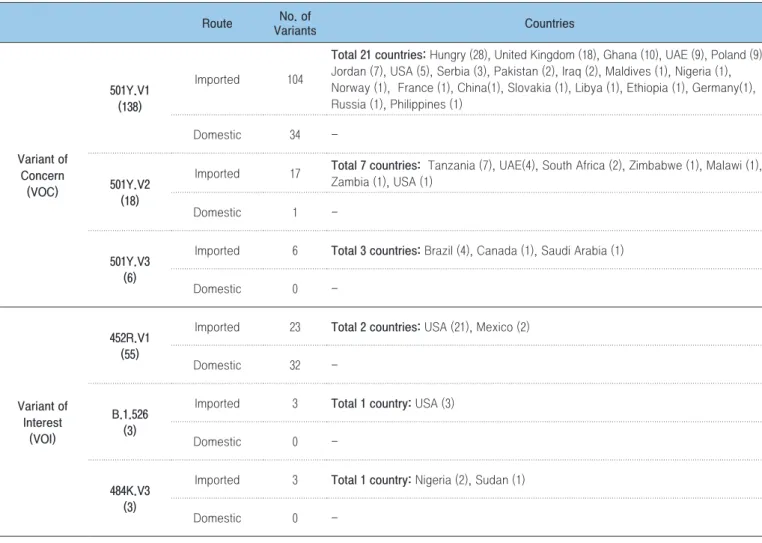
From December 2020 to March 1, 2021, a total of 162 cases of VOCs were identified in Korea, including 138 cases of the 501Y.V1 variant, 18 cases of 501Y.V2, and 6 cases of 501Y.V3 (Table 1). In particular, since 15 cases of the 501Y.V1 variant were confirmed in December 2020, it has been steadily becoming more common, reaching 72 cases in February 2021. Of the 138 cases of 501Y.V1, 104 were confirmed in international travelers from 21 countries, including Hungary (28 cases), the UK (18 cases), Ghana (10 cases), the UAE (9 cases), Poland (9 cases), and Jordan (7 cases). Among the 18 cases of the 501Y.V2 variant related to international travelers, 17 were confirmed in travelers from 7 countries including Tanzania (7 cases), the UAE (4 cases), and South Africa (2 cases). All 6 cases of the 501Y.V3 variant were confirmed to have been imported from 3 countries: Brazil (4 cases), Canada (1 case), and Saudi Arabia (1 case) (Table 2).
L452R.V1, a VOI originating from California, US, has been found in 55 cases since December 2020, of which 23 cases were confirmed among visitors from the US (21 cases) and Mexico (2 cases). B.1.526, which originated in New York, USA, was confirmed in 3 US visitors in February 2021. In addition, the 484K.V3 variant was confirmed in travelers who entered the country in February 2021 from Nigeria (2 cases) and Sudan (1 case). Thus, the influx of various variants from overseas has been confirmed during the monitoring process since February.
0% 20% 40% 60% 80% 100%
Jan. 2020 Feb. Mar. Apr. May June July Aug. Sept. Oct. Nov. Dec. Jan. 2021 Feb.
GRY L O GV GR GH G V S GH GR V S GRY GV
Figure 1. The distribution of the clades of COVID-19 virus in domestic cases
0% 20% 40% 60% 80% 100%
Jan. 2020 Feb. Mar. Apr. May June July Aug. Sept. Oct. Nov. Dec. Jan. 2021 Feb.
GRY L O GV GR GH GH GR GV O L S V G GRY
Figure 2. The distribution of the clades of COVID-19 virus in imported cases
Table 1. The occurrence status of COVID-19 variants in the Republic of Korea (As of March 1, 2021)
No. of Samples
Variant of Concern (VOC) Variant of Interest (VOI)
Total 501Y.V1 501Y.V2 501Y.V3 Total 452R.V1 B.1.526 484K.V3
Total 1,516 162 (10.7%)* 138 (9.1%) 18 (1.2%) 6 (0.4%) 61 (4.0%) 55 (3.6%) 3 (0.2%) 3 (0.2%) Dec. 2020 495 16 (3.2%) 15 (3.0%) 1 (0.2%) 0 (0.0%) 14 (2.8%) 14 (2.8%) 0 (0.0%) 0 (0.0%) Jan. 2021 551 67 (12.2%) 51 (9.3%) 10 (1.8%) 6 (1.1%) 20 (3.6%) 20 (3.6%) 0 (0.0%) 0 (0.0%) Feb. 2021 470 79 (16.8%) 72 (15.3%) 7 (1.5%) 0 (0.0%) 27 (5.7%) 21 (4.5%) 3 (0.6%) 3 (0.6%)
Conclusion
Since December 2019, COVID-19 has continued to spread, and the magnitude of the outbreak of some variants is increasing. SARS-CoV-2 variants that can affect transmissibility or the immune response are spreading, and the WHO tentatively classifies variants as VOCs and VOIs and recommends public health interventions accordingly. Since the confirmation of the first COVID-19 case in Korea in January 2020, the KDCA has regularly analyzed the genetic characteristics of SARS-CoV-2 through whole-genome analysis, which led to the identification of VOCs (501Y.V1, 501Y.V2, and 501Y.V3) and VOIs (452R.V1, B.1.526, and 484K.V3). In order to respond to growing concerns
the KDCA has been continuing to strengthen the surveillance system by expanding its analytical capacity. However, since many characteristics of the new variants remain unknown, such as their transmissibility, pathogenicity, and virulence, it is necessary to clarify the characteristics of variants through laboratory, clinical, and epidemiological analyses.
Acknowledgments
Conflict of Interest
No potential conflict of interest relevant to this article was
Table 2. The routes in which the COVID-19 variants were identified in the Republic of Korea (As of March 1, 2021)
Route VariantsNo. of Countries
Variant of Concern (VOC) 501Y.V1 (138) Imported 104
Total 21 countries: Hungry (28), United Kingdom (18), Ghana (10), UAE (9), Poland (9), Jordan (7), USA (5), Serbia (3), Pakistan (2), Iraq (2), Maldives (1), Nigeria (1), Norway (1), France (1), China(1), Slovakia (1), Libya (1), Ethiopia (1), Germany(1), Russia (1), Philippines (1)
Domestic 34
-501Y.V2 (18)
Imported 17 Total 7 countries: Tanzania (7), UAE(4), South Africa (2), Zimbabwe (1), Malawi (1), Zambia (1), USA (1)
Domestic 1
-501Y.V3 (6)
Imported 6 Total 3 countries: Brazil (4), Canada (1), Saudi Arabia (1)
Domestic 0 -Variant of Interest (VOI) 452R.V1 (55)
Imported 23 Total 2 countries: USA (21), Mexico (2)
Domestic 32
-B.1.526 (3)
Imported 3 Total 1 country: USA (3)
Domestic 0
-484K.V3 (3)
Imported 3 Total 1 country: Nigeria (2), Sudan (1)
-reported.
Correspondence to: Kim Eun-Jin
Division of Emerging Infectious Diseases, Bureau of Infectious Diseases Diagnosis Control, Korea Disease Control and Prevention Agency, Cheongju, Korea
E-mail: [email protected], Tel: +82-43-719-8140
Submitted: March 18, 2021; Revised: March 23, 2021; Accepted: March 23, 2021
① What was known?
The COVID-19 variants originating from the UK, South Africa, and Brazil have recently been spreading throughout the world, and it is known that they exhibit differences from existing forms of SARS-CoV-2, such as increased transmissibility and decreased immune response.
② What does this study add?
Through whole-genome analyses of COVID-19 in Korea, it was confirmed that the GH clade of SARS-CoV-2 is predominant. Since December 2020, VOCs originating from the UK, South Africa, and Brazil and VOIs from the US have been identified in Korea. Accordingly, the KDCA has been promoting enhanced surveillance by expanding its capacity for genetic analyses.
③ What are the implications?
In order to stem the influx and spread of variants in Korea, it is necessary to respond rapidly by strengthening the surveillance system for variants and establishing a scientific basis for responses by analyzing the characteristics of variants.
References
1. GISAID (Global Initiative on Sharing All Influenza), https://www.
2. PANGO Lineages, https://cov-lineages.org
3. WHO, COVID-19 Weekly Epidemiological Update (25 February 2021), Special edition: Proposed working definitions of SARS-CoV-2 Variants of Interest and Variants of Concern
4. NERVTAG: Brief note on SARS-CoV-2 variant B.1.1.7 (27 January 2021), http://www.gov.uk
5. NERVTAG: Brief note on SARS-CoV-2 B.1.351 (27 January 2021), http://www.gov.uk
6. NERVTAG: Brief note on SARS-CoV-2 VOC P.1 (27 January 2021), http://www.gov.uk
7. Wenjuan Zhang, Brian D. Davis, et al., Emergence of a Novel SARS-CoV-2 Variant in Southern California. JAMA, Published online February 11, 2021. doi:10.1001/jama.2021.1612
8. Medini K. Annavajhala, Hiroshi Mohri, et al., A Novel SARS-CoV-2 Variant of Concern, B.1.526, Identified in New York, medRxiv preprint, 23 February 2021
9. Confirmed cases of COVID-19 variants identified in the United Kingdom (16 February, 2021), https://www.gov.uk/government/ news/confirmed-cases-of-covid-19-variants-identified-in-uk
This article has been translated from the Public Health Weekly Report (PHWR) Volume 14, Number 13, 2021.