Korean Journal of Microbiology (2019) Vol. 55, No. 3, pp. 293-295 pISSN 0440-2413
DOI https://doi.org/10.7845/kjm.2019.9085 eISSN 2383-9902
Copyright ⓒ 2019, The Microbiological Society of Korea
Complete genome sequence of
Enterococcus faecalis strain DM01,
a potential starter culture candidate for soybean fermentation
Sojeong Heo1, Jong-Hoon Lee2 , and Do-Won Jeong1*1Department of Food and Nutrition, Dongduk Women’s University, Seoul 02748, Republic of Korea 2Department of Food Science and Biotechnology, Kyonggi University, Suwon 16227, Republic of Korea
콩발효 종균후보 Enterococcus faecalis strain DM01의 유전체 염기서열
허소정1 ・ 이종훈2 ・ 정도원1*1동덕여자대학교 식품영양학과, 2경기대학교 식품생물공학과
(Received August 6, 2019; Revised August 28, 2019; Accepted September 3, 2019)
*For correspondence. E-mail: [email protected]; Tel.: +82-2-940-4463; Fax: +82-2-940-4610
Enterococcus faecalis strain DM01 was isolated from meju, a traditional Korean fermented soybean product. The strain did not exhibit resistance to eight antibiotics (ampicillin, chloram-phenicol, ciprofloxacin, erythromycin, gentamicin, penicillin G, tetracycline, and vancomycin), biofilm formation, and he-molytic activity. The genome of strain DM01 consists a single circular 2,785,968-bp chromosome with a G + C content of 37.68%. The complete genomic sequence of strain DM01 provides genetic information to support the absence of anti-biotic resistance, biofilm formation, and hemolytic activity. Keywords: Enterococcus faecalis, meju, soybean fermentation,
starter
Enterococcus faecalis belongs to lactic acid bacteria has been used as a starter culture for cheese production (Foulquie Moreno et al., 2006). Some strains have been used as probiotics to improve human health and to enhance farm animals growth (Franz et al., 2011; Yamaguchi et al., 2013). The pharma-ceutical company SymbioPharm (Germany) sells a medicine Symbioflor 1 containing E. faecalis culture for the illness of upper respiratory system. Recently, E. faecalis has been reported as a predominantly isolated lactic acid bacterium of
fermented soybean foods (Jeong et al., 2014; Park et al., 2017). We isolated E. faecalis DM01 from a commercial meju, a traditionally manufactured Korean fermented soybean product used for the production of traditional soybean sauce and paste. The strain sustained growth on tryptic soy agar (TSA; BD Diagnostic Systems) containing 7% (w/v) NaCl of final con-centration. The strain exhibited proteolytic activity on TSA containing 6% NaCl and 2% skim milk (Sigma-Aldrich), and lipolytic activity on TSA containing 4% NaCl and 1% tribu-tyrin (Sigma-Aldrich) (Jeong et al., 2014). Both activities are the prerequisite of starter culture candidate for soybean fer-mentation. When the European Food Safety Authority guide-lines for the safe use of microorganisms as food/feed materials were applied (EFSA, 2004), strain DM01 was susceptible to eight antibiotics (ampicillin, chloramphenicol, ciprofloxacin, erythromycin, gentamicin, penicillin G, tetracycline, and van-comycin) and exhibited neither hemolysis nor biofilm for-mation. To shed light on the genetic background behind safety of E. faecalis DM01 as a fermentation starter candidate, its complete genome was sequenced.
Whole-genome sequencing was performed using the PacBio Single-Molecule Real-Time (SMRT) sequencing system by ChunLab, Inc. One contig was generated from reads from the PacBio system (90,291 reads and 968.28× coverage) for E.
294
∙ Heo et al.미생물학회지 제55권 제3호
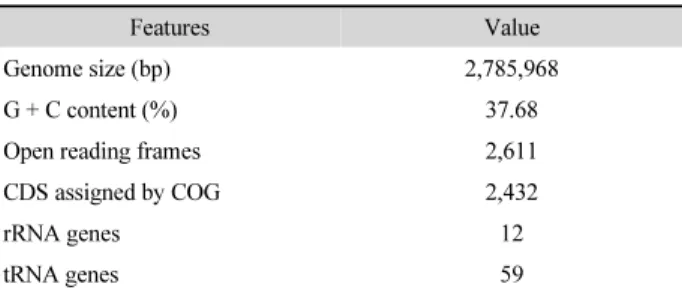
Table 1. Genome features of Enterococcus faecalis strain DM01
Features Value
Genome size (bp) 2,785,968
G + C content (%) 37.68
Open reading frames 2,611
CDS assigned by COG 2,432
rRNA genes 12
tRNA genes 59
Abbreviations: CDS, coding DNA sequence; COG, Cluster of Orthologous Groups of proteins.
faecalis DM01 with the HGAP4 algorithm in SMRT Link version 7.0.1 (Pacific Bioscience) and CodonCode Aligner (CodonCode Co.). Genome annotation was carried out using NCBI Prokaryotic Genome Annotation Pipeline version 4.6 (Tatusova et al., 2016). Open reading frames were predicted using Glimmer 3 (Tatusov et al., 1997), followed by annotation through a search against the Clusters of Orthologous Groups database (Tatusov et al., 1997).
The complete genome of strain DM01 consists of a single circular 2,785,968-bp chromosome with a G + C content of 37.68% (Table 1). The genome is predicted to contain 2,611 open reading frames, 59 tRNA genes, and 12 rRNA genes. In total, 2,432 genes were functionally assigned to categories based on the Clusters of Orthologous Groups. The majority of the genes are related to carbohydrate transport and metabolism [248 genes (10.2%)], followed by transcription [199 genes (8.2%)] and amino acid transport and metabolism [177 genes (7.3%)]. The high proportion of genes in carbohydrate and amino acid utilization indicates that strain DM01 has the ability to use of soybean carbohydrates and proteins. The genome of strain DM01 does not encode the virulence factors such as α- hemolysin, β-hemolysin, biofilm formation, and enterotoxin. Although strain DM01 showed sensitive to eight antibiotics (ampicillin, chloramphenicol, ciprofloxacin, erythromycin, gentamicin, penicillin G, tetracycline, and vancomycin), two potential antibiotic resistance genes annotated to encode chloramphenicol resistance protein (FLL49_RS11675) and erythromycin resistance ATP-binding protein (FLL49_RS06 530) were identified. It is well known that annotated antibiotic resistance genes do not always link with phenotypic resistance (Jeong et al., 2017). The phenotypic susceptibility of strain DM1 to chloramphenicol and erythromycin insinuates that
both genes are involved in the general metabolic process of its possessor. The complete genome sequence of E. faecalis DM01 provides genetic information to support the absence of antibiotic resistance, biofilm formation, and hemolytic activity.
Nucleotide sequence accession number(s)
E. faecalis DM01 has been deposited in the Korean Collec-tion for Type Cultures under accession number KCTC 43096, and its complete genome sequence has been deposited in DDBJ/ENA/GenBank under accession number CP041344.
적 요
메주로부터 분리한 Enterococcus faecalis DM01 균주는 8 종의 항생제(ampicillin, chloramphenicol, ciprofloxacin, ery-thromycin, gentamicin, penicillin G, tetracycline, vancomycin) 저항성, 바이오필름 및 용혈현상을 나타내지 않았다. GC 함량 37.68%, 2,785,968 bp 크기의 단일 chromosome을 보유하고 있는 DM01 균주의 유전체 정보는 콩발효식품 제조용 종균 적 용에 요구되는 항생물질 저항성, 바이오필름 및 용혈현상 관 련의 안전성을 뒷받침하는 것으로 확인되었다.
Acknowledgements
This work was supported by the National Research Foundation of Korea (NRF) [NRF-2016R1D1A1B01011421 and NRF- 2019R1A2C1003639].
References
EFSA. 2004. EFSA scientific colloquium. Summary report. QPS. Qualified presumption of safety of microorganism in food and feed. Brussels, Belgium.
Foulquie Moreno MR, Sarantinopoulos P, Tsakalidou E, and De Vuyst L. 2006. The role and application of enterococci in food and health. Int. J. Food Microbiol. 106, 1–24.
Franz CM, Huch M, Abriouel H, Holzapfel W, and Galvez A. 2011. Enterococci as probiotics and their implications in food safety. Int. J. Food Microbiol. 151, 125–140.
Jeong DW, Heo S, Ryu S, Blom J, and Lee JH. 2017. Genomic insights into the virulence and salt tolerance of Staphylococcus equorum.
Genome sequence of E. faecalis∙
295
Korean Journal of Microbiology, Vol. 55, No. 3
Sci. Rep. 7, 5383.
Jeong DW, Kim HR, Jung G, Han S, Kim CT, and Lee JH. 2014. Bacterial community migration in the ripening of doenjang, a traditional Korean fermented soybean food. J. Microbiol. Biotechnol. 24, 648–660.
Park J, Jin GD, Pak JI, Won J, and Kim EB. 2017. Development of a rapid identification method for the differentiation of Entero-coccus species using a species-specific multiplex PCR based on comparative genomics. Curr. Microbiol. 74, 476–483.
Tatusov RL, Koonin EV, and Lipman DJ. 1997. A genomic pers-pective on protein families. Science 278, 631–637.
Tatusova T, DiCuccio M, Badretdin A, Chetvernin V, Nawrocki EP, Zaslavsky L, Lomsadze A, Pruitt KD, Borodovsky M, and Ostell J. 2016. NCBI prokaryotic genome annotation pipeline. Nucleic Acids Res. 44, 6614–6624.
Yamaguchi T, Miura Y, and Matsumoto T. 2013. Antimicrobial susceptibility of Enterococcus strains used in clinical practice as probiotics. J. Infect. Chemother. 19, 1109–1115.