Metallothionein 유전자를 기초로 한 멸종위기 육상
달팽이
Satsuma myomphala
(거제외줄달팽이) 의
분자계통학적 연구
상민규, 강세원, 황희주, 정종민, 송대권, 민혜린, 박지은, 하희철, 이현준, 홍찬의, 안영모, 박소영
1,
박영수
2, 박홍석
3, 한연수
4, 이준상
5, 이용석
순천향대학교 자연과학대학 생명시스템학과, 1국립낙동강생물자원관 다양성보전·변화연구부, 2순천향대학교 의과대학 간호학과, 3㈜지앤시바이오, 4전남대학교 농업생명과학대학 식물생명공학부, 5강원대학교 환경연구소Molecular Phylogenetic Study of the Endangered Land Snail
Satsuma myomphala Based on Metallothionein Gene.
Min Kyu Sang, Se Won Kang, Hee-Ju Hwang, Jong Min Chung , Dae Kwon Song, Hye Rin
Min, Jie Eun Park, Hee Cheol Ha, Hyun Jun Lee, Chan Eui Hong, Young Mo Ahn, So Young
Park
1, Young-Su Park
2, Hong Seog Park
3, Yeon Soo Han
4, Jun Sang Lee
5and Yong Seok Lee
Department of Life Science and Biotechnology, College of Natural Sciences, Soonchunhyang University, Asan, Chungnam 31538, Republic of Korea, 1Biodiversity Conservation & Change Research Division, Nakdonggang National Institute of
Biological Resources, Sangju, Gyeonbuk 37242, Korea, 2Department of Nursing, College of Medicine, Soonchunhyang
University, Asan, Chungnam 31538, Republic of Korea, 3Research Institute, GnC BIO Co., LTD, Daejeon, 34069, Republic of
Korea, 4College of Agriculture and Life Science, Chonnam National University, Gwangju, 61186, Republic of Korea 5Institute of Environmental Research, Kangwon National University, Chuncheon, Gangwon 24341, Republic of Korea
ABSTRACT
Metallothionein (MT) family of metal-binding proteins are involved in maintaining homeostasis and heavy metal poisoning. Recently, MT has been considered as a biomarker that can identify a particular species, very similar to the use of cytochrome oxidase I (COI) gene. Satsuma myomphala species of land snails have been reported from North-East Asia, including South Korea and Japan. In particular, the land snail species have been known from only a limited area of Geoje Island, Gyeongsangnam-do province of South Korea. Genetic studies of S. myomphala has been limited with only 6 nucleotide, 2 protein registered on the NCBI server. For elucidating the genetic information of S. myomphala, we conducted RNA sequencing analysis using Illumina HiSeq 2500 next-generation platform. We screened the MT gene from the RNA-Seq database to confirm the molecular phylogenetic relationship. After sequencing, the de novo analysis and clustering generated 103,774 unigenes. After annotation against PANM database using BLAST program, we obtained MT sequence of 74 amino acid residues containing the coding region of 222 bp. Based on this sequence, we found about 53 sequences using the BLAST program in NCBI nr database. Using ClustalX alignment, Maximum-Likehood Tree of MEGA program, we confirmed the molecular phylogenetic relationships that showed similarity with mollusks such as Helix pomatia and H. aspersa, Megathura crenulata.
Key words: Metallothionein, Satsuma myomphala, Phylogenetics
INTRODUCTION
Matallothionein (MT) 은 약 60여 개의 아미노산으로 구 성되고, 분자량이 6-7 kDa 인 단백질로서, 아연 (Zn), 구리 (Cu) 와 같은 생리학적 중금속이나 카드뮴 (Cd), 수은 (Hg), 은 (Ag) 과 같은 생체이물 중금속과 결합하는 성질을 가지고 있다 (Lee et al., 2008; Baek et al., 2009). MT는 약 22-23%의 시스테인 (Cys) 잔기와 8개의 리신 (Lys) 잔기로
Received: December 12, 2016; Revised: December 24, 2016; Accepted: December 30, 2016
Corresponding author : Yong Seok Lee
Tel: +82 (41) 530-3040, e-mail: [email protected] 1225-3480/24636
This is an Open Access article distributed under the terms of the Creative Commons Attribution Non-Commercial License with permits unrestricted non-commercial use, distribution, and reproducibility in any medium, provided the original work is properly cited.
이루어져 있으며, 히스티딘 (His) 과 방향족 아미노산이 존재 하지 않는 것으로 밝혀져 있다 (Dunn et al., 1987; Kagi and Kojima, 1987; Kagi and Schaffer, 1988). 또한 체내 에 유입된 금속의 농축에 의해 세포 내 발현이 유도되고, 중금 속의 조절과 세포보호에 관여하는 것으로 알려져 있다 (Kagi and Vallee, 1960; Kagi and Vallee, 1961). 이러한 MT는 중금속 오염에 대한 환경 모니터링 마커로서 사용 가능성이 제 시된 바 있으며 (Simes et al., 2003), 분자계통분류학적으로 도 매우 중요한 단백질로 다뤄지고 있다 (Lee et al., 2008; Yong Hun Jo, 2009). 현재까지 알려진 바에 의하면, MT는 15개의 family로 구분되어 있으며, 연체동물은 Mussel의 MT 아미노산 서열에서 최초로 발견된 C-x-C-x (3) -C-T-G-x (3) -C-x-C-x (3) C-x-C-K 에 상응하는 특이 서열패턴을 보이 는 것으로 보고되었다. (Binz and Kagi, 1999; Cherian et
al., 2003; Singh and Hanson, 2006).
본 연구의 대상종인 Satsuma myomphala (거제외줄달팽
이) 는 한국, 일본 등의 동북아시아 지역에 분포하는 대형 육산 패류종이다. 그러나, 국내에서는 경상남도 거제도에서만 발견 되는 고립종으로, 멸종위기 야생생물 관찰종이며, 국가적색목 록 평가결과 위급종으로 지정되어 있다. S. myomphala는 NCBI (National Center for Biotechnology Information) 데이터베이스에 COI 서열 및 rRNA 서열을 포함한 nucleotide에 대한 연구 6건과 단백질에 대한 연구 2건 만이 진행되어 있어 유전자 연구가 매우 부족한 실정이다 (Kang et al., 2016). 본 연구에서는 S. myomphala 의 전사체로부터 확인된 MT 유전자를 이용하여 분자계통학적 유연관계 및 계통분류학 적 위치를 확인하고자 하였다.
MATERIALS AND METHODS
1. Materials
본 연구에서 사용된 S. myomphala 는 연체동물문
(Mollusca), 복족강 (Gastropoda), 이새아강 (Heterobranchia), 유폐하강 (Pulmonata), 병안목 (Stylommatophora), 달팽이 상과 (Helicoidea), 외줄달팽이과 (Camaenidae), 외줄달팽이 속 (Satsuma) 에 속하는 분류학적 위치를 가지며, 국내에서는 거제도에만 분포하는 고립종이다 (Min, 2004). S. myomphala 는 2014년 8월 경남 거제시 남부면 갈곶리에서 채집하였다. 2. Methods 1) cDNA library 구축 및 염기서열 분석
S. myomphala 의 내장낭 (visceral mass) 을 적출하여
Trizol reagent (Thermo Fisher Scientific, USA) 를 이용
해 total RNA를 추출하였고, Spectrophotometer와 Agilent Technologies 2100 Bioanalyer를 이용하여 RNA의 농도 및 quality를 확인하였다. 추출된 RNA에서 mRNA를 정제한 후 cDNA를 합성하였고, 합성된 cDNA를 통해 cDNA library를 구축하고, 차세대염기서열분석기 (Illumina HiSeq 2500 NGS) 를 사용하여 전사체 분석을 수행 하였다.
2) 전사체의 생물정보학적 분석 및 Metallothionein 서열 확보 차세대염기서열분석기를 이용하여 생산된 raw reads에서 Cutadapt (v1.11) 및 Sickle (v1.33) 프로그램을 사용하여 low quality sequence를 제거하여 clean reads를 확보하였 으며, 생성된 clean reads는 Trinity (v2.0.4) 프로그램을 이 용하여 de novo assembly 하였다. Assembly 결과 얻은 contig 들은 TGICL (TIGR Gene Indices Clustering tools) (v2.1) 프로그램을 이용하여 clustering 한 후 assembly 과정을 통해 unigene 서열들을 확보하였다. 생성된 unigene 서열들은 PANM 데이터베이스 (Kang et al., 2016) 에 BLAST 프로그램을 사용하여 annotation 하였다. Annotation 결과 중 MT로 예측되는 full-length 서열들을 골라낸 후 EMBOSS Package의 sixpack 프로그램을 통해 6 frame으로 가능한 모든 ORF의 아미노산 서열들을 추출하였 으며, NCBI nr 데이터베이스에 다시 한번 BLASTp를 통해 재검증하고, 15개의 family로 나누어진 pattern 공식 중 연체 동물에 해당하는 공식과 비교하여 최종 결정하였다 (Braun et al., 2001).
3) Multiple alignment 및 phylodendrogram 분석 NCBI nr 데이터베이스에 BLAST를 시행하여 얻은 다른 생물들의 MT 서열과 S. myomphala 의 MT 서열을 mFASTA format으로 변환한 후 ClustalX2 (v2.1) 프로그램 을 이용하여 multiple aligment를 진행하였다 (Larkin et
al., 2007). 또한 MEGA6 프로그램를 이용하여 Neighbor-
Joining 방법을 통해 phylodendrogram을 도식화하였으며, 이를 바탕으로 S. myomphala 의 MT 서열을 다른 연체동물
들의 MT 서열과 비교분석하였다 (Jeanmougin et al., 1998; Tamura et al., 2013).
RESULTS AND DISCUSSION
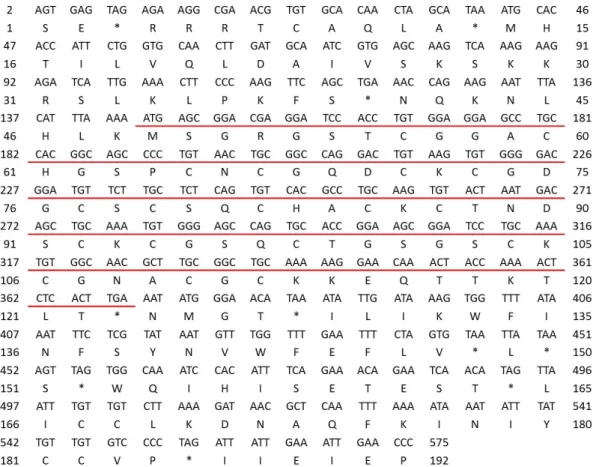
S. myomphala 의 MT 유전자 서열 중 코딩 영역은 총
222 bp 로 구성되어 있었으며, 아미노산 서열은 74개로 이루 어져 있었다. 코딩 영역의 염기 서열에서 GC 함량은 총 124 bp 로 55.9%였으며, 시스테인 (Cys) 잔기는 이미 알려진 것과 비슷하게 약 24% 정도 확인되었다. 그러나, 리신 (Lys) 잔기
는 7개가 확인되어 알려진 8개와 상이하였다. 또한, 한 개의 히스티딘 (His) 과 방향족 아미노산 (프롤린, Pro) 한 종류가 발견되어 이미 알려진 MT 서열과 약간 차이가 있음을 확인하 였다 (Fig. 1.). 이미 알려진 연체동물의 MT 서열 공식인 C-x-C-x (3) -C-T-G-x (3) -C-x-C-x (3) C-x-C-K와 S. myomphala 의 MT 서열을 비교분석한 결과, 연체동물과 달리 C-x-C-K로 종 결되지 않고 3-말단 부분에 9개의 아미노산이 더 존재하고 있 었다 (Fig. 2.). 이는 추후 유전체 서열 및 유연 관계에 있는 근 연종의 서열 분석 등을 통해 재검증이 필요하다고 판단된다. BLAST 결과를 토대로 선정한 21종의 MT 서열과 S.
myomphala 의 MT 서열을 ClustalX2를 이용하여 multiple
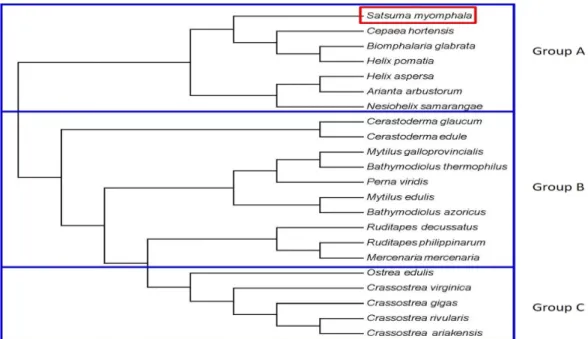
alignment를 수행한 후 그 결과를 토대로 MEGA6 프로그램의 Neighbor-Joining 방법을 이용하여 phylodendrogram을 그려 본 결과, Helix pomatia, Helix aspersa, Cepaea hortensis,
Biomphalaria glabrata, Nesiohelix samarangae 및 Arianta arbustorum 의 복족류 (연체동물문) 들과 동일한 그
룹으로 묶이는 것을 확인할 수 있었고, 이 중에
Biomphalaria glabrata 만 담수달팽이이고, 그 외의 5종은
육산 연체동물이었다 (Fig. 3. and Fig. 4.).
본 연구를 통해 S. myomphala 의 MT 서열은 근연종들의 MT 서열과 매우 유사하고, 참고서열들과 마찬가지로 독특한 공식에 매우 적합하게 일치함을 확인할 수 있었으며, phylogenetic analysis 결과 또한 유의성 있게 그룹별로 정리 됨을 확인 할 수 있었다. 과거 동물에서 주로 연구가 되어왔던 MT 관련 연구는 최근
Fig. 1. The metallothionein nucleotide sequence and deduced amino acid sequence of Satsuma myomphala (under line = coding sequence).
Fig. 2. Mollusca Metallothionein has specific motifs such as Cys-Cys, Cys-X-Cys or Cys-X-Y-Cys.
미생물, 원생생물 등에서도 활발하게 이루어지고 있다 (Sharma et al., 2016; Zahid et al., 2016; Jenny et al., 2016). 특히 계통분류학적 관계 규명을 위해 MT에 관한 다 양한 자료가 축적되고 있으며, 종간 또는 종의 특징을 설명하 는데 유용하게 사용될 수 있을 것이다. 향후 더 많은 생물들의 MT 서열이 축적된다면 이와 같이 MT 를 이용한 계통분류학 적 연구가 더 체계적으로 이루어 질 수 있을 것이라 판단된다.
CONCLUSIONS
거제외줄달팽이 (Satsuma myomphala) 의 metallothionein 유전자는 염기서열 222 bp 로 이루어져있으며, 74개의 아미노
Fig. 4. Multiple sequence alignment result of S. myomphala and 23 MT protein reference sequences. Abbreviation: Arianta arbustorum (Aar), Bathymodiolus azoricus (Baz), Bathymodiolus thermophilus (Bth), Biomphalaria glabrata (Bgl), Cepaea hortensis (Cho), Cerastoderma edule (Ced),
Cerastoderma glaucum (Cgl), Crassostrea ariakensis (Car), Crassostrea gigas (Cgi), Crassostrea rivularis (Cri), Crassostrea virginica (Cvi), Helix aspersa (Has), Helix pomatia (Hpo), Mercenaria mercenaria (Mem), Mytilus edulis (Med), Mytilus galloprovincialis (Mga), Nesiohelix samarangae
(Nsa), Ostrea edulis (Oed), Perna viridis (Pvi), Ruditapes decussatus (Rde), Ruditapes philippinarum (Rph), Satsuma myomphala (Smy).
Fig. 3. The result of phylodendrogram analysis on evolutionary relationships (Group A: Gastropoda, Group B: Marin Bivalves, Group C: Oysters).
산으로 구성되어 있다. 연체동물의 metallothionein 서열의 공식인 C-x-C-x (3) -C-T-G-x (3) -C-x-C-x (3) C-x-C-K에 맞 춰본 결과 알려진 공식과 일치하는 것을 확인할 수 있었으며, 시스테인 (Cys) 의 함유량 또한 약 24%정도 인 것을 확인 할 수 있었다. BLAST 결과를 토대로 선정된 21종의 생물의 MT 서열 중 아미노산 레벨에서 가장 높은 스코어로 alignment 되 는 서열들은 같은 복족강에 속하는 육산연체동물인 Cepaea hortensis, Biomphalaria glabrate, Helix pomatia 등으로
나타났다. ClustalX2를 통해 multiple alignment한 후 Neighbor-Joining 방법에 따라 phylodendrogram을 그려 본 결과 S. myomphala의 MT 서열은 C. hortensis, B. glabrata, H. pomatia, H. aspersa, Arianta arbustorum, Nesiohelix samarangae 등과 같은 육산연체동물들과 같은 그룹으로 묶여지는 것을 확인할 수 있었다. 이러한 결과를 통 해 S. myomphala 의 전사체 분석을 통해 밝혀진 MT 서열은 근연종들의 MT 서열과 매우 일치함을 알 수 있었으며, MT 서열이 분류에 사용될 수 있다는 것을 확인시켜 주었다.
ACKNOWLEDGEMENT
본 논문은 정부 (환경부) 의 재원으로 국립생물자원관의 지 원 (NIBR201603205) 및 순천향대학교 학술연구비 지원으로 수행되었습니다.REFERENCE
Baek, M.K., Lee, J.-S., Kang, S.W., Lee, J.B., Kang, H.J., Jo, Y.-H., Noh, M.-Y., Han, Y.S., Choi, S.-H., Chae, S.-H., Park, H.-S., Lee, J.-S., and Lee, Y.S. (2009) Phylogenetic Analysis based on Metallothionein Gene Sequence of an Indigenous Species Pisidium (Neopisidium) coreanum in Korea.
The Korean Journal of Malacology, 25: 153-160.
Binz, P.A., and Kagi, J.H.R. (1999) Metallothionein: Molecular evolution and classification pp. 696. MAIK Nauka/Interperiodica distributed exclusively by Springer Science+Business Media LLC. Basel-Berlin- Boston.
Braun, R.C., Pedretti, K.T., Casavant, T.L., Scheetz, T.E., Birkett, C.L., and Roberts, C.A. (2001) Parallelization of local BLAST service on workstation clusters. Future Generation Computer Systems, 17: 745-754.
Cherian, M., Jayasurya, A., and Bay, B.H. (2003) Metallothioneins in human tumors and potential roles in carcinogenesis. Mutation Research/Fundamental
and Molecular Mechanisms of Mutagenesis, 533:
201-209.
Dunn, M.A., Blalock, T.L., and Cousins, R.J. (1987) Metallothionein. Proceedings of the Society for
Experimental Biology and Medicine, 185: 107-119.
Jeanmougin, F., Thompson, J., Gouy, M., Higgins, D., and Gibson, T. (1998) Multiple sequence alignment with Clustal X. Trendsin Biochemical Sciences, 23: 403-405.
Jenny, M.J., Payton, S.L., Baltzegar, D.A., and Lozier, J.D. (2016) Phylogenetic Analysis of Molluscan Metallothioneins: Evolutionary Insight from Crassostrea
virginica. J. Mol. Evol., 83: 110-125.
Kagi, J., and Vallee, B. (1960) Metallothionein: a Cadmium and Zinc-containing Protein from Equine Renal Cortex THE JOURNAL OF BIOLOQICAL
CHEMISTRY, 235: 3460-3465.
Kagi, J., and Vallee, B. (1961) Metallothionein: a cadmium and zinc-containign protein from equine renal cortex. II. Physico-chemical properties. THE
JOURNAL OF BIOLOQICAL CHEMISTRY, 236:
2435-2442.
Kagi, J.H., and Kojima, Y. (1987) Chemistry and biochemistry of metallothionein. Experientia Supplementum, 52: 25-61. Kagi, J.H.R., and Schaffer, A. (1988) Biochemistry of
metallothionein. Biochemistry, 27: 8509-8515.
Kang, S.W., Park, S.Y., Patnaik, B.B., Hwang, H.J., Chung, J.M., Song, D.K., Park, Y.S., Park, H.S., Park, S.H., Han, Y.S., Lee, J.S., and Lee, Y.S. (2016) The Protostome database (PANM-DB): Version 2.0 release with updated sequences. The Korean Journal
of Malacology, 32: 185-188.
Kang, S.W., Patnaik, B.B., Hwang, H.-J., Park, S.Y., Chung, J.M., Song, D.K., Patnaik, H.H., Lee, J.B., Kim, S., Park, H.S., Park, S.-H., Han, Y.S., Lee, J.S., and Lee, Y.S. (2016) Sequencing and De Novo assembly of visceral mass transcriptome of the Critically Endangered land snail Satsuma
myomphala: Annotation and SSR Discovery. Comparative Biochemistry and Physiology Part D: Genomics and Proteomics
Larkin, M.A., Blackshields, G., Brown, N.P., Chenna, R., McGettigan, P.A., McWilliam, H., Valentin, F., Wallace, I.M., Wilm, A., Lopez, R., Thompson, J.D., Gibson, T.J., and Higgins, D.G. (2007) Clustal W and Clustal X version 2.0. Bioinformatics, 23: 2947-2948.
Lee, J.-S., Min, B.-J., Kang, S.W., Lee, J.B., Baek, M.K., Hwang, S.Y., Kim, S.H., Kho, W.-G., Choi, S.-H., Chae, S.-H., Park, H.-S., Han, Y.S., Lee, J.-S., Jeong, K.-H., and Lee, Y.S. (2008) Molecular Phylogenetic Study of Nesiohelix samarangae Based on Metallothionein Gene. The Korean Journal of
Malacology, 24: 73-80.
Min, D.K. (2004) Mollusks in Korea (Min Molluscan Research Institute) pp. 566. Hangeul Graphics. Nordberg, M., and Kojima, Y. (1979) Metallothionein and
Other Low Molecular Weight Metal-Binding Proteins.
Metallothionein. Birkhauser, Basel, 41: 41-116.
Sharma, J., Shamim, K., Dubey, S.K., and Meena, R.M. (2016) Metallothionein assisted periplasmic lead sequestration as lead sulfite by Providencia
vermicola strain SJ2A. Sci Total Environ
Simes, D.C., Bebianno, M.J., and Moura, J.J.G. (2003) Isolation and characterisation of metallothionein from the clam Ruditapes decussatus. Aquatic Toxicology, 63: 307-318.
Singh, V.K., and Hanson, J. (2006) Assessment of metallothionein and antibodies to metallothionein in normal and autistic children having exposure to vaccine-derived thimerosal. Pediatr Allergy Immunol., 17: 291-296.
Tamura, K., Stecher, G., Peterson, D., Filipski, A., and Kumar, S. (2013) MEGA6: Molecular Evolutionary Genetics Analysis version 6.0. Mol. Biol. Evol., 30: 2725-2729.
Trinchella, F., Riggio, M., Filosa, S., Parisi, E., and Scudiero, R. (2008) Molecular cloning and sequencing
of metallothionein in squamates: new insights into the evolution of the metallothionein genes in vertebrates. Gene, 423: 48-56.
Yong Hun Jo, M.K.B., Se Won Kang, Jae Bong Lee, Byun In-Seon, Sang-Haeng Choi, Sung-Hwa Chae, Jung-Ha Kang, Yeon Soo Han, Hong-Seog Park and Yong Seok Lee. (2009) Molecular cloning and expression pattern of Metallothionein Genef rom the left-handed shell, Physa acuta. The Korean Journal
of Malacology, 25: 223-230.
Zahid, M.T., Shakoori, F.R., Zulifqar, S., Ahmed, I., Al-Ghanim, K., Mehboob, S., and Shakoori, A.R. (2016) Molecular Characterization of a Copper Metallothionein Gene From a Ciliate Tetrahymena farahensis. J. Cell. Biochem., 117: 1843-1854.