고유진동수와 고유모드를 이용하여 외팔보의 다중 크랙 탐지
Detection of Multi-Crack using Modified Dynamic Characteristics of
Cantilever
김정호* ․ 이정우* ․ 이정윤
†
Jung Ho Kim, Jung Woo Lee and Jung Youn Lee
1)
1. 서 론
본 연구에서는 외팔보의 다중 크랙 발생
전, 후의 고유벡터와 고유진동수를 이용하여
크랙을 탐지한다.
2. 이 론
2.1 회전스프링 사용하여 크랙 묘사
Chondros (1998)에 의하여 유도된 회전 스프링
을 사용하여 크랙을 묘사하였다.
(1)
여기서,
로 크랙의 깊이
와 단면의
높이
에 대한 비이며
(2)
식(1)로부터 회전 스프링 강성(
)을 얻을 수 있
으며 그 방정식은 다음과 같다.
(3)
2.2 다중 크랙 탐지 알고리즘
1) 고유벡터 변화량 행렬을 구하고
감도계수 행렬
을 구한다.
2) 감도계수 행렬로 부터 다음과 같은 반
†
교신저자: 정회원, 경기대학교 기계 시스템 공학부
Tel : 031-249-9811 , Fax :031-244-6300
* 경기대학교 대학원
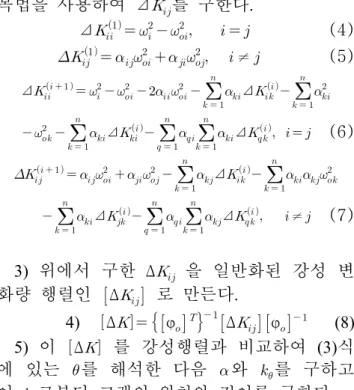
복법을 사용하여
⊿
를 구한다.
⊿
(4)
≠
(5)
⊿
⊿
⊿
⊿
(6)
⊿
⊿
⊿
≠ (7)
3) 위에서 구한
Δ
을 일반화된 강성 변
화량 행렬인
Δ
로 만든다.
4)
Δ
φ
Δ
φ
(8)
5) 이
Δ
를 강성행렬과 비교하여 (3)식
에 있는
를 해석한 다음
와
를 구하고
이
로부터 크랙의 위치와 깊이를 구한다.
3. 모사 실험
Fig. 1은 외팔 보의 모델을 나타낸다. 길이 L =
300 mm, 높이 h = 10 mm, 폭 b = 20 mm, 세로
탄성계수 E = 210 GPa, 포아송 비 ν = 0.3, 밀도,
ρ = 7860 kg/m
3
인 보를 등 간격으로 5개 요소로
나누었다.
1) CASE 0: 크랙이 없는 경우
2) CASE 1: 1번 및 3번 요소 오른쪽에 각 각
의 크랙을 갖는 경우
Fig. 2 Multi-Crack model in cantilever beam
한국소음진동공학회 2014년 추계학술대회
No. of iteration
0 5 10 15 20 25 30 35 40 45 50
P
redi
ct
iv
e
C
rac
k
D
ept
h(
m
m
)
0
2
4
6
8
No.1 Element
No.2 Element
4. 결과 및 고찰
4.1 고유진동수 변화 검토
Table 1 Comparison of natural frequencies before and
after crack
mode
CASE 0
(Hz)
CASE 1
(Hz)
1
92.82
86.17
92.84
2
582.08
488.08
83.85
3
1634.88
1479.03
90.47
4
3229.63
2866.38
88.75
5
5360.43
4248.52
79.26
4.2 고유벡터 변화 검토
Table 3 Delta eigenvectors before and after crack
(a) CASE 1
mode
delta eigenvectors ×
1
-0.0003 0.0040 -0.0002 -0.0016 -0.0004 0.0083 0.0001 0.0071 0.0005 0.0069
2
-0.0019 -0.0297 -0.0022 0.0343 0.0029 -0.0818 0.0002 -0.0166 -0.0002 -0.0026
3
-0.0030 0.0411 -0.0023 0.0013 0.0010 -0.2305 -0.0031 0.0962 0.0078 0.2161
4
0.0033 0.2275 -0.0012 -0.2251 -0.0008 -0.2547 -0.0017 0.1193 0.0050 0.1006
5
-0.0025 0.3338 0.0019 0.1041 0.0013 0.6988 -0.0038 -0.3272 0.0070 0.4634
6
-0.0060 -0.0032 0.0048 -0.3747 -0.0040 -0.2317 0.0042 0.0224 -0.0047 -0.1884
7
-0.0010 -0.2354 0.0022 0.3439 0.0046 0.8779 -0.0067 0.6582 -0.0072 -0.8625
8
0.0009 0.8369 -0.0037 0.2903 0.0034 0.1894 -0.0024 0.5422 -0.0074 -0.6524
9
0.0026 0.4584 -0.0052 0.2082 0.0024 -0.4267 0.0025 0.4158 0.0074 1.2920
10
-0.0008 -0.1389 -0.0009 -0.3531 0.0011 -0.3711 0.0013 -0.0391 0.0023 0.3242
4.3 감도계수의 해석
Table 4 Sensitivity coefficient of 3 d.o.f system
(a) CASE 1
α
ij x 10
-0.0016 0.1697 -0.0060 -0.0149 -0.0456 0.0115 0.0031 0.0009 -0.0036 -0.0003
-0.1683 -0.0615 -0.9781 -0.3533 0.3157 -0.0557 0.1097 0.0239 0.0353 0.0058
-0.0098 0.8968 -0.1690 -1.5070 0.4067 -0.0298 0.3193 0.0712 0.0556 0.0115
0.0096 0.4633 1.4150 -0.1654 0.4990 0.1052 0.8725 0.1887 0.0859 0.0231
0.0464 -0.3379 -0.3982 -0.3830 -0.3201 2.2830 -0.5951 -0.0851 -0.5484 -0.0671
-0.0233 0.1256 0.0885 -0.0446 -2.2220 -0.2859 0.3186 -0.0144 0.7514 0.0778
0.0009 -0.1813 -0.4122 -0.7606 0.4888 -0.1224 -0.3498 -2.1680 -1.0520 -0.1787
-0.0011 -0.0713 -0.1735 -0.3265 0.0867 0.0785 1.9850 -0.3067 -1.3840 -0.1632
0.0084 -0.1013 -0.1597 -0.2180 0.7587 -0.6124 1.2290 1.1170 -0.2282 -0.8497
0.0016 -0.0242 -0.0413 -0.0607 0.1557 -0.1139 0.3015 0.2142 0.7822 -0.0397
4.4 크랙 탐지 해석
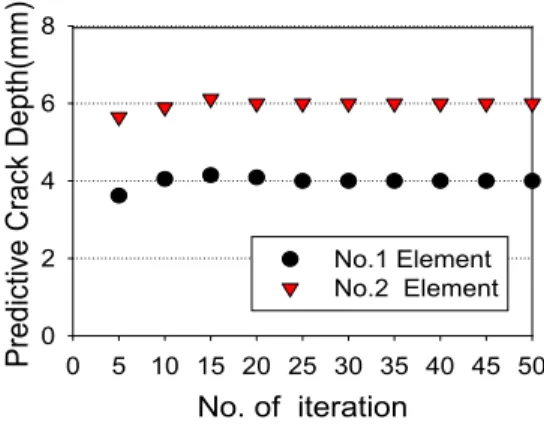
Fig. 3은 반복회수에 따른 크랙탐지를 예측
한 그림이다. 반복회수가 증가함에 따라 오
차가 감소하여 1번과 2번 요소의 크랙의 깊
Fig. 3 Predictive crack depth according to the
number of iteration
이 에 수렴함을 볼 수
있다. Table 5은 반복회수를 50번까지 하였을
때 크랙 탐지의 예측한 결과이다.
Table 5 Predictive crack in cantilever beam
Element
No.
Crack depth a(mm)
ratio
(%)
orignal
prediction
1
4.000
3.990
99.75
2
0
0
-3
6.000
6.005
100.09
4
0
0
-5
0
0
5. 결 론
(1) 크랙 발생 전, 후의 고유벡터 변화량을
가지고 감도 계수를 해석하는 방안을 제안하
였다.
(2) 본 방법을 크랙이 발생한 외팔보에 적
용하여 크랙 탐지를 잘 예측하므로 제안된
방법이 타당함을 알 수 있었다.
참 고 문 헌
(1) Petroski, H. J., 1981, “Simply static and dynamic
models for cracked elastic beam,'' International
Journal of Fracture, Vol. 17, pp. 71-76.
(2) Dimarogonas, A. D. and Papadopoulos, C. A.,
1983, “Vibration of cracked shaft in bending,''
Journal of Sound and Vibration, Vol. 91, pp.
583-593.