한국해안․해양공학회 학술발표논문집 (2009) 2009년 11월 5일-11월 6일
제18권, pp. 168-171
Hindcast of abnormal storm waves in the East Sea in 2006 using an
atmosphere-wind wave coupled modelling system
대기-파랑결합모델을 이용한 2006년 동해의 이상파랑 재현계산
Han Soo Lee1 , Kyeong Ok Kim2 , Byung Ho Choi3이한수1
, 김경옥2, 최병호3
1. INTRODUCTION
The surface winds over the East Sea (ES) vary distinctively with the seasons, blowing mild or moderate and variable in summer and very strong due to the East Asian monsoon and storms in winter. Atmospheric low pressure reacting with and passing through the ES sometimes causes abnormal storm waves on the Korean and Japanese coasts of the ES in winter.
According to Cavaleri and Bertotti (2004; 2006)and Ponce de León and Guedes Soares(2008), unlike the open ocean where wind field data are generally good, the wind field in an enclosed basin such as the Mediterranean Sea is almost always underestimated, mainly because of the orography of the surrounding land. The bias of the wind field depends on the proximity of land, and the wave fields obtained from the wind field input through a series of numerical experiments showed an average underestimate of almost30 % to 40 % against the recorded data. This showed the crucial importance of the wind field in wave field estimation, especially in terms of the resolution of the wind field and the effect of the surrounding land. The semi-enclosed ES in this study has very similar characteristics to those of the Mediterranean Sea, being surrounded by the mountainous land of Russia and the Korean Peninsula to the north and west and by the islands of Japan to the south and east. Therefore, it is indispensable to introduce and analyse meteorological conditions through mesoscale atmospheric modelling to understand and estimate
the abnormal storm waves in numerical studies. Recently, Lee et al. (2008) studied the mechanisms of generation of abnormal storm waves including Yorimawari Wave events in the ES in February 2008. The study was based on observations and numerical simulations using an atmosphere-wave coupled modelling system, taking into account meteorological conditions as well as topographical and bathymetric effects in numerical studies.
Since the abnormal storm waves are a critical factor not only in coastal damage and disaster, but also in the design of coastal structures, it is critical to estimate them accurately, taking into account the meteorological conditions and topographical and bathymetric effects. Therefore, in this paper we describe the study results of hindcast for abnormal storm waves in ES in October 2006 using an atmosphere-wave coupled modeling system focusingon two aspects; a) reanalysis of wind fields with a mesoscale model and b) modification of wave model.
2. ATMOSPHERE-WAVE COUPLED MODELING SYSTEM 2.1 Mesoscale atmospheric model
The atmosphere model in an atmosphere-wave coupled modelling system is a three-dimensional non-hydrostatic mesoscale model, MM5, developed at Pennsylvania State University (PSU)-NCAR. This model is based on non-hydrostatic, compressible form of governing equations in spherical and sigma coordinates with physical processes such as precipitation physics, 1 일본 히로시마대학교 국제협력연구과 특임조교
2 한국해양연구원 연구원 3 성균관대학교 교수
Planetary Boundary Layer (PBL) processes and atmospheric radiation processes incorporated by a number of physics parameterizations. MM5 also considers the complex topographical effects during the calculation. For more details on MM5, refer to Grell et al. (1995).
2.2 Wave model and its modification
A third-generation wave model, Simulating Waves Nearshore (SWAN), which computes random, short-crested waves in coastal regions with shallow water and ambient currents, was used for the wind waves in this study.
SWAN is based on an Eulerian formulation of the discrete spectral balance of action density and simulates refractive wave propagation over arbitrary water depth and currents fields. In this model, triadwave-wave interactions and depth-induced wave breaking are considered in source and sink terms, which is different from other third-generation wave models. The more details of SWAN are referred to Booji et al. (1999).
In third-generation wind wave model, the action density is balanced according to the source and sink terms. Among the source and sink terms, the wave energy dissipation by whitecapping is most less understood and rather numerically and empirically estimated considering the energy balance from the action balance equation (Cavaleri et al. 2007). In SWAN, the whitecapping dissipation term is determined as follows (Booij et al. 1999)
(
)
, ( , ) , ds w m m k S E k σ θ = Γσ ⎛⎜ ⎞⎟ σ θ ⎝ ⎠ (1)(
1)
m ds m PM k s C k s δ δ ⎡ ⎛ ⎞ ⎛⎤ ⎞ Γ = ⎢ − + ⎜ ⎟ ⎜⎥ ⎟ ⎝ ⎠ ⎝ ⎠ ⎣ ⎦ (2)Where τ : steepness parameter, s : overall wave steepness (s=km*Etot^(1/2)), and Cds: empirical coefficient of proportionality. Cds and δ are tunable parameters and Komen et al. (1984) used Cds =2.36x10⁻⁵, δ=0 and m=4, whereas Janssen used Cds =4.10x10⁻⁵, δ=0.5 and m=4 for growing and fully developed wind seas for deep water.
However, previous studies reported that the significant wave period, in particular, is underestimated due to overestimation of wave energy dissipation in low-frequency waves in mainly whitecapping sink term (Rogers et al. 2003; van der Westhuysen et al. 2007). Under the developed wind seas or swell conditions, this leads to significant results in wave simulation. In this study, we followed the Donelan and Yuan (1994)to determine the whitecapping terms in SWAN in general for arbitrary water depth;
(
σ θ)
σ θ σ, ) , ( , E k k s s C S n m m m PM ds w ds ⎟⎟ ⎠ ⎞ ⎜⎜ ⎝ ⎛ ⎟⎟ ⎠ ⎞ ⎜⎜ ⎝ ⎛ = (3) where, n: free tunable parameter. The overestimation of the whitecapping dissipation in lower-frequency is reduced while the dissipation in higher-frequency is increased by increasing Cds and n (Rogers et al. 2003). The parameter Cds and n are tuned for simulations.3. ABNORMAL WAVES IN OCTOBER 2006
In 2006, abnormal storm waves in ES on 23 October 2006 due to extra-tropical cyclone and local winds caused huge coastal damages in the east coasts of Korea (Jeong et al. 2007; Kim and Lee 2008). The maximum observed significant wave height was about 9 m at Sokcho.
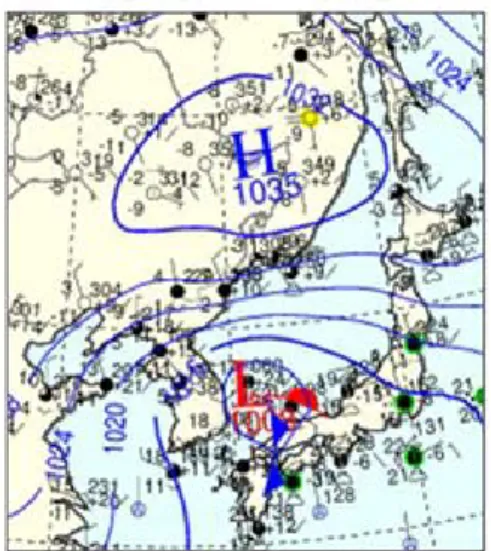
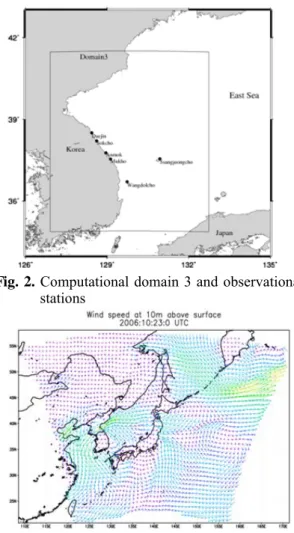
For the reanalysis of wind fields, four computational domains were set with 36km, 12km, 4km, and 1.3km grid interval covering the whole ES and a part of the western Pacific by domain 1. The wave model was also performed on the corresponding four domains with the reanalyzed wind fields by the mesoscale model as wind inputs. Fig. 1 shows the weather charts at 09:00 KST on 23 October 2006 and Fig. 2 shows the computational domain 3 with observational stations. The simulation periods for wind and wave were 20 days from 10 October to 30 October 2006.
Fig. 1. Weather chart at 09:00 KST on 23 October
2006
4. RESULTS
Figs. 3 and 4 show the reanalyzed wind fields at 00:00 UTC on 23 October 2006 from domain 1 and 2, which is same time in KST with the weather chart in Fig. 1. The simulatedwind fields in domain 2 show the counter-clockwise wind fields due to
the extra-tropical cyclone located at east off the east coast of Korea. The strong wind fields are shown particularly in the north part of Korean peninsula.
Fig. 5 shows the simulated maximum significant wave heights distribution from domain 1, 2 and 3 for simulation periodsin case of the free tunable parameter, n=2. Within the ES, the higher values of significant wave heights were found in the north part of east coast of Korea and west off Noto peninsula in Japan. The significant wave heights near the Ulreong Island, Korea show about 4m and the values near the east coast of Korea are about 2~2.5m.
Fig. 2. Computational domain 3 and observational
stations
Fig. 3. Simulated windfield from domain 1
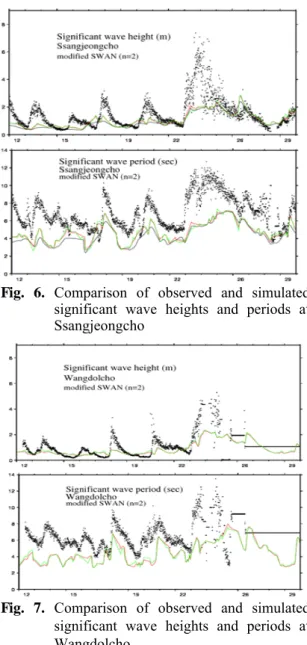
The comparison of observed and simulated significant wave heights and periods at Ssangjeongcho and Wangdolcho are shown in Figs. 6 and 7, respectively, in case of the free tunable parameter, n=2.
The significant wave heights in both stations shows good agreements in normal wind conditions,
which can be recognized in low wave heights during the period. At Ssangjeongcho station, the simulated significant wave heights before and after the peak at 23 to 24 October show good agreement with the observations. The peak values at 23 ~ 24 October and local peak at 18 and 20 October at Ssangjeongcho are not reproduced well. The simulated significant wave heights at Wangdolcho also show similar results with Ssangjeongcho. The simulated significant wave periods, however, show general underestimations at both stations even though the peak phase and pattern agreewell with the observations. The general underestimation of wave periods might attribute to a) incorrect initial condition of wave fields, b) overestimation of sink terms, in particular, the whitecapping under developed wind seas and swell condition, and c) inaccurate local wind generation.
Fig. 4. Simulated wind field from domain 2
Fig. 5. Maximum significant wave heights of
Fig. 6. Comparison of observed and simulated
significant wave heights and periods at Ssangjeongcho
Fig. 7. Comparison of observed and simulated
significant wave heights and periods at Wangdolcho
5. DISCUSSION AND CONCULSIONS
During the simulation periods, there are local peaks of significant wave heights before the peak on 23 October. It is difficult to reproduce the initial local peak without proper observed wave spectra at boundaries even though the ES is a semi-enclosed sea. The underestimation of simulated significant wave periods was not resolved satisfactorily even by introducing the modified whitecapping term with free tunable parameter. To evaluate further the functionality of the sink term, the observed wave frequency spectra is necessary. As pointed out by Jeong et al. (2007), the swell and developed wind waves are the main causes of the abnormal storm waves in the case of 23 October 2006 based on observations. Therefore, accurate local wind fields
responsible for the developed wind seas are required for wave field analysis.
The reproduced wind and wave fields using an atmosphere-wave coupled modeling system show generally good agreement with observations. However, further studies on the evaluation and improvement of whitecapping sink term are necessary.
REFERENCES
Booij, N., Ris, R.C. and Holthuijsen, L.H. (1999). A third-generation wave model for coastal regions, 1. Model description and validation. J. Geophy. Res., 104(C4), 7649–7666.
Cavaleri, L., Alves, J.H.G.M., Ardhuin, F., Babanin, A., et al. (2007). Wave modelling - The state of the art. Progress In Oceanography, 75(4), 603-674. Cavaleri, L. and Bertotti, L. (2004). Accuracy of the
modelled wind and wave fields in enclosed seas. Tellus A, 56, 167-175.
Cavaleri, L. and Bertotti, L. (2006). The improvement of modelled wind and wave fields with increasing resolution. Ocean Engineering, 33(5-6), 553-565. Donelan M. A. and Yuan, Y. (1994). Wave dissipation
by surface processes. Dynamics and Modelling of Ocean Waves. G. J. Komen, Cambridge University Press, 143–155.
Grell, G.A., Dudhia, J. and Stauffer, D.R. (1995). A description of the fifth-generation Penn State/NCAR Mesoscale Model (MM5), National Center for Atmospheric Research, NCAR Tech. Note, NCAR/TN-398 + STR.
Jeong, W.M., Oh, S.-H. and Lee, D.Y. (2007). Abnormally high waves on the East Coast. Journal of KSCOE, 19(4), 295-302.
Kim, T.-R. and Lee, K.-H. (2008). Examinations on the Wave Hindcasting of the Abnormal Swells in the East Coast. Journal of Korean Society of Ocean Engineers, 22(6), 13-19.
Lee, H.S., T. Yamashita, T. Komaguchi and Mishima, T. (2008). Numerical Simulation of so-called ‘Yorimawari-Waves’ caused bythe Low Pressures on Feb. 2008 Using a Meso-scale Meteorological Model and the Wave Model. Annual Journal of Coastal Engineering (JSCE), 55, 161-165.
Ponce de León, S. and Guedes Soares, C. (2008). Sensitivity of wave model predictions to wind fields in the Western Mediterranean sea. Coastal Engineering, 55(11), 920-929.
Rogers, W.E., David, W.W. and Paul, A.H. (2003). Investigation of Wave Growth and Decay in the SWAN Model: Three Regional-Scale Applications. Journal of Physical Oceanography, 33(2), 366-389 van der Westhuysen, A.J., Zijlema, M. and Battjes, J.A.
(2007). Nonlinear saturation-based whitecapping dissipation in SWAN for deep and shallow water. Coastal Engineering, 54(2), 151-170.