한국정밀공학회 2013 년도 춘계학술대회논문집
1. Introduction
AutoCAD, MAYA, 3ds Max are the tools that we commonly use to make a 3D model, but if we don’t have enough time to draw or create model by ourselves or we need to find out more similar models, we have to think about the ways of searching or downloading those models from large number of repositories of 3D models on internet. 3D models similarity or matching is a topic in active research that is applied on many areas such as computer graphic, biology, or mechanical engineering, etc.
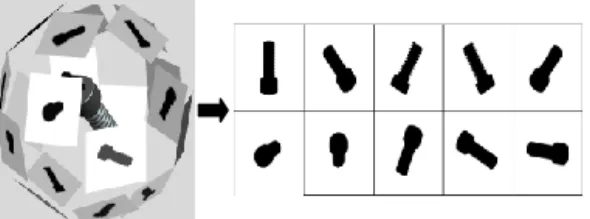
Shape representation is one method that we use in shape retrieval or matching. It is divided into three categories such as feature vector-based, statistics-based, and view-based representation. Light field descriptor (LFD) is one of view-based representation and it was proposed by Ding-Yun Chen1. LFD represents a 3D model as a set of 2D images (silhouettes) rendered from vertices of dodecahedron (Fig. 1).
Fourier descriptors (FD) and Zernike moment descriptors (ZMD) are used in LFD method because of their superior retrieval performances compared to other descriptors for the contour-based descriptors and region-based descriptor respectively2. Invariance of the FD is naturally achieved while the ZMD is inherited only rotation invariant from its formula. To achieve translation and scale invariance, direct method was proposed by S. Belkasim 3. However, to get scale invariance with this method, areas of shapes of all images have to be fixed.
In this paper, we propose a method for getting scale invariance by using pre-computed ZMD and regular moments.
Fig. 1 Procedure obtaining silhouettes from 3D shape
2. Zernike Moment Descriptors Zernike moments are defined by a set of complex polynomials which formed by a complete orthogonal basis set defined on the unit disc (x2+y2) ≤ 1. The
Zernike moment of order n with m repetition are obtained by:
(1)
For a digital image, integrals are replaced by summations:
(2)
, where and
(3) Radial polynomial defined by:
(4)
To make sure achieving invariance from the shape without losing the pixels, first we need to apply the translation invariance by transform image function f (x, y) to f x( x y, y), which x y, are
Achieving Scale Invariance for Shape Comparison Between 3D
Mechanical Parts
*Seng Hong Chhay1, Jin-won Son1, # Young Choi1([email protected]) 1
School of Mechanical Engineering, Chung-Ang University
Key words : Zernike moment, Shape representation, Light field descriptor, Silhouette, Regular moment
2 2 * 1 1 ( , ) ( , ) nm x y nm n A f x y V dxdy
* 1 ( , ) ( , ) nm nm x y n A f x y V
( , ) ( , ) ( )exp( ) nm nm nm V x y V R jm ( )/2 2 0 ( )! ( ) ( 1) ! ! ! 2 2 n m s n s nm s n s R n m n m s s s
2 2 1 x y 93
한국정밀공학회 2013 년도 춘계학술대회논문집 2 2 1 2 2 ( , ). ( )cos nm x y nm n C f x y R m dxdy
coordinate of centroid of the shape.
Regular moment of image function f(x, y): (5)
f(x/a, y/a) is the image function for scaled version
image which regular moment defined by :
(6)
After expansion Eq.(6) with Eq.(5), we get: 2
p q
pq pq
m a m (7)
m'00 = β (pre-determined value), thus
00 /
a m (8) The scale invariance can be accomplished by setting zeroth order of regular moment m00 equal to
pre-determined value β, that value can enlarge or reduce each shape in the images.
3. Proposed method on Scale Invariance After getting the translation invariance from the images, scale Invariance between a queried image and scaled images can be achieved by pre-calculating ZMD of Eq. (9) by expanding Eq. (10) and (11) with all 36 coefficients then apply regular moment.
The magnitudes of ZMD are defined by:
, which
(10)
(11)
Some of ZMD using coefficients to get scale invariance are shown as below:
(12)
The regular moment of the queried image can be achieved by Eq. (5), and for compared images, the regular moment can be obtained by following Eq. (7). At this time, the β is the zeroth moment of compared image, and the value of m00 is the zeroth moment of
the queried image. Using Eq. (7) and (12), we can calculate ZMD of queried image which the area of object is changed to same as the area of object of compared image.
4. Conclusion
By using proposed method, we expect to get scale invariance of ZMD. In future works, we will implement this method for validation using images having different scales. Moreover we will improve accuracy of 3D model retrieval and computation time.
Acknowledgements
This work (Grants No. C0028169) was supported by Business for Cooperative R&D between Industry, Academy, and Research Institute funded Korea Small and Medium Business Administration in 2012.
References
1. Ding-Yun Chen, Xiao-Pei Tian, Yu-Te Shen and Ming Ouhyoung “On Visual Similarity Based 3D Model Retrieval” 2003
2. J. S. Park, D. H. Chang “2D Invariant Descriptors for Shape-Based Image Retrieval” Pattern Recognition Letters, 2001
3. S. Belkasim*, E. Hassan, T. Oberdi “Explicit Invariance of Cartesian Zernike moments”, Pattern Recognition Letters, 28, 1969-1980, 2007. 4. Alireza Khotanzad, and Yaw Hua Hong
“Invariant Image Recognition by Zernike Moments” IEEE Transactions on Pattern analysis and Machine Intelligence, Vol.12, No.5, 1990