Development of Fluidigm SNP Type Genotyping
Assays for Marker-assisted Breeding of Chili Pepper
(
Capsicum annuum L.)
Haein Kim1, Jae Bok Yoon2, and Jundae Lee1* 1
Department of Horticulture, Chonbuk National University, Jeonju 54896, Korea 2
Research and Development Unit, Pepper and Breeding Institute, Hwaseong 18422, Korea *Corresponding author: [email protected]
Chili pepper (Capsicum annuum L.) is an economically important horticultural crop in Korea; however, various diseases, including Phytophthora root rot, anthracnose, powdery mildew, Cucumber mosaic virus (CMV), Pepper mild mottle virus (PMMoV), and Pepper mottle virus (PepMoV), severely affect their productivity and quality. Therefore, pepper varieties with resistance to multiple diseases are highly desired. In this study, we developed 20 SNP type assays for three pepper populations using Fluidigm nanofluidic dynamic arrays. A total of 4,608 data points can be produced with a 192.24 dynamic array consisting of 192 samples and 24 SNP markers. The assays were converted from previously developed sequence-tagged-site (STS) markers and included markers for resistance to Phytophthora root rot (M3-2 and M3-3), anthracnose (CcR9, CA09g12180, CA09g19170, CA12g17210, and CA12g19240), powdery mildew (Ltr4.1-40344, Ltr4.2-56301, and Ltr4.2-585119), bacterial spot (Bs2), CMV (Cmr1-2), PMMoV (L4), and PepMoV (pvr1 and pvr2-123457), as well as for capsaicinoids content (qcap3.1-40134, qcap6.1-299931, qcap6.1-589160, qdhc2.1-1335057, and qdhc2.2-43829). In addition, 11 assays were validated through a comparison with the corresponding data of the STS markers. Furthermore, we successfully applied the assays to commercial F1 cultivars and to our breeding lines. These 20 SNP type assays will be very useful for developing new superior pepper varieties with resistance to multiple diseases and a higher content of capsaicinoids for increased pungency. OPEN ACCESS Received: Revised: Accepted: April 4, 2017 May 23, 2017 May 24, 2017
Abstract
Additional key words: disease resistance, foreground selection, high-throughput genotyping, molecular marker, SNP
Introduction
Chilipepper (Capsicum annuum L.) isoneofthemostimportantvegetablecropsinKorea (Leeetal., 2004). However, annualproductionandcultivationhasgraduallydeclineddue, inpart, topepperdiseases thatusuallyoccurinthesummerseason.
Major pepper diseasesinclude Phytophthora root rot (Phytophthora capsici; Liu et al., 2014), anthracnose (Colletotrichum scovillei and C. truncatum, formerly C. acutatum and C. capsici, respectively; This research was supported by the “Coopera-
tive Research Program for Agriculture Science & Technology Development (Project No. PJ011 14501 and PJ01114502)” of the Rural Develop- ment Administration, Republic of Korea. HORTICULTURAL SCIENCE and TECHNOLOGY 35(4):465-479, 2017
URL: http://www.kjhst.org
pISSN : 1226-8763 eISSN : 2465-8588
This is an Open-Access article distributed under the terms of the Creative Commons Attribution NonCommercial License which permits unrestricted non-commercial use, distribution, and reproduction in any medium, provided the original work is properly cited.
Copyrightⓒ2017 Korean Society for Horticultural Science.
Mahasuketal., 2016), powderymildew (Leveillula taurica; Lefebvreetal., 2003), bacterialwilt (Ralstonia solanacearum; Mimuraetal., 2009), bacterialspot (Xanthomonas campestris pv. vesicatora; Truongetal., 2011), Cucumber mosaic virus (CMV; Eunetal., 2016), Pepper mild mottle virus (PMMoV; Yangetal., 2012), Tomato spotted wilt virus (TSWV; Kimetal., 2017), and Pepper mottle virus (PepMoV; Kimetal., 2011, 2017). Thesediseasesaredifficulttocontrol, evenwiththeuseof agrichemicals. Therefore, peppervarietieswithmultipleresistancearehighlydesired. Inaddition, higherlevelsofpungencyare alsodesiredbythepepperprocessingindustry (Leeetal., 2016a). Thepungencyofchilipepperisrelatedtothecontentof capsaicinoidssuchascapsaicinanddihydrocapsaicin (Aza-Gonzálezetal., 2011).
Molecularmarkersarewidelyusedtoimprovetheefficiencyofplantbreedingprograms, toconstructgeneticlinkagemaps, and todetectgenesorquantitativetraitloci (QTL) controllingspecifictraits (Collardetal., 2005; CollardandMackill, 2008; Xuand Crouch, 2008). Marker-assistedselection (MAS) andmarker-assistedbackcrossing (MABC) arecommonlyusedtoimprovethe efficiencyofselectioninplantbreeding. MASinvolvesforegroundselectionofatargettraitortraitsofinterest, whileMABC involvesbackgroundselectionofoverallgenomicregionsinBCgenerations (CollardandMackill, 2008). MASandMABCcan reducethebreedingperiodandthenumberofgenerationsneededinabreedingprogramcomparedtoconventionalphenotypic selectionbecausecodominantmarkersallowbreederstodistinguishbetweenhomozygotesandheterozygotesandtodetectearly thedesiredtraitsinseedsorseedlingswithouthavingtogrowtheplantstomaturityorinoculatethem.
Severalmolecularmarkershavebeendevelopedinpepperfordiseaseresistanceandcapsaicinoidscontent. Twodominant markers, OpD04-717-SCARandP5-SNAP, forthedetectionofamajorQTL, Phyto.5.2, forresistanceto P. capsici havebeen reported (Quirinetal., 2005), andcodominantmarkersM3-CAPSandPhyto5NBS1-HRMforthetraithavealsobeendeveloped (Leeetal., 2012; Liuetal., 2014). ThemarkersCaR12.2M1-CAPSandCcR9M1-SCARhavebeenlinkedtothemajorQTLsfor resistanceto C. scovillei and C. truncatum, respectively (Leeetal., 2010, 2011). Bacterialspotresistancegenes (Bs2 and Bs3) havebeenclonedinpepper (Taietal., 1999b; Römeretal., 2007), andgene-basedcodominantmarkers14F/14Rand25-1for Bs2 andPR-Bs3for Bs3 weresubsequentlydeveloped (Römeretal., 2010; Truongetal., 2011). ThreeSNPmarkers, CaTm -int3HRM, CaT1616BAC, and240H02sp6, wereidentifiedandlinkedtoasingledominantgene, Cmr1, thatcontrolsCMV resistance (Kangetal., 2010). TwoCAPSmarkers, pvr1-R1andpvr1-R2, weredevelopedtodetect pvr1 and pvr12allelesfor potyvirusresistancein C. chinense accessions (Yeametal., 2005). Pvr4 and Tsw geneshavealsobeencloned: Pvr4 isapotyvirus resistancegeneoriginatingfrom C. annuum ‘CM334’ and Tsw isaTSWVresistancegenefrom C. chinense accessions ‘PI159236’ and ‘PI152225’ (Kimetal., 2017). Markers61786andNB575mwerefoundtocosegregatewiththe Pvr4 and Tsw genes, respectively. Inaddition, high-resolutionDNAmelting (HRM) markerslinkedtotheQTLsresponsibleforhighcapsaicin anddihydrocapsaicincontentin C. chinense ‘BhutJolokia’ havebeendeveloped (Leeetal., 2016a). Manyothertrait-linked markershavebeenreportedinpepper. Therefore, high-throughputscreeningmethodsareneededforthesimplifiedandcost -effectiveanalysisofmultiplemolecularmarkersinasinglereaction.
RemarkabletechnologicalachievementshaveoccurredoverthepastfewdecadesinthefieldofDNAsequencingandSNP genotyping, includingnext-generationsequencing (NGS) andhigh-throughputSNPgenotyping (Varshneyetal., 2009; Kumar etal., 2012; PolandandRife, 2012; Thomson, 2014). High-throughputSNPgenotypingisparticularlyusefulincropbreeding (Thomson, 2014). MolecularmarkerscanberapidlydevelopedforSNPs, whicharethemostabundantpolymorphismswith unlimitednucleotidevariationsbetweenindividualorganisms, evenwithinthesamespecies (Rafalski, 2002). Moreover, analysisofSNPmarkersisaccurate, rapid, andinexpensive.
AffymetrixAxiomarray, DouglasArrayTape, Fluidigmdynamicarrays, restriction-enzyme-basedgenotyping-by-sequencing (GBS), andampliconsequencing (Thomson, 2014). Amongthem, Fluidigmdynamicarraysadoptaflexible, PCR-basedSNP platformusingananofluidicintegratedfluidcircuit (IFC; Wangetal., 2009). TherearethreedifferenttypesofFluidigmdynamic arrays: a48.48dynamicarray, whichyields2,304datapointswith48samplesand48markers, aswellas96.96and192.24 dynamicarrays, whichyield9,216and4,608datapoints, respectively (Wangetal., 2009; Thomson, 2014). Thissystemcansave bothresourcesandtimebyreducingthereactionvolumesto7-10nLandproducing2,304-9,216datapointswithin2-4hours (Thomson, 2014), while384- and96-wellPCRsystemsrequire5-20µLofthereactionvolumesperwellandittakes4-8daysto producethesamenumberofdatapointswiththePCRsystems.
Inthisstudy, wedevelopedSNPtypeassayslinkedtodiseaseresistanceorcapsaicinoidscontentforuseinFluidigm192.24 dynamicarraysthatcouldsimultaneouslyanalyze24SNPmarkers. TheCAPS, SCAR, andSNPmarkerspreviouslydeveloped inchilipepperweresuccessfullyconvertedintotheFluidigmSNPtypeassays.
Materials and Methods
Plant MaterialsThreepopulations (PG, CHB-F3, andJN-F5) wereusedtodeveloptheSNPtypeassays. ThePGpopulationconsistedof51
Capsicum accessionsincludingsixspecies (C. annuum, C. baccatum, C. chinense, C. frutescens, C. pubescens, and C. chacoense), whichwereobtainedfromtheNationalAgrobiodiversityCenter, RuralDevelopmentAdministration, RepublicofKorea (Table2; http://genebank.rda.go.kr/). TheCHB-F3populationwasmadeupof48individualsoriginatingfromacrossof C.
annuum ‘A1’ × C. annuum ‘2602’, whichwasusedforQTLanalysisofCMVP1resistance (Table3; Eunetal., 2016). TheJN-F5 populationconsistedof50individualsofanF5 singleseeddescent (SSD) populationderivedfromacrossof C. annuum ‘NB1’
× C. chinense ‘BhutJolokia’, whichwasusedforQTLanalysisofcapsaicinoidscontent (Table4; Leeetal., 2016a). Inaddition, 33commercialcultivars, 30breedinglines, and7geneticsourcesforpepperwereusedforvalidationofthenewlydeveloped SNPtypeassays(Tables5and6).
Primer Design for the Fluidigm SNP Type Assays
ThefollowingtargetsequencecriteriawereemployedtodesignprimersfortheSNPtypeassays. Lengthofthetarget sequences: aminimumof60bp (includingbothupstreamanddownstreamofthetargetSNPsite) andamaximumof 250bp. ForSNPs, onlyoneSNPwaspresentinthetargetsequence. Forinsertions/deletions (In/Dels), thelengthoftheIn/Delwas shorterthan10bp. TheG/Ccontentofthetargetsequencewas < 65%. Atotalof43primersweredesignedusingD3Assay Design (https://d3.fluidigm.com/; Fluidigm, SouthSanFrancisco, CA, USA). PrimerinformationislistedinTable1. Eachassay consistedofthreetypesofprimers: aspecifictargetamplification (STA) primer, alocus-specific (LS) primer, andanallele -specific (AS) primer (Wangetal., 2009).
DNA Extraction
GenomicDNAwaspreparedfromfreshleavesusingtheminiprepmethoddescribedbyEunetal. (2016). TheDNA concentrationwasmeasuredusingaBioDropµLITE (BioDropUKLtd., Cambridge, UK) andadjustedto50ng·µL-1. TheDNA
wasusedfortheSNPtypeassaysandHRManalysis. Specific Target Amplification
BeforeperformingtheSNPtypeassay, specifictargetamplification (STA), whichisusedtoenrichtheampliconincludingthe targetedSNPsequences, wasperformedtoincreasetheprobabilityofsuccessoftheSNPtypeassay (Wangetal., 2009). First, a 10× STAprimerpoolwaspreparedcomprisingamixtureof2µLofSTAprimerforeachofthe24markers, 2µLofLSprimer foreachofthe24markers, and304µLofDNAsuspensionbuffer (Teknova, Holister, CA, USA). Foreachofthe191samples, STAwasexecutedusingaLightCycler96Real-TimePCR (Roche, Basel, Switzerland) inatotalvolumeof5µLperreaction, whichcontained2.5µLofmastermix (Qiagen, Hilden, Germany), 0.5µLofthe10× STAprimerpool, 0.75µLofPCR-certified water, and1.25µLofgenomicDNAwiththefollowingPCRprofile: pre-denaturationfor900sat95°Cfollowedby14cycles ofa2-stepamplificationof15sat95°Cand240sat60°C. Then, 3µLofamplifiedproductwasdilutedin97µLofPCR-certified waterandthenusedfortheSNPtypeassay.
SNP Type Assay
ToperformtheSNPtypeassaysusingthe192.24IFC, theassaymixandsamplemixwereprepared. Theassaymixcontained 1.2µLofPCR-certifiedwater, 2µLof2× assayloadingreagent, and0.8µLoftheassaypre-mix, whichwascomprisedof3µL ofeachASprimer, 8µLofeachLSprimer, and29µLofDNAsuspensionbuffer (Teknova, Holister, CA, USA). Thesample pre-mixcontained540µLof2× FastProbeMasterMix (Biotium, Fremont, CA, USA), 54µLofSNPtype20× sampleloading reagent, 18µLofSNPtype60× reagent, 6.48µLof50× ROXdye (Invitrogen, Waltham, MA, USA), and11.52µLofPCR -certifiedwater. Subsequently, thesamplemixwaspreparedbymixing1.9µLofeachSTAproductand2.6µLofthesample pre-mixineachwelloftwo96-wellplates. Finally, 3µLofeachsamplemixand3µLofeachassaymixwereloadedinto192 sampleinletsand24assayinletsofthe192.24IFC, respectively.
TheSNPtypeassayswereperformedinseriesusingthreemachines, theIFCcontrollerRX (Fluidigm, SouthSanFrancisco, CA, USA), theIFCcycler (Fluidigm, SouthSanFrancisco, CA, USA), andtheEP1system (Fluidigm, SouthSanFrancisco, CA, USA) accordingtothemanufacturer’sinstructions (Wangetal., 2009).
Scoring of SNPs
IneachSNPtypeassay, twotypesoffluorescence, FAM (red, Yaxis) andHEX (green, Xaxis), wereanalyzedandeach fluorescencewaslinkedtoeachSNP (Table1). UsingFluidigmSNPgenotypinganalysisversion4.1.3 (Fluidigm, SouthSan Francisco, CA, USA), threedifferentgenotypes (A, H, andB) wereidentified: AandBrefertoaspecifichomozygousSNP; H referstoaheterozygousSNP(Fig. 1).
Analysis of HRM Markers
HRManalysiswasperformedusingaLightCycler96Real-TimePCRmachine (Roche, Basel, Switzerland). Thereaction solutionforHRManalysiswaspreparedandPCRreactionswereperformedaccordingtoLeeetal. (2016b). High-Resolution Meltsoftwareversion1.1 (Roche, Basel, Switzerland) wasusedtoanalyzethemarkertypesofHRM. HRMmarkerinformation wasderivedfromthereferencesinTable1.
Results and Discussion
Development of the SNP Type Assays
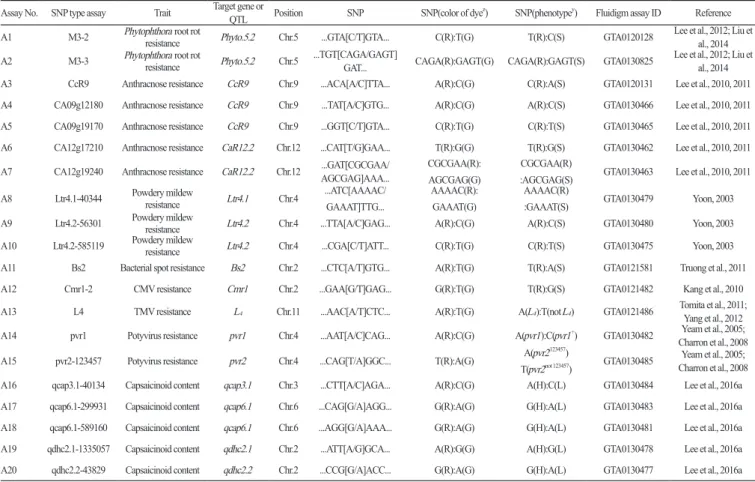
Atotalof43primersetsweredesignedfortheSNPtypeassaysand20assayswereclearlyanalyzedviaclassificationinto threeortwogroups (Fig. 1). InFig. 1, red, green, andbluepointsindicateXX (fluorescenceofonlyFAMdye), YY (onlyHEX dye), andXY (bothFAMandHEXdyes) markertypes, respectively. ThemarkertypeofeachSNPtypeassaywasdividedinto resistant (R), heterozygous (H), orsusceptible (S) typesfordiseaseresistance, andhigh (H), heterozygous (M), orlow (L) typesfor capsaicinoidscontent (Fig. 1andTable1). The20successfulSNPtypeassaysarelistedinTable1, whichincludesthenameof theoriginalgenesorQTLsforcapsaicinoidscontent (qcap3.1, qcap6.1, qdhc2.1, and qdhc2.2) andforresistancetodiseasessuch as Phytophthora rootrot (Phyto.5.2), anthracnose (CcR9 and CaR12.2), powderymildew (Ltr4.1 and Ltr4.2), bacterialspot (Bs2), CMV (Cmr1), TMV (L4), andpotyvirus (pvr1 and pvr2). Atotalof5192.24ICFswereanalyzedusingthe43primersetsandthe threesegregatingpopulations(Tables2, 3, and4). The20successfulSNPtypeassaysshowedclearresultsthatwerepolymorphic inatleastonepopulation (Fig. 1andTable1). Inaddition, 11assayswerecomparedwiththecorrespondingoriginalHRM markerstodeterminewhetherthemarkertypescosegregated(Tables2, 3, and4).
TwoSNPtypeassays, M3-2 (Fig. 1A)andM3-3 (Fig. 1B), wereconvertedfromtheM3-CAPSmarkertightlylinkedto
Table 1. List of Fluidigm SNP type assays used in this study and relevant information.
Assay No. SNP type assay Trait Target gene or QTL Position SNP SNP(color of dyez) SNP(phenotypey) Fluidigm assay ID Reference
A1 M3-2 Phytophthora root rot resistance Phyto.5.2 Chr.5 ...GTA[C/T]GTA... C(R):T(G) T(R):C(S) GTA0120128 Lee et al., 2012; Liu et al., 2014 A2 M3-3 Phytophthora root rot resistance Phyto.5.2 Chr.5 ...TGT[CAGA/GAGT]GAT... CAGA(R):GAGT(G) CAGA(R):GAGT(S) GTA0130825 Lee et al., 2012; Liu et al., 2014 A3 CcR9 Anthracnose resistance CcR9 Chr.9 ...ACA[A/C]TTA... A(R):C(G) C(R):A(S) GTA0120131 Lee et al., 2010, 2011 A4 CA09g12180 Anthracnose resistance CcR9 Chr.9 ...TAT[A/C]GTG... A(R):C(G) A(R):C(S) GTA0130466 Lee et al., 2010, 2011 A5 CA09g19170 Anthracnose resistance CcR9 Chr.9 ...GGT[C/T]GTA... C(R):T(G) C(R):T(S) GTA0130465 Lee et al., 2010, 2011 A6 CA12g17210 Anthracnose resistance CaR12.2 Chr.12 ...CAT[T/G]GAA... T(R):G(G) T(R):G(S) GTA0130462 Lee et al., 2010, 2011 A7 CA12g19240 Anthracnose resistance CaR12.2 Chr.12 ...GAT[CGCGAA/AGCGAG]AAA... CGCGAA(R):
AGCGAG(G)
CGCGAA(R)
:AGCGAG(S) GTA0130463 Lee et al., 2010, 2011 A8 Ltr4.1-40344 Powdery mildew resistance Ltr4.1 Chr.4 ...ATC[AAAAC/
GAAAT]TTG...
AAAAC(R): GAAAT(G)
AAAAC(R)
:GAAAT(S) GTA0130479 Yoon, 2003
A9 Ltr4.2-56301 Powdery mildew resistance Ltr4.2 Chr.4 ...TTA[A/C]GAG... A(R):C(G) A(R):C(S) GTA0130480 Yoon, 2003 A10 Ltr4.2-585119 Powdery mildew resistance Ltr4.2 Chr.4 ...CGA[C/T]ATT... C(R):T(G) C(R):T(S) GTA0130475 Yoon, 2003 A11 Bs2 Bacterial spot resistance Bs2 Chr.2 ...CTC[A/T]GTG... A(R):T(G) T(R):A(S) GTA0121581 Truong et al., 2011
A12 Cmr1-2 CMV resistance Cmr1 Chr.2 ...GAA[G/T]GAG... G(R):T(G) T(R):G(S) GTA0121482 Kang et al., 2010
A13 L4 TMV resistance L4 Chr.11 ...AAC[A/T]CTC... A(R):T(G) A(L4):T(not L4) GTA0121486 Tomita et al., 2011; Yang et al., 2012
A14 pvr1 Potyvirus resistance pvr1 Chr.4 ...AAT[A/C]CAG... A(R):C(G) A(pvr1):C(pvr1+) GTA0130482 Yeam et al., 2005;
Charron et al., 2008 A15 pvr2-123457 Potyvirus resistance pvr2 Chr.4 ...CAG[T/A]GGC... T(R):A(G) A(pvr2123457)
T(pvr2not 123457) GTA0130485 Charron et al., 2008Yeam et al., 2005;
A16 qcap3.1-40134 Capsaicinoid content qcap3.1 Chr.3 ...CTT[A/C]AGA... A(R):C(G) A(H):C(L) GTA0130484 Lee et al., 2016a A17 qcap6.1-299931 Capsaicinoid content qcap6.1 Chr.6 ...CAG[G/A]AGG... G(R):A(G) G(H):A(L) GTA0130483 Lee et al., 2016a A18 qcap6.1-589160 Capsaicinoid content qcap6.1 Chr.6 ...AGG[G/A]AAA... G(R):A(G) G(H):A(L) GTA0130481 Lee et al., 2016a A19 qdhc2.1-1335057 Capsaicinoid content qdhc2.1 Chr.2 ...ATT[A/G]GCA... A(R):G(G) A(H):G(L) GTA0130478 Lee et al., 2016a A20 qdhc2.2-43829 Capsaicinoid content qdhc2.2 Chr.2 ...CCG[G/A]ACC... G(R):A(G) G(H):A(L) GTA0130477 Lee et al., 2016a
zR, red (FAM dye); G, green (HEX dye).
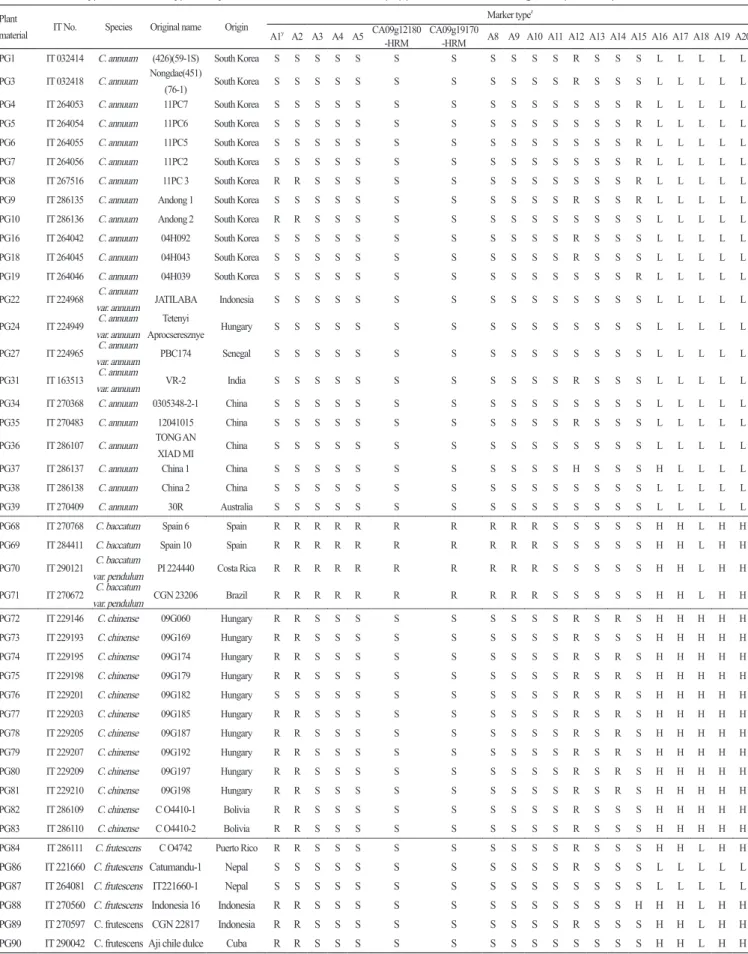
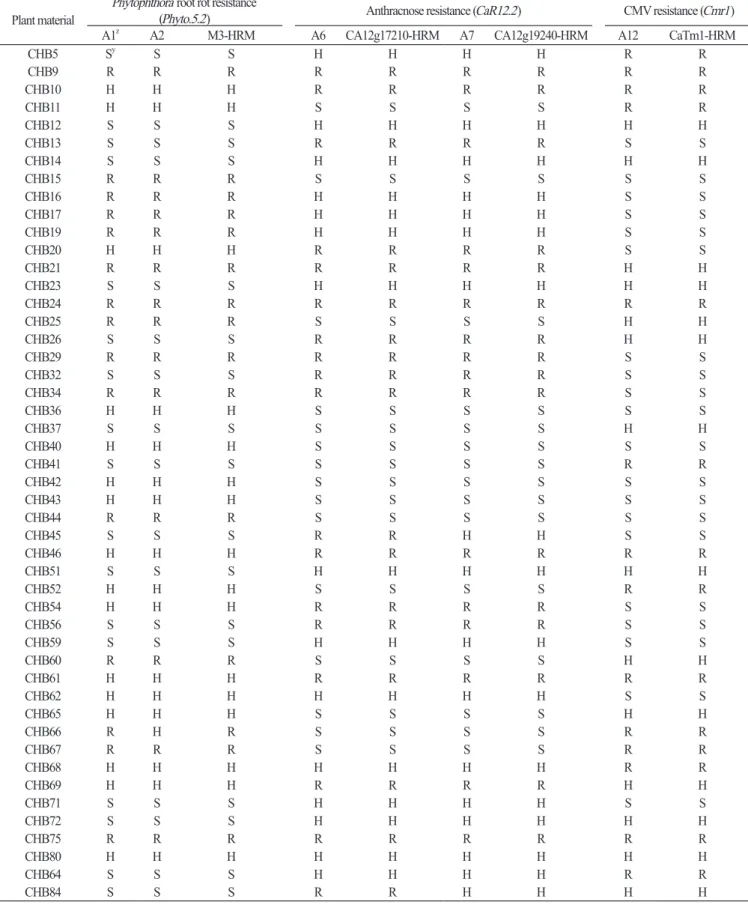
Phyto.5.2, amajorQTLforresistancetorootrotcausedby P. capsici (Table1, A1, andA2; Quirinetal., 2005; Leeetal., 2012). Theseassaysrevealedthattheresistanceallelewaswidelydistributedamongdomesticated Capsicum speciesexceptfor C. annuum (Table2, A1andA2). Thus, theresistanceofthefivedomesticatedspeciesshouldbeanalyzedviainoculationwith P. capsici becausetheresistancealleleoriginatedfrom C. annuum accessions, including ‘CM334’, ‘PI201232’, ‘PI201234’, and ‘AC2258’ (Liuetal., 2014). ThemarkertypesfortheM3-2assaywereperfectlymatchedwiththoseofthepreviouslydeveloped M3-HRMmarkerintwosegregatingpopulations, CHB-F3andJN-F5 (Tables3and4, A1), whiletheM3-3assayrevealedonly onerecombinantintheCHB-F3population (Tables3and4, A2). Therefore, theM3-2assaycanbeusedtoselect Phytophthora rootrotresistancebecauseitcosegregatedperfectlywiththeM3-HRMmarker.
Threeassays, CcR9 (Fig. 1C), CA09g12180 (Fig. 1D), andCA09g19170 (Fig. 1E), werederivedfromtheCcR9M1-SCAR markertodetect CcR9, amajorQTLforresistancetoanthracnosecausedby C. truncatum (Table1, A3, A4, andA5), whiletwo assays, CA12g17210 (Fig. 1F)andCA12g19240(Fig. 1G), originatedfromtheCaR12.2M1-CAPSmarkertoselect CaR12.2, a
Fig. 1. Scatter plots of 20 SNP type assays. R, resistant; S, susceptible; H, heterozygous for A-O, high capsaicinoid content allele
for P-T; L, low capsaicinoid content allele.
R R S R H H H S S H R or H H M M M M M H H L L L L L S S R K Bs2 L Cmr1-2 M L4 N pvr1 P qcap3.1-40134 R qcap6.1-589160 O pvr2-123457 Q qcap6.1-299931 S qdhc2.1-1335057 T qdhc2.2-43829 R R R R R R R R S S S H H H H H R R S S S S S S S A M3-2 B M3-3 C CcR9 D CA09g12180 F CA12g17210 H Ltr4.1-40344 E CA09g19170 G CA12g19240 I Ltr4.2-56301 J Ltr4.2-585119
Table 2. Marker types of 18 SNP type assays and two HRM markers in 51 pepper accessions including six Capsicum species.
Plant
material IT No. Species Original name Origin
Marker typez
A1y A2 A3 A4 A5 CA09g12180
-HRM CA09g19170-HRM A8 A9 A10 A11 A12 A13 A14 A15 A16 A17 A18 A19 A20
PG1 IT 032414 C. annuum (426)(59-1S) South Korea S S S S S S S S S S S R S S S L L L L L
PG3 IT 032418 C. annuum Nongdae(451)
(76-1) South Korea S S S S S S S S S S S R S S S L L L L L
PG4 IT 264053 C. annuum 11PC7 South Korea S S S S S S S S S S S S S S R L L L L L
PG5 IT 264054 C. annuum 11PC6 South Korea S S S S S S S S S S S S S S R L L L L L
PG6 IT 264055 C. annuum 11PC5 South Korea S S S S S S S S S S S S S S R L L L L L
PG7 IT 264056 C. annuum 11PC2 South Korea S S S S S S S S S S S S S S R L L L L L
PG8 IT 267516 C. annuum 11PC 3 South Korea R R S S S S S S S S S S S S R L L L L L
PG9 IT 286135 C. annuum Andong 1 South Korea S S S S S S S S S S S R S S R L L L L L
PG10 IT 286136 C. annuum Andong 2 South Korea R R S S S S S S S S S S S S S L L L L L
PG16 IT 264042 C. annuum 04H092 South Korea S S S S S S S S S S S R S S S L L L L L
PG18 IT 264045 C. annuum 04H043 South Korea S S S S S S S S S S S R S S S L L L L L
PG19 IT 264046 C. annuum 04H039 South Korea S S S S S S S S S S S S S S R L L L L L
PG22 IT 224968 C. annuum
var. annuum JATILABA Indonesia S S S S S S S S S S S S S S S L L L L L
PG24 IT 224949 C. annuum var. annuum
Tetenyi
Aprocseresznye Hungary S S S S S S S S S S S S S S S L L L L L
PG27 IT 224965 C. annuum
var. annuum PBC174 Senegal S S S S S S S S S S S S S S S L L L L L
PG31 IT 163513 C. annuum
var. annuum VR-2 India S S S S S S S S S S S R S S S L L L L L
PG34 IT 270368 C. annuum 0305348-2-1 China S S S S S S S S S S S S S S S L L L L L
PG35 IT 270483 C. annuum 12041015 China S S S S S S S S S S S R S S S L L L L L
PG36 IT 286107 C. annuum TONG AN XIAD MI China S S S S S S S S S S S S S S S L L L L L
PG37 IT 286137 C. annuum China 1 China S S S S S S S S S S S H S S S H L L L L
PG38 IT 286138 C. annuum China 2 China S S S S S S S S S S S S S S S L L L L L
PG39 IT 270409 C. annuum 30R Australia S S S S S S S S S S S S S S S L L L L L
PG68 IT 270768 C. baccatum Spain 6 Spain R R R R R R R R R R S S S S S H H L H H
PG69 IT 284411 C. baccatum Spain 10 Spain R R R R R R R R R R S S S S S H H L H H
PG70 IT 290121 C. baccatum
var. pendulum PI 224440 Costa Rica R R R R R R R R R R S S S S S H H L H H
PG71 IT 270672 C. baccatum
var. pendulum CGN 23206 Brazil R R R R R R R R R R S S S S S H H L H H
PG72 IT 229146 C. chinense 09G060 Hungary R R S S S S S S S S S R S R S H H H H H PG73 IT 229193 C. chinense 09G169 Hungary R R S S S S S S S S S R S S S H H H H H PG74 IT 229195 C. chinense 09G174 Hungary R R S S S S S S S S S R S R S H H H H H PG75 IT 229198 C. chinense 09G179 Hungary R R S S S S S S S S S R S R S H H H H H PG76 IT 229201 C. chinense 09G182 Hungary S S S S S S S S S S S R S R S H H H H H PG77 IT 229203 C. chinense 09G185 Hungary R R S S S S S S S S S R S R S H H H H H PG78 IT 229205 C. chinense 09G187 Hungary R R S S S S S S S S S R S R S H H H H H PG79 IT 229207 C. chinense 09G192 Hungary R R S S S S S S S S S R S R S H H H H H PG80 IT 229209 C. chinense 09G197 Hungary R R S S S S S S S S S R S R S H H H H H PG81 IT 229210 C. chinense 09G198 Hungary R R S S S S S S S S S R S R S H H H H H
PG82 IT 286109 C. chinense C O4410-1 Bolivia R R S S S S S S S S S R S S S H H H H H
PG83 IT 286110 C. chinense C O4410-2 Bolivia R R S S S S S S S S S R S S S H H H H H
PG84 IT 286111 C. frutescens C O4742 Puerto Rico R R S S S S S S S S S R S S S H H L H H
PG86 IT 221660 C. frutescens Catumandu-1 Nepal S S S S S S S S S S S R S S S L L L L L PG87 IT 264081 C. frutescens IT221660-1 Nepal S S S S S S S S S S S S S S S L L L L L PG88 IT 270560 C. frutescens Indonesia 16 Indonesia R R S S S S S S S S S S S S H H H L H H PG89 IT 270597 C. frutescens CGN 22817 Indonesia R R S S S S S S S S S R S S S H H L H H PG90 IT 290042 C. frutescens Aji chile dulce Cuba R R S S S S S S S S S S S S S H H L H H
majorQTLforresistancetoanthracnosecausedby C. scovillei (Table1, A6andA7; Leeetal., 2011). Theseassaysshowedthat resistanceallelesonlyappearedin C. baccatum and C. chacoense (Table2, A3-A5). Resistancewasalreadyknowntobepresent in C. baccatum, including ‘PBC80’, ‘PBC81’, ‘Cbp’, and ‘PI594137’ (Parketal., 2009). However, theresistanceof C. chacoense hasnotbeenanalyzedwithinoculationassays, andthusneedstobeexamined. ThemarkertypesoftheCA12g17210and CA12g19240assaysperfectlycoincidedwiththoseoftheCA12g17210-HRMandCA12g19240-HRMmarkers, respectively, intheCHB-F3andJN-F5 populations (Table2, A6; Table3, A6andA7).
Threeassays, Ltr4.1-40344 (Fig. 1H), Ltr4.2-56301 (Fig. 1I), andLtr4.2-585119 (Fig. 1J), weredevelopedtoidentifytwo QTLs, Ltr4.1 and Ltr4.2, forpowderymildewresistance, whichwerederivedfrom C. baccatum ‘PBC81’ (Table1, A8, A9, and A10; Yoon, 2003). Liketheanthracnoseresistanceassays, theresistancemarkertypesoftheseassayswerealsospecificto accessionsof C. baccatum and C. chacoense (Table2, A8-A10).
TheBs2 (Fig. 1K)assaywasbasedonthe Bs2 geneconferringresistancetomost Xanthomonas campestris pv vesicatora racesincluding0, 1, 2, 3, 7, and8 (Table1, A11; Stalletal., 2009; Truongetal., 2011). Theresistancemarkertypeofthisassaywas foundonlyin C. chacoense accessions (Table2, A11). ThisresultwassupportedbyTaietal. (1999a) whodescribed Bs2 resistancefromawildspeciesofpepper, C. chacoense ‘PI260435’.
TheCmr1-2 (Fig. 1L) assaywasderivedfromtheCaTm-int3-HRMmarkercloselylinkedto Cmr1, adominantresistance geneagainstCMVKoreanandCMVFNYstrains (Table1, A12; Kangetal., 2010). Theresistancemarkertypeofthisassaywas widelydistributedthroughout Capsicum spp. exceptfor C. baccatum and C. chacoense (Table2, A12), anditssegregation patternwasthesameasthatoftheCaTm1-HRMmarkerintheCHB-F3andJN-F5 populations (Tables3and4, A12). Therefore, thisassaycanbeusedtoselectthe Cmr1 gene.
TheL4 (Fig. 1M) assaywasdevelopedtoselect L4allelesresistanttomostpathotypesincludingToMV (P0), PaMMV (P0and P1), andPMMoV (P1.2andP1.2,3) (Table1, A13; Tomitaetal., 2011). Similartothe Bs2 gene, theresistancemarkertypeofthe L4 assaywaspresentonlyin C. chacoense accessions (Table2, A13). ThisresultwasconsistentwiththefindingsofBoukema (1984) whoreportedthat L4 resistancewasfoundin C. chacoense accessions ‘PI260429’ and ‘SA185’.
Twoassays, pvr1(Fig. 1N) andpvr2-123457 (Fig. 1O), werecreatedtodetect pvr1 and pvr2 genes, respectively, whichwere allelicandencodedaneIF4Eprotein, butoriginatedfromdifferentgeneticresources: pvr1 from C. chinense and pvr2 from C. annuum and C. frutescens (Table1, A14andA15; Kangetal., 2005; Charronetal., 2008). Aresistantmarkertypeofthe pvr1 Table 2. Continued.
Plant
material IT No. Species Original name Origin
Marker typez
A1y A2 A3 A4 A5 CA09g12180
-HRM CA09g19170-HRM A8 A9 A10 A11 A12 A13 A14 A15 A16 A17 A18 A19 A20
PG91 IT 261294 C. frutescens SVK 278 Laos R R S S S S S S S S S S S S R H L L L L
PG92 IT 267517 C. frutescens ATP 24 Laos S S S S S S S S S S S R S S R L L L L L
PG93 IT 158741 C. pubescens
NUM-113-ROJO Guatemala R R S S S S S S S S S S S R R L L L L L
PG95 IT 207297 C. pubescens Locoto Bolivia R R S S S S S S S S S R S S S H H H H H
PG96 IT 283281 C. chacoense
BOL-AWS-1999-358 Unknown R R R R R R R R R R R S R S S H H L H H
PG97 IT 283500 C. chacoense G2280 Germany R R R R R R R R R R R S R S S H H L H H
PG98 IT 283501 C. chacoense BERKMORTEL Unknown R R R R R R R R R R R S R S S H H L H H
zR, resistant; S, susceptible; H, heterozygous for A1-A14, high capsaicinoid content allele for A16-A20; L, low capsaicinoid content allele.
yA1, M3-2; A2, M3-3; A3, CcR9; A4, CA09g12180; A5, CA09g19170; A6, CA12g17210; A7, CA12g19240; A8, Ltr4.1-40344; A9, 56301; A10,
Ltr4.2-585119; A11, Bs2; A12, Cmr1-2; A13, L4; A14, pvr1; A15, pvr2-123457; A16, qcap3.1-40134; A17, qcap6.1-299931; A18, qcap6.1-589160; A19, qdhc2.1-1335057; A20, qdhc2.2-43829.
Table 3. Comparison of marker types between the SNP type assays and HRM markers in the CHB-F3 population.
Plant material Phytophthora root rot resistance (Phyto.5.2) Anthracnose resistance (CaR12.2) CMV resistance (Cmr1)
A1z A2 M3-HRM A6 CA12g17210-HRM A7 CA12g19240-HRM A12 CaTm1-HRM
CHB5 Sy S S H H H H R R CHB9 R R R R R R R R R CHB10 H H H R R R R R R CHB11 H H H S S S S R R CHB12 S S S H H H H H H CHB13 S S S R R R R S S CHB14 S S S H H H H H H CHB15 R R R S S S S S S CHB16 R R R H H H H S S CHB17 R R R H H H H S S CHB19 R R R H H H H S S CHB20 H H H R R R R S S CHB21 R R R R R R R H H CHB23 S S S H H H H H H CHB24 R R R R R R R R R CHB25 R R R S S S S H H CHB26 S S S R R R R H H CHB29 R R R R R R R S S CHB32 S S S R R R R S S CHB34 R R R R R R R S S CHB36 H H H S S S S S S CHB37 S S S S S S S H H CHB40 H H H S S S S S S CHB41 S S S S S S S R R CHB42 H H H S S S S S S CHB43 H H H S S S S S S CHB44 R R R S S S S S S CHB45 S S S R R H H S S CHB46 H H H R R R R R R CHB51 S S S H H H H H H CHB52 H H H S S S S R R CHB54 H H H R R R R S S CHB56 S S S R R R R S S CHB59 S S S H H H H S S CHB60 R R R S S S S H H CHB61 H H H R R R R R R CHB62 H H H H H H H S S CHB65 H H H S S S S H H CHB66 R H R S S S S R R CHB67 R R R S S S S R R CHB68 H H H H H H H R R CHB69 H H H R R R R H H CHB71 S S S H H H H S S CHB72 S S S H H H H H H CHB75 R R R R R R R R R CHB80 H H H H H H H H H CHB64 S S S H H H H R R CHB84 S S S R R H H H H
zA1, M3-2; A2, M3-3; A6, CA12g17210; A7, CA12g19240; A12, Cmr1-2. yR, resistant; S, susceptible; H, heterozygous.
assaywasmainlydistributedin C. chinense accessions (Table2, A14), whilethatofthepvr2-123457assaywasfoundin C. annuum and C. frutescens accessions (Table2, A15). Thepvr2-123457assaywasbasedonaspecificSNPofpotyvirus-resistance genes, pvr21, pvr22, pvr23, pvr24, pvr25, and pvr27 (Charronetal., 2008).
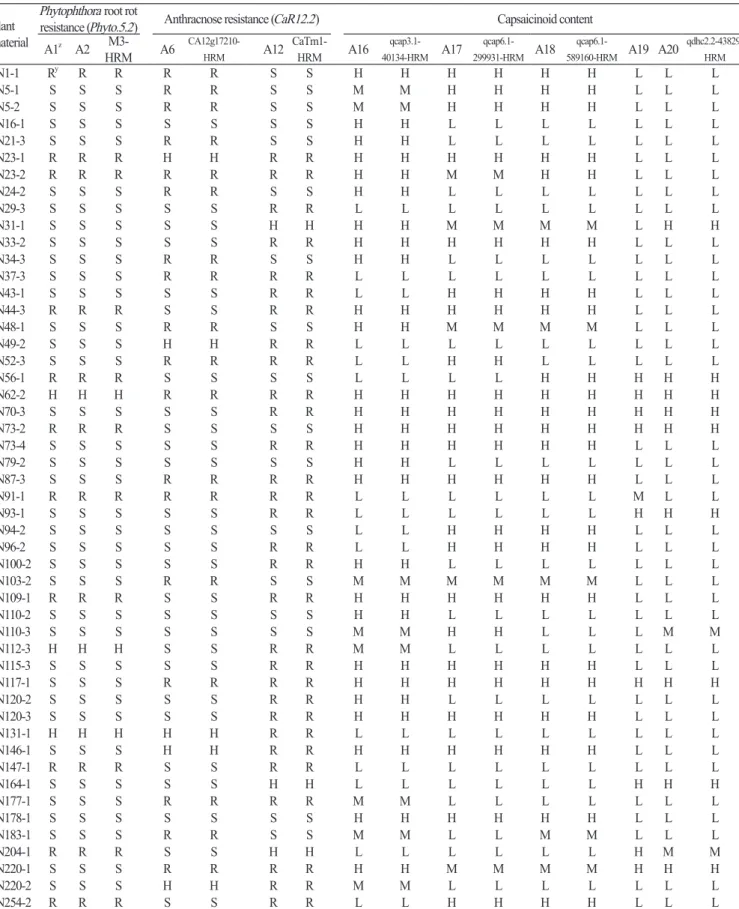
Fiveassays, qcap3.1-40134 (Fig. 1P), qcap6.1-299931 (Fig. 1Q), qcap6.1-589160 (Fig. 1R), qdhc2.1-1335057 (Fig. 1S), and qdhc2.2-43829 (Fig. 1T), werelinkedtofourQTLs, qcap3.1 and qcap6.1 forcapsaicincontentand qdhc2.1 and qdhc2.2 for dihydrocapsaicincontent, whichwereidentifiedin C. chinense ‘BhutJolokia’ (Table1, A16-A20; Leeetal., 2016a). Theqcap6.1 -589160assaywasspecifictoonly C. chinense accessions, whiletheotherfourassayswerewidelypolymorphicinfive Capsicum species, withtheexceptionof C. annuum (Table2, A16-A20). ThisresultimpliedthattheQTL qcap6.1 mighthavea greatereffectoncapsaicinoidcontentthantheotherthreeQTLs. Inaddition, linkageanalysisintheJN-F5 populationshowed thatthefourassayscosegregatedwithcorrespondingHRMmarkers (Table4, A16, A17, A18, andA20). Thisresultsuggests thattheassayscanbeusedtodetectcorrespondingQTLs.
Application of SNP Type Assays to Pepper Cultivars and Breeding Lines
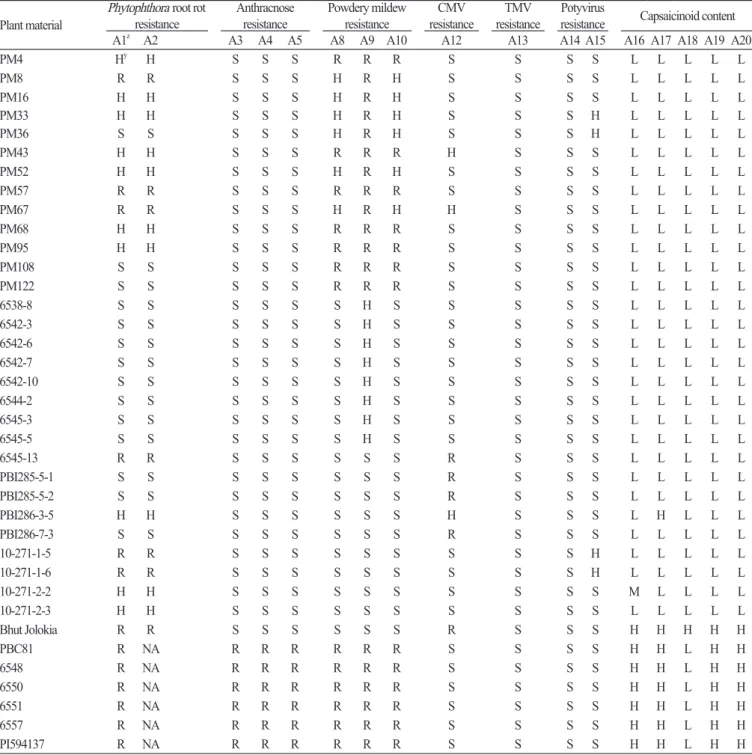
SuccessfulSNPtypeassayswereperformedon33commercialcultivars, 30breedinglines, and7geneticsourcesofchili pepper (Tables5and6). Onlyfiveassays, M3-2 (A1), M3-3 (A2), Cmr1-2 (A12), pvr2-123457 (A15), andqcap3.1-40134 (A16), exhibitedpolymorphicresultsforthe33commercialcultivars(Table5). Allcultivarsexceptfor ‘Geumsugangsan’, ‘Nokkwang’, and ‘Matkwang’ were Phytophthora-resistantvarieties. TheresultsofM3-2andM3-3assayswereconsistentwiththeresistance phenotypesexceptforthoseof ‘Gangcheolhong’, ‘Ganghantopstar’, and ‘PRChengyang’, whichmighthavedevelopedwith anotherresistancegene(s) unrelatedtothe Phyto.5.2 genebecausetheM3-CAPSmarkerwasperfectlymatchedwiththe resistanceinthe C. annuum resourcesincluding ‘AC2258’, ‘CM331’, ‘CM334-INRA’, ‘CM334-KBU’, ‘PBC602’, ‘YCM334’, ‘PI201234’, ‘PBC280’, and ‘PBC495’ (Table5, A1andA2; Leeetal. 2012). AcomparisonoftheassayswithM3-HRMmarkers showedthattheM3-3assaywasmoreaccuratethantheM3-2assay, whichhadonerecombinant (‘Meetinggochudaemok’). The otherthreepolymorphicassays, Cmr1-2, pvr1-123457, andqcap3.1-40134, indicatedthatcultivarswiththeresistancemarker typemighthaveCMVandpotyvirusresistanceandthatcultivarshavingthehighcapsaicinoidcontentmarkertypemightbe morepungent (Table5, A12, A15, andA16). Inananalysisofpepperbreedinglines, 9assaysdemonstratedpolymorphicresults amongthecultivars(Table6). Resistancemarkertypesofthreeassays, Ltr4.1-40344 (A8), Ltr4.2-56301 (A9), andLtr4.2-585119 (A10), werepresentinPMbreedinglinesthatwereresistanttopowderymildew (Table6, A8, A9, andA10). Intheanalysisofthe 7geneticsources, a C. chinense accession, ‘BhutJolokia’, oneoftheworld’shottestpeppers, hadallhighcapsaicinoidcontent markertypesonthefivecapsaicinoidcontentassays (Table6, A16-A20; Leeetal., 2016a). Sixanthracnose-resistant C. baccatum accessions, including ‘PBC81’ and ‘PI594137’, hadalloftheresistancemarkertypesforthethreeanthracnoseresistanceassays (Table6, A3, A4, andA5; Parketal., 2009).
Fluidigmdynamicarrays, ahigh-throughputSNPgenotypingmethod, includethreeformatsforIFCs: 96samples × 96SNPs, 48samples × 48SNPs, or192samples × 24SNPs. Theycanbeusedwiththreetypesofassays: TaqMan, KASP, orSNPtype assays (Wangetal., 2009; Thomson, 2014). Inthisstudy, weusedFluidigmdynamicarraysforthefirsttimeforforeground selectionoftargetedgenesorQTLsinpepperbycombining192.24IFCswithSNPtypeassaystoanalyze24SNPmarkersata time. Thissystemcansavebothresourcesandtimebyreducingthereactionvolumeandproducing4,608datapointsatatime (Wangetal., 2009). Ofthe43primersetsdesigned, 20SNPtypeassaysweresuccessfullydeveloped (Fig. 1andTable1). The accuracyof11assayswasconfirmedbycomparingwiththecorrespondingoriginalHRMmarkers(Tables2, 3, 4, and5). These
Table 4. Comparison of marker types between the SNP type assays and HRM markers in the JN-F5 population.
Plant material
Phytophthora root rot
resistance (Phyto.5.2) Anthracnose resistance (CaR12.2) Capsaicinoid content
A1z A2 M3-HRM A6 CA12g17210-HRM A12 CaTm1-HRM A16 qcap3.1-40134-HRM A17 qcap6.1-299931-HRM A18 qcap6.1-589160-HRM A19 A20 qdhc2.2-43829-HRM JN1-1 Ry R R R R S S H H H H H H L L L JN5-1 S S S R R S S M M H H H H L L L JN5-2 S S S R R S S M M H H H H L L L JN16-1 S S S S S S S H H L L L L L L L JN21-3 S S S R R S S H H L L L L L L L JN23-1 R R R H H R R H H H H H H L L L JN23-2 R R R R R R R H H M M H H L L L JN24-2 S S S R R S S H H L L L L L L L JN29-3 S S S S S R R L L L L L L L L L JN31-1 S S S S S H H H H M M M M L H H JN33-2 S S S S S R R H H H H H H L L L JN34-3 S S S R R S S H H L L L L L L L JN37-3 S S S R R R R L L L L L L L L L JN43-1 S S S S S R R L L H H H H L L L JN44-3 R R R S S R R H H H H H H L L L JN48-1 S S S R R S S H H M M M M L L L JN49-2 S S S H H R R L L L L L L L L L JN52-3 S S S R R R R L L H H L L L L L JN56-1 R R R S S S S L L L L H H H H H JN62-2 H H H R R R R H H H H H H H H H JN70-3 S S S S S R R H H H H H H H H H JN73-2 R R R S S S S H H H H H H H H H JN73-4 S S S S S R R H H H H H H L L L JN79-2 S S S S S S S H H L L L L L L L JN87-3 S S S R R R R H H H H H H L L L JN91-1 R R R R R R R L L L L L L M L L JN93-1 S S S S S R R L L L L L L H H H JN94-2 S S S S S S S L L H H H H L L L JN96-2 S S S S S R R L L H H H H L L L JN100-2 S S S S S R R H H L L L L L L L JN103-2 S S S R R S S M M M M M M L L L JN109-1 R R R S S R R H H H H H H L L L JN110-2 S S S S S S S H H L L L L L L L JN110-3 S S S S S S S M M H H L L L M M JN112-3 H H H S S R R M M L L L L L L L JN115-3 S S S S S R R H H H H H H L L L JN117-1 S S S R R R R H H H H H H H H H JN120-2 S S S S S R R H H L L L L L L L JN120-3 S S S S S R R H H H H H H L L L JN131-1 H H H H H R R L L L L L L L L L JN146-1 S S S H H R R H H H H H H L L L JN147-1 R R R S S R R L L L L L L L L L JN164-1 S S S S S H H L L L L L L H H H JN177-1 S S S R R R R M M L L L L L L L JN178-1 S S S S S S S H H H H H H L L L JN183-1 S S S R R S S M M L L M M L L L JN204-1 R R R S S H H L L L L L L H M M JN220-1 S S S R R R R H H M M M M H H H JN220-2 S S S H H R R M M L L L L L L L JN254-2 R R R S S R R L L H H H H L L L
zA1, M3-2; A2, M3-3; A6, CA12g17210; A12, Cmr1-2; A16, qcap3.1-40134; A17, qcap6.1-299931; A18, qcap6.1-589160; A19, qdhc2.1-1335057; A20, qdhc2.2-43829. yR, resistant; S, susceptible; H, heterozygous for A1, A2, A6, A12, high capsaicinoid content allele for A16-A20; L, low capsaicinoid content allele.
resultssuggestthatthenewlydevelopedSNPtypeassayscanbeusedinplaceoftheoriginalmarkers. Theother9assaysalso needtobecomparedtooriginalmarkersusingpolymorphicpopulationstoconfirmtheiraccuracy. TheseSNPtypeassayswill beusefulinmolecularbreedingprogramsfordevelopingnewpeppervarietiesresistanttomultiplediseasesandwithincreased pungency.
Table 5 . Marker types of 17 SNP type assays and an M3-HRM marker in 33 commercial pepper cultivars.
Plant material
Phytophthora root rot
resistance Anthracnose resistance Powdery mildew resistance resistanceCMV resistanceTMV Potyvirusresistance Capsaicinoid content
A1z A2
M3-HRM A3 A4 A5 A8 A9 A10 A12 A13 A14 A15 A16 A17 A18 A19 A20
Anseongmachum Hy H H S S S S S S H S S H L L L L L Tantandaemok H H H S S S S S S H S S R L L L L L PR Power H H H S S S S S S H S S H L L L L L Konesianhot H H H S S S S S S H S S H L L L L L Meetinggochudaemok H R R S S S S S S R S S H M L L L L Kataguruma H H H S S S S S S H S S S L L L L L PR Smart H H H S S S S S S R S S S L L L L L Muhanjilju H H H S S S S S S H S S H L L L L L Illpyundansim H H H S S S S S S H S S H L L L L L AR Legend H H H S S S S S S H S S S L L L L L Josaengace H H H S S S S S S R S S H L L L L L Gisedeungdeung H H H S S S S S S H S S H L L L L L Bitgoeul H H H S S S S S S R S S S L L L L L Geumgangseok H H H S S S S S S H S S H L L L L L PR Hwanhoseoung H H H S S S S S S R S S H L L L L L Gangcheolhong S S S S S S S S S H S S H L L L L L Yebbeundokyacheongcheong H H H S S S S S S R S S S L L L L L Supergeumdang H H H S S S S S S H S S H L L L L L PR Cheonmyung H H H S S S S S S R S S H L L L L L Ganghantopstar S S S S S S S S S R S S H L L L L L PR Chengyang S S S S S S S S S H S S H M L L L L PR Pungnyunga H H H S S S S S S R S S S L L L L L PR Jeolsemiin H H H S S S S S S R S S S L L L L L Buldojang H H H S S S S S S R S S S L L L L L Mubyungjidae R R R S S S S S S H S S S L L L L L Mutanjidae R R R S S S S S S R S S S L L L L L Manmul H H H S S S S S S H S S S L L L L L Chungseong H H H S S S S S S S S S S L L L L L Sinbi H H H S S S S S S S S S S L L L L L Haemalgeungochu H H H S S S S S S S S S S M L L L L Geumsugangsan S S S S S S S S S S S S S L L L L L Nokkwang S S S S S S S S S S S S S L L L L L Matkwang S S S S S S S S S S S S S L L L L L
zA1, M3-2; A2, M3-3; A3, CcR9; A4, CA09g12180; A5, CA09g19170; A8, Ltr4.1-40344; A9, Ltr4.2-56301; A10, Ltr4.2-585119; A12, Cmr1-2; A13, L4; A14, pvr1;
A15, pvr2-123457; A16, qcap3.1-40134; A17, qcap6.1-299931; A18, qcap6.1-589160; A19, qdhc2.1-1335057; A20, qdhc2.2-43829.
Table 6 . Marker types of 17 SNP type assays in 30 breeding lines and 7 genetic sources for pepper.
Plant material Phytophthora root rot resistance Anthracnose resistance Powdery mildew resistance resistanceCMV resistanceTMV resistancePotyvirus Capsaicinoid content
A1z A2 A3 A4 A5 A8 A9 A10 A12 A13 A14 A15 A16 A17 A18 A19 A20
PM4 Hy H S S S R R R S S S S L L L L L PM8 R R S S S H R H S S S S L L L L L PM16 H H S S S H R H S S S S L L L L L PM33 H H S S S H R H S S S H L L L L L PM36 S S S S S H R H S S S H L L L L L PM43 H H S S S R R R H S S S L L L L L PM52 H H S S S H R H S S S S L L L L L PM57 R R S S S R R R S S S S L L L L L PM67 R R S S S H R H H S S S L L L L L PM68 H H S S S R R R S S S S L L L L L PM95 H H S S S R R R S S S S L L L L L PM108 S S S S S R R R S S S S L L L L L PM122 S S S S S R R R S S S S L L L L L 6538-8 S S S S S S H S S S S S L L L L L 6542-3 S S S S S S H S S S S S L L L L L 6542-6 S S S S S S H S S S S S L L L L L 6542-7 S S S S S S H S S S S S L L L L L 6542-10 S S S S S S H S S S S S L L L L L 6544-2 S S S S S S H S S S S S L L L L L 6545-3 S S S S S S H S S S S S L L L L L 6545-5 S S S S S S H S S S S S L L L L L 6545-13 R R S S S S S S R S S S L L L L L PBI285-5-1 S S S S S S S S R S S S L L L L L PBI285-5-2 S S S S S S S S R S S S L L L L L PBI286-3-5 H H S S S S S S H S S S L H L L L PBI286-7-3 S S S S S S S S R S S S L L L L L 10-271-1-5 R R S S S S S S S S S H L L L L L 10-271-1-6 R R S S S S S S S S S H L L L L L 10-271-2-2 H H S S S S S S S S S S M L L L L 10-271-2-3 H H S S S S S S S S S S L L L L L Bhut Jolokia R R S S S S S S R S S S H H H H H PBC81 R NA R R R R R R S S S S H H L H H 6548 R NA R R R R R R S S S S H H L H H 6550 R NA R R R R R R S S S S H H L H H 6551 R NA R R R R R R S S S S H H L H H 6557 R NA R R R R R R S S S S H H L H H PI594137 R NA R R R R R R S S S S H H L H H
zA1, M3-2; A2, M3-3; A3, CcR9; A4, CA09g12180; A5, CA09g19170; A8, Ltr4.1-40344; A9, Ltr4.2-56301; A10, Ltr4.2-585119; A12, Cmr1-2; A13, L4; A14, pvr1;
A15, pvr2-123457; A16, qcap3.1-40134; A17, qcap6.1-299931; A18, qcap6.1-589160; A19, qdhc2.1-1335057; A20, qdhc2.2-43829.
yR, resistant; S, susceptible; H, heterozygous for A1-A15, high capsaicinoid content allele for A16-A20; L, low capsaicinoid content allele
Literature Cited
Aza-González C, Núñez-Palenius HG, Ochoa-Alejo N (2011) Molecular biology of capsaicinoid biosynthesis in chili pepper (Capsicum
spp.). Plant Cell Rep 30:695-706. doi:10.1007/s00299-010-0968-8
Charron C, Nicolai M, Gallois JL, Robaglia C, Moury B, Palloix A, Caranta C (2008) Natural variation and functional analyses provide evidence for co-evolution between plant eIF4E and potyviral VPg. Plant J 54:56-68. doi:10.1111/j.1365-313X.2008.03407.x Collard BCY, Jahufer MZZ, Brouwer JB, Pang ECK (2005) An introduction to markers, quantitative trait loci (QTL) mapping and
marker-assisted selection for crop improvement: The basic concepts. Euphytica 142:169-196. doi:10.1007/s10681-005-1681-5
Collard BCY, Mackill DJ (2008) Marker-assisted selection: an approach for precision plant breeding in the twenty-first century. Phil Trans R Soc B 363:557-572. doi:10.1098/rstb.2007.2170
Eun MH, Han JH, Yoon JB, Lee J (2016) QTL mapping of resistance to the Cucumber mosaic virus P1 strain in pepper using a genotyping-by-sequencing analysis. Hortic Environ Biotechnol 57:589-597. doi:10.1007/s13580-016-0128-3
Kang BC, Yeam I, Frantz JD, Murphy JF, Jahn MM (2005) The pvr1 locus in Capsicum encodes a translation initiation factor eIF4E that interacts with Tobacco etch virus VPg. Plant J 42:392-405. doi:10.1111/j.1365-313X.2005.02381.x
Kang WH, Hoang NH, Yang HB, Kwon JK, Jo SH, Seo JK, Kim KH, Choi D, Kang BC (2010) Molecular mapping and characterization of a single dominant gene controlling CMV resistance in peppers (Capsicum annuum L.). Theor Appl Genet 120:1587-1596. doi:10.1007/s00122-010-1278-9
Kim HJ, Han JH, Kim S, Lee HR, Shin JS, Kim JH, Cho J, Kim YH, Lee HJ, Kim BD, Choi D (2011) Trichome density of main stem is tightly linked to PepMoV resistance in chili pepper (Capsicum annuum L.). Theor Appl Genet 122:1051-1058. doi:10.1007/s00122-010-1510-7
Kim SB, Kang WH, Huy HN, Yeom SI, An JT, Kim S, Kang MY, Kim HJ, Jo YD, Ha Y, Choi D, Kang BC (2017) Divergent evolution of multiple virus-resistance genes from a progenitor in Capsicum spp. New Phytologist 213:886-899. doi:10.1111/nph.14177 Kumar S, Banks TW, Cloutier S (2012) SNP discovery through next-generation sequencing and its application. Int J Plant Genomics
831460. doi:10.1155/2012/831460
Lee J, Do JW, Yoon JB (2011) Development of STS markers linked to the major QTLs for resistance to the pepper anthracnose caused by Colletotrichum acutatum and C. capsici. Hortic Environ Biotechnol 52:596-601. doi:10.1007/s13580-011-0178-5
Lee J, Hong JH, Do JW, Yoon JB (2010) Identification of QTLs for resistance to anthracnose to two Colletotrichum species in pepper. J Crop Sci Biotechnol 13:227-233. doi:10.1007/s12892-010-0081-0
Lee J, Park SJ, Hong SC, Han JH, Choi D, Yoon JB (2016a) QTL mapping for capsaicin and dihydrocapsaicin content in a population of
Capsicum annuum ‘NB1’ x Capsicumchinense ‘Bhut Jolokia’. Plant Breeding 135:376-383. doi:10.1111/pbr.12355
Lee SH, Lee JB, Kim SM, Choi HS, Park JW, Lee JS, Lee KW, Moon JS (2004) The incidence and distribution of viral diseases in pepper by cultivation types. Res Plant Dis 10:231-240. doi:10.5423/RPD.2004.10.4.231
Lee WP, Lee J, Han JH, Kang BC, Yoon JB (2012) Validity test for molecular markers associated with resistance to Phytophthora root rot in chili pepper (Capsicum annuum L.). Korean J Hortic Sci Technol 30:64-72. doi:10.7235/hort.2012.11112
Lee YR, Yoon JB, Lee J (2016b) A SNP-based genetic linkage map of Capsicum baccatum and its comparison to the Capsicum annuum
reference physical map. Mol Breeding 36:61. doi:10.1007/s11032-016-0485-8
Lefebvre V, Daubèze AM, Rouppe van der Voort J, Peleman J, Bardin M, Palloix A (2003) QTLs for resistance to powdery mildew in pepper under natural and artificial infections. Theor Appl Genet 107:661-666. doi:10.1007/s00122-003-1307-z
Liu WY, Kang JH, Jeong HS, Choi HJ, Yang HB, Kim KT, Choi D, Choi GJ, Jahn M, Kang BC (2014) Combined use of bulked segregant analysis and microarrays reveals SNP markers pinpointing a major QTL for resistance to Phytophthora capsici in pepper. Theor Appl Genet 127:2503-2513. doi:10.1007/s00122-014-2394-8
Mahasuk P, Struss D, Mongkolporn O (2016) QTLs for resistance to anthracnose identified in two Capsicum sources. Mol Breed 36:10. doi:10.1007/s11032-016-0435-5
Mimura Y, Kageyama T, Minamiyama Y, Hirai M (2009) QTL analysis for resistance to Ralstonia solanacearum in Capsicum accession ‘LS2341’. J Jpn Soc Hort Sci 78:307-313. doi:10.2503/jjshs1.78.307
Park SK, Kim SH, Park HG, Yoon JB (2009) Capsicum germplasm resistant to pepper anthracnose differentially interact with
Colletotrichum isolates. Hortic Environ Biotechnol 50:17-23
Poland JA, Rife TW (2012) Genotyping-by-sequencing for plant breeding and genetics. Plant Genome 5:92-102. doi:10.3835/ plantgenome2012.05.0005
Quirin EA, Ogundiwin EA, Prince JP, Mazourek M, Briggs MO, Chlanda TS, Kim KT, Falise M, Kang BC, Jahn MM (2005) Development of sequence characterized amplified region (SCAR) primers for the detection of Phyto.5.2, a major QTL for resistance to
Phytophthora capsici Leon. in pepper. Theor Appl Genet 110:605-612. doi:10.1007/s00122-004-1874-7
Rafalski A (2002) Applications of single nucleotide polymorphisms in crop genetics. Curr Opin Plant Biol 5:94-100. doi:10.1016 /S1369-5266(02)00240-6
Römer P, Hahn S, Jordan T, Strauβ T, Bonas U, Lahaye T (2007) Plant pathogen recognition mediated by promoter activation of the pepper Bs3 resistance gene. Science 318:645-648. doi:10.1126/science.1144958
Römer P, Jordan T, Lahaye T Identification and application of a DNA-based marker that is diagnostic for the pepper (Capsicum annuum) bacterial spot resistance gene Bs3. Plant Breeding 129:737-740. doi:10.1111/j.1439-0523.2009.01750.x
Stall RE, Jones JB, Minsavage GV (2009) Durability of resistance in tomato and pepper to Xanthomonads causing bacterial spot. Annu Rev Phytopathol 47:265-284. doi:10.1146/annurev-phyto-080508-081752
Tai T, Dahlbeck D, Stall RE, Peleman J, Staskawicz BJ (1999a) High-resolution genetic and physical mapping of the region containing the Bs2 resistance gene of pepper. Theor Appl Genet 99:1201-1206. doi:10.1007/s001220051325
Tai TH, Dahlbeck D, Clark ET, Gajiwala P, Pasion R, Whalen MC, Stall RE, Staskawicz BJ (1999b) Expression of the Bs2 pepper gene confers resistance to bacterial spot disease in tomato. Proc Natl Acad Sci 96:14153-14158. doi:10.1073/pnas.96.24.14153
Thomson MJ (2014) High-throughput SNP genotyping to accelerate crop improvement. Plant Breeding Biotech 2:195-212. doi:10.9787/ PBB.2014.2.3.195
Tomita R, Sekine KT, Mizumoto H, Sakamoto M, Murai J, Kiba A, Kikichi Y, Suzuki K, Kobayashi K (2011) Genetic basis for the hierarchical interaction between Tobamovirus spp. and L resistance gene alleles from different pepper species. Mol Plant Microbe Interact 24:108-117. doi:10.1094/MPMI-06-10-0127
Truong HTH, Kim KT, Kim S, Cho MC, Kim HR, Woo JG (2011) Development of gene-based markers for the Bs2 bacterial spot resistance gene for marker-assisted selection in pepper (Capsicum spp.). Hortic Environ Biotechnol 52:65-73. doi:10.1007/ s13580-011-0142-4
Varshney RK, Nayak SN, May GD, Jackson SA (2009) Next-generation sequencing technologies and their implications for crop genetics and breeding. Trends Biotechnol 27:522-530. doi:10.1016/j.tibtech.2009.05.006
Wang J, Lin M, Crenshaw A, Hutchinson A, Hicks B, Yeager M, Berndt S, Huang WY, Hayes RB, Chanock SJ, Jones RC, Ramakrishnan R (2009) High-throughput single nucleotide polymorphism genotyping using nanofluidic Dynamic Arrays. BMC Genomics 10:561. doi:10.1186/1471-2164-10-561
Xu Y, Crouch JH (2008) Marker-assisted selection in plant breeding: from publications to practice. Crop Sci 48:391-407. doi:10.2135/ cropsci2007.04.0191
Yang HB, Liu WY, Kang WH, Kim JH, Cho HJ, Yoo JH, Kang BC (2012) Development and validation of L allele-specific markers in
Capsicum. Mol Breeding 30:819-829. doi:10.1007/s11032-011-9666-7
Yeam I, Kang BC, Lindeman W, Frantz JD, Faber N, Jahn MM (2005) Allele-specific CAPS markers based on point mutations in resistance alleles at the pvr1 locus encoding eIF4E in Capsicum. Theor Appl Genet 112:178-186. doi:10.1007/s00122-005-0120-2 Yoon JB (2003) Identification of genetic resources, interspecific hybridization and inheritance analysis for breeding pepper (Capsicum