ICCAS2005 June 2-5, KINTEX, Gyeonggi-Do, Korea
GA-fuzzy P
2ID Control System for Flexible-joint Robot Arm
Teranun Tangcharoensuk, Boonchana Purahong, and Pitikhate Sooraksa
Department of Information Engineering Faculty of Engineering King Mongkut’s Institute of Technology Ladkrabang Chalongkrung Rd., Ladkrabang, Bangkok, Thailand 10520
E-mail: [email protected], [email protected]
Abstract: This paper presents a GA-fuzzy P2ID control system for the flexible-joint robot arm. This controller is designed based on
the parameter adjustment using fuzzy logic and genetic algorithms. According to the simulations, the better performance has been achieved acquired that the robot moved smoothly and met its required objectives.The results of comparison between 8 parameters and 10 parameters can be conclusion that the 10 parameters have setting time little than 8 parameters. In usability can be use 8 or 10 parameters these one.
Keywords: Genetic Algorithm (GA), Fuzzy P2ID Controller, Flexible-joint Robot Arm
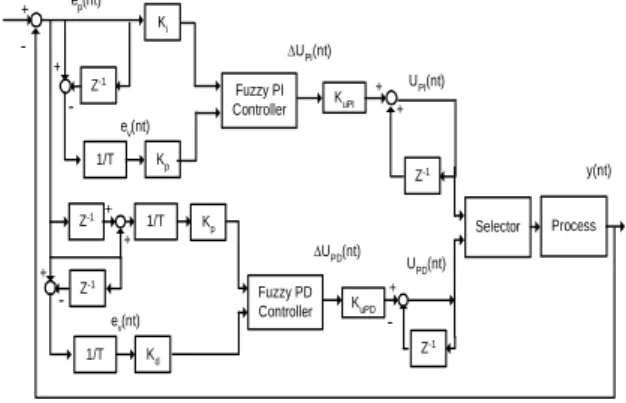
Z-1 Ki Kp Fuzzy PI Controller KuPI Z-1 Process 1/T + ep(nt) ev(nt) ∆UPI(nt) UPI(nt) + + y(nt) Kd Fuzzy PD Controller KuPD Z-1 Selector 1/T ev(nt) ∆UPD(nt) U PD(nt) + Z-1 1/T + - Z -1 + -Kp + +
1. INTRODUCTION
Smooth movements of the flexible-joint robot arm are depend on the controller that can indicate every specific moment. Because those movements are non-linear, if we use the controller which is suited the non-linear system, it will increase the system’s efficiency [1]. Therefore, this paper presents the fuzzy P2ID that can adjust for appropriate
parameters using genetic algorithm (GA) to control the arm’s movement. In general, the parameters adjustment usually is usually modified by the users, but this method takes too much time to obtain appropriate results. Since this type of controller has many parameters for tuning, using GA would be worthwhile in order to search for fruitful results. Detail development of the controller can be found in [2]. This paper aims to apply the method to control a flexible-joint robot arm for smooth and accurate movements. Next sections provides a brief detail behind the ideas.
Fig. 1 Fuzzy P2ID control system.
3. GENETIC ALGORITHMS
Genetic Algorithms [5, 6, 7] were duplicated from the natural evolutions. This method is efficiently applied to the problem solving; the importance of the method relies on how many potential members will survive as the suitable potentials to solve problems. Each generation will be created by population selection, and each member has the limited potential for fitting the problems’ boundaries. Also, this method is combined with the genetic operation, which the best result will come for the last survived member.
2. FUZZY P
2ID
CONTROLLER
Fuzzy P2ID controller is the coordination between the fuzzy
PI and fuzzy PD controllers, which both controllers will process parallel to each other. Those controllers will be proscribed by a switch that chooses which controller will be in charged. As soon as the system starts, the fuzzy PD controller gives the faster rise time comparing with fuzzy PI controller [3]. Then the process will reach the designed exchange point, the system will swap the control to the fuzzy PI controller because it provides the better output at steady state [4]. When the process reaches the indicated point as the stabilized condition, the fuzzy PI controller will be terminated, and if the output of the process is not in the steady state which means lower than 90 percents of the projected resulted, the fuzzy PD controller will stand by to take control. For this reason, this process is called fuzzy P2ID control system.
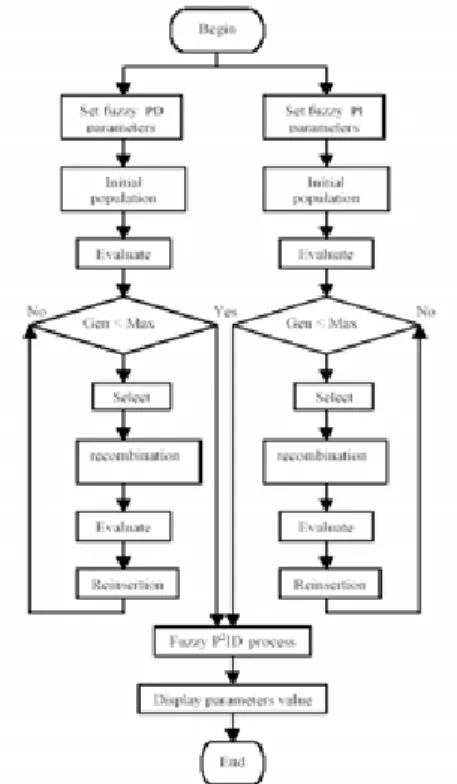
Genetic operation is consisted of selection, recombination, mutation, and reinsertion. The first procedure initiates with the population creation randomly, the size of population depends on the problems. Next procedure is determining each member by using the objective function, or targeting function, which will not be restricted, it depends on types of problems to be solved. Then, there will be the inspection, if it doesn’t find the answer; it will start creating the next generation members by obtaining the parent members which were selected from the fitness values. The selected parent members will be mixed together, and then all offspring will be mutated by using probability and then finding the value of each offspring and then bringing 3-6 best of them to replace the parent members as the next generation. This will be cycling like this till it finds the appropriate values.
The chromosome’s length has eight variables which consisted of the fuzzy PD controller that has objected parameters: they are Kpd, Kd, Ld, Kupd, fuzzy PI controller, Kpi, Ki, Li, Kupi, which will give I = {Kpd, Kd, Ld, Kupd,
ICCAS2005 June 2-5, KINTEX, Gyeonggi-Do, Korea
Kpi, Ki, Li, Kupi} by substituting the values and the
restriction of the parameters with the real numbers and the initial value of the parameter for starting the program. The initial parameter value is the initial population at 30, and the maximum generated value is at 30.
Fig. 2 Flow chart of the GA program for fuzzy P2ID
controller.
4. FLEXIBLE-JOINT ROBOT ARM
Fig. 3 Flexible-joint robot arm model.
The mathematical model [8] from Fig. 3 is shown as these following equations.
u(t)
(t)]
2
(t)
1
[
k
(t)
2
2I
0
(t)]
2
(t)
1
[
k
(t)]
1
gsin[
M(t)
(t)
1
1I
=
−
−
=
−
+
+
θ
θ
~
θ
θ
θ
~
θ
θ
&&
l
&&
k
(1)
In which I1 is the arm’s rotational inertia, I2 is the rotor inertia
of the motor, θ1(t) is the changing angle of the arm is angle of
the motor’s comparing with vertical axis, θ2(t) is the changing
angle of the rotor of motor axis, u(t) ismotor’s torque,
~
is spring constant which used as the joint of the arm, M(t) is the total mass of the arm varies by time which is the spring joining the arm, is the distance from the center of the rotational axis,g is gravity of the earth.
l
k
5. SIMULATION AND RESULTS
The simulation is the application of the fuzzy P2ID
idealistic which adjusted the parameter values suited with the genetic algorithm in order to control the movements of the flexible-joint robot arm from Eq. (1)
There are two parts in this simulation; the first part uses the fuzzy P2ID controller which has been adjusted the 8
parameters values with the genetic algorithm as shown in Table 1, the second part uses the fuzzy P2ID controller which
has been adjusted select-point and sampling-time of system with the genetic algorithm, then it calls the 10 parameters values as shown in Table 3. Then, comparing the results from both parts and determining the efficiency which indicated in Table 2 and 4.
Table 1 Parameter values acquired from the fuzzy P2ID
controller which has been adjusted the 8 parameters values with the genetic algorithm. Given I1 =0.030(kgm2), I2=
0.001(kgm2),
~
= 31(Nm/rad), Mg = 0.8(Nm), Set point(degree) = 100, 180, Sampling Time (Ts) = 0.01xsec
l
Setpoint(degree) Kpd Kd Kupd Ld
100 2.7762 3.1111 19.2384 50
180 10.7762 5.1111 19.34 70 Setpoint
(degree) Kpi Ki Kupi Li
100 0.9703 0.0211 2.3158 40 180 0.9703 0.0211 2.5 50
Fig. 4 The comparison of controlled position reaction acquired from the fuzzy P2ID controller which has been
adjusted the parameter values with the genetic algorithm. The targeted values = 100
ICCAS2005 June 2-5, KINTEX, Gyeonggi-Do, Korea
Table 2 Performance of the fuzzy P2ID controller which has
been adjusted 8 parameters values with the genetic algorithm. Setpoint
(degree) Rise time (s) Setting time (s) Overshoot (%)
100 0.1663 0.3234 0
180 0.2127 0.3346 0
Table 3 Parameter values acquired from the fuzzy P2ID
controller which has been adjusted the 10 parameters values with the genetic algorithm. Given, I1 = 0.030(kgm2), I2=
0.001(kgm2),
k~
= 31(Nm/rad), Mgl
= 0.8(Nm),Set point (degree) = 100, 180 Setpoint (degree) Kpd Kd Kupd Ld Ts 100 2.7762 3.1111 19.2384 50 0.0099 180 10.7762 5.1111 19.34 70 0.0098 Setpoint (degree)
Kpi Ki Kupi Li Sel
100 0.9703 0.0211 2.3158 40 95.169
180 0.9703 0.0211 2.5 50 171.98
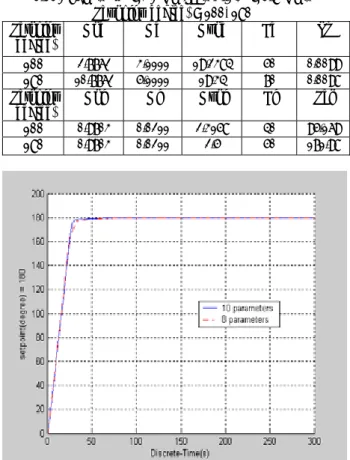
Fig. 5 The comparison of controlled position reaction acquired from the fuzzy P2ID controller which has been
adjusted the parameter values with the genetic algorithm. The targeted values = 180
Table 4 Performance of the fuzzy P2ID controller which has
been adjusted the 10 parameters values with the genetic algorithm.
Setpoint
(degree) Rise time (s) Setting time (s) Overshoot (%)
100 0.1673 0.2347 0
180 0.2127 0.2891 0
6. CONCLUSION
Table 2 and 4 show that the application of the fuzzy P2ID
controller which has adjusted the parameter values with the genetic algorithm brought up the satisfied results. The rise time and setting time are small, and the overshoot value is significantly small. It means that this idea has high efficiency in controlling the arm movements which creates the accurate and smooth arm’s movements. Furthermore, the results shows that this idea brought up low errors.
Performance comparison between the adjusted 8 parameters and adjusted 10 parameters with the genetic algorithm concludes that the rise time values is nearly result but setting time values of 10 parameters little than 8 parameters, include respond without error. In usability can be use 8 or 10 parameters these one.
Fig. 6 Zoom in output from Fig. 4
Fig. 7 Zoom in output from Fig. 5
ICCAS2005 June 2-5, KINTEX, Gyeonggi-Do, Korea
REFERENCES
[1] K.S. Tang, Kim F. Man, Guanrong Chen and Sam Kwong, 2001. A GA- Optimized Fuzzy PD+I Controller for Nonlinear Systems. The 27th Annual Conference of the
IEEE Industrial Electronics Society, 2001: 718-723. [2] T. Onboonare , S. Charumartphan and P . Sooraksa,
2003. A Geno-Fuzzy P2ID Controller For Mobile
Robots. Processdings of the Third Asian Conference on Industrial Automation and Robotics, Bangkok, Thailand, May. 8-9, 2003 :189-192 .
[3] Heidar A. Malki, Huaidong Li.,Guanrong Chen, 1994. New Design and Stability Analysis of Fuzzy Proportional- Derivative Control Systems. IEEE Transaction on Fuzzy Systems, Nov., 1994: 245-254.
[4] Guanrong Chen, Hao Ying, 1993. Stability analysis of nonlinear fuzzy PI control systems. Third International Conference on Industrial Fuzzy Control and Intelligent Systems, Dec. 1-3,1993: 128 – 133.
[5] K.F. man , K.S. Tang and S. Kwong. 1989. Genetic Algorithms Concepts and Designs, Springer-verlay, London, U.K.
[6] David E Goldberg. 1989. Genetic Algorithm in Search Optimization and Machine Learning, Addison Wesley Publishing Company, New York.
[7] A. H. Wright. 1991. Genetic Algorithm for Real Parameter Optimization In Foundation of Genetic Algorithm, J. E. Rawlins (Ed.), Morgan Kaufmann.
[8] Heidar A. Malki, Dave Misir, Denny Feigenspan, and Guanrong Chen, 1997. Fuzzy PID Control of a Flexible-Joint Robot Arm with Uncertainties from Time-Varying Loads. IEEE Transaction on Control Systems Technology, May. 1997: 371-378.