ICCAS2005 June 2-5, KINTEX, Gyeonggi-Do, Korea
1. INTRODUCTION
As great emphasis is being placed on robotics in home based domains, human-robot interaction (HRI) has become an increasingly important issue. Understanding and predicting a human user’s intentions are still major problems in the field of robotics, but the concept of HRI focuses on the interaction itself, not just the end of results of that interaction.
In the intelligent room project at the MIT Artificial Intelligence Laboratory, researchers have attempted to pull the computer out into the real world of the human being. For this research, they are combining robotics and vision technology with speech understanding systems, and agent based architectures to provide ready-at-hand computation and information services for people engaged in day to day activities, both on their own and in conjunction with others [1]. In terms of design, there is specific research being done that considers design principles for intelligent environments and that defines design criteria for creating highly embedded, interactive spaces, called Intelligent Environments [2].
If a robot only performed the tasks that it was specifically commanded to perform, the situation would quickly become inconvenient and tiresome for the user. In this paper, our goal is to propose an interaction method that allows the robot to execute actions in response to even unspoken commands in an intelligent room-based domain.
To achieve our purpose, the robot should make correct decisions based on information acquired from two sources: communication with the human user and recognition from the environment. Communication between humans and robots is achieved by multi modal input and output methods such as verbal, visual and pen-touch methods. Environmental information includes temperature, weather forecasting, and room illumination by utilizing sensory inputs and a wireless network system.
This article defines the state of that information, including the probability of and causal relations among such data. We assume that all information is gathered from other research, so this paper does not focus on how to gather this information. With these information values, we have constructed a Bayesian belief network to create the full system architectures
of an intelligent room system. In addition, we have used computer simulation to make a robot one component of an intelligent room for HRI. The robot evaluates the environment in the intelligent room and automatically operates the light when illumination is needed, the air-conditioner when the temperature needs to be adjusted, and the stereo when emotional relief is required.
Task sets are predefined in a limited home environment such as the living room, and are related to the information from evaluating the environment and responding to, commands given by verbal, visual, and pen touch inputs. Tasks will be slightly modified depending on the users’s preferences and physical and emotional condition.
There are many variables that must be considered by the robot for it to make the correct decisions to fulfill a given task. Therefore, we construct a Bayesian belief network for predicting the human user’s intentions and analyzing the components that are most relevant to the task at hand. This network will improve the robot’s ability to understand human commands, intuit human desires, and predict human intentions.
Outline
Section 2 describes some sample interactions with and applications of the intelligent room, such as simple scenarios in which a robot would be required to predict the human user’s intentions. In section 3, we describe the full system architecture of the intelligent room, and provide some details regarding the Bayesian belief network including its method of evaluating probabilities. Also we show the modeling of the Bayesian belief network as used in the intelligent room system architecture, that we have constructed, and provide explanations of the nodes and their states in the model. We simulated the intelligent room in the computer domain, and we give the results in section 4. Finally, we conclude our research in section 5.
2. INTELLIGENT ROOM SCENARIO
Recent researches on intelligent rooms has shown theAn analysis of the component of Human-Robot Interaction for Intelligent room.
Jong-Chan Park*, and Dong-Soo Kwon
**Dept. of Mechanical Eng., Korea Advanced Institute of Science and Technology, Daejeon, Korea (Tel : +82-42-869-3082; E-mail: [email protected])
Dept. of Mechanical Eng., Korea Advanced Institute of Science and Technology , Daejeon, Korea (Tel : +82-42-869-3042; E-mail: [email protected])
Abstract: Human-Robot interaction (HRI) has recently become one of the most important issues in the field of robotics. Understanding and predicting the intentions of human users is a major difficulty for robotic programs. In this paper we suggest an interaction method allows the robot to execute the human user’s desires in an intelligent room-based domain, even when the user does not give a specific command for the action. To achieve this, we constructed a full system architecture of an intelligent room so that the following were present and sequentially interconnected: decision-making based on the Bayesian belief network, responding to human commands, and generating queries to remove ambiguities. The robot obtained all the necessary information from analyzing the user’s condition and the environmental state of the room. This information is then used to evaluate the probabilities of the results coming from the output nodes of the Bayesian belief network, which is composed of the nodes that includes several states, and the causal relationships between them. Our study shows that the suggested system and proposed method would improve a robot’s ability to understand human commands, intuit human desires, and predict human intentions resulting in a comfortable intelligent room for the human user.
Keywords: Intelligent room, Human-Robot Interaction, situation awareness, Bayesian belief network, probability, conditional probability,
importance of the computer’s ability to precisely understand human commands and quickly and correctly display the relevant information. However, in conventional intelligent room scenarios, the computer will not act to alter any situation in the intelligent room until the human makes a specific command that something be done. In such situations, interaction between the human and the robot is always initiated by the human stating his or her desires.
In this paper, our research goals are to make the robot perceptive to the situation and able to infer the best course of action for that situation; in other words, the robot presumes what the human wants and executes the necessary action before the human gives the order. Before fulfilling the task, as the robot may need to ensure that the human really wants the action to be undertaken, therefore, in some cases, the robot should initiate interaction with the human to confirm that its intended course of action is acceptable.
Intelligent room scenarios progress in a restricted place, like a home-based domain, where there is limited information that must be gathered from the human user and from the environment. These scenarios may seem simple, but they are actually quite difficult to implement with a robot. Below are some sample scenarios.
Scenario 1 : A human enters the living room at night. He is exhausted and immediately reclines on the sofa. In this situation, even though the room is dark, the robot should not turn on all of the lights; the human requires only enough light for a dim and restful illumination.
Scenario 2 : A human enters the living room during the day. The robot is programmed with the knowledge that the human usually enjoys listening to music during the afternoon. When the human sits down on the sofa, the robot should ask, “Tom, would you like to listen to music now?”. If the human responds affirmatively, then the robot should decide the best kind of music and the appropriate volume for satisfying the user by considering all the data available on the user and on the environment.
In the intelligent room project at the MIT A.I. Laboratory, researchers are developing the next generation of the Intelligent Rooms, called Hal (after the computer in the movie, 2001 : A space odyssey). A sample scenario that is run within Hal is [2]: A user walks into Hal and lies down on the sofa after shutting the door. Hal responds by dimming the lights, closing the curtains, and turning on the stereo so that it plays Mozart at low volume. Hal then asks, “Michael, what time would you like to get up?”.
The intelligent room considered in this paper controls illumination, room temperature, and music.
3. SYSTEM ARCHITECTURE
3.1 Full system architectureTo implement the intelligent room, first we defined the output states, which are the results of the system. Three states are defined: illumination, room temperature, and music, including genre and volume. When constructing the system architecture, we considered two cases:
Case 1: Control the illumination, and room temperature (Fig. 1)
Case 2: Control the music (Fig. 2)
In Case 1, the robot must first ascertain whether or not a human is present in the room. The system begins to operate when a human enters, and the robot makes decisions by using
a Bayesian belief network, unless the human doesn’t command the robot directly; because the intelligent system architecture gives top priority to a human’s stated command, the robot will always obey it first. After making a decision, the probability of the output states may be ambiguous. Therefore, we defined a threshold value that determines whether or not the result is ambiguous. If ambiguity exists, the robot queries the human and requests a command, and the interaction between the human and the robot is thus initiated. If no ambiguity exists, the robot controls the intelligent room by making decisions based on the results from the Bayesian belief network.
Fig. 1 Case 1 : System architecture for controlling the illumination and room temperature.
Fig. 2 Case 2 : System architecture for controlling the music. In Case 2, human enters the living room, and the robot becomes aware of the human’s presence, the intelligent room system starts to operate. Then, the robot decides if the human wants to listen to music by going through the Bayesian belief
network model. If the robot decides that the human does not want music, the robot keeps the intelligent room in silence. If, on the other hand, the robot determines that music would be appropriate, then the robot must make two more decisions in order to choose the genre and the volume. As in Case 1, when ambiguity exists, the robot will attempt to interact with the human in order to clarify the situation.
The system architecture of Case 1 is less complicated than that of Case 2, because the task of offering music to a human is more complex than simply controlling the illumination, or the room temperature. The two cases are fundamentally different. For Case 1, adjustments to the illumination and room temperature are automatic when a human enters the room. Generally speaking, humans care little about non-continuous changes of this kind of system control. In Case 2, however, always playing music or querying the human for listening preferences may make the human feel uncomfortable, or even angry or annoyed. In addition, if the robot chooses the wrong kind of music, the human may experience boredom or impatience. Therefore, the intelligent room system should include a feature that allows the music to be changed variously to other results of decision or turned off completely if it senses that its decision was inappropriate. Finally, we must also consider what happens in this system architecture when a state of emergency occurs. Emergency situations include ringing phones, visitors entering the house, and conversations starting between humans. In those kinds of emergency situations, the intelligent room should automatically turn down the volume.
Considering the situations and differences in Case 1 and Case2, only by using the Bayesian belief network is hard and complex. Thus we made the full system architecture of the intelligent room.
3.2 Bayesian belief network
In the intelligent room system, the robot makes decisions by evaluating the probabilities of the output states in the Bayesian belief network. We can represent the statistical dependencies (or independencies) or the causal relationships among the component variables graphically by means of a Bayesian belief network. The Bayesian belief network can represent continuous multidimensional distributions over their variables, and also have the most successful applications for discrete variables [3,4]. For this reason, and because the calculations are simpler, we shall concentrate on the discrete case.
A
B
D
C
P(a)
P(b)
P(c|b)
P(d|a,c)
A
B
D
C
P(a)
P(b)
P(c|b)
P(d|a,c)
Fig. 3 The Bayesian belief network consists of four nodes. In Fig. 3 we describe the Bayesian belief network. The network consists of four nodes, each of which has several states. In considering a single node in a net, it is useful to distinguish the set of nodes immediately before that node (called its parents), and the set immediately after it (called its children). So, in Fig. 3, the parent of C is B, and the child of C is D. In the network, node A has states {
a
1,a
2 , …}, which are collectively denoted simply as a, node B has states {1
b
,2
b
, …}, which are denoted as b, and so forth. The links betweennodes represent direct causal influence. For example, the link from A to D represents the direct influence of A upon D. In this network, the variables at B also influence D, but such influence is indirect, through C. Simple probabilities are denoted as P(a) and P(b), and conditional probabilities are denoted as P(c|b), and P(d|a,c).
Those probabilities can be used to calculate the probability of final output node D. First, the conditional probability of c should be calculated. ) | ( ... ) ( ) | ( ) ( ) | ( ) | ( ) (c1 Pc1 b Pc1 b1 Pb1 P c1 b2 Pb2 Pc1 bk P = = + + =
∑
b b c P( 1| )(1)
In Eq. (1), k is the number of states in the nodes. Since we know that node A, and C are independent, then
∑
∑
= = c a c d P a d P c a d P d P( 1) ( 1| , ) ( 1| ) ( 1| )(2)
When we want to know the probability of the state
d
1 we can evaluate from the Eq. (2) using Eq. (1).For a robot to accomplish the necessary decision-making and situation awareness to control intelligent room and make the human user comfortable, the Bayesian belief network must be utilized.
3.3 Modeling of the Bayesian belief network
The key to ensuring that the robot can successfully make appropriate decisions is to make the Bayesian belief network reasonable and compatible to a real situation.
In this paper we include the Bayesian belief network throughout the whole system architecture to achieve an intelligent room, and causal relations connect each of the networks.
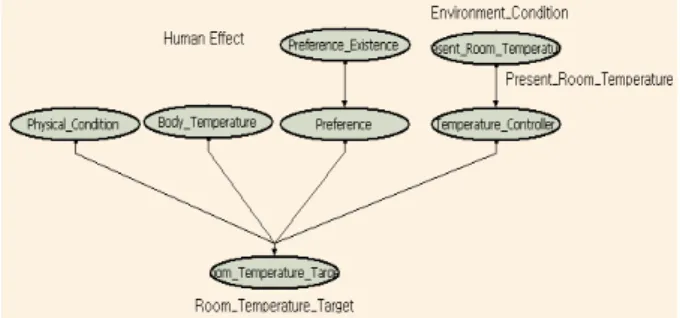
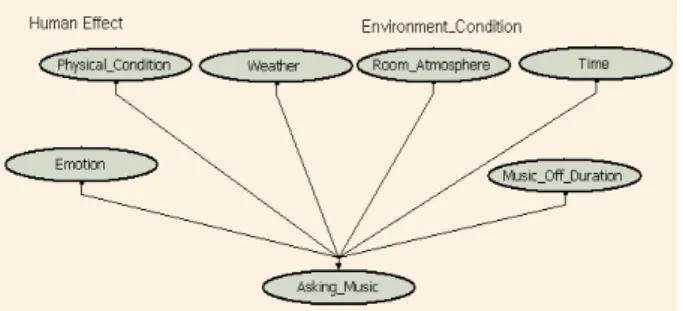
Figs. 4 to 7 show real models of the Bayesian belief networks that we constructed using the MSBNx program [5].
Fig. 4 Bayesian network for controlling the room temperature.
Fig. 6 Bayesian network for whether or not to query the human user.
Fig. 7 Bayesian network for controlling the music. In Figs. 4 to 7, the ellipses are the nodes. The top nodes are input information or data, and the bottom nodes are the outputs that are the results of the Bayesian belief network. We chose each node as independent sets, and the states of the nodes have a linguistic value that is described by the probabilities. Table. 1 shows all nodes and every possible state from all Bayesian belief networks.
Fig. 4 shows that the Bayesian belief network is used to control room temperature as the output node modifies the target of the room temperature. The temperature that is generally accepted as comfortable is termed the general temperature. The output node is named Room_Temperature_Target and its states modify the general temperature of the room to make the temperature either warmer or cooler than the general temperature. In fact we can use the air-conditioner, and just apply the target temperature from the result of the Bayesian belief network. The target temperature might be changed from general temperature, because of the human’s health conditions or personal preferences.
For the illumination control, as shown in Fig. 5, the Bayesian belief network is constructed to allow the robot to change the colors and intensity of the lights to modify the atmosphere in the room in consideration of both the human user’s condition and the environment. The Bayesian belief network in Fig. 6 involves the robot’s decision of whether or not to ask the human about listening to music. In this situation, the robot considers not only the human’s preferences and the information from environment, but also considers the duration of time since the music was last turned on; so if the music has not been on for a long time, the robot might suggest playing music, if other factors indicate that this action is appropriate.
In Fig. 7, we described the Bayesian belief network for controlling the decisions involving the genre, and volume of the music. Unlike cases in which illumination or room temperature need to be altered, the desire for music is much
more subjective and variable. When controlling the room temperature or the illumination, the conditional probabilities can be decided by averaging the values of human preferences. In the case of controlling music, however, the conditional probabilities are very dependent on the user’s specific preference at that moment. So the values of conditional probabilities in each Bayesian belief network might be very different from each other. For that reason, we construct the Bayesian belief network for controlling the music by summing the same networks. In other words, there are two men in the room for this case. We could also extend the model for a more complicated case to achieve a truly intelligent room.
Table. 1 All the states of the nodes in the Bayesian belief network.
4. SIMULATION RESULTS
Robots, that use the system architecture with the Bayesian network are aware of the situation and can conjecture the intentions of the human user by predicting and by interacting with the human to verify those predictions. We discuss below some results of our simulations.
In the simulation, which uses the computer as a robot, and involves a limited space based on the home domain, we can see the performance of the intelligent room. For the illumination control, when there are fewer than five people in the room and the room atmosphere is normal, the output states of the node ‘light_impression_need’ would be a warm state. When it is evening, and the weather is fine, the state of the output node would be a dark state. Finally considering the two outputs and the other input states (emotion : happy, physical condition : tired, and preferred color : blue) would lead to the decision for the output states to be general, and the room
would be darkened.
For controlling the music, the robot would decide to play ballads at low volume when the input states are ‘emotion : sad’, ‘physical condition : poor’, ‘room atmosphere : normal’, ‘time : evening’, and ‘weather : fine’. If the phone rings, the robot would recognize an emergency state and would mute the music.
Considering the results, we have concluded that the suggested method would allow the intelligent room to be implemented effectively, and would make it comfortable for the human user.
5. CONCLUSION
This paper presents the construction of an intelligent room, including full system architecture, Bayesian belief network, and human-robot interaction. In this system a robot can intuit the human user’s intentions and desires and can decide which tasks should be undertaken to increase the human’s comfort level. By using the Bayesian belief network before receiving a specific command, in the full system architecture of the intelligent room, a robot can successfully initiate interaction with the human user by making a query. We conclude that using the Bayesian network for predicting the human’s intentions would be an effective way for interaction to be initiated between the robot and the human.
Even though we used a computer simulation, we focused on the role of the robot that can support any kinds of service in the front of human, and can obtain additional information from the intelligent room when the robot is out of sight. In this environment, the robot acts as a supervisor. This automation is achieved by using a probability network in which all information is locally and globally connected.
The suggested system and proposed method would improve the robot’s ability to understand human commands as well as predict human intentions. The robot’s ability to do these things successfully will result in a, comfortable intelligent room for human beings.
Finally, we can conclude that the robot will become the more important one because it can operate as a supervisor of intelligent room environment. The robot’s global connectivity, which includes the physical and informational network, is essential for satisfying humans expectations and ensuring better robot-human interaction.
ACKNOWLEDGMENTS
The authors would like to thank Jung-Yean Yang, Kang-Woo Lee, Jung-Hoon Hwang, Soo-Chul Lim, and Hyoung-Rock Kim, co-workers in our team, for their useful comments on this research and we gratefully acknowledge the contributions of our many survey participants.
REFERENCES
[1] Rodney A, Brooks, “The Intelligent Room Project,” MIT Artificial Intelligence Lab.
[2] Michael H. Coen, “Design Principles for Intelligent Environments,” National Conference on Artificial Intelligence (AAAI-98), 1998.
[3] Richard O. Duda, Peter E.Hart, David G. Stork, “Pattern Classification,” Second Edition.
[4] Jeff Gill, “Bayesian methods : A social and behavioral sciences approach,”