INTRODUCTION
Artemisia is an herbaceous medicinal plant, whose leaf has been used as a traditional oriental medicine to cure various diseases such as asthma, malaria, hepatitis, inflammation and infections by fungi, bacteria and viruses (Zheng et al. 2004). Therefore, many volatile constituents for various medicinal properties have been separated and identified from Artemisia leaves using a novel technique of solid-phase microextrac-tion (SPME) as well as routine analysis methods such as steam distillation and solvent extraction (Choi et al. 2005; Koobkokkruad et al. 2008). However, since these
constitu-ents have different medicinal effects, and some of them are harmful to human health, their relative compositions need to be controlled by post-harvest processing for increasing the medical or industrial use of Artemisia.
Ionizing radiation generates reactive intermediates and stable products from the dissociation of water molecules, which include water radical cation (H2O∙++), excited water (H2O*), hydronium ion (H3O++), hydroxyl radical (∙OH), hy-drogen ion (H++), hydrated electron (e
-aq), hydrogen radical (H∙), hydrogen peroxide (H2O2), hydroxyl ion (OH-), super-oxide radical anion (O2∙-), and molecular hydrogen (H2) (Spinks and Woods 1990; Lee et al. 2009). Among these, ∙OH, H∙, O2∙-, and H2O2are biologically quite toxic and damaging to cellular components (Cadenas 1989; Esnault et al. 2010). However, these free radicals or reactive oxygen species are also the secondary determinants for the
radiation-─ ─ 17 ──
Differential Modulation of Volatile Constituents in
Artemisia princeps and Artemisia argyi Plants after
Gamma Ray or Electron Beam Irradiation
Ji Hong Kim, Eun Ju Cho, Min Hee Lee, Ji Eun Kim, Byung Yeoup Chung,Tae Hoon Kim1and Jin-Hong Kim*
Advanced Radiation Technology Institute, Korea Atomic Energy Research Institute, Jeongeup 580-185, Korea
1Korea Forest Seed & Variety Center, Chungju 380-941, Korea
Abstract -- The effects of gamma ray or electron beam irradiation on herbaceous medicinal plants were investigated in terms of the composition of volatile constituents using the aerial parts or leaves of Artemisia princeps Pamp. cv. Ganghwayakssuk and Artemisia argyi cvs. Namhaeyakssuk and Hwanghaessuk. The composition of volatile constituents in leaves was clearly distinguishable among the three Artemisia cultivars. However, the relative proportions of the major volatile con-stituents such as 1,8-cineole, αα-pinene, camphene, santolina triene, and artemesia triene, were similarly changed in two or three cultivars by gamma ray or electron beam irradiation. In parti-cular, the proportion of 1,8-cineole was increased up to 1.29- to 1.71-fold in the three cultivars after irradiation with gamma ray. These results suggest that gamma ray or electron beam irradiation can be applied to modulate the composition of volatile constituents in the leaves of Artemisia plants.
Key words : Artemisia, Gamma ray, Electron beam, Solid-phage microextraction, Volatile constituent
* Corresponding author: Jin-Hong Kim, Tel. +82-63-570-3333, Fax. +82-63-570-3390, E-mail. [email protected]
induced physiological responses (Esnault et al. 2010). There-fore, both the direct physicochemical and indirect reactive oxygen species-mediated effects of ionizing radiation on cellular components can be effectively utilized for radiation processing of biological materials (Koobkokkruad et al. 2008; Kim et al. 2009; Lee et al. 2011).
In the present study, we report that volatile constituents in aerial parts or leaves of Artemisia plants were differently identified from Artemisia princeps Pamp. cv. Ganghwayak-ssuk and Artemisia argyi cvs. NamhaeyakGanghwayak-ssuk and Hwang-haessuk. Moreover, it is suggested that gamma ray and/or electron beam irradiation could modulate the relative pro-portions of these constituents in leaves of Artemisia plants.
MATERIALS AND METHODS
1. Plant material and gamma ray or electron beam irradiation
Artemisia princeps Pamp. cv. Ganghwayakssuk and Arte-misia argyi cvs. Namhaeyakssuk and Hwanghaessuk were cultivated in the same experimental field. Artemisia princeps Pamp. cv. Ganghwayakssuk and Artemisia argyi cv. haeyakssuk were collected from islands Ganghwa and Nam-hae in Republic of Korea, respectively. Aerial parts or leaves of Artemisia plants were harvested and ground in liquid ni-trogen to a fine powder. About one gram of the leaf powder was put in a glass vial and one day later irradiated with 100-kGy gamma ray at a dose rate of 6.25 100-kGy h-1for 16 h or
with 10-kGy electron beam. Irradiation was carried out using a 60Co gamma (IR-221, MDS Nordion Inc., Kanata, Canada)
or an electron beam irradiator (UELV-10-10S, EB-Tech Co. Ltd., Daejeon, Korea) at the Advanced Radiation Technology Institute in Jeongeup-si, Jeollabuk-do, Republic of Korea.
2. SPME-GC/MS analysis of volatile constituents Glass vials containing the leaf powder were further incu-bated at room temperature for one day after irradiation. They were then subjected to GC/MS analysis using a solid-phase microextraction (SPME) fiber (Zheng et al. 2004). Although steam distillation and solvent extraction are routine analysis methods for volatile constituents, they require time-consum-ing procedures and relatively large amounts of samples and organic solvents. Therefore, the SPME method has been
used for determination of volatile constituents in Artemisia leaves (Zheng et al. 2004; Choi et al. 2005).
In the present study, volatile constituents of the leaf pow-der in glass vials were analyzed using a SPME fiber assem-bly (50/30 m DVB/CarboxenTM/PDMS StableFlexTM,
Su-pelco, Bellefonte, PA, USA) in a GC/MS system (6890N/ 5975B, Agilent Technologies, Santa Clara, CA, USA), which was equipped with a capillary column (HP5-MS 19091S-433, Agilent Technologies, Santa Clara, CA, USA) and a multifunctional autosampler and sample preparation robot (MPS Twister®, Gerstel GmbH & Co. KG, Mülheim van der
Ruhr, Germany). The SPME fiber was exposed to the head-space of the sample vials for 10 min. After autoinjection, the bound analysts were desorbed from the fiber in a GC inlet at 250�C for 2 min and the volatiles chromatographed on the HP5-MS capillary column. The GC temperature was raised from initially 35�C to 180�C at a rate of 5�C min-1and then
to 325�C at a rate of 10�C min-1and held constant for 5 min.
The helium carrier gas flow was kept constant at 1.0 ml min-1.
Mass selective detection was accomplished by the 5975B MS interfaced to the GC, operated at a mass range of m/z==
50~350 amu.
RESULTS AND DISCUSSION
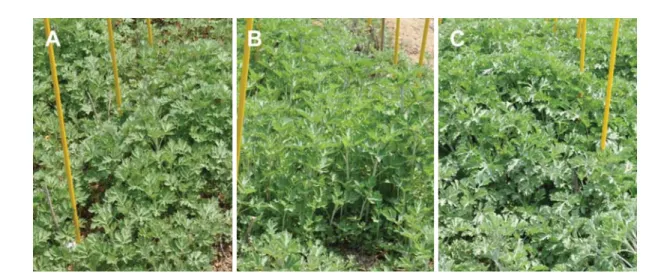
1. Difference in the composition of volatile constituents in three Artemisia cultivarsArtemisia plants have many volatile constituents with a variety of biological activities, exhibiting strong medicinal and/or allelopathic properties (Zheng et al. 2004; Yun 2009). However, it has been reported in various Artemisia species that the composition of volatile constituents is substantially changed depending on the growing season and/or habitat (Kim 1997; Yun and Choi 2003; Zheng et al. 2004). In the present study, Artemisia princeps Pamp. cv. Ganghwayak-ssuk and Artemisia argyi cvs. NamhaeyakGanghwayak-ssuk and Hwang-haessuk were cultivated in the same experimental field and harvested at the same time (Fig. 1). Therefore, the genotypic variations in relation to the composition of volatile constitu-ents could be estimated and compared among the three Arte-misia cultivars. The composition of volatile constituents in leaves was clearly distinguishable among the three Artemisia cultivars, even between Artemisia argyi cvs. Namhaeyakssuk and Hwanghaessuk, which belong to the same species (Fig.
2). The most abundant volatile constituent was β-thujone in Ganghwayakssuk, artemesia triene in Namhaeyakssuk, and artemesia ketone in Hwanghaessuk (Table 1). The 2-hexenal, α-pinene, and 1,8-cineole were commonly detected in the three cultivars. In contrast, the camphene or the santolina triene and artemesia triene was detectable only in Gangh-wayakssuk and Namhaeyakssuk, or in Namhaeyakssuk and Hwanghaessuk, respectively. These results imply that the difference in the composition of volatile constituents among the three cultivars can be attributed to the genotypic variations more than the growing season and/or habitat. Moreover, the profiles of common and different volatile constituents among the three Artemisia cultivars could be used to evaluate and compare the influence of gamma ray or electron beam on major volatile constituents of Artemisia leaves.
2. Change in the composition of major volatile constituents in three Artemisia cultivars after irradiation with gamma ray or electron beam
The growing season and habitat of Artemisia plants are important factors to affect the composition of volatile con-stituents in leaves (Kim 1997; Yun and Choi 2003; Zheng et al. 2004). Moreover, it was recently reported that the re-lative abundance of isoprenoids and other volatile compo-nents in the aerial parts of Artemisia annua was substantially changed by different nutritional treatments (Malik et al. 2009). However, post-harvest treatments such as drying, freezing, or heating are general considerations for enhance-ment of effective constituents and improveenhance-ment of function-Fig. 1. Cultivation of Artemisia plants in the experimental field. A, B and C represent Artemisia princeps Pamp. cv. Ganghwayakssuk and
Artemisia argyi cvs. Namhaeyakssuk and Hwanghaessuk, respectively.
Fig. 2. Difference in the composition of volatile constituents of
leaves among three Artemisia cultivars. Chromatograms were obtained by SPME-GC/MS analysis. Peaks with a character sent major volatile constituents in each cultivar. A, B, and C repre-sent Artemisia princeps Pamp. cv. Ganghwayakssuk and Artemisia
argyi cvs. Namhaeyakssuk and Hwanghaessuk, respectively.
5e++5 4e++5 3e++5 2e++5 1e++5 0 (A) (B) (C) a5 b7 b6 b8 b9 b5 b2 b3 b4 b1 c6 c5 c4 c1 c2 c3 c7 c8 a4 a3 a1 a2 a6 a7 5e++5 4e++5 3e++5 2e++5 1e++5 0 5e++5 4e++5 3e++5 2e++5 1e++5 0 Signal (a.u.) Signal (a.u.) Signal (a.u.) 0 5 10 15 20 25 30 35 Time (min)
ality and preservation in plant materials.
In the present study, the composition of major volatile con-stituents in Artemisia leaves was compared among the three cultivars, Ganghwayakssuk, Namhaeyakssuk, and Hwang-haessuk, before and after post-harvest irradiation with 100-kGy gamma ray or 10-100-kGy electron beam. As shown in Table 1, the gamma ray or electron beam irradiation caused noticeable changes in the relative proportions of major vola-tile constituents. The relative proportion of 1,8-cineole in volatile constituents, which was about 16% in Ganghwayak-ssuk, 12% in NamhaeyakGanghwayak-ssuk, and 20% in HwanghaeGanghwayak-ssuk, was substantially increased up to 20%, 17%, and 34% (1.29-, 1.45-, and 1.71-fold) after irradiation with gamma ray. This increase was also observed to some extent after treatment with electron beam. In contrast, the proportion of artemesia triene in Namhaeyakssuk, and Hwanghaessuk seemed to be increased by gamma ray but decreased by electron beam. Moreover, the gamma ray irradiation commonly decreased the relative proportions of α-pinene, camphene, and santo-lina triene in leaves of two or three cultivars. These results imply that the influence of gamma ray or electron beam
irra-diation on the composition of volatile constituents in Artemi-sia leaves could be more dependent on the constituents them-selves than the species or cultivar. This supposition is partly supported by the fact that β-phellandrene, β-caryophyllene, and β-myrcene were steeply decreased up to 9%, 17%, and 20% of the control after irradiation with gamma ray, respec-tively, as these constituents were found to exist only in one of three cultivars tested. Furthermore, unlike 100-kGy gam-ma ray or 10-kGy electron beam, 0.5~10 kGy gamma ray
failed to directly and shortly modulate the composition of volatile constituents in the three cultivars (data not shown).
CONCLUSION
In the present study, the obtained data indicated that gam-ma ray or electron beam irradiation could modulate the com-position of volatile constituents in leaves of Artemisia prin-ceps and Artemisia argyi, depending on the radiation dose or each constituent more than the species or cultivar. There-fore, it is suggested that such irradiation can be applied to Table 1. Change in the composition of major volatile constituents in Artemisia leaves after irradiation of 100-kGy gamma ray at a dose rate
of 6.25 kGy h-1for 16 h or 10-kGy electron beam. A, B, and C represent Artemisia princeps Pamp. cv. Ganghwayakssuk and Artemisia argyi cvs. Namhaeyakssuk and Hwanghaessuk, respectively. Digits are the proportion of the respective to the total volatile constituents and are expressed as means±S.E. of 2~4 independent experiments; N.D., not detected. In A-a3, A-a4, b6,
B-b9, C-c4, and C-c5 peaks, the mean values without a common letter are significantly different at P==0.05 by Tukey’s honestly
significant difference (HSD) test
GC peak Composition (%)
Control Gamma ray Electron beam Constituent
A-a1 2.0±0.5 1.4±0.2 3.1±0.6 2-hexenal
A-a2 1.8±0.2 N.D. 2.1±0.2 α-pinene
A-a3 10.8±1.0a 1.0±0.1b 11.5±1.4a β-phellandrene
A-a4 15.5±0.3a 20.0±0.3b 16.2±0.6a 1,8-cineole
A-a5, A-a6 68.3±1.1 76.4±0.4 65.8±2.2 β-thujone
A-a7 1.6±0.2 1.2±0.3 1.3±0.1 camphene B-b1 1.5±0.2 3.1±0.9 6.0±1.5 2-hexenal B-b2 4.8±0.9 0.5±0.2 6.5±0.9 santolina triene B-b3 1.9±0.4 1.6±0.2 2.6±0.5 α-pinene B-b4 1.0±0.2 0.5±0.2 1.2±0.2 camphene B-b5, B-b7, B-b8 73.7±1.7 76.1±1.7 69.2±2.9 artemesia triene
B-b6 11.9±0.9a 17.3±1.1b 13.1±0.5a 1,8-cineole
B-b9 5.3±2.0a 0.9±0.4a 1.5±0.6a β-caryophyllene
C-c1 3.7±1.1 3.0±0.6 3.2±0.9 2-hexenal
C-c2 3.1±0.4 0.2±0.2 3.1±0.6 santolina triene
C-c3 2.7±0.1 0.9±0.5 3.2±0.4 α-pinene
C-c4 12.1±2.1a 2.4±0.8b 11.8±1.0a β-myrcene
C-c5 19.8±2.6a 33.9±0.1b 24.1±0.5ab 1,8-cineole
C-c6 43.5±2.0 41.7±0.6 40.5±1.3 artemesia ketone
C-c7 7.8±1.4 9.1±1.2 7.3±0.5 artemesia triene
modulate the composition of volatile constituents in Artemi-sia leaves for specific industrial/medical purposes such as aroma therapy, air fresheners, antifungal or antibacterial agents, and so on.
ACKNOWLEDGMENT
This research was supported by the Nuclear R&D Pro-gram of the Ministry of Education, Science and Technology (MEST), Republic of Korea.
REFERENCES
Cadenas E. 1989. Biochemistry of oxygen toxicity. Annu. Rev.
Biochem. 58:79-110.
Choi BB, Lee HJ and Bang SK. 2005. Studies on the volatile flavor components and biochmical characterizations of
Artemisia princeps and A. argyi. Korean J. Food & Nutr.
18:334-340.
Esnault MA, Legue F and Chenal C. 2010. Ionizing radiation: Advances in plant response. Environ. Exp. Bot. 68:231-237. Kim JH. 1997. Variation of monoterpenoids in Artemisia feddei
and Artemisia scoparia. J. Plant Biol. 40:267-274. Kim JH, Lee MH, Moon YR, Kim JS, Wi SG, Kim TH and
Chung BY. 2009. Characterization of metabolic disturbances closely linked to the delayed senescence of Arabidopsis leaves after irradiation. Environ. Exp. Bot. 67:363-371. Koobkokkruad T, Chochai A, Kirdmanee C and De-Eknamkul
W. 2008. Effects of low-dose gamma irradiation on
artemi-sinin content and amorpha-4,11-diene synthase activity in
Artemisia annua L. Int. J. Radiat. Biol. 84:878-884.
Lee MH, Moon YR, Chung BY, Kim JS, Lee KS, Cho JY and Kim JH. 2009. Practical use of chemical probes for reactive oxygen species produced in biological systems by irradia-tion. Radiat. Phys. Chem. 78:323-327.
Lee SS, Lee EM, An BC, Kim TH, Lee KS, Cho JY, Yoo SH, Bae JS and Chung BY. 2011. Effects of irradiation on deco-lourisation and biological activity in Schizandra chinensis extracts. Food Chem. 125:214-220.
Malik AA, Ahmad J, Mir SR, Ali M and Abdin MZ. 2009. In-fluence of chemical and biological treatments on volatile oil composition of Artemisia annua Linn. Ind. Crop. Prod.
30:380-383.
Spinks JWT and Woods RJ. 1990. Water and inorganic aqueous systems. pp. 243-313. In: An Introduction to Radiation Chemistry (Spinks JWT and Woods RJ eds.), John Wiley and Sons, New York, NY.
Yun KW. 2009. Phytotoxicity and volatile monoterpenes of leaves from Artemisia capillaris and Artemisia iwayomogi used as Korean herbal Injin. J. Ecol. Field Biol. 32:9-12. Yun KW and Choi S. 2003. Seasonal variation in allelopathic
potential of Artemisia princeps var. orientalis on plants and microbes. J. Plant Biol. 46:105-110.
Zheng X, Deng C, Song G and Hu Y. 2004. Comparison of essential oil composition of Artemisia argyi leaves at differ-ent collection times by headspace solid-phase microextrac-tion and gas chromatography-mass spectrometry.
Chroma-tographia 59:729-732.
Manuscript Received: January 13, 2012 Revised: January 19, 2012 Revision Accepted: February 3, 2012