INTRODUCTION
Black raspberry (Rubus occidentalis L.) is a perennial shrub distribute in the eastern parts of North America. Traditionally, the North-Amercian Indians made tea from black raspberry roots used to treat stomach aches. The leaves are highly astringent and used to treat bowel com-plaints. Black raspberry fruits contain high levels of antho-cyanins (Kong et al. 2003), chemopreventive phytoche-micals including ellagic acid, ferulic acid, coumaric acid, beta-carotene, vitamins C and E, folic acid, calcium,
seleni-um, and beta-sitosterol (Harris et al. 2001; Xue et al. 2001; Han et al. 2005). The biological activities of berries are partially determined by their content of a diverse range of phytochemicals (Perkins-Veazie and Nonnecke 1992; See-ram 2006). Anthocyanins are one of the most abundant phenolic compounds and are responsible for coloration of fruits and vegetables, serves as an insect and animal attrac-tant. In addition, numerous studies have demonstrated that anthocyanins function as antioxidants (Wang et al. 1997), anti-inflammatories (Wang et al. 1999), and antimutagens (Yoshimoto et al. 1999). It is known to accumulate in the vacuoles of epidermal cells and is influenced by environ-mental stimuli. Especially, anthocyanin biosynthesis was induced by UV-irradiation (Park et al. 2007). The
expres-─ ─ 121 ──
Molecular Cloning and Characterization
of a Flavanone-3-hydroxylase Gene from Rubus occidentalis L.
Seung Sik Lee, Eun Mi Lee, Byung Chull An, Shyamkumar Barampuram, Jae-Sung Kim,Jae-Young Cho1, In-Chul Lee2and Byung Yeoup Chung*
Advanced Radiation Technology Institute, Korea Atomic Energy Research Institute, Jeongeup 580-185, Korea
1Department of Applied Life Sciences, Chonbuk National University, Jeonju 561-756, Korea 2Senior Industry Cluster Agency, Youngdong University, Chungbuk 370-701, Korea
Abstract -- Flavanone-3-hydroxylase (F3H) is one of the key enzymes for the biosynthesis of
flavonals, anthocyanins, catechins and proanthocyanins. F3H catalyzes the 3ββ-hydroxylation of (2S)-flavonones to form (2R, 3R)-dihydroflavonols. In this report, we isolated a full-length cDNA of RocF3H from black raspberry (Rubus occidentalis L.) using a reverse transcriptase-PCR and rapid amplification of the cDNA ends (RACE)-PCR. The full-length cDNA of RocF3H contains a 1,098 bp open reading frame (ORF) encoding a 365 amino acid protein with a calculated mole-cular weight of about 41.1 kDa and isoelectric point (pI) of 5.45. The genomic DNA analysis re-vealed that the RocF3H gene had three exons and two introns. Comparison of the deduced amino acid sequence of the RocF3H with other F3Hs revealed that the protein is highly homologous with various plant species. The conserved amino acids ligating the ferrous iron and the residues part-icipating in the 2-oxoglutarate binding (R-X-S) were found in RocF3H at the similar positions to other F3Hs. Southern blot analysis indicated that RocF3H exist a multi-gene family. The isolation of RocF3H gene will be helpful to further study the role of F3H gene in the biosynthesis of flavo-noids in R. occidnetalis.
Key words : Anthocyanin, Black raspberry, Flavanone-3-hydroxylase, RACE, Southern blot
* Corresponding author: Byung Yeoup Chung, Tel. +82-63-570-3331, Fax. +82-63-570-3339, E-mail. [email protected]
sion of chalcone synthase (CHS), flavanone 3-hydroxylase (F3H), and dihydroflavonol 4-reductase (DFR) genes show-ed a positive correlation with anthocyanin accumulation in UV-B-irradiated lettuce leaves. And also, Nagata et al. (Na-gata et al. 2005) recently reported that gamma-rays induce anthocyanin synthesis relating genes in Arabidopsis.
Anthocyanin biosynthesis has been well investigated in many plants and the structural and regulatory genes of this metabolic pathway have been cloned and characterized (Winkel-Shirley 2001; Hieber et al. 2006). Among the many genes involved in anthocyanin biosynthesis, flava-none-3-hydroxylase (F3H) is one of the key enzymes for the production of flavonals, anthocyanins, catechins and proanthocyanins. F3H catalyzes the 3β-hydroxylation of (2S)-flavonones to form (2R, 3R)-dihydroflavonols. F3H is also a 2-oxoglutarate dependent dioxygenase. It was first identified from crude extracts of Matthiola incana and elu-cidated through a parsley cell culture (Forkmann et al. 1980; Britsch et al. 1981). Subsequently, cDNAs encoding F3H were islolated from Petunia hybrida (Britsch et al. 1992), Hordeum vulgare (Meldgaard 1992), Malus domestica (Da-vies 1993), Medicago sativa (Charrier et al. 1995), Zea mays (Deboo et al. 1995), Arabidopsis thaliana (Pelletier and Shirley 1996), Perilla frutescenes (Gong et al. 1997), Sau-ssurea medusa (Jin et al. 2005), and Ginko biloba (Shen et al. 2006). Many F3Hs have been isolated and characterized in herbal plants. However, there is little reporting on the cloning of F3H genes from woody plant species. The F3H gene from a black raspberry, used as a medicinal woody-plant, was isolated and characterized in this study. This report will be helpful to further research for the role of the F3H gene in the biosynthesis of flavonoids in R. occiden-talis.
MATERIALS AND METHODOS
1. Plant and material growth conditions
Black raspberry (Rubus occidentalis) plants were grown in green house of Chonbuk National University (Jeonju, Korea) under ambient conditions. Leaves were immediately frozen in liquid nitrogen after harvesting and stored at -70 �C until used.
2. Genomic DNA and total RNA extraction
Genomic DNA was extracted from the leaves of R. occi-dentalis by a modified cetyltrimethylammonium bromide (CTAB) method (Doyle and Doyle 1987). Total RNA was extracted from the leaves of R. occidentalis by using CTAB method (Jaakola et al. 2001). The quality and concentration of DNA and RNA were measured with agarose gel electro-phoresis and spectrophotometer.
3. 5′′ RACE and 3′′ RACE
5′- and 3′-RACE were performed using a gene-specific primer with the SMARTTMRACE cDNA Amplification Kit (Clontech Laboratories, CA, USA) according to the manu-facturers instructions. The gene-specific primers, RocF3H-GSP1 (5′-TTGACATGTCCGGTGGCAAAAAGGG-3′; for 3′-RACE) and RocF3H-GSP2-3 (5′-AACCGGGTATG-AGAAGTAGGTCACAATCTCGC-3′, for 5′-RACE), were designed and synthesized based on the conserved sequences of other F3H genes. RACE-PCR conditions were 5 cycles of 94�C for 30 sec, 72�C for 2 min, then 5 cycles of 94�C for 30 sec, 70�C for 30 sec, 72�C for 2 min, and 30 cycles of 94�C for 30 sec, 68�C for 30 sec, 72�C for 2 min. The amplified RACE-PCR products were purified and cloned to pGEM-T Easy vector (Promega, Madison, USA) followed by a sequencing.
4. Isolation of full-length cDNAs and genomic sequences of R. occidentalis F3H genes
After comparing and aligning the sequences of the 5 ′-and 3′-RACE-PCR fragments, the cDNA of RocF3H was obtained through a reverse transcriptase (RT)-PCR with two primers, RocF3H-F(NdeI) (5′-cat atgGC TCC TACAC CTACTACTCTGACCG-3′: the restriction endonuclease site was represented by lower case letters and the start codon was boxed) and RocF3H-R(EcoRI) (5 ′-gaattcTCA-AGCAAAAATATCATCCACTTGC-3′: the restriction endonuclease site was represented by lower case letters and the stop codon was boxed), and the cDNA library prepared by the Maxime RT premix kit (iNtRON BIOTECHNO-LOGY, Seongnam, Korea) as a template. The PCR was performed at 94�C for 20 sec, 63�C for 20 sec, and 72�C for 2 min with 30 cycles using Maxime PCR PreMix Kit (i-StarTaq) (iNtRON BIOTECHNOLOGY, Seongnam, Korea).
To isolate the genomic DNA of RocF3H, we extracted the genomic DNA from the leaves by a modified CTAB method (Doyle and Doyle, 1987), and then a PCR was per-formed with the primers of F (NdeI) and RocF3H-R(EcoRI) covering the coding region under the following conditions: 94�C for 20 sec, 63�C for 20 sec, and 72�C for 2 min with 30 cycles. The PCR products were purified and cloned to pGEM-T Easy vector (Promega, Madison, USA) followed by a sequencing.
5. Bioinformatic and phylogenetic analysis
The obtained sequences were analyzed using bioinfor-matics tools from websites (http://www.ncbi.nlm. nih.gov, http://www.expasy.org). Multiple sequence alignment of RocF3H and other plant F3Hs were carried out using the Clustal W program (Thompson et al. 1997) from websites (http://www.ebi.ac.uk/Tools/clustalw/index.html) and a phylogenetic tree was constructed by the neighbour-joining method (Kimura 1980; Saitou and Nei 1987) using the Clu-stal W program. Secondary structure was predicted at Net-work Protein Sequence Analysis server (NPS@) (http://npsa-pbil.ibcp.fr/cgi-bin/npsa_automat.pl?page=/NPSA/npsa_ server.html).
6. Southern blot analysis
Ten-μg aliquots of the total genomic DNA were digested for overnight at 37�C with Bgl II, EcoR I, Nhe I, or Xba I, which did not cut within the probe region, and separated by 0.8% agarose gel electrophoresis and then transferred onto a positively charged nylon membrane (Zeta-Probe blotting membrane; Bio-Rad, CA, USA) by a capillary transfer (Sambrook and Russell 2001). The blot was cross-linked by UV-radiation and hybridized with RocF3H gene-specific probes, the full length cDNA of RocF3H labeled with [
α-32P]dCTP by random primer DNA labeling kit Ver. 2
(Takara, Otsu, Japan), in church buffer (Church and Gilbert 1984) [0.5 mM Na2HPO4, pH 7.2, 1 mM EDTA, 1% (w/v)
BSA, 7% (w/v) sodium dodecyl sulfate (SDS)] at 65�C. After incubating with gene-specific probes, the hybridized blots were washed twice with 2×SSC (1×is 150 mM NaCl, 15 mM sodium citrate), 0.1% SDS at for 20 min at 65�C, and then washed twice with 1×SSC, 0.1% SDS at for 10 min at room temperature. After washing, blots were dried and exposed to X-ray film for appropriate times at
--70�C.
RESULTS AND DISCUSSION
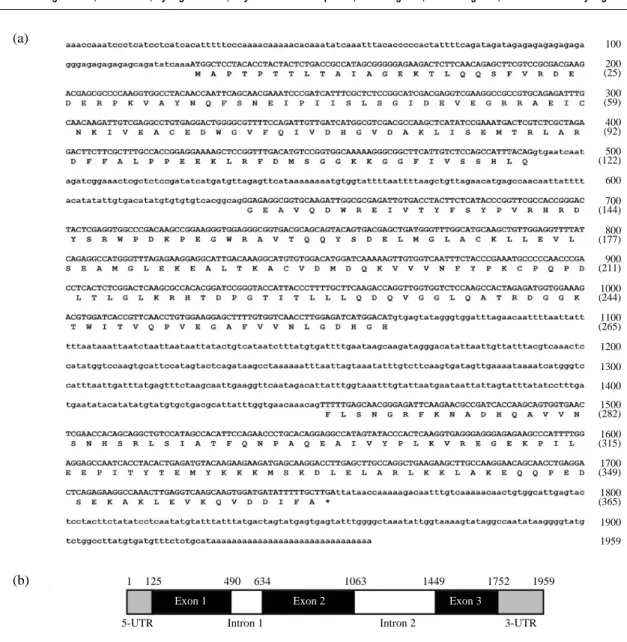
1. Isolation and characterization of RocF3H By using the RACE-PCR method, the full-length cDNA sequence of RocF3H gene was isolated. The cDNA is 1,429-bp, including poly (A) tail, and contains an open reading frame (ORF) of 1,098-bp (including stop codon TGA). There is a 124-bp 5′ UTR (untranslated region) up-stream of the start codon (ATG) and a 207-bp 3′ UTR down-stream of the stop codon (TGA). A start codon (ATG) which conforms to the predicted translation start site for eukaryo-tic genes (A/GXXATGG) (Kozak 1984) is present (Fig. 1).The genomic DNA sequence of RocF3H was isolated by PCR based on the sequence of cDNA. We carried out a PCR using specific primers, F (NdeI) and RocF3H-R (EcoRocF3H-RI), derived from the start and stop codon regions of the cDNA. A 1,628 bp of genomic RocF3H containing start and stop codon was isolated, which had a 100% identity in the coding region to the full-length cDNA sequence. A comparison of the genomic DNA and cDNA sequence indicated that RocF3H gene contains three exons and two introns (Fig. 1). Exon 1 (366-bp), exon 2 (429-bp) and exon 3 (303-bp) were separated by intron 1 (144-bp) and intron 2 (386-bp). It was also found that the putative splicing site obeyed the GU/AG rule.
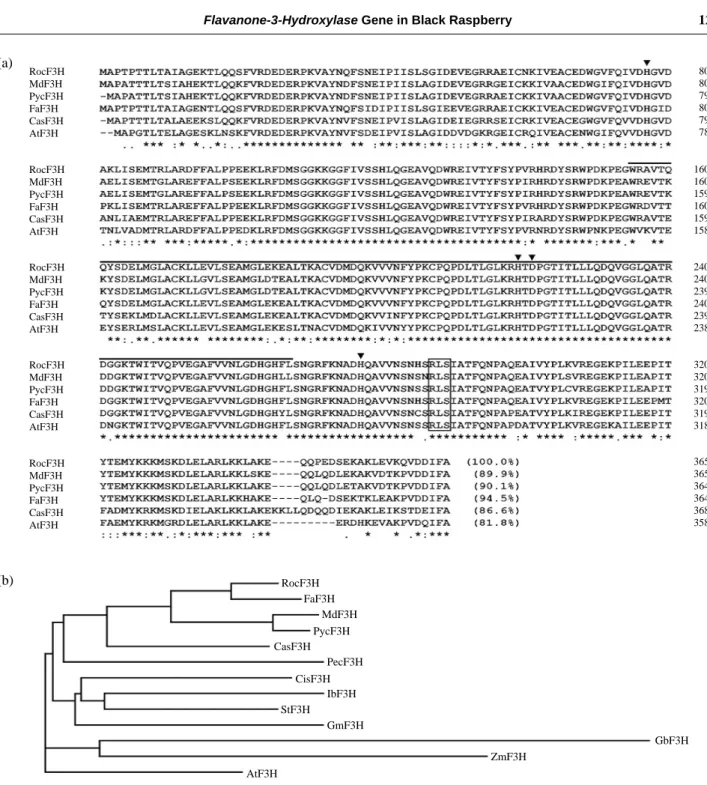
The deduced RocF3H protein encodes a polypeptide of 365 amino acid residues, corresponding to a molecular weight of 41.1 kDa and a calculated isoelectric point (pI) value of 5.45 (using the software of Compute pI/Mw tool at www.ex-pasy.org). By the web-based database search with Con-served Domains (at http://www.ncbi.nlm.nih.gov/Structure/ cdd/wrpsb.cgi) and the multi-alignment by Clustal W (Tho-mpson et al. 1997), it was revealed that the RocF3H be-longs to the 2OG-Fe (II)_Oxy superfamily and had a high homology with other plant F3Hs (Fig. 2a). For example, RocF3H showed more than 80% identites to the counter-parts of Malus×domestica (MdF3H), Pyrus communis (PycF3H), Fragaria×ananassa (FaF3H), Camellia
sinen-sis (CasF3H) and Arabidopsinen-sis thaliana (AtF3H) (Fig. 2a).
Especially, the deduced amino acid sequence of the RocF3H proteins showed a 95% identity to Fragaria×ananassa
F3H (FaF3H). And also the amino acid residues (His77, His219, His277 and Asp221) for ligating ferrous iron, and Arg287 and Ser289 participating in the 2-oxoglutarate binging (R-X-S) were highly conserved (Britsch et al. 1993; Lukacin and Britsch 1997).
To investigate the evolutionary relationships among RocF3H and other F3H proteins, the phylogenetic tree was constructed using neighbor-jointing method (Fig. 2b). Rela-tively, RocF3H was generally more homologous to woody species F3Hs, such as Malus×domestica (MdF3H: 95%),
Pyrus communis (PycF3H: 90%) and Camellia sinensis
(CsaF3H: 87%), except for Ginkgo biloba (GbF3H: 67%) than herbal F3Hs (~70~80%).
To gain insight into the secondary structure of RocF3H, we performed secondary structure prediction for the pri-mary sequences using NPSA server. The secondary struc-tures of RocF3H are composed of alpha helices (32.05%), random coils (49.32%), extended strands (17.53%) and am-biguous states (1.1%). Ten alpha-helices (55~67, 81~95, 99~103, 127~132, 154~180, 185~191, 263~265, 319~345, 348~355, 357~362) are linked by random coils and extended strands (Fig. 3). Extended strands
Fig. 1. Sequence and structure of the RocF3H gene. (a) Genomic DNA sequence and deduced amino acid sequence of RocF3H. The stop
codon (TGA) is represented as an asterisk in the sequence. Lower case letters indicate UTR. Capital letters indicate translated region. The corresponding amino acid is indicated below the codon sequence by single-letter code. The nucleotides (upper line) and amino acid residues (lower line, in parenthesis) are numbered on the right. (b) Schematic representation of the genomic DNA structure of RocF3H. Positions of the exons (black boxes) and introns (white boxes) were determined by comparing the genomic DNA sequence with the cDNAs of RocF3H. The gray box represents the UTR.
(a)
(b) 1 125 490 634 1063 1449 1752 1959
5-UTR Intron 1 Intron 2 3-UTR
Exon 1 Exon 2 Exon 3
100 200 (25) 300 (59) 400 (92) 500 (122) 700 (144) 800 (177) 900 (211) 1000 (244) 1100 (265) 1500 (282) 1600 (315) 1700 (349) 1800 (365) 1200 1900 1959 1300 1400 600
Fig. 2. Sequence alignment of the deduced amino acid sequence of RocF3H with other plant F3Hs. (a) The deduced amino acid sequence of
RocF3H was aligned with those of other plant F3H proteins using the Clustal W program. Amino acid residues are numbered at the right side, and the percentage of the number of identical amino acids shared with RocF3H is shown in parentheses at the end of the last lines. The 2OG-Fe(II)_Oxy conserved domain is lined. The conserved amino acid residues for ligating ferrous are represented by reverse triangle. The conserved amino acid residues for participating in a 2-oxoglutarate binding (R-X-S) are boxed. Asterisks indicate the amino acids conserved in all the sequences and the dashes within sequences represent the gaps introduced to optimize alignment. ‘*’ indicates positions which have a single, fully conserved residue. ‘:’ indicates that one of the following ‘strong’ groups is fully con-served. ‘.’ indicates that one of the following ‘weaker’ groups is fully concon-served. Multiple alignments were analyzed by Clustal W. (b) Phylogenetic analysis of RocF3H and other F3H proteins. A phylogenic tree was constructed by the neighbour-joining method using the Clustal W program. GenBank accession number of the proteins are as follows: MdF3H (Malus×domestica, AAX89397), PycF3H (Pyrus communis, AAX89400), FaF3H (Fragaria×ananassa, AAU04791), CasF3H (Camellia sinensis, AAT68774), AtF3H (Arabidopsis thaliana, AAC49176), PecF3H (Petroselinum crispum, AAP57394), CisF3H (Citrus sinensis, BAA36553), IbF3H (Ipomoea batatas, ABL74481), StF3H (Solanum tuberosum, AAM48289), GmF3H (Glycine max, AAU06218), GbF3H (Ginkgo biloba, AAU93347), ZmF3H (Zea mays, AAA91227).
(a) (b) RocF3H FaF3H MdF3H PycF3H CasF3H PecF3H CisF3H IbF3H StF3H GmF3H GbF3H ZmF3H AtF3H RocF3H MdF3H PycF3H FaF3H CasF3H AtF3H RocF3H MdF3H PycF3H FaF3H CasF3H AtF3H RocF3H MdF3H PycF3H FaF3H CasF3H AtF3H RocF3H MdF3H PycF3H FaF3H CasF3H AtF3H RocF3H MdF3H PycF3H FaF3H CasF3H AtF3H 80 80 79 80 79 78 160 160 159 160 159 158 240 240 239 240 239 238 320 320 319 320 319 318 365 365 364 364 368 358
mainly distributed at the N-terminal region (21 aa) and between central alpha-helix and C-terminal alpha-helix (42 aa). The active site of His and Asp residues for iron binding and the 2-oxoglutarate binding motif (R-X-S) placed on the random coils. Secondary structure of RocF3H is very simi-lar with SmF3H (Saussurea medusa) and AtF3H (Jin et al. 2005). These results suggest that they may have similar function.
Based on the primary and secondary sequence analyses, we strongly suggested that RocF3H functions as a real F3H in R. occidentalis.
2. Southern blot analysis
To determine the copy number of RocF3H in Rubus
occidentalis, aliquots of genomic DNA (10μg/sample) of R. occidentalis were restricted with Bgl II, EcoR I, Nhe I or Xba I respectively. All restriction endonucleases did not cut
within the genomic DNA sequences of RocF3H. Several distinct hybrization bands were detected from all lanes (Fig. 4). This result suggests that F3H belonged to a multi-gene family in the R. occidentalis. Like a F3H gene from R.
occidentalis, F3H genes from Perilla frutescens (Gong et al. 1997) and Ginkgo biloba (Shen et al. 2006) were
encod-ed by a multi-gene family, whereas the F3H genes from various plant species such as Arabidopsis, maize and petu-nia (Britsch et al. 1992; Deboo et al. 1995; Pelletier and Shirley 1996) were reported to have only single copy.
CONCLUSION
In this report, we reported on the isolation and charac-terization of the full-length cDNA and genomic DNA sequ-ences of F3H from R. occidentalis. RocF3H existed as a multi-gene family in R. occidentalis. Multiple alignments showed that the deduced amino acid sequences of the RocF3H protein were highly homologous with other plant F3Hs, and it contained conserved active sites for iron bind-ing and the 2-oxoglutarate bindbind-ing. Sequence analyses, sequence alignment, phylogenetic tree analysis and secon-dary structure prediction, implies that RocF3H protein may have similar functions with other F3H proteins.
ACKNOWLEDGEMENT
This study was carried out with the support of “Site Joint Cooperating Agricultural Research-promoting Project (Pro-ject No. 2007040108003702)”, RDA, and in part by the Nuclear R & D Program of the Ministry of Science and
Fig. 3. Secondary structure prediction of RocF3H. Four kinds of line bars in descending in length represent alpha helix, extended strand,
random coil and ambiguous states respectively. Building of the consensus based on 3 different methods of prediction was performed at NPSA structure prediction server. The numerals are residue counts along the whole proteins.
50 100 150 200 250 300 350
Fig. 4. Southern blot analysis of RocF3H. Genomic DNA of R. occidentalis was extracted as described in MATERIALS AND METHODS. Genomic DNA (10μg ml-1) was
respe-ctively digested with Bgl II (lane B), EcoR I (lane E), Nhe I (lane N) and Xba I (lane X) followed by hybridization with the coding region of RocF3H as the probe. The sizes of molecular weight marker are shown on the left.
B E N X (kb) 10 8 6 4 2 RocF3H
Technology, Republic of Korea.
REFERENCES
Britsch L, Dedio J, Saedler H and Forkmann G. 1993. Mole-cular characterization of flavanone 3 beta-hydroxylases. Consensus sequence, comparison with related enzymes and the role of conserved histidine residues. Eur. J.
Bio-chem. 217:745-754.
Britsch L, Heller W and Grisebach H. 1981. Conversion of flavanone to flavone, dihydroflavonol and flavonol with an enzyme system from cell cultures of parsley. Z.
Natur-forsch Sect. C Biosci. 36:742-750.
Britsch L, Ruhnau-Brich B and Forkmann G. 1992. Molecular cloning, sequence analysis, and in vitro expression of flav-anone 3 beta-hydroxylase from Petunia hybrida. J. Biol.
Chem. 267:5380-5387.
Charrier B, Coronado C, Kondorosi A and Ratet P. 1995. Mole-cular characterization and expression of alfalfa (Medicago
sativa L.) flavanone-3-hydroxylase and
dihydroflavonol-4-reductase encoding genes. Plant Mol. Biol. 29:773-786. Church GM and Gilbert W. 1984. Genomic sequencing. Proc.
Natl. Acad. Sci. U. S. A. 81:1991-1995.
Davies KM. 1993. A cDNA clone for flavanone 3-hydroxylase from Malus. Plant Physiol. 103:291.
Deboo GB, Albertsen MC and Taylor LP. 1995. Flavanone 3-hydroxylase transcripts and flavonol accumulation are tem-porally coordinate in maize anthers. Plant J. 7:703-713. Doyle JJ and Doyle JL. 1987. A rapid DNA isolation
proce-dure for small quantities of fresh leaf tissue. Phytochem.
Bull. 19:11-15.
Forkmann G, Heller W and Grisebach H. 1980. Anthocyanin biosynthesis in flowers of Matthiola incana flavanone 3-and flavonoid 3′-hydroxylases. Z. Naturforsch Sect. C
Biosci. 35:691-695.
Gong Z, Yamazaki M, Sugiyama M, Tanaka Y and Saito K. 1997. Cloning and molecular analysis of structural genes involved in anthocyanin biosynthesis and expressed in a forma-specific manner in Perilla frutescens. Plant Mol.
Biol. 35:915-927.
Han C, Ding H, Casto B, Stoner GD and D’Ambrosio SM. 2005. Inhibition of the growth of premalignant and malig-nant human oral cell lines by extracts and components of black raspberries. Nutr. Cancer 51:207-217.
Harris GK, Gupta A, Nines RG, Kresty LA, Habib SG, Frankel WL, LaPerle K, Gallaher DD, Schwartz, SJ and Stoner GD. 2001. Effects of lyophilized black raspberries on azo-xymethane-induced colon cancer and 8-hydroxy-2 ′-deoxy-guanosine levels in the Fischer 344 rat. Nutr. Cancer
40:125-133.
Jaakola L, Pirttila AM, Halonen M and Hohtola A. 2001. Iso-lation of high quality RNA from bilberry (Vaccinium
myr-tillus L.) fruit. Mol. Biotechnol. 19:01-203.
Jin Z, Grotewold E, Qu W, Fu G and Zhao D. 2005. Cloning and characterization of a flavanone 3-hydroxylase gene from
Saussurea medusa. DNA Seq. 16:121-129.
Kimura M. 1980. A simple method for estimating evolutionary rates of base substitutions through comparative studies of nucleotide sequences. J. Mol. Evol. 16:111-120.
Kong JM, Chia LS, Goh NK, Chia TF and Brouillard R. 2003. Analysis and biological activities of anthocyanins.
Phy-tochemistry 64:923-933.
Kozak M. 1984. Compilation and analysis of sequences upst-ream from the translational start site in eukaryotic mRNAs.
Nucleic Acids Res. 12:857-872.
Lukacin R and Britsch L. 1997. Identification of strictly con-served histidine and arginine residues as part of the active site in Petunia hybrida flavanone 3beta-hydroxylase. Eur.
J. Biochem. 249:748-757.
Meldgaard M. 1992. Expression of chalcone synthase, dihy-droflavonol reductase, and flavanone-3-hydroxylase in mu-tants of barley deficient in anthocyanin and proanthocyan-idin biosynthesis. Theor. Appl. Genet. 83:695-706. Nagata T, Yamada H, Du Z, Todoriki S and Kikuchi S. 2005.
Microarray analysis of genes that respond to gamma-irra-diation in Arabidopsis. J. Agric. Food Chem. 53:1022-1030.
Park JS, Choung MG, Kim JB, Hahn BS, Kim JB, Bae SC, Roh KH, Kim YH, Cheon CI, Sung MK and Cho KJ. 2007. Genes up-regulated during red coloration in UV-B irradiated lettuce leaves. Plant Cell Rep. 26:507-516. Pelletier MK and Shirley BW. 1996. Analysis of flavanone
3-hydroxylase in Arabidopsis seedlings. Coordinate regula-tion with chalcone synthase and chalcone isomerase. Plant
Physiol. 111:339-345.
Perkins-Veazie P and Nonnecke G. 1992. Physiological chan-ges during ripening of raspberry fruits. HortScience 27: 331-333.
Saitou N and Nei M. 1987. The neighbor-joining method: a new method for reconstructing phylogenetic trees. Mol.
Biol. Evol. 4:406-425.
Sambrook J and Russell DW. 2001. Molecular cloning: a laboratory manual, 3rd ed. Cold Spring Harbor Laboratory Press, New York, USA.
Seeram NP. 2006. Berries. Academic Press, London, UK. Shen G, Pang Y, Wu W, Deng Z, Zhao L, Cao Y, Sun X and
Tang K. 2006. Cloning and characterization of a flavanone 3-hydroxylase gene from Ginkgo biloba. Biosci. Rep. 26: 19-29.
Thompson JD, Gibson TJ, Plewniak F, Jeanmougin F and Hig-gins DG. 1997. The CLUSTAL_X windows interface: flexible strategies for multiple sequence alignment aided by quality analysis tools. Nucleic Acids Res. 25:4876-4882. Wang H, Cao G and Prior RL. 1997. Oxygen radical absorbing capacity of anthocyanins. J. Agric. Food Chem. 45:304-309.
Wang H, Nair MG, Strasburg GM, Chang YC, Booren AM, Gray JI and DeWitt DL. 1999. Antioxidant and antiin-flammatory activities of anthocyanins and their aglycon, cyanidin, from tart cherries. J. Nat. Prod. 62:294-296.
Xue H, Aziz RM, Sun N, Cassady JM, Kamendulis LM, Xu Y, Stoner GD and Klaunig JE. 2001. Inhibition of cellular trans-formation by berry extracts. Carcinogenesis. 22:351-356. Yoshimoto M, Okuno S, Yoshinaga M, Yamakawa O,
Yama-guchi M and Yamada J. 1999. Antimutagenicity of sweet-potato (Ipomoea batatas) roots. Biosci. Biotechnol. Bio-chem. 63:537-541.
Manuscript Received: June 27, 2008 Revision Accepted: August 11, 2008