한국정밀공학회 2013 년도 춘계학술대회논문집
1. Introduction
Currently, following the development of the manufacturing industry, high efficiency, high precision, and high rigidity have been the main trends in computer numerical control (CNC) machine tools. To meet the needs of CNC machine tool’ development and to adapt to market requirements, we need to use the advanced characteristics of spindles to ensure that we produce machine tools with excellent capabilities [1].
Based on the finite element method and thermal analysis, established the finite element model of spindle system and calculated boundary conditions in thermal characteristics of the spindle system. Used the finite element analysis software ANSYS Workbench thermal analysis of the spindle system, got the spindle system temperature distribution, and calculated temperature rise of spindle system affected by different preload, which provide basis for optimization design of the spindle.
2. The spindle system and heat sources
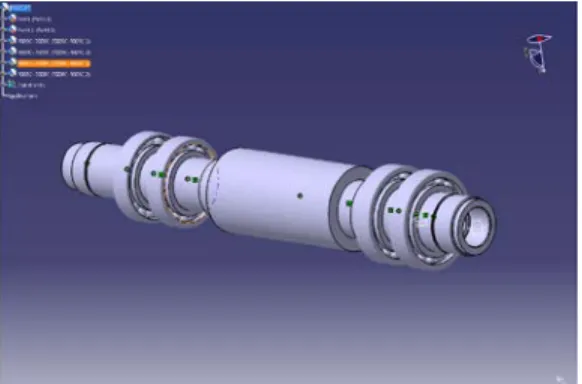
In this paper, the schematic of the high-speed spindle is shown in Fig. 1. The spindle uses four bearings employing an angular-contact ball bearing to support the rotating part of the spindle. The front bearings use NSK 7009C and the rear bearing use NSK 7008C in the spindle system.
In the machine tool operations, the major heat sources include the heat generated by the cutting process and the heat from bearings. It is assumed that
Fig. 1 The shaft of a 45,000-rpm spindle system
the majority of cutting heat is taken away by coolant and therefore the heat generated by bearings is the dominant heat causing thermal deformations [2]. According to Harris [3], the heat generated by a bearing can be computed by the following eq. (1):
(1)
Where n is the rotating speed of the bearing (rpm);
M is the total frictional torque of the bearing (N mm)
and Hf is the heat generated (W). The frictional torque M is a sum of two torques: (1) the torque due to
applied load, M1. (2) the torque due to viscous
friction, M2.
3. The thermal analysis
In this paper, the material of shaft uses SCM435 and the thermal conductivity is 42.7 W/m℃. The rotor uses Fe-Si and the thermal conductivity is
예압에 따른 45,000-rpm 주축의 열해석에 관한 기초 연구
A basic study on the thermal analysis of 45,000-rpm spindle
with different preload
*이 건1, 김동현1, #이춘만1
*Jian lee1, Dong Hyeon Kim1#Choon Man Lee ([email protected])1 1
창원대학교 기계공학부
Key words : High-speed spindle, Bearing preload, Thermal analysis
nM
H
f=
1
.
047
*
10
−4한국정밀공학회 2013 년도 춘계학술대회논문집
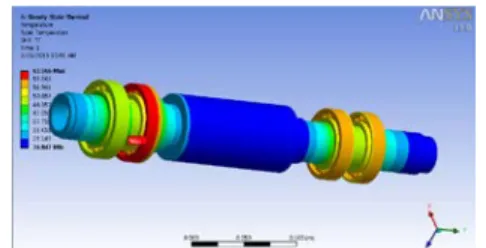
Fig. 2 the temperature distribution with preload 0 N
Fig. 3 the temperature distribution with preload 300N
42.7 W/m℃. The rings of bearing use SUJ2 and the thermal conductivity is 41.9 W/m℃. Meanwhile the ambient temperature is 22℃. In this study, the front bearings of spindle were affected by different preload. Used the ANSYS Workbench thermal analysis, got the spindle temperature distribution with different preload.
Fig. 2 shows that when the preload is not applied. At the speed of 45,000-rpm, the heat generation of front bearing is calculated by 179.91W and the heat generation of rear bearing is calculated by 131.18W. The temperature rises from 22℃ to 63.57℃.
Fig. 3 shows that when the preload is applied of 300N. At the speed of 45,000-rpm, the heat generation of front bearing is calculated by 202.31W and the temperature rises to 68.86℃.
4. Conclusions
The aim of the paper was to study the heat generation of bearings with different preload and got the spindle system temperature distribution using ANSYS. We know that a high preload on the bearing can enhance the stiffness and the natural frequency of the spindle. But this paper shows that as the preload was increased, the temperature of spindle was also increased. So it is important for spindle system to
choose the proper preload.
Acknowledgement
This work was supported by Grant no. RTI04-01-03 from the Regional Technology Innovation Program of the Ministry of Knowledge Economy (MKE) of Korea.
References
1. Lin CW, Tu JF, Kamman J. "Characterizing high-speed thermo-mechanical-dynamic behaviors of motorized machine tool spindles," International Journal Machine Tools and Manufacture 43(10), 35–50, 2003.
2. Shuyun Jiang, Hebing Mao. "Investigation of variable optimum preload for machine tool spindle," International Journal of Machine Tools and Manufacture, 50, 19–28, 2010.
3. Harris TA. "Rolling bearing analysis," 5th edu. New Wiley and Sons, 2001.