S H O R T G E N O M E R E P O R T
Open Access
Genome sequence of the haloarchaeon
Haloterrigena jeotgali type strain A29
T
isolated
from salt-fermented food
In-Tae Cha
1,2†, Mi-Hwa Lee
3†, Byung-Yong Kim
4, Yong-Joon Cho
4, Dae-Won Kim
5, Kyung June Yim
1,
Hye Seon Song
1, Myung-Ji Seo
2, Jin-Kyu Rhee
6, Jong-Soon Choi
1,7, Hak-Jong Choi
8, Changmann Yoon
1,
Seong Woon Roh
1,9*and Young-Do Nam
3,9*Abstract
Haloterrigena jeotgali is a halophilic archaeon within the family Natrialbaceae that was isolated from shrimp jeotgal, a traditional Korean salt-fermented food. A29Tis the type strain of H. jeotgali, and is a Gram-negative staining, non-motile, rod-shaped archaeon that grows in 10 %–30 % (w/v) NaCl. We present the annotated H.
jeotgali A29Tgenome sequence along with a summary of its features. The 4,131,621 bp genome with a GC
content of 64.9 % comprises 4,215 protein-coding genes and 127 RNA genes. The sequence can provide useful information on genetic mechanisms that enable haloarchaea to endure a hypersaline environment.
Keywords: Haloarchaeon, Haloterrigena jeotgali, Genome sequence, Salt-fermented food, Jeotgal Introduction
An extremely halophilic archaeon, called a haloarchaeon, that is a member of the family Natrialbaceae [1] was iso-lated from various hypersaline environments such as soda and salt lakes, solar salterns, salt mines, salted soils, deep-sea brine, and various salt-fermented foods. Although high salinity is toxic to most cells, extreme halophiles are adapted to their hypersaline environments [2]. Most halo-philic archaea require at least 1.5 M NaCl for growth and optimum growth occurs in the range of 3.1 to 3.4 M NaCl [3]. Since halophilic enzymes from the haloarchaea are generally considered to be active and stable at high salt concentrations, they have potential for biotechnological applications such as engineering for salt-resistant plants in agriculture, environmental bioremediation of organic pollutants and production of fermented foods. The genus Haloterrigena was first proposed by Ventosa et al. [4] with the reclassification of Halococcus turkme-nicus as Haloterrigena turkmenica [4], and presently
includes nine species: H. turkmenica [4], H. thermoto-lerans [5], H. longa, H. limicola [6], H. saccharevitans [7], H. hispanica [8], H. jeotgali [9], H. salina [10], and H. daqingensis [11], all of which are pleomorphic, Gram-negative staining, and red- or light pink-pigmented. How-ever, the genus Haloterrigena is poorly characterized at the genome level.
A29T (= KCTC 4020T= DSM 18794T= JCM 14585T= CECT 7218T) is the type strain of H. jeotgali and was isolated from shrimp jeotgal, a traditional Korean salt-fermented food [9]. Although little is known about the roles of the haloarchaea during the fermentation process, the increasing genome information is expected to contribute to expansion of the understanding of their roles and halotolerant features. Here, we present a sum-mary of the classification and features of H. jeotgali A29Talong with the annotated genome sequence. Organism information
Classification and features
A taxonomic analysis was conducted by comparing the H. jeotgaliA29T16S rRNA gene sequence with the most re-cent release of the EzTaxon-e database [12]. Phylogenetic relationships between strain A29T and closely related species were evaluated using MEGA6 program [13], * Correspondence:[email protected];[email protected]
†Equal contributors 1
Biological Disaster Analysis Team, Korea Basic Science Institute, Daejeon 305-806, Republic of Korea
3
Research Group of Gut Microbiome, Korea Food Research Institute, Sungnam 463-746, Republic of Korea
Full list of author information is available at the end of the article
© 2015 Cha et al. Open Access This article is distributed under the terms of the Creative Commons Attribution License (http:// creativecommons.org/licenses/by/4.0), which permits unrestricted use, distribution, and reproduction in any medium, provided the original work is properly credited. The Creative Commons Public Domain Dedication waiver (http://creativecommons.org/ publicdomain/zero/1.0/) applies to the data made available in this article, unless otherwise stated.
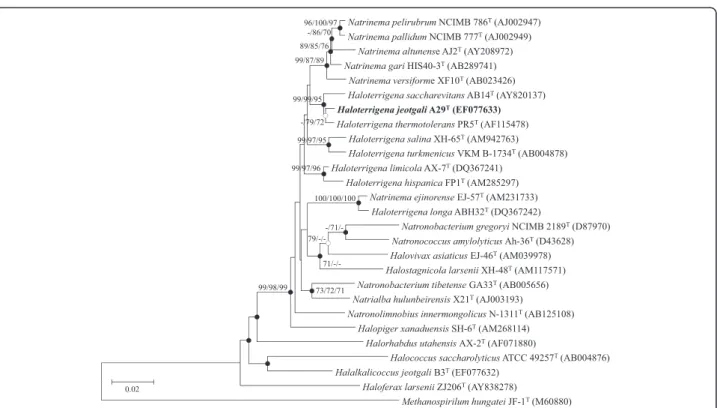
and dendrograms were generated by the neighbor-joining [14], minimum evolution [15], and maximum likelihood [16] methods. A bootstrap analysis investi-gating the stability of the dendrogram was performed by obtaining a consensus tree based on 1,000 randomly generated trees. Strain A29T showed the highest level of the 16S rRNA gene similarity to H. thermotolerans PR5T (99.0 %), H. saccharevitans AB14T (98.3 %), H. limicola AX-7T (97.1 %), H. turkmenica 4kT (96.8 %), H. salinaXH-65T(96.6 %), H. hispanica FP1T (96.1 %), H. longaABH32T (94.9 %), and H. daqingensis JX313T (94.6 %). The DNA-DNA relatedness between strain A29T and the related strains H. thermotolerans PR5T, H. saccharevitans AB14T, and H. limicola AX-7T was 23.2 %, 22.0 %, and 17.9 %, respectively. The 16S rRNA gene sequence similarity data and DNA–DNA related-ness value of less than 70 % [17] suggested that strain A29T represents a distinct genospecies [9] (Table 1).
The consensus phylogenetic tree based on the 16S
rRNA gene sequences indicated that strain A29T was
clustered in a branch with other species of the genus Haloterrigena(Fig. 1).
H. jeotgali A29T is Gram-negative staining,
non-motile, rod-shaped (0.4 μm wide and 1.0 μm long)
(Fig. 2), and grows in irregular clusters. Colonies cul-tured on complex agar medium were light red, circular, and measured 0.5 mm in diameter after 7 days at 37 °C. Growth occurred in the presence of 10–30 % (w/v) NaCl at temperatures ranging from 17–50 °C and in the pH range of 6.5–8.5. Optimal conditions for growth were; a NaCl concentration of 15–20 % (w/v), a temperature ranging from 37–45 °C, and a pH of 7.0–7.5. The isolate was catalase-positive and oxidase-negative and did not reduce nitrate to nitrite. Mg2+ was not required for growth. Cell lysis occurred in distilled water. This strain was able to hydrolyze casein and Tween 80 but not
Table 1 Classification and general features of Haloterrigena jeotgali A29T[19]
MIGS ID Property Term Evidence codea
Classification Domain Archaea TAS [25]
Phylum Euryarchaeota TAS [26]
Class Halobacteria TAS [27,28]
Order Natrialbales TAS [1]
Family Natrialbaceae TAS [1]
Genus Haloterrigena TAS [4]
Species Haloterrigena jeotgali TAS [9]
(Type) strain A29T(KCTC 4020, DSM 18794, JCM 14585, CECT 7218) TAS [9]
Gram stain Negative TAS [9]
Cell shape Rod TAS [9]
Motility Non-motile TAS [9]
Sporulation Not reported
Temperature range 17–50 °C TAS [9]
Optimum temperature 37–45 °C TAS [9]
pH range; Optimum 6.5–8.5; 7.0 − 7.5 TAS [9]
Carbon source Fructose, lactose, acetate TAS [9]
MIGS-6 Habitat Salt-fermented food TAS [9]
MIGS-6.3 Salinity 35 % NaCl (w/v) TAS [9]
MIGS-22 Oxygen requirement Aerobic TAS [9]
MIGS-15 Biotic relationship Free-living TAS [9]
MIGS-14 Pathogenicity Not reported
MIGS-4 Geographic location South Korea TAS [9]
MIGS-5 Sample collection 2006 NAS
MIGS-4.1 Latitude Not reported
MIGS-4.2 Longitude Not reported
MIGS-4.4 Altitude Not reported
a
Evidence codes - TAS: Traceable Author Statement (i.e., a direct report exists in the literature); NAS: Non-traceable Author Statement (i.e., not directly observed for the living, isolated sample, but based on a generally accepted property for the species, or anecdotal evidence). These evidence codes are from the Gene Ontology project [29]
starch, gelatin, urea, or DNA. Anaerobic growth oc-curred in the presence of nitrate but not of sulfate, thio-sulfate, dimethyl sulfoxide, or trimethylamine N-oxide. Fructose, lactose, and acetate—but not sucrose, glucose, citrate, or formate—were utilized as carbon and energy
Fig. 2 Transmission electron micrograph of H. jeotgali A29T. The
scale bar represents 200 nm
Natrinema pelirubrumNCIMB 786T(AJ002947) Natrinema pallidumNCIMB 777T(AJ002949)
Natrinema altunense AJ2T(AY208972) Natrinema gariHIS40-3T(AB289741)
Natrinema versiforme XF10T(AB023426) Haloterrigena saccharevitansAB14T(AY820137) Haloterrigena jeotgali A29T(EF077633) Haloterrigena thermotoleransPR5T(AF115478)
Haloterrigena salinaXH-65T(AM942763) Haloterrigena turkmenicusVKM B-1734T(AB004878) Haloterrigena limicolaAX-7T(DQ367241)
Haloterrigena hispanicaFP1T(AM285297) Natrinema ejinorenseEJ-57T(AM231733) Haloterrigena longaABH32T(DQ367242)
Natronobacterium gregoryiNCIMB 2189T(D87970) Natronococcus amylolyticusAh-36T(D43628) Halovivax asiaticus EJ-46T(AM039978) Halostagnicola larseniiXH-48T(AM117571) Natronobacterium tibetenseGA33T(AB005656) Natrialba hulunbeirensis X21T(AJ003193)
Natronolimnobius innermongolicusN-1311T(AB125108) Halopiger xanaduensisSH-6T(AM268114)
Halorhabdus utahensis AX-2T(AF071880)
Halococcus saccharolyticusATCC 49257T(AB004876) Halalkalicoccus jeotgali B3T(EF077632)
Haloferax larseniiZJ206T(AY838278)
Methanospirilum hungateiJF-1T(M60880) 100/100/100 79/-/-96/100/97 99/97/95 71/-/-99/97/96 89/85/76 99/87/89 99/99/95 73/72/71 99/98/99 0.02 -/86/70 -/79/72
-/71/-Fig. 1 Phylogenetic tree based on the neighbor-joining (NJ) algorithm for the 16S rRNA gene sequences of strain A29Tand closely related taxa. Numbers at the nodes indicate bootstrap values calculated using NJ/minimum evolution (ME)/maximum likelihood (ML) probabilities. Filled and open circles represent nodes recovered by both ME and ML methods or by either method, respectively. Methanospillum hangatei JF-1Tserved as an outgroup
Table 2 Project information
MIGS ID Property Term
MIGS-31 Finishing quality Improved-high-quality draft MIGS-28 Libraries used 300-bp paired end (Illumina);
400-bp single end (Ion Torrent); 10 kb (PacBio RS)
MIGS-29 Sequencing platforms Illumina MiSeq, Ion Torrent PGM, PacBio RS system MIGS-31.2 Fold coverage 700.5×
MIGS-30 Assemblers CLC Genomics Workbench 6.5.1, SMRT Analysis 2.1
MIGS-32 Gene calling method GLIMMER 3.02
Locus Tag HL44 GenBank ID JDTG00000000 GenBank Date of Release June 20, 2014 GOLD ID Gi0069863 BIOPROJECT PRJNA236631
MIGS-13 Source material identifier
A29T
Project relevance Environmental and biotechnological
sources. Acid was not produced from fructose, lactose, acetate, sucrose, glucose, citrate, or formate. Strain A29T was resistant to bacitracin, penicillin, ampicillin, chlor-amphenicol, and erythromycin, but was sensitive to no-vobiocin, anisomycin, and aphidicolin. The major polar lipids were phosphatidylglycerol, phosphatidylglycerol phosphate methyl ester, and mannose-2,6-disulfate(1–2)-glucose glycerol diether [9].
Genome sequencing and annotation
Genome project history
H. jeotgali strain A29Tgenome was sequenced to obtain information regarding mechanism(s) or molecule(s) that confer adaption to a hypersaline environment and to iden-tify the primary structure of potentially novel halophilic enzymes with relatively low similarity to those in the se-quence database. The genome project and sese-quence were
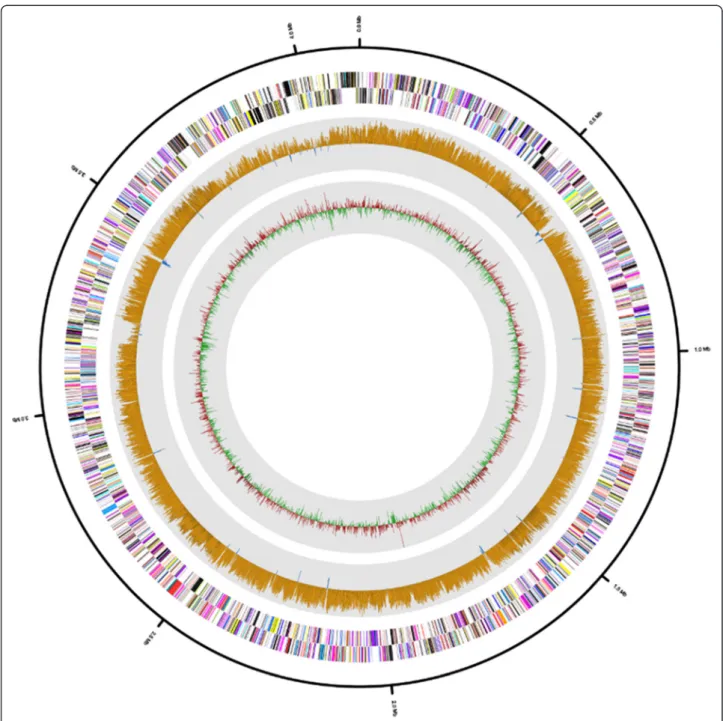
Fig. 3 Graphical circular map of the H. jeotgali A29Tgenome. RNA genes (red, tRNA and blue, rRNA) and genes on the reverse and forward
strands (colored according to COG categories) are shown from the outside to the center. The inner circle shows the GC skew; yellow and blue indicate positive and negative values, respectively. GC content is indicated in red and green
deposited in the Genomes OnLine Database [18] and GenBank (JDTG00000000), respectively. Sequencing and annotation were performed by ChunLab Inc. (Seoul, Korea). Project information and associated MIGS version 2.0 compliance levels [19] are shown in Table 2.
Growth conditions and genomic DNA preparation
H. jeotgaliA29T was grown aerobically in DSM Medium 954 at 37°C. Genomic DNA was extracted and purified using a G-spin™ DNA extraction kit (iNtRON Biotech-nology, Sungnam, Korea) according to the manufac-turer’s instructions.
Genome sequencing and assembly
The genome of H. jeotgali A29T was sequenced from a total of 9,473,809 quality-trimmed sequencing reads (700.5-fold coverage) that combined 6,797,702 reads (473.8-fold coverage) from the Illumina MiSeq. 300 bp paired-end library (Illumina, San Diego, CA, USA); 2,617,102 reads (181.1-fold coverage) obtained using an Ion Torrent Personal Genome Machine (PGM) 318v2 chip (Life Technologies, Carlsbad, CA, USA); and 59,005 reads (45.7-fold coverage) from a PacBio RS 10 kb li-brary (Pacific Biosciences, Menlo Park, CA, USA). Illumina and PGM data were assembled de novo with CLC Genomics Workbench 6.5.1 (CLC bio, Boston, MA, USA) and PacBio data were assembled with the HGAP2 algorithm in SMRT Analysis 2.1 (Pacific Bio-sciences). Resultant contigs were assembled with CodonCode Aligner 3.7 (CodonCode Corporation, Centerville, MA, USA). The final assembly yielded three scaffolds with 20 contigs spanning 4.1 Mb.
Genome annotation
Open reading frames of the assembled genome were pre-dicted using the Integrated Microbial Genomes-Expert Review platform as part of the Joint Genome Institute gen-ome annotation pipeline [20]. Additional gene prediction and functional annotation were achieved using the Rapid Annotation using Subsystem Technology pipeline. Pre-dicted ORFs were compared during gene annotation using NCBI Clusters of Orthologous Groups [21], Pfam [22], and EzTaxon-e [12] databases. rRNA and tRNA genes were identified using RNAmmer 1.2 [23] and tRNAscan-SE 1.23 [24] tools, respectively. Genomic features were visualized with CLgenomics 1.06 (ChunLab Inc.).
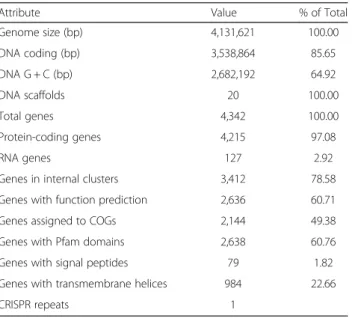
Table 3 Genomic statistics
Attribute Value % of Total
Genome size (bp) 4,131,621 100.00 DNA coding (bp) 3,538,864 85.65 DNA G + C (bp) 2,682,192 64.92 DNA scaffolds 20 100.00 Total genes 4,342 100.00 Protein-coding genes 4,215 97.08 RNA genes 127 2.92
Genes in internal clusters 3,412 78.58
Genes with function prediction 2,636 60.71
Genes assigned to COGs 2,144 49.38
Genes with Pfam domains 2,638 60.76
Genes with signal peptides 79 1.82
Genes with transmembrane helices 984 22.66
CRISPR repeats 1
Table 4 Number of genes associated with general COG functional categories
Code Value % age Description
J 154 6.53 Translation, ribosomal structure, and biogenesis A 1 0.04 RNA processing and modification
K 107 4.54 Transcription
L 129 5.47 Replication, recombination, and repair B 3 0.13 Chromatin structure dynamics D 19 0.81 Cell cycle control, mitosis, and meiosis Y 0 0.00 Nuclear structure
V 31 1.31 Defense mechanisms
T 78 3.31 Signal transduction mechanisms M 69 2.93 Cell wall/membrane biogenesis N 17 0.72 Cell motility
Z 0 0.00 Cytoskeleton
W 0 0.00 Extracellular structures
U 21 0.89 Intracellular trafficking, secretion, and vesicular transport
O 101 4.28 Posttranslational modification, protein turnover, chaperones
C 167 7.08 Energy production conversion G 88 3.73 Carbohydrate transport metabolism E 217 9.20 Amino acid transport metabolism F 66 2.80 Nucleotide transport metabolism H 131 5.56 Coenzyme transport metabolism I 125 5.30 Lipid transport metabolism P 158 6.70 Inorganic ion transport metabolism Q 50 2.12 Secondary metabolites biosynthesis, transport
catabolism
R 400 16.96 General function prediction only S 226 9.58 Function unknown
- 2198 50.62 Not in COGs
Genome properties
The draft genome sequence of H. jeotgali A29T was
4,131,621 bp and comprised three scaffolds including 20 contigs, and had a GC content of 64.9 % (Fig. 3 and Table 3). Of the 4,342 predicted genes, 4,215 were protein-coding and 2,636 ORFs (60.7 %) were assigned putative functions, whereas the remaining genes were annotated as hypothetical proteins. The genome con-tained 127 ORFs assigned to RNA genes, including 47 predicted for tRNA, 14 for rRNA (five 5S, two 16S, and seven 23S), and 66 for miscellaneous RNA (one archaeal signal recognition particle; five for the HgcC family; one archaeal RNA P; and 59 clustered regularly interspaced short palindromic direct repeat elements). The distribu-tion of genes across COG funcdistribu-tional categories is pre-sented in Table 4.
Conclusions
H. jeotgali A29T encoded the genes associated with the mechanisms of salinity tolerance, biosynthesis and trans-port of compatible solutes such as glycine betaine (N,N,N-trimethylglycine) (choline sulfatase, choline dehydrogenase, betaine reductase, and glycine betaine transporter OpuD), ion exclusion using cation (Mg2+and Cu2+) transport and K+ transport and Na+/H+ antiporter systems. The se-quences may contribute to expansion of our knowledge of complex osmoregulation mechanism of the haloarchaea that should facilitate biotechnological applications of the haloarchaea and provide useful information on genetic mechanisms that enable haloarchaea to endure hypersaline environments.
Abbreviations
ME:Minimum evolution; ML: Maximum likelihood; NJ: Neighbor-joining; PGM: Personal Genome Machine.
Competing interests
The authors declare that they have no competing interests.
Authors’ contributions
KJY and HSS carried out the microbial cultivation and DNA isolation. ITC, MHL, SWR, BYK, YJC and DWK participated in the sequence analyses. ITC, MHL and SWR drafted the manuscript. M-JS, J-KR and CY helped to draft the manuscript. SWR and Y-DN conceived of the study and participated in its design. H-JC and J-SC participated in its design and coordination. All authors read and approved the final manuscript.
Acknowledgments
This research was supported by Basic Science Research Program through the National Research Foundation of Korea funded by the Ministry of Science, ICT & Future Planning (2012R1A1A2040922 and 2014R1A1A1002980) and a Korea Basic Science Institute NAP grant (T34780).
Author details
1Biological Disaster Analysis Team, Korea Basic Science Institute, Daejeon 305-806, Republic of Korea.2Division of Bioengineering, Incheon National University, Incheon 406-772, Republic of Korea.3Research Group of Gut Microbiome, Korea Food Research Institute, Sungnam 463-746, Republic of Korea.4ChunLab Inc., Seoul National University, Seoul 151-742, Republic of Korea.5Systems Biology Team, Center for Immunity and Pathology, Korea National Institute of Health, Cheongju 361-951, Republic of Korea.
6Department of Food Science and Engineering, Ewha Womans University, Seoul 120-750, South Korea.7Graduate School of Analytical Science and Technology, Chungnam National University, Daejeon 305-764, Republic of Korea.8World Institute of Kimchi, Gwangju 503-360, Republic of Korea. 9Korea University of Science and Technology, Daejeon 305-350, Republic of Korea.
Received: 22 September 2014 Accepted: 21 July 2015
References
1. Gupta RS, Naushad S, Baker S. Phylogenomic analyses and molecular signatures for the class Halobacteria and its two major clades: a proposal for division of the class Halobacteria into an emended order Halobacteriales and two new orders, Haloferacales ord. nov. and Natrialbales ord. nov. Int J Syst Evol Microbiol. 2015;65:1050–69. 2. Grant WD. Life at low water activity. Philos Trans R Soc Lond B Biol Sci.
2004;59:1249–66.
3. Oren A. Sensitivity of selected members of the family Halobacteriaceae to quinolone antimicrobial compounds. Arch Microbiol. 1996;165:354–8. 4. Ventosa A, Gutierrez MC, Kamekura M, Dyall-Smith ML. Proposal to transfer
Halococcus turkmenicus, Halobacterium trapanicum JCM 9743 and strain GSL-11 to Haloterrigena turkmenica gen. nov., comb. nov. Int J Syst Bacteriol. 1999;49:131–6.
5. Montalvo-Rodriguez R, Lopez-Garriga J, Vreeland RH, Oren A, Ventosa A, Kamekura M. Haloterrigena thermotolerans sp. nov., a halophilic archaeon from Puerto Rico. Int J Syst Evol Microbiol. 2000;50:1065–71.
6. Cui HL, Tohty D, Zhou PJ, Liu SJ. Haloterrigena longa sp. nov. and Haloterrigena limicola sp. nov., extremely halophilic archaea isolated from a salt lake. Int J Syst Evol Microbiol. 2006;56:1837–40.
7. Xu XW, Liu SJ, Tohty D, Oren A, Wu M, Zhou PJ. Haloterrigena saccharevitans sp. nov., an extremely halophilic archaeon from Xin-Jiang, China. Int J Syst Evol Microbiol. 2005;55:2539–42.
8. Romano I, Poli A, Finore I, Huertas FJ, Gambacorta A, Pelliccione S, et al. Haloterrigena hispanica sp. nov., an extremely halophilic archaeon from Fuente de Piedra, southern Spain. Int J Syst Evol Microbiol. 2007;57:1499–503.
9. Roh SW, Nam YD, Chang HW, Kim KH, Sung Y, Kim MS, et al. Haloterrigena jeotgali sp. nov., an extremely halophilic archaeon from salt-fermented food. Int J Syst Evol Microbiol. 2009;59:2359–63.
10. Gutierrez MC, Castillo AM, Kamekura M, Ventosa A. Haloterrigena salina sp. nov., an extremely halophilic archaeon isolated from a salt lake. Int J Syst Evol Microbiol. 2008;58:2880–4.
11. Wang S, Yang Q, Liu ZH, Sun L, Wei D, Zhang JZ, et al. Haloterrigena daqingensis sp. nov., an extremely haloalkaliphilic archaeon isolated from a saline-alkaline soil. Int J Syst Evol Microbiol. 2010;60:2267–71.
12. Kim OS, Cho YJ, Lee K, Yoon SH, Kim M, Na H, et al. Introducing EzTaxon-e: a prokaryotic 16S rRNA gene sequence database with phylotypes that represent uncultured species. Int J Syst Evol Microbiol. 2012;62:716–21.
13. Tamura K, Stecher G, Peterson D, Filipski A, Kumar S. MEGA6: Molecular Evolutionary Genetics Analysis version 6.0. Mol Biol Evol.
2013;30:2725–9.
14. Saitou N, Nei M. The neighbor-joining method: a new method for reconstructing phylogenetic trees. Mol Biol Evol. 1987;4:406–25.
15. Rzhetsky A, Nei M. A simple method for estimating and testing minimum-evolution trees. Mol Biol Evol. 1992;9:945–67.
16. Felsenstein J. Evolutionary trees from DNA sequences: a maximum likelihood approach. J Mol Evol. 1981;17:368–76.
17. Wayne LG, Brenner DJ, Colwell RR, Grimont PAD, Kandler O, Krichevsky MI, et al. International Committee on Systematic Bacteriology. Report of the ad hoc committee on reconciliation of approaches to bacterial systematics. Int J Syst Bacteriol. 1987;37:463–4.
18. Liolios K, Chen IM, Mavromatis K, Tavernarakis N, Hugenholtz P, Markowitz VM, et al. The Genomes On Line Database (GOLD) in 2009: status of genomic and metagenomic projects and their associated metadata. Nucleic Acids Res. 2010;38:346–54.
19. Field D, Garrity G, Gray T, Morrison N, Selengut J, Sterk P, et al. The minimum information about a genome sequence (MIGS) specification. Nat Biotechnol. 2008;26:541–7.
20. Markowitz VM, Mavromatis K, Ivanova NN, Chen IM, Chu K, Kyrpides NC. IMG ER: a system for microbial genome annotation expert review and curation. Bioinformatics. 2009;25:2271–8.
21. Tatusov RL, Galperin MY, Natale DA, Koonin EV. The COG database: a tool for genome-scale analysis of protein functions and evolution. Nucleic Acids Res. 2000;28:33–6.
22. Finn RD, Bateman A, Clements J, Coggill P, Eberhardt RY, Eddy SR, et al. Pfam: the protein families database. Nucleic Acids Res. 2014;42:222–30. 23. Lagesen K, Hallin P, Rodland EA, Staerfeldt HH, Rognes T, Ussery DW.
RNAmmer: consistent and rapid annotation of ribosomal RNA genes. Nucleic Acids Res. 2007;35:3100–8.
24. Lowe TM, Eddy SR. tRNAscan-SE: a program for improved detection of transfer RNA genes in genomic sequence. Nucleic Acids Res. 1997;25:955–64. 25. Woese CR, Kandler O, Wheelis ML. Towards a natural system of organisms: proposal for the domains Archaea, Bacteria, and Eucarya. Proc Natl Acad Sci U S A. 1990;87:4576–9.
26. Garrity GM, Holt JG. Phylum AII. Euryarchaeota phy. nov. In: Boone DR, Castenholz RW, Garrity GM, editors. Bergey’s Manual of Systematic Bacteriology, vol. 2. 2nd ed. New York: Springer; 2001. p. 211.
27. Editor L. Validation List no. 85. Validation of publication of new names and new combinations previously effectively published outside the IJSEM. Int J Syst Evol Microbiol. 2002;52:685–90.
28. Grant WD, Kamekura M, McGenity TJ, Ventosa A. Class III. Halobacteria class nov. In: Boone DR, Castenholz RW, Garrity GM, editors. Bergey’s Manual of Systematic Bacteriology, vol. 2. 2nd ed. New York: Springer; 2001. p. 294–334. 29. Ashburner M, Ball CA, Blake JA, Botstein D, Butler H, Cherry JM, et al. Gene
ontology: tool for the unification of biology. The Gene Ontology Consortium. Nat Genet. 2000;25:25–9.
Submit your next manuscript to BioMed Central and take full advantage of:
• Convenient online submission
• Thorough peer review
• No space constraints or color figure charges
• Immediate publication on acceptance
• Inclusion in PubMed, CAS, Scopus and Google Scholar
• Research which is freely available for redistribution
Submit your manuscript at www.biomedcentral.com/submit
![Table 1 Classification and general features of Haloterrigena jeotgali A29 T [19]](https://thumb-ap.123doks.com/thumbv2/123dokinfo/5084550.75286/2.892.87.813.148.712/table-classification-general-features-haloterrigena-jeotgali-a-t.webp)