O R I G I N A L A R T I C L E
Open Access
Identification and Characterization of
LARGE
EMBRYO, a New Gene Controlling Embryo
Size in Rice (
Oryza sativa L.)
Gileung Lee
1, Rihua Piao
2, Yunjoo Lee
1, Backki Kim
1, Jeonghwan Seo
1, Dongryung Lee
1, Su Jang
1, Zhuo Jin
1,
Choonseok Lee
1, Joong Hyoun Chin
3and Hee-Jong Koh
1*Abstract
Background: Although embryo accounts for only 2–3% of the total weight of a rice grain, it is a good source of various nutrients for human health. Because enlarged embryo size causes increase of the amount of nutrients and bioactive compounds stored within rice grain, giant embryo mutants of rice (Oryza sativa L.) are excellent genetic resources for improving the nutritional value of rice grains.
Results: Three giant embryo mutants, including large embryo (le), giant embryo (ge) and super-giant embryo (ges), with variable embryo size were used in this study. We investigated whether genes controlling embryo size in these mutants (le, ge and ges) were allelic to each other. Although ge and geswas allelic to GIANT EMBRY (GE), le was not allelic to ge and gesin allelism test. The GE gene carried a unique nucleotide substitution in each of the two mutants (ge and ges), resulting in non-synonymous mutations in exon 2 of GE in both mutants. However, the GE gene of the le mutant did not carry any mutation, suggesting that the enlarged embryo phenotype of le was governed by another gene. Using map-based cloning, we mapped the LE gene to the short arm of chromosome 3. The le mutant showed mild enlargement in embryo size, which resulted from an increase in the size of scutellar parenchyma cells. The LE encodes a C3HC4-type RING finger protein and was expressed to relatively high levels in seeds at a late developmental stage. Knockdown of LE expression using RNA interference increased the embryo size of rice grains, confirming the role of LE in determining the embryo size.
Conclusion: Overall, we identified a new gene controlling embryo size in rice. Phenotypic and molecular
characterization results suggest that the le mutant will serve as a valuable resource for developing new rice cultivars with large embryos and nutrient-dense grains.
Keywords: Rice, Large embryo, Giant embryo, C3HC4-type RING finger protein, Nutritional value Background
With an ever-increasing demand for high quality rice (Oryza sativa L.), several attempts have been made to improve the quality of rice (Fitzgerald et al.2009). A ma-ture rice embryo typically accounts for only 2–3% of the total kernel weight, but has enriched various nutrients, such as proteins, lipids, vitamins, minerals, and
phyto-chemicals (Gopala Krishna et al. 1984; Tanaka et al.
1977). The high nutritional content of embryo makes it
popular to use brown rice, polished embryonic rice, and byproduct (bran) generated after polishing.
Breeding efforts to improve the nutritional quality of rice have focused on the induction and isolation of mutants. Various mutants with distinct embryo and endosperm phenotypes have been reported in rice, in-cluding endospermless, embryoless, reduced embryo,
and giant embryo mutants (Satoh and Omura 1981;
Hong et al. 1995). Among these, the giant embryo
mutants have often been used as breeding materials to improve the nutritional value of rice. To date, sev-eral giant embryo rice cultivars have been reported (Maeda et al. 2001; Takahashi et al. 2009; Hong et al. © The Author(s). 2019 Open Access This article is distributed under the terms of the Creative Commons Attribution 4.0
International License (http://creativecommons.org/licenses/by/4.0/), which permits unrestricted use, distribution, and reproduction in any medium, provided you give appropriate credit to the original author(s) and the source, provide a link to the Creative Commons license, and indicate if changes were made.
* Correspondence:[email protected]
1Department of Plant Science and Research Institute for Agriculture and Life
Sciences, and Plant Genomics and Breeding Institute, Seoul National University, Seoul 08826, South Korea
2012; Han et al. 2012). Brown rice of these rice mu-tants contain higher amounts of proteins, lipids, es-sential amino acids, vitamins (B1, B2, and E), minerals
(Ca, Fe, Mg, K, and P), and bioactive compounds [γ-aminobutyric acid (GABA) and γ-oryzanol] than those of wild-type rice cultivars with normal embryo
size (Koh et al. 1993; Zhang et al. 2005; Jeng et al.
2012; Kim et al. 2013).
Until now, only two genes related to the enlargement of embryo size have been identified in rice. GIANT
EMBRYO (GE) was mapped on chromosome 7 (Satoh
and Iwata 1990; Koh et al. 1996), and Nagasawa et al.
(2013) revealed that GE gene encodes CYP78A13, a
cytochrome P450 protein, and functions in determin-ing embryo/endosperm size. The loss-of-function GE exhibits an enlargement of embryo and shrinkage of endosperm. Additionally, GE plays critical role in shoot apical meristem (SAM) maintenance, and GE
overexpression promotes cell proliferation, plant
growth and grain yield (Yang et al.2013). In maize, the insertion of a transposable element in ZmGE2, a homolog of OsGE, has resulted in a reduction in its ex-pression and an increase in the embryo to endosperm
ratio (EER) (Zhang et al. 2012). ZmGE2 encodes a
cytochrome P450 protein of the CYP78A family, and overexpression of OsGE in maize results in a reduction in EER. These results suggest that cytochrome P450 proteins play an important role in regulating embryo size, and the mechanism of EER determination is evo-lutionarily conserved in rice and maize (Zhang et al.
2012). GOLIATH (GO), another gene related to embryo
size, has been mapped to the long arm of chromosome
3 (Taramino et al.2003). Independently identified
mu-tant, plastochron3 (PLA3) is allelic to go mutant. The loss of function PLA3, which encodes glutamate car-boxypeptidase, exhibits pleiotropic phenotypes includ-ing enlarged embryo (caused by an increase in the number of cells), seed vivipary, defects in SAM main-tenance, aberrant leaf morphology (Kawakatsu et al.
2009). Recently, new giant embryo breeding materials
have been reported; these display an enlarged embryo and higher content of triacylglycerol compared with the wild type. The gene responsible for these pheno-types is not allelic to GE and maps to the short arm of
chromosome 3 (Sakata et al.2016).
In this study, we performed allelism tests to deter-mine if genes responsible for the enlarged embryo phenotypes of the embryo mutants, ge, ges, and le, are allelic to each other and identified a new gene con-trolling embryo size. Our results will contribute to understanding genetic regulation of embryo size. Fur-thermore, the series of mutants may facilitate the breeding of embryonic cultivar with high nutritional value.
Results
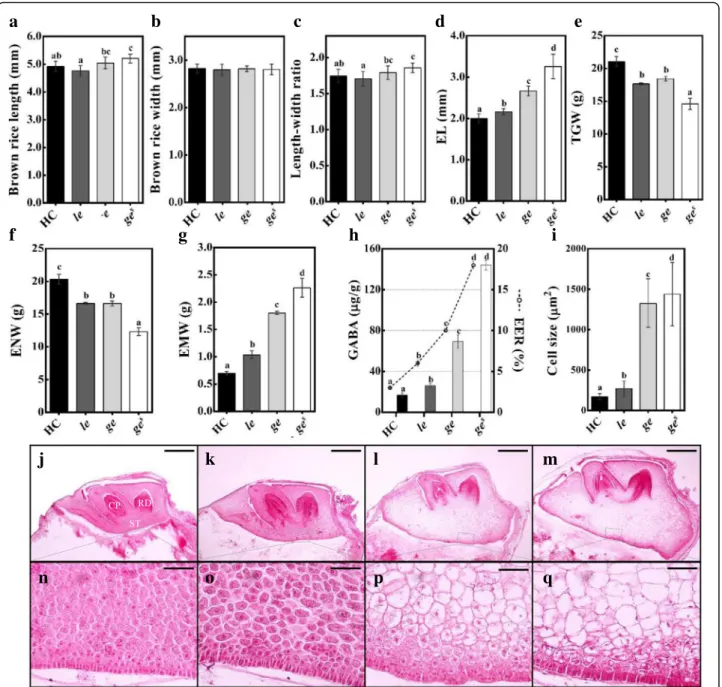
Characterization of Three Giant Embryo Rice Mutants All three mutants exhibited enlarged embryo phenotype compared with Hwacheong (HC). Depending on the em-bryo size, the three giant emem-bryo mutants were designated as le, ge, and ges; the embryo size was relatively smaller in le, larger in ges, and intermediate in ge mutant (Figs.1and
2d). We evaluated the relative embryo size of these mu-tants using the EER, which is defined as the weight of the embryo relative to that of the endosperm. The EER grad-ually increased in the order of le, ge, and gesmutants, and the GABA content of brown rice followed the same trend (Fig.2h). The enlarged embryo phenotype of all mutants resulted from a conspicuous enlargement of scutellar par-enchyma cells (Fig.2i and n-q). In addition to the embryo size, other phenotypes were also investigated. Although none of the giant embryo mutants showed any major de-fects in shoot and radicle differentiation, the shoot size of geand gesmutants was slightly smaller than that of le mu-tant and wild-type HC (Fig.2j-m). Among grain character-istics, the width of mutant rice grains was comparable to that of HC; however, the length and length to width ratio
(LWR) of the ges grains were significantly higher than
those of HC (Fig. 2a-c). The giant embryo mutants
showed significantly lower thousand-grain weight (TGW) and endosperm weight (ENW) but higher embryo weight
(EMW) than HC (Fig. 2e-g). Compared with HC, the ge
and gesmutants showed a dramatic increase in EMW of
157% and 223%, respectively, whereas the le mutant
ex-hibited only a 48% increase in EMW (Fig. 2g). Among
other agronomic traits, culm length (CL), grain width (GW), grain length (GL), and LWR of the le mutant were significantly different from those of HC (Additional file3: Figure S2).
Genetic Analysis of Giant Embryo Mutants
In order to confirm allelism and heredity among genes responsible for enlarged embryo phenotype in three mu-tants, we investigated the segregation ratio of F2 seeds
derived from reciprocal crosses among HC, le, ge, and ges(Table1). Data showed that the embryo phenotype of
F2 seeds derived from reciprocal crosses between each
mutant and HC segregated in a 3: 1 ratio (normal: en-larged), indicating that the enlarged embryo phenotype of each mutant was controlled by a single recessive gene.
Because we previously showed that ges is allelic to ge
(Kim et al. 1992), we inferred that the enlarged embryo
phenotype of ges mutant was induced by a mutation in
GIANT EMBRYO (GE) gene. In reciprocal crosses
be-tween ge and ges, the EL of F1seeds was increased, and
embryos of all F2seeds showed the enlarged phenotype,
suggesting that the ge locus is identical to that of ges (Table 1). On the other hand, F2seeds derived from
giant embryo mutants, ge and ges, showed three different embryo phenotypes with 9:3:4 segregation ratio (normal type: le type: ge/ges type) (Additional file 4: Figure S3), suggesting that LE is not allelic to GE.
Sequencing Analysis ofGE Locus in the Three Giant Embryo Mutants
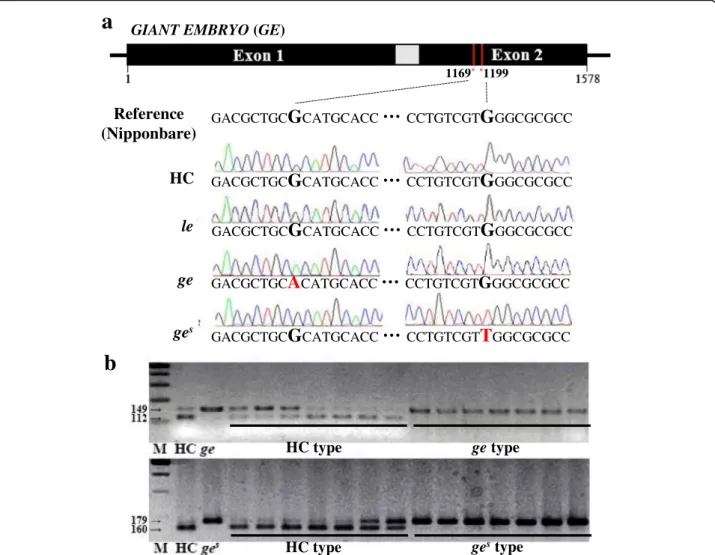
We sequenced the GE locus (Os07g0603700) of all three giant embryo mutants. Data revealed G to A single base change at nucleotide position 1169 in the GE locus of ge mutant, resulting in arginine (Arg) to histidine (His) amino acid substitution at position 390, and G to T sin-gle base change at nucleotide position 1199 in the GE locus of gesmutant, resulting in tryptophan (Trp) to leu-cine (Leu) amino acid substitution at position 400
(Fig. 3a). These mutations co-segregated with the
en-larged embryo phenotype in F2 seeds derived from
crosses between HC and each of these two mutants (ge and ges) (Fig. 3b). However, no nucleotide substitutions were detected in the GE locus of le mutant. Additionally, no genetic polymorphism was present in the PLA3/GO locus of le mutant (data not shown). These data suggest that, while mutations in GE were responsible for the
en-larged embryo phenotypes of ge and ges mutants,
another gene was responsible for the enlarged embryo phenotype of le mutant. These results were consistent with those of our allelism tests described above.
Map-Based Cloning ofLE Gene
To isolate gene responsible for the enlarged embryo phenotype of le mutant, we performed map-based cloning using F2and F3populations derived from a cross
between le mutant and rice cv. Hangangchal1 (Tongil--type). Bulked segregant analysis (BSA) showed that the
LE gene was linked with the InDel marker S03128 on
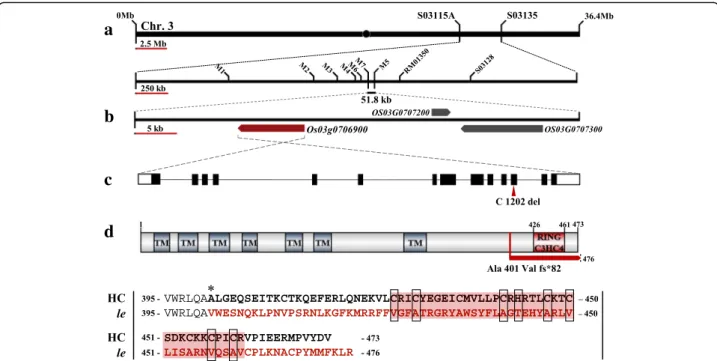
the short arm of chromosome 3. To determine the exact position of LE locus, we developed a new set of InDel markers on the basis of genetic polymorphisms between sequences of indica and japonica rice (http://www.ncbi. nlm.nih.gov/). Using these markers, LE was mapped to an approximately 52-kb region between M7 and M5 markers
(Fig. 4a). Three predicted open reading frames (ORFs)
were located within this candidate region (Fig. 4b), all of which were sequenced in the le mutant and HC. Sequence analysis revealed the deletion of a single nucleotide‘C’ at position 1202 in exon 12 of the locus Os03g0706900 in le
mutant (Fig.4c). This locus encodes a C3HC4-type RING
finger protein. The deletion of ‘C’ at position 1202 was Fig. 1 Grain and embryo phenotypes of HC and giant embryo mutants. Images from left to right are of HC, le, ge, and gesin this order.
predicted to cause frameshift mutation and termination
of the ORF after 82 aberrant amino acids (Fig. 4d and
Additional file5).
To perform co-segregation analysis, we developed a
derived cleaved amplified polymorphic sequences
(dCAPS) marker. The dCAPS genotype of F2individuals
co-segregated with the enlarged embryo phenotype of
the F3 seeds type. These data showed that the deletion
of C base at nucleotide position 1202 of the locus
Os03g0706900 was responsible for the enlarged embryo
phenotype of le mutant (Additional file6). To determine whether this mutant variation is present as a natural variation in the rice germplasm, we genotyped the Os03g0706900 locus in 12 O. sativa cultivars (six japon-ica, two tongil-type, and four indica) and one O. nivara accession using the dCAPS marker. However, none of
a
b
c
d
e
f
j
k
l
m
g
h
i
n
o
p
q
Fig. 2 Characterization of phenotypic traits of rice grains and embryos of HC and giant embryo mutants. a-i Evalucation of various seed characters. Brown rice length (a), width (b), and LWR (c); Embryo length (EL) (d); Thousand-grain weight (TGW) (e); Endosperm weight (ENW, 1000 seeds) (f); Embryo weight (EMW, 1000 seeds) (g); GABA content of EER (h); Size of scutellar parenchyma cells (i). j-q Longitudinal sections of embryo at 20 days after pollination (DAP): wild type (j and n), le (k and o), ge (l and p), and ges(m and q). CP, coleoptiles; RD, radicle; ST,
scutellum (n-q). The means followed by lowercase letters indicate statistically significant difference (p < 0.05, ANOVA) according to Duncan test. Error bars indicate ± s.d. of replicates. Scale bars = 0.5 mm (j-m), Scale bar = 50μm (n-q)
these rice genotypes harbored the mutation present in the Os03g0706900 locus of le mutant (Additional file 6). Therefore, we focused on Os03g0706900 as a candidate for LE.
Effect ofLE Knockdown on Embryo Size
To confirm whether the LE gene regulates embryo size in rice, we used dsRNA-mediated interference (RNAi) to knockdown the expression of LE in the japonica cv.
Dongjin. The embryo size of RNAi T1-plant grains was
significantly bigger than that of wild-type grains (Fig. 5a and c). Quantitative real time PCR (qRT PCR) analysis using leaf samples revealed that the expression of LE gene in RNAi T1plants was significantly lower than that
in wild-type (Fig.5c), indicating that LE controls embryo size in rice.
Expression Pattern ofLE
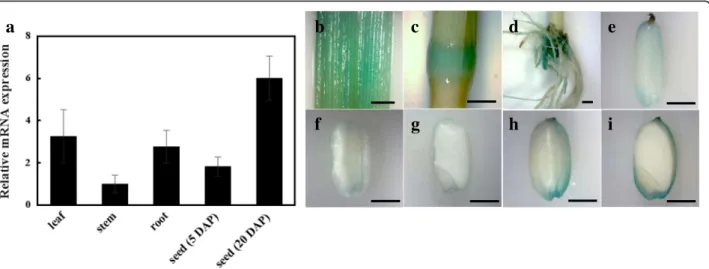
We conducted qRT PCR analysis to monitor the expres-sion of LE in various organs, including leaves, stems, roots, and seeds (Fig.6). LE was expressed in all organs in
HC (Fig. 6a). The expression of LE in stems was lower
than that in leaves and roots. In seeds, the expression level of LE was much lower at 5 DAP than at 20 DAP, indicat-ing that the expression of LE increases as seeds mature
(Fig. 6a). We also performed β-glucuronidase (GUS)
staining experiments using transgenic rice plants expressing GUS reporter under the control of LE gene promoter (proLE::GUS). GUS staining data were consistent with the results of qRT PCR analysis (Fig.
6b-i). GUS expression was observed in all organs,
in-cluding leaves, stems, roots, and seeds (Fig. 6b-i),
and the expression of GUS in seeds increased over
time (Fig. 6f-i). Interestingly, GUS staining data
showed that LE is expressed in the outer part of rice seed (Fig. 6g and i).
Discussion
In this study, we performed map-based cloning to iden-tify the LE gene responsible for the enlarged embryo phenotype of the rice le mutant. We showed that LE is not allelic to GE. Although LE was mapped to the same
chromosome with GO (Kawakatsu et al. 2009) and new
giant embryolocus (Sakata et al.2016), the candidate re-gion of LE locus was far from the position of GO and the other locus. RNAi transgenic approach confirmed that LE, Os03g0706900, is the gene responsible for the large embryo in the le mutant.
The LE protein consists of 473 amino acid residues with a C3HC4-type RING finger domain at the C-terminus and seven transmembrane motifs at the N-terminus predicted using TMHMM server v. 2.0 (http://www.cbs.dtu.dk/services/TMHMM/) (Additional file 5). Multiple sequence alignment of LE orthologs re-vealed that the amino acid sequence of the predicted transmembrane motifs and the consensus sequence of
RING finger domain (Cys-×2-Cys-X11-Cys-X-His-X3
-Cys-×2-Cys-X6-Cys-X2-Cys) were highly conserved
across monocots and dicots. However, the consensus se-quence of LE in le mutant was highly dissimilar because of the frameshift generated by the single nucleotide dele-tion. (Fig. 4d and Additional file 5). These results indi-cate that the functional role of LE orthologs is conserved in plants and is dependent on the C3HC4-type RING finger domain. The sequence of LE is identical to that of
OsRHC1cloned and characterized previously (Cheung et
al.2007). OsRHC1 is differentially expressed in bacterial blight resistant near-isogenic lines (NILs) containing Table 1 Segregation of F2seeds derived from the reciprocal crosses among HC and three giant embryo mutants
Cross combination EL of F1
seed (mm)
Number of different embryo type Expected ratio x2 p-value
nor le ge ges HC/le 2.10a 299 99 – – 3:1 0 1 le/HC 260 100 – – 3:1 1.34 0.25 HC/ge 2.16a 348 – 134 – 3:1 1.87 0.17 ge/HC 269 – 83 – 3:1 0.31 0.58 HC/ges 2.12a 246 – – 76 3:1 0.27 0.61 ges/HC 265 – – 84 3:1 0.12 0.73 le/ge 2.15a 177 64 71 – 9:3:4 1.16 0.56 ge/le 145 48 63 – 9:3:4 0.02 0.99 le/ges 2.21a 178 60 – 78 9:3:4 0.02 0.99 ges/le 160 51 – 63 9:3:4 0.67 0.72 ges/ge 3.12b – – 296 117 3:1 2.27 0.13 ge/ges – – 106 45 3:1 1.61 0.2
Xa14or Xa23 as well as in NILs susceptible to bacterial blight (Cheung et al.2007). Additionally, transgenic Ara-bidopsis plants overexpressing OsRHC1 are more resist-ant to bacterial pathogens than wild-type Arabidopsis
(Ma et al. 2009). In rice, the function of C3HC4-type
RING finger proteins is not well understood. To date, only a few C3HC4-type RING finger proteins have been reported in rice, including OsCOP1, OsCOIN1, and OsXB3; these are involved in photomorphogenesis, abi-otic stress tolerance, and disease resistance, respectively (Tsuge et al. 2001; Liu et al. 2007; Wang et al. 2006). However, there is no report that C3HC4-type RING fin-ger protein is involved in embryo morphology and devel-opment in rice. By contrast, the function of C3HC4-type RING finger proteins in Arabidopsis is well character-ized, and several genes encoding C3HC4-type RING fin-ger proteins have been identified, including AtCOP1 and AtCIP8 (photomorphogenesis) (von Arnim and Deng
1993; Hardtke et al. 2002), AtTED3 (light signaling)
(Pepper and Chory 1997), AtPEX10 and AtPEX12
(per-oxisome biogenesis) (Schumann et al. 2003; Fan et al.
2005), AtXBAT32 (root development), and AtSDIR1
(stress tolerance) (Zhang et al. 2007). Among these,
AtPEX10 and AtPEX12 contain two transmembrane helices and a C3HC4-type RING finger domain, which are similar in sequence to those of LE. Both AtPEX10 and AtPEX12 are required for peroxisome biogenesis, and their dysfunction leads to lethality at the heart stage of embryogenesis.
Both transmembrane motifs at the N-terminus and a C3HC4-type RING domain at the C-terminus predicted
were considered essential for the function and
localization of LE protein. Amino acid sequences of LE orthologs were highly conserved among monocots and dicots. ZmZF13, a maize ortholog of OsLE, has been previously identified from a cDNA library obtained from
developing maize seeds (Wang et al. 2010). There is,
however, no published information on the functions of
HC type ge type HC type gestype
b
GACGCTGCG
CATGCACC···
CCTGTCGTG
GGCGCGCC GACGCTGCG
CATGCACC···
CCTGTCGTG
GGCGCGCC GACGCTGCG
CATGCACC···
CCTGTCGTG
GGCGCGCC GACGCTGCA
CATGCACC···
CCTGTCGTG
GGCGCGCC GACGCTGCG
CATGCACC···
CCTGTCGTT
GGCGCGCCReference
(Nipponbare)
HC
le
ge
ge
sGIANT EMBRYO (GE)
1169* *1199
a
Fig. 3 Sequence analysis of the GE locus. a Identification of mutations in GE locus. b Co-segregation test of mutation point and enlarged embryo phenotype in F2seeds derived from HC/ge and HC/gescrosses
these LE orthologs, except for pathogen defense of OsRHC1. Therefore, further studies are needed to under-stand the mechanism of action of LE, and its regulation of embryo size in rice grains.
With the increase in the embryo size of giant em-bryo mutants (le < ge < ges), the GABA content of brown rice also increased by 150%, 400%, and 850% compared with wild type, respectively. In addition to
GABA content, other nutrients and micronutrients such as protein, lipid, vitamin B1 and vitamin E were
also higher in ges and le mutant compared to normal
rice (Koh et al. 1993; Kim and Kim 2013; Chung et
al. 2014a). Giant embryo mutants with high nutri-tional content are very useful breeding materials to improve the nutritional value of rice. Therefore, the creation and discovery of new genetic variation
a
b
c
Fig. 5 Comparison of embryo phenotype and LE expression between RNAi transgenic plant and wild type (Dongjin). a Seed phenotype of WT and RNAi plants. b Comparison of embryo length between WT and RNAi plants. c Relative expression of LE (normalized to UBIQUITIN) in WT and RNAi plants. Error bars indicate ± s.d. of three replicates. Asterisks represent significant difference, as determined by a two-tailed Student’s t-test (*, p < 0.05; **, p < 0.01). Scale bar = 1 mm
a
b
c
d
Fig. 4 Map based cloning of the LE gene. a Schematic diagram of mapping of LE locus. b Candidate ORFs in delimited candidate region. c LE gene structure and splicing pattern. Black lines, white solid boxes, and black solid boxes indicate intron, UTRs, and exons, respectively. The mutation position is marked with red arrow head. d LE protein structure and comparison of amino acid sequence of the frameshift region between the HC and le mutant. Asterisk represents the location of amino acid substitution caused by one base deletion in le mutant. Amino acids in the region of frameshift (fs) are indicated in red. Red background and black open boxes indicate amino acid sequences of RING C3HC4 domain and conserved residues in the domain
controlling embryo size is very important for breed-ing cultivars with high nutritional value. We used our three giant embryo mutants to breed high nutri-tional rice cultivar and had registered four cultivars to plant variety protection national list in Korea (soe-nong8 and seonong16 derived from ge; seonong14 derived from ges; seonong17 derived from le).
Enlarged embryo size and easy embryo detachment are desirable traits of rice cultivars used for bran or bran oil production. However, High EER giant embryo
mutants such as ge and ges are can’t be used to
in-crease the nutritional value of milled or polished rice, because most of the embryo are separated from the rice grain during the milling process. Therefore, most of giant embryo rice cultivars are supplied as unpol-ished rice (brown rice) to customers. On the other hand, seonong17, a cultivar derived from le mutant with relatively low EER, showed 88% of embryo re-sidual rate with developed milling process (Kim and
Kim 2013). This result implicates that the le mutant,
with mildly enlarged embryo, is expected to serve as an appropriate breeding material for improving the nu-tritional quality of milled rice because large part of embryo remain attached to the endosperm even after milling.
Generally, giant embryo mutants exhibit problematic germination and seedling growth. For example, the go mutant shows pleiotropic phenotypes, including vivipar-ous seed, shortened plastochron, and conversion of pan-icle primary branches to vegetative shoots, in addition to
the enlarged embryo phenotype (Kawakatsu et al.2009).
Similarly, the ge mutant shows abnormal seedling growth characterized by the production of malformed
leaves and dwarfism, which eventually result in death
(Yang et al. 2013). By contrast, the le mutant showed
normal germination rate and seedling emergence (data not shown). Besides, Seonong17 is effective in lowering body fat and has high hypolipidemic and antioxidant ac-tivities (Chung et al. 2014b, 2016). These observations suggest that the le mutant is a highly valuable genetic re-source for improving the nutritional quality of rice.
Overall, we identified a new gene, LE, responsible for the enlarged embryo phenotype of the le mutant of rice, and characterized the potential of the le mutant as a breeding material. The embryo of le mutant was only
mildly enlarged comparing to the embryos of ge and ges
mutants. LE encodes a C3HC4-type RING finger pro-tein, expecting new molecular mechanism to control embryo size. Although further investigations are needed to understand the function of LE, this study provides novel insights into the genetic mechanism of embryo de-velopment in rice and introduces new breeding material for high nutritional rice cultivars with large embryos.
Conclusion
The rice le mutant showed a mild enlargement of em-bryo and increased GABA content compared with wild type. Through allelism tests and sequence analysis, we showed that the enlarged embryo phenotype of le mu-tant was not controlled by previously reported genes regulating embryo size but by LE, a new gene controlling embryo size. The LE gene encodes a C3HC4-type RING finger protein. The disruption of the RING domain led to the enlargement of embryo size, possibly due to the increase in size of scutellar parenchyma cells. LE was
a
b
c
d
e
f
g
h
i
Fig. 6 Tissue-specific RNA expression pattern of LE. a qRT-PCR analysis of LE gene in leaf, stem, root and seed (5 and 20 DAP). b-i GUS expression pattern of various tissues in ProLE:GUS transgenic line [leaf (b); stem (c); root (d); seed at 5 DAP (e); seed at 10 DAP (f and g); seed at 20 DAP (h and i)]. Error bars indicate ± s.d. of replicates. Scale bars = 2 mm
highly expressed during the late stage of seed develop-ment. These results extend our understanding of embryo development in rice and facilitate the breeding of new giant embryo rice cultivars.
Methods
Plant Materials
Three giant embryo mutants were generated from a
fertil-ized egg cell of japonica cv. HC treated with
N-methyl-N-nitrosourea and designated as le, ge, and ges, in ascending order of embryo size (Kim et al.1991,1992; gemwhich is nomenclature of the mutant least altered em-bryo size was renamed as le to avoid confusion with alleles of GE gene). Wild-type japonica cv. HC was used as a control in phenotype analysis. The F2seeds derived from a
cross between le mutant and HC were used to calculate the segregation ratio. Map-based cloning was conducted using F2and F3populations derived from a cross between
le mutant and cv. Hangangchal1 (Tongil-type). All plant
materials were grown under normal cultivation conditions in the experimental paddy field of the Seoul National Uni-versity, Suwon, Korea.
Phenotypic Analysis
Dimensions of rice grains were measured from images captured under a microscope with HD’MEASURE soft-ware (HANA Vision, Korea). To measure ENW, EMW, and EER, embryos and endosperms were dissected from husked seeds (14% water content) and weighed separ-ately using an electronic balance (CAS, USA). Agro-nomic traits such as days to heading (DTH), culm length (CL), panicle length (PL), panicle number (PN), spikelet number per panicle (SPP), and spikelet fertility (SF) were also measured to compare morphological differences be-tween HC and giant embryo mutants. All phenotypic data collected from HC and mutants were statistically analyzed using IBM SPSS Statistics software version 24 (IBM, USA).
Histological Analysis
Seeds of HC and giant embryo mutants harvested at 20 DAP were fixed in formalin-acetic acid-alcohol (FAA) fixative (3.7% formaldehyde, 5% acetic acid, and 50% ethanol) for 24 h at 4 °C. Seeds were dehydrated by soak-ing them in a series of ethanol solutions of increased concentration for 2 h per each solution. After final dehy-dration using 100% ethanol, seeds were cleaned using a series of cleaning solution with progressively decreasing ethanol concentration and increasing concentration of histoclear, followed by soaking in 100% histoclear solu-tion overnight. For paraffin infiltrasolu-tion, Paraplast® (Sigma, USA) was gradually added to histoclear solution at 60 °C. Finally, seeds were stored in 100% melted paraf-fin for 24 h at 60 °C. The parafparaf-fin-infiltrated samples
were embedded in an embed block and cut into 10μm
sections with an HM 340 E Rotary Microtome (Microm Lab, Germany). The sections were stained with 1% safra-nin O solution (1% safrasafra-nin O and 30% ethanol) and ex-amined under CX31 Microscope (Olympus, Japan). Quantification of GABA Content
Fifty milligrams of finely ground brown rice powder was homogenized with 1 ml of 0.01 N HCl prepared in 25% acetonitrile and centrifuged at 13,000 rpm for 3 min. The supernatant was filtered through a 0.2μm syringe filter. The clear supernatant was derivatized using EZ:FAAST Kit (Phenomenex, USA) and subjected to gas chroma-tography (GC) using a GC-2010 gas chromatograph (GC-2010, Japan) equipped with a flame ionization de-tector (FID) and a ZB-5 capillary column (30 m × 0.25
mm; 0.25μm diameter) for the analysis of GABA. Each
sample was tested four times. Allelism Test and Sequence Analysis
F1and F2seeds derived from reciprocal crosses among
HC, and each of the three mutants, le, ge, and ges, were
used for genetic analysis. F2 seeds produced from each
cross were classified according to the embryo size, and chi-square (χ2
) test was performed to detect statistically significant differences. Two overlapping DNA fragments
spanning the GE ORF (Nagasawa et al. 2013) were PCR
amplified and sequenced with ABI Prism 3730 XL DNA Analyzer (PE Applied Biosystems, USA). The sequences of HC and three giant embryo mutants were aligned
using CodonCode Aligner software (CodonCode
Corporation, USA) and analyzed. Co-segregation test was conducted to detect SNP using CAPS and dCAPS markers (Additional file1: Table S1).
Map-Based Cloning ofLE
F2 seeds derived from a cross between le mutant and
Hangangchal 1 were classified into mutant type and wild
type based on the embryo size. Twenty mutant type F2
seeds and 20 wild type F2seeds were selected to prepare
DNA bulks. Mutant and wild DNA bulks were subjected to BSA using 66 sequence-tagged-site (STS) markers (Michelmore et al.1991; Chin et al.2007). For fine
map-ping the LE gene, 397 F2 and 857 F3 plants were used,
and seven new STS markers were designed using Pri-mer3 version 0.4.0 (http://bioinfo.ut.ee/primer3-0.4.0) based on polymorphisms between sequences of indica
and japonica rice (https://blast.ncbi.nlm.nih.gov and
http://gramene.org). Primer sequences used in this study are listed in Additional file1: Table S1.
Candidate Gene Analysis
To identify nucleotide polymorphisms in candidate genes, DNA fragments of genes were PCR amplified
from HC and le mutant using gene-specific primers (Additional file 1: Table S1) and purified using Gel & PCR Purification Kit (Inclone, Korea). The purified PCR products were cloned into pGEM-T Easy vector (Promega, USA) and transformed into Escherichia coli strain DH5α. Plasmid DNA was isolated from the trans-formed colonies using Plasmid MiniPrep Kit (Inclone, Korea) and sequenced using an ABI Prism 3730 XL DNA Analyzer (PE Applied Biosystems, USA). DNA se-quencing data were aligned using CodonCode Aligner software (CodonCode Corporation, USA).
Multiple Sequence Alignment and Phylogenetic Analysis The amino acid sequences with high similarity to LE were
downloaded from the Universal Protein Resource
(UniProt, http://www.uniprot.org). Multiple sequence
alignment was carried out using Probcons, and back-ground color shading was applied with Jalview using the percent identity scheme. Details of protein sequences used in this study are provided in Additional file 2: Figure S1. Transmembrane motifs were predicted using TMHMM server v. 2.0 (http://www.cbs.dtu.dk/services/TMHMM/). RNA Extraction and qRT-PCR Analysis
Total RNA was extracted from leaf, stem, and root tis-sues collected at heading time, and from seeds 5 and 20 DAP, using Hybrid-R™ RNA Purification Kit (GeneAll, Korea). All RNA samples were treated with RNase-free
Recombinant DNase Ι (Takara Bio, Japan) to eliminate
genomic DNA contamination. First-strand cDNA was
synthesized using M-MLV reverse transcriptase
(Promega, USA). qRT-PCR was performed using SYBR
Premix Ex Taq (Takara, Japan) on a CFX96™ Real-Time
PCR Detection System (Bio-Rad, USA), according to the manufacturer’s instructions. Primers used for qRT-PCR analysis are listed in Additional file1: Table S1. Expres-sion levels of LE were normalized relative to UBIQUI-TIN5, a housekeeping gene.
GUS Staining
GUS staining was carried out as previously described
(Jefferson et al. 1987). The GUS staining solution was
vacuum-infiltrated into various organ samples for 10 min. All samples were submerged in the staining solu-tion and incubated overnight at 37 °C. This was followed by incubation in 90% ethanol overnight at room temperature to bleach the chlorophyll.
Vector Construction and Transformation
For the generation of RNAi and proLE::GUS transgenic plants, the 3′ untranslated region (3′ UTR; + 6925 to + 7215 bp) and promoter region (− 2135 to − 1 bp) of LE were PCR amplified and cloned into pH7GWIWG2(II) and pHGWFS7, respectively, using Gateway® BP and LR
Clonase™ II enzyme mixes (Invitrogen, USA). The final constructs were introduced into the japonica cv. Dong-jin via Agrobacterium-mediated transformation using the
strain LBA4404 as described (Nishimura et al. 2007)
with slight modifications. Primers used for cloning PCR products are listed in Additional file1: Table S1.
Additional files
Additional file 1:Table S1. Agronomic traits of HC three giant embryo mutants. DTH, days to heading; CL, culm length; PL, panicle length; PN, panicle number; SPP, spikelet per panicle; SF, spikelet fertility; GL, grain length; GW, grain width; LWR, length-width ratio. The means followed by lowercase letters are significantly different (p < 0.05, ANOVA) according to Duncan test. (XLSX 10 KB)
Additional file 2:Figure S1. Types of segregated F2seed derived from
cross-combinations of le/ge (a) and le/ges(b). (PDF 96 KB)
Additional file 3:Figure S2. Multiple sequence alignment of LE orthologs. Asterisk represents the location of amino acid substitution caused by one base deletion in le mutant. Substituted amino acid residues by frameshift are highlighted by red background shading. Predicted transmembrane motifs and the C3HC4-type RING finger domain are underlined with blue and red lines, respectively. Conserved residues in the C3HC4-type RING finger domain are enclosed within black open boxes. Os, Oryza sativa; Ta, Triticum aestivum; Hv, Hordeum vulgare; Zm, Zea mays; At, Arabidopsis thaliana; Br, Brassica rapa; Gm, Glycine max. (PDF 531 KB)
Additional file 4:Figure S3. Co-segregation test on F2individuals and
various rice genotypes. a Co-segregation test on F2individuals derived
from the cross between HC/le mutant. b Co-segregation test on other varieties and O.nivara. 1, Hwacheong; 2, Hwaseonchal, 3. Ilpum, 4. Unkwang, 5. Hapcheon, 6. Nipponbare, 7. Dasan, 8. Hangangchal 1ho, 9. IR36, 10. IR64, 11. IR56, 12. IR21015, 13. O.nivara. (PDF 23 KB)
Additional file 5:Information of the primers used in this study. (XLSX 11 KB)
Additional file 6:Information of LE orthologs used in multiple sequence alignment. (XLSX 9 KB)
Abbreviations
BSA:Bulked segregant analysis; CL: Culm length; DAP: Days after pollination; EER: Embryo to endosperm ratio; EL: Embryo length; EMW: Embryo weight; ENW: Endosperm weight; GE: Giant embryo; GL: Grain length; GUS: β-glucuronidase; GW: Grain width; HC: Hwacheong; LE: Large embryo; LWR: Length to width ratio; NILs: Near-isogenic lines; ORF: Open reading frame; qRT PCR: Quantitative real time PCR; RNAi: dsRNA-mediated interference; TGW: Thousand-grain weight
Acknowledgements
We thank Dr. Joohyun Lee (Konkuk University) for kind advice on map-based cloning of LE gene.
Funding
This study was supported by a grant from the Next-Generation BioGreen 21 Program (No. PJ013165) of the Rural Development Administration, Korea. Availability of Data and Materials
All data supporting the conclusions of this article are provided within the article and its additional files (Additional file3: Table S1, Additional file4: Figure S1, Additional file5: Figure S2, Additional file6: Figure S3, Additional file1: Table S2. Additional file2: Table S3, respectively).
Authors’ Contributions
GL designed and performed the experiments, and wrote the manuscript. RP, YL and BK provided assistance and advice on experiments. JS, DL, SJ, and ZJ provided assistance on the experiments. CL and JHC improved the manuscript.
HJK supervised the research and improved the manuscript. All authors reviewed the manuscript. All authors read and approved the final manuscript. Ethics Approval and Consent to Participate
Not applicable. Consent for Publication Not applicable. Competing Interests
The authors declare that they have no competing interests.
Publisher’s Note
Springer Nature remains neutral with regard to jurisdictional claims in published maps and institutional affiliations.
Author details
1Department of Plant Science and Research Institute for Agriculture and Life
Sciences, and Plant Genomics and Breeding Institute, Seoul National University, Seoul 08826, South Korea.2Rice Research Institute, Jilin Academy of Agricultural Sciences, Gongzhuling 136100, Jilin, China.3Graduate School
of Integrated Bioindustry, Sejong University, 209, Neungdong-ro, Gwangjin-gu, Seoul 05006, South Korea.
Received: 8 November 2018 Accepted: 11 March 2019
References
Cheung M-Y, Zeng N-Y, Tong S-W, Wing-Yen Li F, Zhao K-J, Zhang Q, Sai-Ming Sun S, Lam H-M (2007) Expression of a RING-HC protein from rice improves resistance to Pseudomonas syringae pv. Tomato DC3000 in transgenic Arabidopsis thaliana. J Exp Bot 58(15–16):4147–4159
Chin JH, Kim JH, Jiang W, Chu SH, Woo MO, Han L, Brar D, Koh HJ (2007) Identification of subspecies-specific STS markers and their association with segregation distortion in rice (Oryza sativa L.). J Crop Sci Biotechnol 10(3):175–184 Chung SI, Kim TH, Rico CW, Kang MY (2014a) Effect of instant cooked giant
embryonic rice on body fat weight and plasma lipid profile in high fat-fed mice. Nutrients 6(6):2266
Chung SI, Lo LMP, Nam SJ, Jin X, Kang MY (2016) Antioxidant capacity of giant embryo rice Seonong 17 and Keunnunjami. J Adv Agric Technol 3:94–98 Chung SI, Rico CW, Lee SC, Kang MY (2014b) Hypolipidemic and body fat–
lowering effects of giant embryo brown rice (Seonong 17 and Keunnunjami) in high-fat-fed mice. Cereal Chemistry J 91(1):18–22
Fan JL, Quan S, Orth T, Awai C, Chory J, Hu JP (2005) The Arabidopsis PEX12 gene is required for peroxisome biogenesis and is essential for development. Plant Physiology 139(1):231–239
Fitzgerald MA, McCouch SR, Hall RD (2009) Not just a grain of rice: the quest for quality. Trends Plant Sci 14(3):133–139
Gopala Krishna AG, Prabhakar JV, Sen DP (1984) Effect of degree of milling on tocopherol content of rice bran. J Food Sci Technol 21(4):222–224 Han SJ, Kwon SW, Chu S-H, Ryu SN (2012) A new rice variety‘Keunnunjami’, with
high concentrations of Cyanidin 3-glucoside and Giant embryo. Korean J Breed Sci 44(2):185–189
Hardtke CS, Okamoto H, Stoop-Myer C, Deng XW (2002) Biochemical evidence for ubiquitin ligase activity of the Arabidopsis COP1 interacting protein 8 (CIP8). Plant J 30(4):385–394
Hong H-C, Kim Y-G, Choi Y-H, Yang S-J, Lee K-S, Lee J-H, Jung O-Y, Yang C-I, Cho Y-C, Choi I-S, Baek M-K, Kim M-K, Yea J-D, Hwang H-G, Roh J-H, Kim S-L, Choi H-C, Lee Y-T, Lee S-H (2012) A Medium-Maturing, Giant-embryo, and Germination Brown Rice Cultivar‘Keunnun’. Korean J Breed Sci 44(2):160–164 Hong S-K, Aoki T, Kitano H, Satoh H, Nagato Y (1995) Phenotypic diversity of 188
rice embryo mutants. Dev Genet 16(4):298–310
Jefferson RA, Kavanagh TA, Bevan MW (1987) GUS fusions: beta-glucuronidase as a sensitive and versatile gene fusion marker in higher plants. EMBO J 6(13):3901 Jeng TL, Shih YJ, Ho PT, Lai CC, Lin YW, Wang CS, Sung JM (2012)γ-Oryzanol,
tocol and mineral compositions in different grain fractions of giant embryo rice mutants. J Sci Food Agric 92(7):1468–1474
Kawakatsu T, Taramino G, Itoh J-I, Allen J, Sato Y, Hong S-K, Yule R, Nagasawa N, Kojima M, Kusaba M, Sakakibara H, Sakai H, Nagato Y (2009) PLASTOCHRON3/ GOLIATH encodes a glutamate carboxypeptidase required for proper development in rice. Plant J 58(6):1028–1040
Kim DD, Kim TH (2013) Manufacturing method of aseptic packing cooked Rice using specialty Rice with embryo buds. KR patent, pp 10–1545056 Kim JY, Seo WD, Park DS, Jang KC, Choi KJ, Kim SY, Oh SH, Ra JE, Yi G, Park SK,
Hwang UH, Song YC, Park BR, Park MJ, Kang HW, Nam MH, Han SI (2013) Comparative studies on major nutritional components of black waxy rice with giant embryos and its rice bran. Food Sci Biotechnol 22(1):121–128 Kim KH, Heu MH, Park SZ, Koh H-J (1991) New mutants for endosperm and
embryo characters in Rice. Korean J Crop Sci 36(3):197–203
Kim KH, Park SZ, Koh HJ, Heu MH (1992) New mutants for endosperm and embryo characters in rice: two dull endosperms and a giant embryo. Proc SABRAO Int Symp‘Impact of Biological Research on Agricultural Productivity:125–131 Koh H, Won Y, Heu M, Park S (1993) Nutritional and agronomic characteristics of
super-giant embryo mutant in rice. Korean J Crop Sci 38(6):537–544 Koh HJ, Heu MH, McCouch SR (1996) Molecular mapping of the ge (s) gene
controlling the super-giant embryo character in rice (Oryza sativa L.). Theor Appl Genet 93(1–2):257–261
Liu K, Wang L, Xu Y, Chen N, Ma Q, Li F, Chong K (2007) Overexpression of OsCOIN, a putative cold inducible zinc finger protein, increased tolerance to chilling, salt and drought, and enhanced proline level in rice. Planta 226(4):1007–1016
Ma K, Xiao J, Li X, Zhang Q, Lian X (2009) Sequence and expression analysis of the C3HC4-type RING finger gene family in rice. Gene 444(1–2):33–45 Maeda H, Nemoto H, Iida S, Ishii T, Nakagawa N, Hoshino T, Sakai M, Okamoto M,
Shinoda H, Yoshida T (2001) A New Rice Variety with Giant Embryos, “ Haiminori&rdquo. Breed Sci 51(3):211–213
Michelmore RW, Paran I, Kesseli RV (1991) Identification of markers linked to disease-resistance genes by bulked Segregant analysis - a rapid method to detect markers in specific genomic regions by using segregating populations. Proc Natl Acad Sci U S A 88(21):9828–9832
Nagasawa N, Hibara K, Heppard EP, Vander Velden KA, Luck S, Beatty M, Nagato Y, Sakai H (2013) GIANT EMBRYO encodes CYP78A13, required for proper size balance between embryo and endosperm in rice. Plant J 75(4):592–605 Nishimura A, Aichi I, Matsuoka M (2007) A protocol for agrobacterium-mediated
transformation in rice. Nat Protocols 1(6):2796–2802
Pepper AE, Chory J (1997) Extragenic suppressors of the Arabidopsis det1 mutant identify elements of flowering-time and light-response regulatory pathways. Genetics 145(4):1125–1137
Sakata M, Seno M, Matsusaka H, Takahashi K, Nakamura Y, Yamagata Y, Angeles ER, Mochizuki T, Kumamaru T, Sato M, Enomoto A, Tashiro K, Kuhara S, Satoh H, Yoshimura A (2016) Development and evaluation of rice giant embryo mutants for high oil content originated from a high-yielding cultivar ‘Mizuhochikara’. Breed Sci 66(3):425–433
Satoh H, Iwata N (1990) Linkage analysis in rice. On three mutant loci for endosperm properties, ge (giant embryo), du-4 (dull endosperm-4) and flo-1 (floury endosperm-1). Japan J Breed 40(Suppl 2):268–269
Satoh H, Omura T (1981) New endosperm mutations induced by chemical mutagens in Rice Oryza sativa L. Japanese J Breed 31(3):316–326 Schumann U, Wanner G, Veenhuis M, Schmid M, Gietl C (2003) AthPEX10, a nuclear
gene essential for peroxisome and storage organelle formation during Arabidopsis embryogenesis. Proc Natl Acad Sci U S A 100(16):9626–9631
Takahashi S, Ohtani T, Iida S, Sunohara Y, Matsushita K, Maeda H, Tanetani Y, Kawai K, Kawamukai M, Kadowaki K-i (2009) Development of CoQ10-enriched rice from giant embryo lines. Breed Sci 59(3):321–326
Tanaka K, Ogawa M, Kasai Z (1977) The Rice scutellum. II. A comparison of Scutellar and Aleurone Electron-dense particles by transmission Electron microscopy including energy-dispersive X-ray analysis. Cereal Chemistry 54(3):684–689
Taramino G, Allen J, Hong S-K, Nagasawa N, Nagato Y, Sakai H (2003) Mapping of GOLIATH, a new gene controlling embryo size in rice. Rice Genet Newsl 20:24–26
Tsuge T, Inagaki N, Yoshizumi T, Shimada H, Kawamoto T, Matsuki R, Yamamoto N, Matsui M (2001) Phytochrome-mediated control of COP1 gene expression in rice plants. Mol Gen Genomics 265(1):43–50
von Arnim AG, Deng XW (1993) Ring finger motif of Arabidopsis thaliana COP1 defines a new class of zinc-binding domain. J Biol Chem (26) 268: 19626–19631
Wang G, Wang H, Zhu J, Zhang J, Zhang X, Wang F, Tang Y, Mei B, Xu Z, Song R (2010) An expression analysis of 57 transcription factors derived from ESTs of developing seeds in maize (Zea mays). Plant Cell Rep 29(6):545–559 Wang YS, Pi LY, Chen X, Chakrabarty PK, Jiang J, De Leon AL, Liu GZ, Li L, Benny
ubiquitin ligase required for full Xa21-mediated disease resistance. Plant Cell 18(12):3635–3646
Yang W, Gao M, Yin X, Liu J, Xu Y, Zeng L, Li Q, Zhang S, Wang J, Zhang X, He Z (2013) Control of rice embryo development, shoot apical meristem maintenance, and grain yield by a novel cytochrome p450. Mol Plant 6(6): 1945–1960
Zhang L, Hu P, Tang S, Zhao H, Wu D (2005) Comparative studies on major nutritional components of rice with a giant embryo and a Normal embryo. J Food Biochem 29(6):653–661
Zhang P, Allen WB, Nagasawa N, Ching AS, Heppard EP, Li H, Hao X, Li X, Yang X, Yan J, Nagato Y, Sakai H, Shen B, Li J (2012) A transposable element insertion within ZmGE2 gene is associated with increase in embryo to endosperm ratio in maize. Theor Appl Genet 125(7):1463–1471
Zhang Y, Yang C, Li Y, Zheng N, Chen H, Zhao Q, Gao T, Guo H, Xie Q (2007) SDIR1 is a RING finger E3 ligase that positively regulates stress-responsive abscisic acid signaling in Arabidopsis. Plant Cell 19(6):1912–1929