State-of-the-Art Remote Robotic Systems in the DUPIC Fuel Development
Kiho Kim, Jangjin Park, Myungseung Yang
Korea Atomic Energy Research Institute, 150 Duckjin-Dong, Yuseong-Ku, Daejeon 305-353, khkim5@kaeri,re,kr 1. Introduction
DUPIC (Direct Use of PWR fuel in CANDU reactors) fuel cycle technology is being developed in the DUPIC Fuel Development Facility (DFDF) at the Korea Atomic Energy Research Institute (KAERI). The DFDF is a completely shielded M6 hot-cell and isolation room of the IMEF (Irradiated Material Examination Facility). As the DFDF hot-cell is active, direct human access to the in-cell is not possible because of the nature of the high radioactivity of the spent PWR fuel. All the DUPIC fuel fabrication processes and equipment operations, therefore, are conducted in a fully remote manner.
Undesirable products such as spent nuclear fuel powder debris and contaminated wastes are inevitably produced during the DUPIC fuel development processes. They are deposited on the DUPIC fuel fabrication equipment and the inside floor and wall of the DFDF hot-cell and the isolation room’s floor, thereby contaminating the interior of the DFDF. Such radioactive waste is required to be cleaned and disposed of to prevent the contamination from spreading inside the DFDF. The objective of this paper was to develop the remote robotic systems for a decontamination to be used in the highly radioactive zone of the DFDF, thereby completely eliminating a human’s interaction with hazardous radioactive contaminants.
2. Design Considerations
The design development of the remote robotic systems for use in the DFDF should consider mutually dependent design elements ٛsuch as the DFDF, the DUPIC fuel fabrication equipment’s arrangement, and the remote operation and maintenance. In the design process, a compromise needs to be made between these elements. First two design elements are important factors in determining the size, mobile means, and cleanup tool of the remote robotic systems. More details are involved for the environmental and spatial limitations of the DFDF in-cell facility, geometrical constraints of the fabrication equipment, and the availability and location of the utilities necessary for an operation. As to the remote operation and maintenance, the design concept should take into account the remote manipulation strategies, remote repair procedures, and the capabilities and constrains of the remote handling devices that are available at the DFDF. The design should also include the considerations of an interface with a human operator, modular construction for an easy maintenance, power transmission for a control, and radiation effects of materials to be used.
3. Remote Robotic Systems
The remote robotic systems developed in this work are mainly classified into four systems depending on the task environment that they are applied to - ROCCS (Remotely Operated Contamination Collection System)-I and -System)-ISystem)-I, TOMS (TeleOperated Mopping System), and TOSS (TeleOperated Swabbing System). Each of these remote robotic systems was designed in modules to facilitate a maintenance by a remote manipulation.
3.1 ROCCS-I
ROCCS-I [1] which employs the vacuum cleaning method was developed to decontaminate the contaminated floor of the DFDF hot-cell and to collect the loose spent nuclear fuel debris and other radioactive waste. ROCCS-I has a small and compact configuration of 300x400x400 (LxWxH) mm, a maximum speed of 0.2 m/sec, a small turning radius as well as forward and reserve motions, and an ability to collect contaminated particles of up to 0.3 µm. ROCCS-I is powered and controlled via a tether in the teleoeprated control mode. As shown in Fig. 1, the operator located at the out-of-cell location controls, via a handcontroller, ROCCS-I in order to move it into the desired work location inside the hot-cell. ROCCS-I described in this paper has been installed in the DFDF hot-cell at KAERI, and it is now under a hot-cell operation.
Figure 1. ROCCS-I and its hot-cell operation.
3.2 ROCCS-II
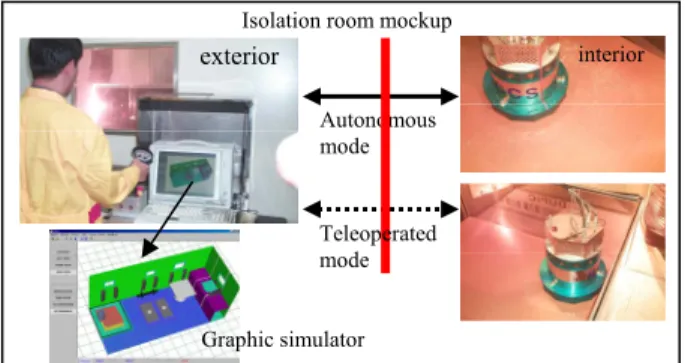
ROCCS-II [2] was developed to decontaminate the contaminated floor surface of the DFDF isolation room. ROCCS-II which also employs the vacuum cleaning method has more intelligence when compared to ROCCS-I in terms of an autonomous navigation, omnidirectional cleanup and added vision information. ROCCS-II has a configuration of 465x465 (HxD) mm, a maximum speed of 0.1m/sec, an ability to collect contaminated particles of up to 0.3 µm, as well as an ability to clean up a floor surface in all directions. The control console is the interface device between the operator and ROCCS-II located at a remote site. The
In-cell Operation/ Situation Task Command ROCCS-I In-Cell
Transactions of the Korean Nuclear Society Autumn Meeting Busan, Korea, October 27-28, 2005
graphic simulator installed on the control console provides the operator with added vision information and a more useful means for developing an improved ability to simulate and control ROCCS-II. ROCCS-II is operated either by a teleoperated control or by an autonomous control (Fig.3). In both the manual and autonomous modes, the operator can supervise and intervene in all the operations of ROCCS-II both through the mock-up window and the graphic simulator. Currently, ROCCS-II is under performance tests in order to acquire its reliability and stability before it is put into service in the DFDF isolation room.
Figure 2. ROCCS-II and its mock-up operation.
3.3. TOMS
TO MS [ 3 ] w a s d e veloped to clean up th e contaminated floor surface of the DFDF hot-cell by mopping it. TOMS mainly comprises three subsystems - a mopping slave located inside the hot-cell, a mopping master and a control console located outside the hot-cell. The mopping slave that mops the contaminated floor surface has a configuration of 280x180x170 (LxHxW) mm and an ability to mop an area of 24 m2 with a single
roll of the mopping cloth. The mopping master which is installed on the control console is a man-machine interface device that allows for an interaction between the operator and the mopping slave. The control consol provides a control location for TOMS. TOMS is operated by a teleoperated control by employing a bilateral force reflecting control scheme. A human operator located outside the hot-cell can perform a series of floor mopping tasks by controlling the mopping slave via the mopping master. A mopping force occurring when, in operation, the mopping tool of the mopping slave contacts with the floor surface can be
Figure 3. TOMS and its mock-up operation.
reflected to the operator through the mopping master, thus allowing the operator to have a sense of a real mopping. TOMS is under performance tests at the mock-up and will be installed in situ for service.
3.4. TOSS
Currently, our research efforts are employed on the development of TOSS to be used in the DFDF hot-cell. TOSS also employs a mopping concept which is to remotely clean the contaminants deposited onto the hot-cell wall by mopping it with a wet cloth. Detailed design development of TOSS was completed, and preparations for its construction are being undertaken. A graphical representation of the designed TOSS is shown in Fig.4.
Figure 4. Graphical representation of the designed TOSS.
4. Conclusions
Remote robotic systems have been developed for use in the high radioactive environment of the DUPIC fuel development facilities. The significance of these developments is in providing remote robotic systems that can clean up the contaminated floor or wall of the DFDF hot-cell and the isolation room without endangering the human workers. The decontamination operations using the developed remote robotic systems will have the benefits of an improved worker safety, a reduced personnel exposure dose rate, and an increased facility soundness.
ACKNOWLEDGEMENTS
This work was performed under the long-term Nuclear R&D program sponsored by the Korea Ministry of Science and Technology.
REFERENCES
[1] K. Kim, J. Park, M. Yang, Radioactive Waste Collection Vehicle for Hot-Cell Applications, Proc. 32nd Int’l Symposium on Robotics, pp. 1271-1275, 2001.
[2] K. Kim, et al., Robotic Contamination Cleaning System, Proc. IEEE/RSJ, Int’l Con. Intelligent Robots and Systems, pp.1874-1879, Switzerland, 2002.
[3] K. Kim, et al., Development of Teleoperated Cleanup System, KAERI/TR-2903/2005, Korea Atomic Energy Research Institute, 2005.
Autonomous mode Isolation room mockup
exterior interior Teleoperated mode Graphic simulator Simulated floor before operation on operation cleaned area Mopping Slave Teleoperation Bilateral Force Reflection Mopping Master Control Console