70
2019 ⦽ǎႊᔍᖒ⠱ʑྜྷ⦺⫭⇹ĥ⦺ᚁݡ⫭םྙ᧞ḲReview of Design Requirements for SNF Dry Storage System
Sunghwan Chung*, Taehyeon Kim, and Yunchang Jeong
KHNP Central Research Institute, 70, Yuseong-daero 1312beon-gil, Yuseong-gu, Daejeon, Republic of Korea *[email protected]
1. Introduction
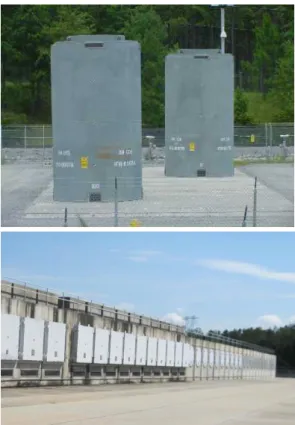
Spent nuclear fuel (SNF) dry storage systems (SDSS) including casks and modules (Fig.1) to store SNF under inert gas atmosphere must be designed in compliance with the applicable requirements of related regulations such as Korea Nuclear Safety Act and US 10 CFR Part 72 (10CFR72). But the direct and quantitative requirements for SDSS are not explicitly specified in the related regulations, and so the design requirements for SDSS based on the US regulatory requirements were reviewed.
Fig. 1. SNF dry storage systems.
2. Regulatory Requirements
According to 10CFR72, SDSS must be so designed to maintain the safe storage conditions of SNF, prevent damage to SNF, assure SNF recovery and withstand the effects of design-basis conditions such as normal, off-normal and accident conditions
and natural phenomena. Normal conditions are considered as intended operations, planned events and environmental conditions to be expected to routinely occur including ambient temperatures, fuel loading and unloading, 1% failure of fuel rods, handling of SDSS, etc. Off-normal conditions are considered as conditions to be expected to occur with moderate frequency including temperatures beyond normal conditions, 10% failure of fuel rods, failure of confinement boundaries, partial air flow blockage, human error, out-of-tolerance equipment performance, equipment failure, or faulty calibration, etc. Accident conditions are considered as conditions to exceed off-normal conditions including drop, tip-over, fire, 100% fuel rod rupture, leakage of confinement boundary, explosive overpressure, 100% air flow blockage, accidents resulting from operational error, etc. Natural phenomena are considered as events to be expected to occur during normal operations including flood, typhoon, tornado, earthquake, burial, lightning, tsunami, etc.
Design-basis fuel to be stored in SDSS must be specified such as fuel type, max. enrichment, max. burnup, min. cooling time of 1 year or more, max. decay heat, max. SNF mass loading limit, SNF conditions, inert atmosphere requirements, etc.
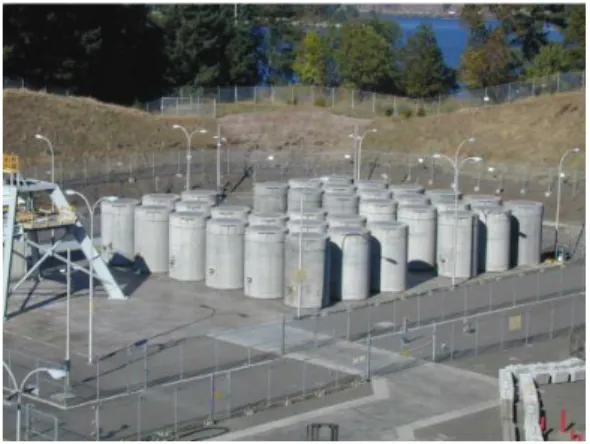
SDSS must ensure that SNF remains subcritical under all credible conditions. SDSS must provide adequate heat removal capacity with passive cooling systems, suitable shielding features for radiation protection under normal and accident conditions, and confinement systems of radioactive material. 10CFR 72 establishes the potential dose equivalent or committed dose equivalent to any individual on or beyond the controlled area boundary of storage facilities (Fig.2) from accidents or direct radiation from normal. SDSS must have sufficient structural capacity so that the structure can withstand the worst-case loads under normal, off-normal, accident conditions and for natural phenomena events. Design earthquake must be equivalent to the safe shutdown earthquake (SSE) for NPPs. SNF cladding must be
2019 ⦽ǎႊᔍᖒ⠱ʑྜྷ⦺⫭ ⇹ĥ⦺ᚁݡ⫭ םྙ᧞Ḳ
71
protected that leads to gross rupture or confined suchthat degradation of fuel will not pose operational safety problems.
Fig. 2. SNF dry storage facility.
3. Design Requirements
Design-basis fuel with max. initial enrichment, max. average fuel assembly burnup and min. cooling time, max. heat load and without any leakage will be specified. And type, weight and dimension of the fuel and max. fuel loading limit in SDSS will also be specified.
SDSS will be so designed that it maintains sub-criticality, confinement, radiation shielding, decay heat removal, structural integrity and physical protection of SNF under design-basis conditions in accordance with the related regulations, thus preventing release of radioactive material and providing protection against radiation exposure. In case of a canister-based SDSS, a fuel-loaded canister will meet the requirements of storage and transport regulations to be transferable within NPP sites.
Design earthquake will be equivalent to safe shutdown earthquake (SSE) for NPP of a horizontal ground motion of min. 0.3 g with appropriate response spectrum. For SSE events, the structural safety of SDSS on the storage pad, on suspending from the crane, during operation in the storage pool, etc. will be verified. SDSS will provide adequate heat removal capacity with natural convection cooling system, and will be so designed that max. cladding temperature does not exceed 400oC and max. cladding hoop stress is less than 90 MPa for fuel loading operation and normal conditions.
SDSS will be so designed that it reasonably maintains confinement of radioactive material under the design-basis conditions.
SNF loaded in SDSS will be packaged, transported
and stored in such a manner that sub-criticality is maintained under the design-basis conditions. Effective multiplication factor (keff) including all biases and uncertainties with a 95% probability at a 95% confidence level will not exceed 0.95.
Radiation dose rates on SDSS surfaces to comply with the radiation requirements of 10CFR72 depend on the radiation dose rate limits of storage facility including SDSS arrangement on the pad. Since dry storage facility are designated as a radiation control area, the storage facility will meet the radiation dose rate limit for the radiation control area in accordance with Korea regulations on technical standards for radiation safety control. Radiation dose rate limit outside SNF dry storage facility will not exceed 0.4 mSv/week, which is based on annual worker exposure dose limit of 20 mSv. Radiation dose rate limit on SDSS surfaces will not exceed 1 mSv/week, which is based on annual individual exposure dose limit of 50 mSv. And operational limit conditions for SDSS will be established to meet ALARA principles and radiation limits for radioactive materials in effluents and direct radiation levels associated with the storage facility operation.
4. Conclusion
SDSS will be designed to accommodate the effects of site characteristics and environmental conditions associated with normal operations, and withstand accidents and natural phenomena events. It will be designed to ensure adequate safety and withstand the effects of design-basis conditions without impairing its capability to perform safety functions. SDSS will store safely SNF for the design life and be compatible with wet or dry SNF loading and unloading facilities. And SDSS will allow ready retrieval of SNF for further processing such as transport after long-term storage to centralized interim storage facility and final depository.
REFERENCES
[1] Korea Act No.14839, Nuclear Safety Act
[2] US 10 CFR Part 72, Licensing Requirements for the Independent Storage of Spent Nuclear Fuel [3] Korea NSSC Regulation No.19, Regulations on