INTRODUCTION
Worldwide, 39% of adults 18 years or older were
over-weight (body mass index [BMI]≥25 kg/m2) and 13% were
considered to have obesity (BMI≥30 kg/m2) in 20161). If
this trend continues, almost half of the world’s adult
pop-ulation will be overweight or obese by 20302). Obesity is
thought to be influenced by psychosocial and cultural
fac-https://doi.org/10.15429/jkomor.2020.20.2.178
JKOMOR
pISSN 1976-9334, eISSN 2288-1522
Review Article
비만치료에 있어서 환자특성에 따른 인지행동요법과 행동수정요법의
효과 비교: 체계적 문헌고찰 및 메타분석
차진영
†⋅김서영
1†⋅신인수
2⋅박영배⋅임영우
누베베 미병연구소, 1누베베 한의원 분당점, 2동국대학교 교육대학원
Comparison of the Effects of Cognitive Behavioral Therapy and Behavioral
Treatment on Obesity Treatment by Patient Subtypes: A Systematic
Review and Meta-analysis
Jin-Young Cha†, Seo-Young Kim1†, In-Soo Shin2, Young-Bae Park, Young-Woo Lim
Nubebe Mibyeong Research Institute, 1Nubebe Korean Medical Clinic (Bundang), 2Graduate School of Education, Dongguk University
Received: Revised: Accepted: October 26, 2020 November 19, 2020 November 21, 2020
Objectives: The present study aimed to compare the impacts of cognitive behavioral therapy (CBT) and behavioral treatment (BT) on weight loss and psychological outcomes among patients with three different subtypes of obesity: simple obesity, obesity with binge eating disorder, and obesity with depression.
Methods: Embase, PubMed, the Cochrane Central Register of Controlled Trials, Research Information Sharing Service, and Korean Studies Information Service System were sys-tematically searched for randomized controlled trials conducted on or before May 2020, that used CBT to treat obesity. Methodological quality was assessed using Cochrane’s risk of bias tool 2 and publication bias was evaluated through the funnel plot using the trim and fill method, Egger’s test, and Begg and Mazumdar rank correlation test. A meta-anal-ysis was conducted using a random-effects model and the standardized mean difference with 95% confidence interval (CI) was used to determine effect size.
Results: Twenty-one randomized controlled trials with a total of 22 intervention arms and 2,590 patients were included. Our study results revealed that the effects of CBT, compared with BT, on weight loss distinctly differed across all patient subgroups. In the simple obesity group, CBT was more effective than BT (Hedges’ g=0.138, CI=0.012~0.264); however, in the obesity with binge eating disorder group, BT was more effective than CBT (Hedges’ g=-0.228, CI=-0.418~-0.038); in the obesity with depression group, the effect of CBT was not statistically different from that of BT (Hedges’ g=0.276, CI=-0.307~0.859). Further stud-ies with larger sample sizes are required to confirm the outcomes observed in this study. Conclusions: Our results indicated that the effects of CBT on obesity treatment vary based on patient subtype. Therefore, our findings suggest that CBT or BT should be se-lectively recommended as a treatment strategy for different obesity subtypes. Key Words: Weight loss, Obesity, Cognitive behavioral therapy, Binge-eating disorder
†These authors contributed equally to
this work for first authorship. Correspondence to: Young-Woo Lim Nubebe Mibyeong Research Institute, 515 Seolleung-ro, Gangnam-gu, Seoul 06150, Korea
Tel: +82-70-5148-7608 Fax: +82-2-566-2252 E-mail: [email protected]
Copyright © 2020 by The Society of Korean Medicine for Obesity Research
tors, as well as by energy imbalance due to excess energy
intake or a lack of energy expenditure3,4). Obesity and
psy-chological issues, such as binge eating disorders and
depres-sion are highly comorbid5,6), and are bi-directionally
asso-ciated7), although the strength of this association is greater
when depression leads to obesity than visa-versa8). Therefore,
to successfully treat obesity and prevent recurrent weight gains, psychological symptoms should be managed along-side weight loss. Behavioral treatment (BT) is an approach used to help individuals develop skills to improve their weight problem with three components: diet, physical
activ-ity, and behavioral therapy9). Cognitive behavioral therapy
(CBT) is an intervention that combined with BT and
cogni-tive approaches9); Cognitive approaches are aimed at
mod-ifying dysfunctional emotions, behaviors, and thoughts3).
Therefore, CBT has the potential of being useful in obesity treatment to influence cognitions related to behavior change, including a low energy diet, high-activity lifestyle, and
real-istic expectations9,10). It also assists patients to prevent
pos-sible relapses and manage critical situations with coping
strategies4).
The comparative effects of CBT and BT on weight loss or psychological outcomes in obesity treatment have been assessed in previous studies; however, the results have
var-ied for obesity subtypes. Peckmezian and Hay11) stated that
CBT a nd BT both led to weight loss with improvements in psychological aspects, such as cognitive restraint and binge eating, for uncomplicated obesity. However, there was no clear comparison of effect between CBT and BT. In a
meta-analysis7), CBT was more effective than BT for weight
loss, increasing cognitive restraint, and reducing emotional eating in a population that pooled together different catego-ries of obesity patients, including those with simple obesity and obesity with depression. In meta-analyses for obesity with binge eating disorder, CBT produced greater reduction than BT in binge eating frequency without weight reduc-tion12-14). However, the comparative effect of CBT in
obe-sity with binge eating disorder remains unclear, since some previous results were obtained from a comparison with
in-active interventions, such as a waitlist13) or comparison of
only one type of CBT intervention14). It was also more
diffi-cult to assess the effect of CBT in the obesity with depres-sion group. Few studies have evaluated the effect of CBT in obesity with depression, since researchers have tended to exclude patients with depression from obesity treatment be-cause of concerns regarding worsening of depressive
symp-toms during weight loss programs15).
Given prior work and gaps in the field, the present study aimed to compare the effects of CBT and BT on obesity treatment and to examine whether the effect size of CBT varies across obesity subtypes. The obesity subtypes in this study were classified as simple obesity, obesity with binge eating disorder, and obesity with depression. Since CBT is the intervention that focuses mainly on emotional, cognitive,
and psychological issues3,9), one could suppose that obese
patients with psychological problems such as binge eating or depression may have different results than those with simple obesity. The obesity subtypes in this study were de-fined as follows: simple obesity is the overweight or obese condition without any severe physical or psychological co-morbidities, obesity with binge eating disorder or obesity with depression is the overweight or obese condition ful-filling binge eating or depressive disorder criteria without severe physical comorbidities. According to the Diagnostic and Statistical Manual of Mental Disorders (DSM)-5
cri-teria16), binge eating disorder is characterized by recurrent
binge eating accompanied with lack of control over eating, consumption of an excessive amount of foods in a discrete period, and distress over binge eating, without inappropriate compensatory weight control methods observed in bulimia nervosa. Depression is characterized by the presentation of depressed mood and/or loss of interest for 2 weeks, plus at least four additional symptoms of unintended weight changes, appetite changes, insomnia or hypersomnia, psychomotor changes, fatigue, feelings of worthlessness, difficulty
METHODS
1. Data sources and searches
A literature search was conducted using the following sources: Cochrane Central Register of Controlled Trials, PubMed, Embase, Research Information Sharing Service, and Korean Studies Information Service System, and in-cluded studies published in all journals on or before May, 2020. Additionally, reference lists from the selected studies, related studies, and grey literature were also searched. The search strategy followed the Preferred Reporting Items for
Systematic Reviews and Meta-analysis (PRISMA)17) protocol.
The search terms used were entered as keywords or Mesh terms where possible, and used in English and Korean: (“cognitive behav*” OR “CBT”) AND (“weight los*” OR “obesity treat*” OR “weight manage*” OR “weight control” OR “dieting”) AND (“obes*” OR “overweight*” OR “binge-eat-ing” OR “depress*”). Two reviewers searched for articles independently, and discrepancies, if any, identified in the search results were resolved through mutual discussion.
2. Study selection (inclusion and exclusion criteria)
To eva lua te the effects of CBT versus BT on va rious in-dividuals suffering from obesity, clinical randomized con-trolled trials (RCTs) that compared the effect of CBT with that of BT on weight loss were analyzed. The eligible pop-ulation included (1) adults over 18 years, (2) overweight or
obese individuals (BMI≥25 kg/m2), and (3) those with no
severe physical or psychological comorbidities other than binge eating disorder and depression criteria. In selected studies, binge eating and depression were diagnosed through
a specialist’s interview according to the DSM -IV18-22),
DSM-IV-TR23), DSM-524) or Hamilton Depression Rating
Scale (HDRS)15) criteria. For our inclusion criteria, we
re-quired that a study on CBT interventions included at least one cognitive therapy (e.g. cognitive restructuring, body im-age acceptance, and problem-solving) beyond general be-havioral therapy (e.g. self-monitoring, stimulus control, and
goal setting)7,15). BT interventions included at least one of
components: general behavioral therapy, diets (such as
calo-rie restriction and nutrition education), exercise, and phys-ical activity. If usual care for weight loss contained any BT component, usual care also was included in BT intervention group.
We excluded the developed CBT studies such as third- wave CBT from our CBT criteria. Third-wave CBTs such as mindfulness-based cognitive therapy and dialectical be-havioral therapy have recently been used for treating obe-sity25,26); however, these focus on the processes of
accept-ance, mindfulness, attention, or value27) that exceeds the
tra-ditional CBT criteria. We excluded studies comparing CBT with no treatment, pharmacological intervention treatment, or surgical treatment.
3. Data extraction and quality assessment
A predefined data template was prepared to compile data from the included studies. The two co-first authors in-dependently extracted and coded the following data based on the template: Study characteristics (author, publication year, and journal), participants (sample size, age, gender, weight, and BMI), interventions (time period, type of inter-vention, and type of control), and outcomes (change in mean and standard deviation of body weight, depressive symptom scores, number of binge eating days/episodes, di-etary restraint scores, and diet/exercise self-efficacy scores). The data were cross-checked by the two co-first authors and any discrepancies were discussed until an agreement was reached. The methodological quality of each included study
was assessed using Cochrane’s risk of bias (RoB) tool 228).
4. Calculating effect sizes
A meta-analysis uses statistical methods to synthesize ef-fect size and standardize quantitative findings from a range
of studies29). In the present study, we calculated effect sizes
based on the standardized mean change difference (SMD) from pre- to post-treatment in both the intervention and
con-trol groups30). The SMDs were computed using the
,
In this formula, a nd a re the pos a nd pre-trea
t-ment means of the intervention group, respectively, a nd
are the post- and pre-treatment means of the control
group, respectively, and is the post-test standard
devia-tion of the intervendevia-tion and control groups. The effect size corresponded to the SMDs using the following formula: ∆ . The estimated variance of the SMD (i.e. “Var
(∆)”) is defined as follow: ∆
In this formula, and a re estima tes of the pre- a nd
post-treatment correlations in the intervention and control groups, respectively.
Small-sample studies tend to overestimate effect sizes. Thus, a small-sample correction factor (Hedges’ g)
involv-ing SMD multiplied by a correction factor J, was used31).
Thisc orrection factor J was computed using the following formula:
,
The weighted mean difference with 95% confidence in-tervals was used to determine effect size. The meta-analysis was conducted using Comprehensive Meta-Analysis soft-ware (version 3.0; Biostat Inc., Englewood, NJ, USA).
5. Data analyses
A nutritionist, clinician, and meta-analytical statistician collaborated on all aspects of this study. The primary
out-come was BMI (kg/m2) or body weight (kg) change. The
secondary outcomes were changes in scores/numbers of de-pressive symptoms, binge eating, dietary restraint, diet self-ef-ficacy, and exercise self-efficacy. Body weight changes were calculated as the differences between pre- and post-treat-ment mean body weights (kg) or percent of body weight reductions. Secondary outcomes included assessments using the following scales: binge eating was assessed using the
Eating Disorder Examination (EDE)19,20,23,24), or the Eating
Disorder Examination-Questionnaire (EDE-Q)18,32), depressive
symptoms using Beck’s Depression Index (BDI)18,20,24,32,33),
BDI-II22,34), HDRS15), or Symptom Check List-2021), dietary
restraint was measured using the EDE-Q18,20,32,35), diet
self-efficacy was assessed via the Weight Efficacy Lifestyle
Questionnaire36-38) or an adopted scale based on a measure
developed by Bandura39), and exercise self-efficacy was
as-sessed through the exercise self-efficacy scale36,40), or an
adopted scale based on a measure developed by Bandura39).
Participants were classified into three obesity subgroups: simple obesity, obesity with binge eating disorder, and obe-sity with depression, and the effect size of outcomes was compared between subgroups. Heterogeneity in primary or secondary outcomes between studies was assessed using Q
test and I2 31). This meta-analysis was conducted using a
random-effect model to assess effect size since there was significant heterogeneity in the types of intervention, partic-ipants, and treatment period between studies. A funnel
plot31), Egger test41), and Begg and Mazumdar rank
correla-tion42) were performed to assess publication bias and to
syn-thetically analyze all the results. Subgroup analysis was conducted on the weight measuring time point divided by ≤12 weeks or >12 weeks. In obesity treatment studies, the difference between the time points of weight measurement is considered important given that it can affect the outcome.
RESULTS
1. Study description
The initial search compiled a total of 680 studies; 603 studies through databases and 77 studies through other sources. We initially screened articles using only the title and abstract; if these were insufficient for determining the appropriateness for inclusion, we then screened the full-text article. In addition, for data-insufficient studies, we con-tacted the corresponding authors requesting sufficient data to calculate the effect size, such as mean, standard devia-tion, and sample sizes; however, we received no response from any author. Ultimately, only 21 studies met the inclusion
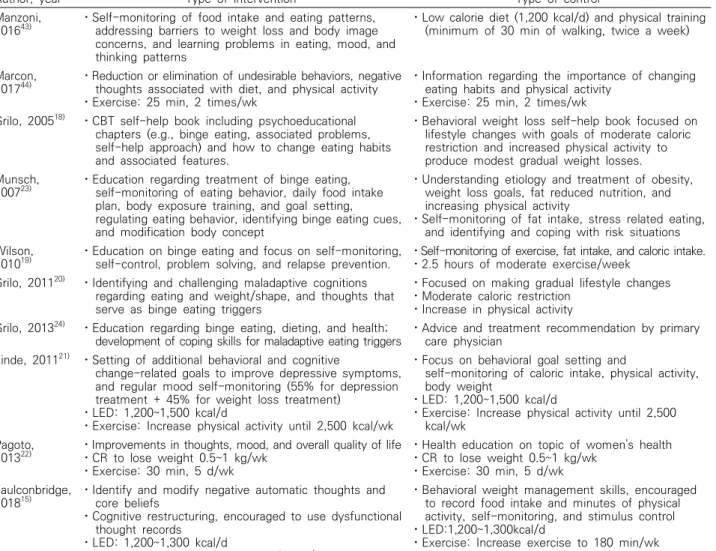
criteria and were assessed (Fig. 1). This included 22 inter-vention arms, one of which included two interinter-vention arms, and a total of 2,590 participants. Studies were classified in-to three categories according in-to obesity subtypes: simple obesity (13 studies; n=1,752), obesity with binge eating dis-order (5 studies; n=423), and obesity with depression (3 studies; n=415). The characteristics of the included studies and comparisons of intervention details between the inter-vention and control groups are shown in Tables 1 and 2, respectively.
2. RoB and publication bias
1) Quality assessment
The RoB assessment for the 21 studies included here is summarized in Fig. 2. The RoB was rated ‘high’ in
1910,15,18-24,32-36,38-40,43,44) a nd ‘some concerns’ in 237,45). In 16
studies10,15,18-24,32-36,40,45), sequence generation or allocation
concealment in the randomization process was not reported or was unclear. In all studies, blinding of one or both of the participants and assessors was not conducted or not mentioned. It is difficult to blind participants and assessors since RCTs involving CBT could not be placebo-controlled clinical trials. We increased the risk assessment rating if the im-balance of study interventions could be biased or if the self-reporting could be influenced.
2) Publication bias
No significant publication bias was observed on Begg and Mazumdar rank correlation (P=0.797) and on the Egger test (P=0.775). Moreover, symmetrical distribution was re-vealed on visual inspection of the funnel plots (Fig. 3). As Fig. 1. Preferred reporting items for systematic review and meta-analysis (PRISMA) flow diagram of identification, screening, eligibility, and inclusion process.
Author , Year Populati on Age (yr) Fe m ale (%) Initi al BMI (kg/m 2) or B W * ( kg ) Nu mber of par tici pan ts rando mi zed Total num ber ana lyz ed CBT intervention period (wk) Type of intervention group Ty pe of contr ol group Outco mes Tanco, 1998 33 ) Simpl e obesi ty NR 100.0 39.5 42 37 8 CT BT pl us LED pl us exer cise BMI, dep ress ion Ramirez, 2001 35 ) Simpl e obesi ty 44.0 78.5 33.78 88 65 16 C T plus NE plus PA B T pl us N E plus PA B W, rest rai nt Ames, 2005 34 ) Simpl e obesi ty 21.5 100.0 31.1 80 26 26 CT p lus LED p lus exercise BT pl us LED pl us exer cise B W, depression Stahr e, 2007 10 ) Simpl e obesi ty 48.6 100.0 100.3 * 54 29 10 C T plus LED D iet inf or mation and pr acti ce BW Befo rt, 2008 39 ) Simpl e obesi ty 44.3 100.0 39.8 44 33 16 CT p lus LED p lus PA BT pl us LED pl us PA BM I, di et s el f-ef fic ac y, exer ci se s el f-e ffi ca cy Werrij , 2009 32) Simpl e obesi ty 45.0 81.0 33.4 200 200 10 C T plus NE B T pl us N E plus exer cise BMI, binge eating, depression, rest rai nt Rodriguez-Hernandez, 2009 45) Simpl e obesi ty 45.4 45.3 100.0 100.0 35.8 36.4 58 47 58 47 26 26 (1) CT plus LE D (LF ) pl us exerci se (2 ) CT plus LE D(LC ) pl us exerci se (1) L ED (L F) pl us exer cise (2) L ED (L C) plus exer cise BMI BMI Annes i, 2010 40 ) Simpl e obesi ty 42.2 100.0 36.6 150 134 26 CT p lus NE plus exercise NE pl us exerci se B W, exercise self-ef ficacy Annes i, 2012 36 ) Simpl e obesi ty 42.5 82.6 41.7 430 430 26 CT p lus CR plus exercise NE pl us exerci se B W, exercise self-ef ficacy, Annes i, 2013 37 ) Simpl e obesi ty 43.4 80.6 40.3 324 324 26 CT p lus CR plus exercise NE pl us exerci se diet se lf-efficacy BMI, diet self-e ffi cacy Jamal, 2016 38) Simpl e obesi ty 40.5 72.7 32.4 194 194 24 CT p lus LED p lus PA CR plus PA Man zo ni, 2016 43 ) Simpl e obesi ty 35.6 100.0 42.2 102 102 6 C T plus LED p lus exercise BT pl us LED pl us exer cise BMI, diet self-e ffi cacy BW Marcon, 2017 44 ) Simpl e obesi ty 46.3 89.7 48.3 44 39 16 CT p lus exe rc ise BT pl us exerci se B W Gri lo, 2005 18 ) B inge ea ting 46 81.3 34.7 75 75 12 C T B T B MI, binge eating, Munsch, 2007 23) B inge ea ting 45.9 88.8 36.5 80 80 16 C T B T pl us N E depression, rest rai nt B MI, binge eating Wi lson, 2010 19 ) B inge ea ting 48.3 85.4 36.5 130 130 24 CT BT pl us CR pl us BMI, binge eating Gri lo, 2011 20 ) B inge ea ting 44.8 67.0 38.8 90 90 24 C T exer cise B T pl us CR pl us PA B MI, binge eating, depression, rest rai nt Gri lo, 2013 24 ) B inge ea ting 45.8 79.0 37.6 48 48 16 C T B T B MI, binge eating, depression Linde, 2011 21 ) Depressi on 52 100.0 39.5 203 203 26 CT p lus LED p lus exercise BT pl us LED pl us exer cise B W, depression Pagoto , 2013 22) Depressi on 45.9 100.0 35.4 161 161 26 CT p lus CR plus exercise BT pl us CR pl us exer cise B W, depression Fau lconbridge, 2018 15 ) Depressi on 49.5 92.2 36.3 5148 20 CT p lus LED p lus exercise BT pl us LED pl us exer cise B W, depression BMI: body mass index, BW : body w ei ght, CBT: cognitiv e behavioral ther apy, N R: not rep orted, C T: cogniti ve therapy, BT: behavior al th erap y, L ED : low en ergy di et, NE : nutr iti on edu cat ion, P A: p hy si ca l acti vity , LF: low fat di et, LC: low carbohydra te di et, CR: calorie rest riction. Ta bl e 1. Ch aract eris tics of Ran domi ze d Con troll ed Trials of Cog ni tive B eh avioral Th erapy
Author, year Type of intervention Type of control Tanco, 199833) ⋅CT therapeutic approaches based on cognitive principles,
discussion regarding body ideals and appearances and en-couraging to recognize psychological and physiological need
⋅Daily records of their food intake (1,200~1,500 kcal/d, daily food diaries) and exercise, reviewed weekly
Ramirez,
200135) ⋅Cognitive restructuring to help them reduce negative self-talk and control self-defeating regarding appearances
⋅Homework assignment to listen to audiotapes to decrease appearance-related distress
⋅Nutritional and behavioral self-management program to promote eating and exercise change
⋅Nutrition and behavioral self-management program to promote eating and exercise change
Ames, 200534) ⋅RCB intervention focused on establishing realistic weight
goals and expectations for weight loss, correcting faulty assumptions regarding appearance, valuing aspects of self-unrelated to weight, and fostering acceptance of the weight and body shape achieved following treatment
⋅SB intervention: Low-calorie intake (e.g.,
1,200~1,500 kcal/d) and training in self-monitoring, goal setting, stimulus control, social support, and relapse prevention strategies. Structured exercise consisting of 30 min of moderate to high intensity activities (e.g., aerobics classes, brisk walking, jogging, cycling) for 5 or more days per week Stahre,
200710) ⋅Cognitive group treatment to inform the probable causes of dysfunctional eating behavior and to focus on
deficiencies in self-control, low self-esteem, and stress ⋅LED: 1,200~1,300 kcal/d
⋅Information on dieting and practical training
Befort,
200839) ⋅Motivational interviewing: changing behaviors by discussing past experiences, clarifying connections
between core values and weight loss, as well as motivation to lose weight
⋅Decrease calorie intake by 500~1,000 kcal/d and increase physical activity to 150 min/wk
⋅Health education: Provision of health information and advice unrelated to weight loss
⋅Decrease energy intake by 500~1,000 kcal/d and increase physical activity to 150 min/wk Werrij, 200932) ⋅First intervention: Same as the control group
⋅Second intervention: Provided with workbooks containing background information on cognitive intervention and homework including thought diaries (changing dysfunctional cognitions concerning eating, control, weight, and shape)
⋅First intervention: Provided with nutritional education, food diaries, and learning when to stop eating, how to refuse food, how to find social support, and how to deal with parties, among others. ⋅Second intervention: Low intensity exercise
program supervised by a physiotherapist
Rodriguez-Hernandez, 200945)
⋅Behavioral strategies, cognitive skills, and relapse prevention techniques to identify factors that trigger overeating ⋅Exercise: Walking, dancing, cycling, or swimming for 30
min/d, for at least 5 d/wk ⋅LED-LF/LC (30 kcal/kg/d)
⋅Exercise: Walking, dancing, cycling, or swimming for 30 min/d, for at least 5 d/wk
⋅LED-LF/LC (30 kcal/kg/d) Annesi,
201040) ⋅Exercise support based on each participant's preference⋅Cognitive behavioral method includes establishing caloric
goals and logging daily food and calorie intake, regular self-weighing, cognitive restructuring, relapse prevention training, understanding cues to overeating, and relaxation strategies
⋅Exercise support based on each participant's preference
⋅Nutrition education include understanding
carbohydrates, protein, fats, and calories, using the US Food Guide Pyramid, menu planning, and developing a plan for snacking
Annesi,
201236) ⋅Exercise support based on each participant's preference (6, 1-hr individual sessions per week).
⋅Cognitive behavioral method included establishing caloric goals and logging daily food and calorie intake, regular self-weighing, cognitive restructuring, relapse
prevention training, understanding cues to overeating, and relaxation strategies
⋅Exercise support based on each participant's preference (6, 1-hr individual sessions per week). ⋅Nutrition education included understanding
carbohydrates, protein, fats, and calories, using the US Food Guide Pyramid, menu planning, and developing a plan for snacking
Annesi,
201337) ⋅Exercise support instructing additional behavioral skills, such as productive self-talk, addressing cues to
exercise, and accommodating barriers to exercise (six, 45~60 min/wk)
⋅Cognitive behavioral nutrition education establishing caloric goals and logging daily food and caloric intake, practicing restructuring, and leveraging cues to overeating
⋅Exercise support instructing additional behavioral skills such as productive self-talk, addressing cues to exercise, and accommodating barriers to exercise (six, 45~60 min/wk)
⋅Standard nutrition education, including
understanding carbohydrates, protein, fats, and calories, and developing a plan for snacking Jamal, 201638) ⋅Cognitive behavior sessions regarding negative thoughts,
challenges in lifestyle change, maintaining motivation, experience sharing
⋅Decrease caloric intake by 500 kcal/d ⋅Increase physical activity by 150 min/wk
⋅Trainers: Dietician, exercise specialist and psychologist
⋅Decrease caloric intake by 500 kcal/d ⋅Increase physical activity by 150 min/wk ⋅Trainers: dietician, exercise specialist Table 2. Comparison of Intervention Details between Intervention and Control Groups
we synthetically analyzed all the results, including the fun-nel plot, rank correlation, and Egger test, publication bias was not indicated. A non-significant tau does not prove the absence of bias since the power of the Egger test was low, unless there was severe bias or a substantial number of
studies46). As a sensitivity analysis, we also assessed the
trim and fill method on the impact of the small study effect.
3. Effects on obesity subtypes
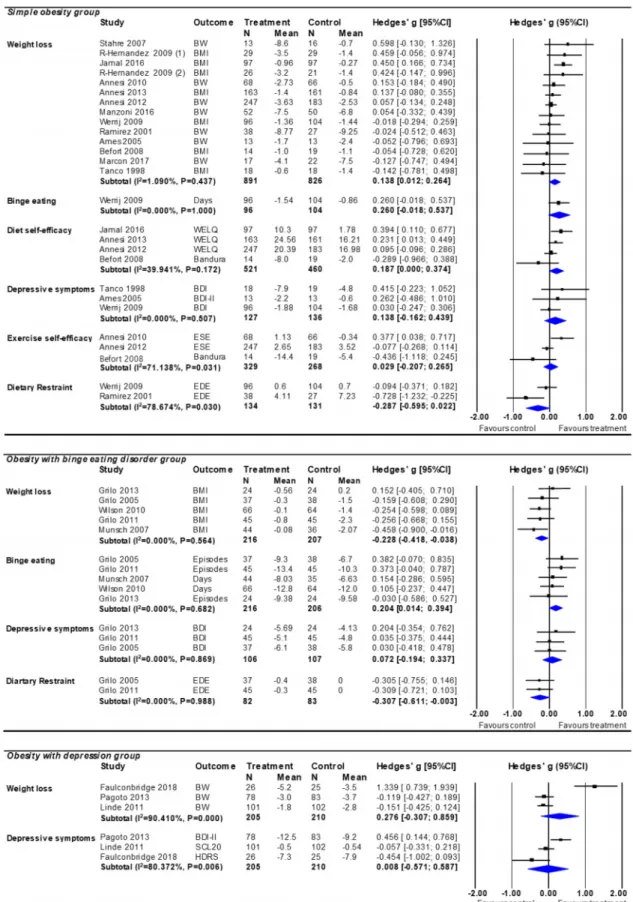
Effects of CBT versus BT on different categories of in-dividuals with obesity are summarized in Table 3.
1) Effects of CBT compared with BT in the simple obesity group
In the simple obesity group, the weight loss effect of CBT was significantly greater than BT even though the ef-fect size was low (Fig. 4). Among the psychological out-comes, only the diet self-efficacy effect of CBT was statisti-cally significant. The effects of CBT on depressive symptoms, binge eating, dietary restraint, and exercise self-efficacy were statistically insignificant compared to that of BT (Fig. 4).
The results of the subgroup analysis revealed that com-pared with BT, the effect of CBT on weight loss in the group ≤12 weeks (n=4) was not significantly different
Author, year Type of intervention Type of control
Manzoni,
201643) ⋅Self-monitoring of food intake and eating patterns, addressing barriers to weight loss and body image
concerns, and learning problems in eating, mood, and thinking patterns
⋅Low calorie diet (1,200 kcal/d) and physical training (minimum of 30 min of walking, twice a week) Marcon,
201744) ⋅Reduction or elimination of undesirable behaviors, negative thoughts associated with diet, and physical activity
⋅Exercise: 25 min, 2 times/wk
⋅Information regarding the importance of changing eating habits and physical activity
⋅Exercise: 25 min, 2 times/wk Grilo, 200518) ⋅CBT self-help book including psychoeducational
chapters (e.g., binge eating, associated problems, self-help approach) and how to change eating habits and associated features.
⋅Behavioral weight loss self-help book focused on lifestyle changes with goals of moderate caloric restriction and increased physical activity to produce modest gradual weight losses. Munsch,
200723) ⋅Education regarding treatment of binge eating, self-monitoring of eating behavior, daily food intake
plan, body exposure training, and goal setting, regulating eating behavior, identifying binge eating cues, and modification body concept
⋅Understanding etiology and treatment of obesity, weight loss goals, fat reduced nutrition, and increasing physical activity
⋅Self-monitoring of fat intake, stress related eating, and identifying and coping with risk situations Wilson,
201019) ⋅Education on binge eating and focus on self-monitoring, self-control, problem solving, and relapse prevention. ⋅Self-monitoring of exercise, fat intake, and caloric intake.⋅2.5 hours of moderate exercise/week
Grilo, 201120) ⋅Identifying and challenging maladaptive cognitions
regarding eating and weight/shape, and thoughts that serve as binge eating triggers
⋅Focused on making gradual lifestyle changes ⋅Moderate caloric restriction
⋅Increase in physical activity Grilo, 201324) ⋅Education regarding binge eating, dieting, and health;
development of coping skills for maladaptive eating triggers ⋅Advice and treatment recommendation by primary care physician Linde, 201121) ⋅Setting of additional behavioral and cognitive
change-related goals to improve depressive symptoms, and regular mood self-monitoring (55% for depression treatment + 45% for weight loss treatment)
⋅LED: 1,200~1,500 kcal/d
⋅Exercise: Increase physical activity until 2,500 kcal/wk
⋅Focus on behavioral goal setting and
self-monitoring of caloric intake, physical activity, body weight
⋅LED: 1,200~1,500 kcal/d
⋅Exercise: Increase physical activity until 2,500 kcal/wk
Pagoto,
201322) ⋅Improvements in thoughts, mood, and overall quality of life⋅CR to lose weight 0.5~1 kg/wk
⋅Exercise: 30 min, 5 d/wk
⋅Health education on topic of women's health ⋅CR to lose weight 0.5~1 kg/wk
⋅Exercise: 30 min, 5 d/wk Faulconbridge,
201815) ⋅Identify and modify negative automatic thoughts and core beliefs
⋅Cognitive restructuring, encouraged to use dysfunctional thought records
⋅LED: 1,200~1,300 kcal/d
⋅Exercise: Increase exercise to 180 min/wk
⋅Behavioral weight management skills, encouraged to record food intake and minutes of physical activity, self-monitoring, and stimulus control ⋅LED:1,200~1,300kcal/d
⋅Exercise: Increase exercise to 180 min/wk CT: cognitive therapy, RCB: reformulated cognitive-behavioral, SB: standard behavioral, LED: low energy diet, LF: low fat diet, LC: low carbohydrate diet, CBT: cognitive behavioral therapy, CR: calorie restriction.
(Hedges’ g=0.038; CI=-0.166~0.243), but in the group >12 weeks (n=10), the effect of CBT was higher than that of BT (Hedges’ g=0.158; CI=0.050~0.266). Differences be-tween the weight measurement time points affected CBT’s influence on weight loss. The subgroup analysis was con-ducted only in the simple obesity group since the other groups had few studies for conducting subgroup analysis.
2) Effects of CBT compared with BT in the obesity with binge eating disorder group
In the obesity with binge eating disorder group, the
ef-fects of CBT and BT were different for each outcome. CBT had a significantly favorable effect on reducing binge eat-ing, while BT had a significant beneficial effect on reducing body weight and improving dietary restraint. The effects of CBT and BT on depressive symptoms was not significantly different (Fig. 4).
3) Effects of CBT compared with BT in the obe-sity with depression group
In the obesity with depression group, no significant dif-ferences in weight loss and depressive symptoms were ob-Fig. 2. Quality assessment using Cochrane collaboration risk of bias tools in the included studies.
served between CBT a nd BT groups (Fig. 4).
DISCUSSION
This meta-analytic approach compared CBT to BT for obesity and divided patients into subgroups, including sim-ple obesity, obesity with binge eating disorder, and obesity
with depression. Our primary findings indicated that com-pared with BT, the effect of CBT on weight loss distinctly differed across all patient subgroups. Our subgroup assess-ment demonstrated that CBT, compared with BT, was effec-tive in promoting weight loss in simple obesity, but in obe-sity with binge eating disorder, BT was more effective in promoting weight loss than CBT. Moreover, in obesity with Fig. 3. A funnel plot of the effect size of body weight or body mass index changes between the cognitive behavioral therapy and behavioral treatment groups.
Subgroup
Effect size (Hedges’ g), 95% confidence interval, and number of intervention arms
Weight loss Depressive symptoms Binge eating Dietary restraint self-efficacyDiet self-efficacyExercise
Simple obesity 0.138 (0.012, 0.264) (N=14) 0.138 (-0.162, 0.439) (N=3) 0.260 (-0.018, 0.537) (N=1) -0.287 (-0.595, 0.022) (N=2) 0.187 (0.000, 0.374) (N=4) 0.029 (-0.207, 0.265) (N=3) Obesity with binge
eating disorder (-0.418, -0.038)-0.228 (N=5) 0.072 (-0.194, 0.337) (N=3) 0.204 (0.014, 0.394) (N=5) -0.307 (-0.611, -0.003) (N=2) - -Obesity with depression (-0.307, 0.859)0.276 (N=3) 0.008 (-0.571, 0.587) (N=3) - - - -Overall 0.059 (-0.056, 0.174) (N=22) 0.093 (-0.091, 0.277) (N=9) 0.218 (0.002, 0.434) (N=6) -0.310 (-0.574, -0.046) (N=4) 0.187 (0.000, 0.374) (N=4) 0.029 (-0.207, 0.265) (N=3) Table 3. Effect Size of Cognitive Behavioral Therapy by Subtypes on Obesity Treatment for Weight Loss and Psychological Outcomes
Fig 4. Forest plot of cognitive behavioral therapy effect compared with behavioral treatment in simple obesity group, obesity with binge eating disorder group, and obesity with depression groups.
depression, there was no statistically significant difference between CBT and BT to reduce body weight. The effects of CBT a nd BT were different for ea ch psychologica l out-come in each obesity subtype. In simple obesity, a mong the psychological outcomes, only the diet self-efficacy effect of CBT was statistically significant and the effects of CBT on depressive symptoms, binge eating, dietary restraint, and ex-ercise self-efficacy were statistically insignificant than that of BT. In obesity with binge eating disorder, CBT had a significantly favorable effect on reducing binge eating. And in obesity with depression, no differences in the depressive symptoms were observed between CBT and BT groups.
Jacob et al.7) systematically reviewed studies that
exam-ined the effect of CBT weight loss interventions a nd psy-chological outcomes (cognitive restraint, emotional/binge eating, and depressive/anxiety symptoms) in adults who were overweight or obese, and reported that in addition to weight loss, CBT is an effective therapy for increasing cog-nitive restraint and reducing emotional eating; this supports our findings in simple obesity. However, in our study, CBT’s effect on weight loss was low, which might be at-tributed to the fact that we evaluated the comparative effect between CBT and BT only with active treatment. The small effects or non-significant differences between treatments do
not imply a lack of significant positive effects14,47-49). Since
both treatments produce significant effects, the results do not reflect superiority in comparisons across the various
treatments14). CBT and BT both lead to weight loss during
obesity treatment11) and indeed, all included studies reported
significant weight reduction from baseline levels in CBT and BT groups. Moreover, even though the primary aim of
several studies32-37,39,40,43) on simple obesity wa s to cha nge
psychological aspects or to prevent relapse, rather than weight loss, the result of our meta-analysis revealed that CBT is more effective for weight loss than BT. This implies that CBT may sufficiently affect both weight loss and psy-chological outcomes in simple obesity.
In obesity with binge eating disorder, CBT had a superior
effect only on binge eating, similar to previous studies12-14),
although we compared with only active control. BT
pro-duced weight loss accompanied by an increase in dietary
re-straint18-20). This could be explained by the fact that CBT in
obesity with binge eating disorder primarily focused on the reduction of binge eating, while BT aimed at behavioral changes, including caloric restriction or increased physical activity.
In cases of obesity with depression, the effects on weight loss and depressive symptoms were not meaningfully differ-ent between the CBT and BT groups. Both cognitive or be-havioral therapy for weight loss improved depressive symptoms. Since involvement in active treatment may also
influence mood among patients with depression50), the type
of treatment, whether CBT or BT, might not be important. We can also speculate that a small sample size can produce
unimpressive P-values48), because of the small number of
studies investigating obesity with depression.
1. Limitations
This study had several limitations. First, the number of studies classified into subgroups was small; thus, the com-parison of outcomes between subgroups was limited, and even in simple obesity, the frequency of binge eating was assessed in only one study. Although we used the Hedges’ g method and Egger test to overcome the bias from a small number of studies, it remains a limitation of this study. Further studies with larger sa mple sizes are required to con-firm the outcomes observed in this study. Second, obesity with binge eating disorder or depression tends to accom-pany other psychological conditions, and binge eating
dis-order in particular has a high comorbidity rate51). The
se-lected study also included individuals with other psycho-logical complications if not severe. In addition, the selected studies had heterogeneity at a measurement time point be-tween 8 and 26 weeks. Therefore, it is necessary to inter-pret these results more carefully and apply them cautiously. Third, we limited the CBT criteria to the traditional CBT. Therefore, we could miss effective CBT interventions for obesity with binge eating disorder or depression. Lastly, re-search registration is recommended for systematic reviews
was not registered.
2. Suggestions for future research
We suggest that further research should expand to all psychological interventions to identify appropriate inter-ventions for each obesity subtype, such as third-wave CBT beyond the traditional CBT. Additionally, the prevalence of comorbidities with other psychological problems among in-dividuals with obesity and binge eating disorder or depres-sion was high, and the number of studies in these groups was small. Therefore, to determine the clear effect of CBT in these populations, more RCTs with well-defined partic-ipants are required. It may also be possible to synthesize qualitative research or conduct network meta-analysis to ob-tain clear results regarding the effect of CBT in treating obesity.
CONCLUSIONS
Our study concluded that compared with BT, the effect of CBT on weight loss distinctly differed across all patient subgroups. Our subgroup assessment revealed that com-pared with BT, CBT was effective in promoting weight loss in simple obesity; however, in obesity with binge eating dis-order, BT was more effective in promoting weight loss than CBT. In obesity with depression, the effect of CBT on weight loss was not statistically different from that of BT. The results also indicated that the effects of CBT and BT varied for each psychological outcome in each subgroup. Therefore, our findings suggest that CBT or BT should be selectively recommended as a treatment strategy for differ-ent obesity subtypes.
References
1. World Health Organization. Obesity and overweight [Internet]. Geneva: World Health Organization; 2020 [cited 2020 April 1]. Available from: https://www.who.i nt/news-room/fact-sheets/detail/obesity-and-overweight. 2. Dobbs R, Sawers C, Thompson F, Manyika J, Woetzel
J, Child P, et al. Overcoming obesity: an initial econom-ic analysis. London : McKinsey Global Institute. 2014. 3. Shaw K, O'Rourke P, Del Mar C, Kenardy J. Psychological
interventions for overweight or obesity. Cochrane Database Syst Rev. 2005 ; 2 : CD003818.
4. Castelnuovo G, Pietrabissa G, Manzoni GM, Cattivelli R, Rossi A, Novelli M, et al. Cognitive behavioral therapy to a id weight loss in obese pa tients: current perspectives. Psychol Res Behav Manag. 2017 ; 10 : 165-73.
5. Da rby A, Ha y P, Mond J, Quirk F, Buttner P, Kennedy L. The rising prevalence of comorbid obesity and eating disorder behaviors from 1995 to 2005. Int J Eat Disord. 2009 ; 42(2) : 104-8.
6. de Wit L, Luppino F, van Straten A, Penninx B, Zitman F, Cuijpers P. Depression and obesity: a meta-analysis of community-based studies. Psychiatry Res. 2010 ; 178(2) : 230-5.
7. Ja cob A, Moullec G, La voie KL, La urin C, Cowa n T, Tisshaw C, et al. Impact of cognitive-behavioral inter-ventions on weight loss and psychological outcomes: a meta-analysis. Health Psychol. 2018 ; 37(5) : 417-32. 8. Mannan M, Mamun A, Doi S, Clavarino A. Is there a
bi-directional relationship between depression and obe-sity among adult men and women? Systematic review and bias-adjusted meta-analysis. Asian J Psychiatr. 2016 ; 21 : 51-66.
9. Wadden TA, Butryn ML. Behavioral treatment of obesity. Endocrinol Metab Clin North Am. 2003 ; 32(4) : 981-1003.
10. Stahre L, Tärnell B, Håkanson CE, Hällström T. A randomized controlled trial of two weight-reducing short-term group treatment programs for obesity with an 18-month follow-up. Int J Behav Med. 2007 ; 14(1) : 48-55.
11. Peckmezian T, Hay P. A systematic review and narra-tive synthesis of interventions for uncomplicated obe-sity: weight loss, well-being and impact on eating disorders. J Ea t Disord. 2017 ; 5 : 15.
12. Palavras MA, Hay P, Dos Santos CA, Claudino A. The efficacy of psychological therapies in reducing weight and binge eating in people with bulimia nervosa and binge eating disorder who are overweight or obese-a critical synthesis and meta-analyses. Nutrients. 2017 ;
9(3) : 299.
13. Brownley KA, Berkman ND, Peat CM, Lohr KN, Cullen KE, Bann CM, et al. Binge-eating disorder in adults: a systematic review and meta-analysis. Ann Intern Med. 2016 ; 165(6) : 409-20.
14. Peat CM, Berkman ND, Lohr KN, Brownley KA, Bann CM, Cullen K, et al. Comparative effectiveness of treat-ments for binge-eating disorder: systematic review and network meta-analysis. Eur Eat Disord Rev. 2017 ; 25(5) : 317-28.
15. Faulconbridge LF, Driscoll CFB, Hopkins CM, Benforado BB, Bishop-Gilyard C, Carvajal R, et al. Combined treat-ment for obesity a nd depression: a pilot study. Obesity (Silver Spring). 2018 ; 26(7) : 1144-52.
16. American Psychiatric Association. Diagnostic and stat-istical manual of mental disorders. 5th ed. Arlington : American Psychiatric Association. 2013.
17. Liberati A, Altman DG, Tetzlaff J, Mulrow C, Gøtzsche PC, Ioannidis JPA, et al. The PRISMA statement for re-porting systematic reviews and meta-analyses of studies that evaluate health care interventions: explanation and elaboration. PLoS Med. 2009 ; 6 : e1000100.
18. Grilo CM, Masheb RM. A randomized controlled com-parison of guided self-help cognitive behavioral therapy and behavioral weight loss for binge eating disorder. Behav Res Ther. 2005 ; 43(11) : 1509-25.
19. Wilson GT, Wilfley DE, Agras WS, Bryson SW. Psychological treatments of binge eating disorder. Arch Gen Psychiatry. 2010 ; 67(1) : 94-101.
20. Grilo CM, Masheb RM, Wilson GT, Gueorguieva R, White MA. Cognitive-behavioral therapy, behavioral weight loss, and sequential treatment for obese patients with binge-eating disorder: a randomized controlled trial. J Consult Clin Psychol. 2011 ; 79(5) : 675-85. 21. Linde JA, Simon GE, Ludman EJ, Ichikawa LE,
Operskalski BH, Arterburn D, et al. A randomized con-trolled trial of behavioral weight loss treatment versus combined weight loss/depression treatment among women with comorbid obesity and depression. Ann Behav Med. 2011 ; 41(1) : 119-30.
22. Pagoto S, Schneider KL, Whited MC, Oleski JL, Merriam P, Appelhans B, et al. Randomized controlled trial of behavioral treatment for comorbid obesity and
depression in women: the be active trial. Int J Obes (Lond). 2013 ; 37(11) : 1427-34.
23. Munsch S, Biedert E, Meyer A, Michael T, Schlup B, Tuch A, et a l. A ra ndomized compa rison of cognitive behavioral therapy and behavioral weight loss treatment for overweight individuals with binge eating disorder. Int J Eat Disord. 2007 ; 40(2) : 102-13.
24. Grilo CM, White MA, Gueorguieva R, Ba rnes RD, Masheb RM. Self-help for binge eating disorder in pri-mary care: a randomized controlled trial with ethnically and racially diverse obese patients. Behav Res Ther. 2013 ; 51(12) : 855-61.
25. Lawlor ER, Islam N, Bates S, Griffin SJ, Hill AJ, Hughes CA, et al. Third-wave cognitive behaviour thera-pies for weight management: a systematic review and network meta-analysis. Obes Rev. 2020 ; 21(7) : e13013. 26. Carrière K, Khoury B, Günak MM, Knäuper B.
Mindfulness-based interventions for weight loss: a sys-tematic review and meta-analysis. Obes Rev. 2018 ; 19(2) : 164-77.
27. Hayes SC, Villatte M, Levin M, Hildebrandt M. Open, aware, and active: contextual approaches as an emerg-ing trend in the behavioral and cognitive therapies. Annu Rev Clin Psychol. 2011 ; 7 : 141-68.
28. Higgins JPT, Thomas J, Chandler J, Cumpston M, Li T, Page MJ, et al. Cochrane handbook for systematic reviews of interventions, Version 6.0 (updated July 2019). London: Cochrane; 2019 [cited 2019 August 10]. Available from: http://www.training.cochrane.org/handb ook.
29. Lipsey MW, Wilson DB. Practical meta-analysis. Applied social research methods series (Vol. 49). Thousand Oaks, CA : Sa ge Publica tions. 2001.
30. Becker BJ. Synthesizing standardized mean-change measures. Br J Math Stat Psychol. 1988 ; 41(2) : 257-78. 31. Borenstein M, Hedges LV, Higgins JPT, Rothstein HR.
Introduction to meta-analysis. London : Wiley. 2009. 32. Werrij MQ, Jansen A, Mulkens S, Elgersma HJ, Ament
AJ, Hospers HJ. Adding cognitive therapy to dietetic treatment is associated with less relapse in obesity. J Psychosom Res. 2009 ; 67(4) : 315-24.
33. Tanco S, Linden W, Earle T. Well-being and morbid obesity in women: a controlled therapy evaluation. Int
J Eat Disord. 1998 ; 23(3) : 325-39.
34. Ames GE, Perri MG, Fox LD, Fallon EA, De Braganza N, Murawski ME, et al. Changing weight-loss expect-ations: a randomized pilot study. Eat Behav. 2005 ; 6(3) : 259-69.
35. Ramirez EM, Rosen JC. A comparison of weight con-trol and weight concon-trol plus body image therapy for obese men and women. J Consult Clin Psychol. 2001 ; 69(3) : 440-6.
36. Annesi JJ. Supported exercise improves controlled eat-ing and weight through its effects on psychosocial fac-tors: extending a systematic research program toward treatment development. Perm J. 2012 ; 16(1) : 7-18. 37. Annesi JJ, Tennant GA. Mediation of social cognitive
theory variables in the relationship of exercise and im-proved eating in sedentary adults with severe obesity. Psychol Health Med. 2013 ; 18(6) : 714-24.
38. Jamal SN, Moy FM, Mohamed MNA, Mukhtar F. Effectiveness of a group support lifestyle modification (GSLiM) programme among obese adults in workplace: a randomised controlled trial. PLoS One. 2016 ; 11(8) : e0160343.
39. Befort CA, Nollen N, Ellerbeck EF, Sullivan DK, Thomas JL, Ahluwalia JS. Motivational interviewing fails to improve outcomes of a behavioral weight loss program for obese African American women: a pilot randomized trial. J Behav Med. 2008 ; 31(5) : 367-77. 40. Annesi JJ. Relations of changes in self-regulatory effi-cacy and physical self-concept with improvements in body satisfaction in obese women initiating exercise with cognitive-behavioral support. Body Image. 2010 ; 7(4) : 356-9.
41. Egger M, Smith GD, Schneider M, Minder C. Bias in meta-analysis detected by a simple, graphical test. BMJ. 1997 ; 315(7109) : 629-34.
42. Begg CB, Mazumdar M. Operating characteristics of a rank correlation test for publication bias. Biometrics. 1994 ; 50(4) : 1088-101.
43. Manzoni GM, Cesa GL, Bacchetta M, Castelnuovo G, Conti S, Gaggioli A, et al. Virtual reality-enhanced cog-nitive-behavioral therapy for morbid obesity: a random-ized controlled study with 1 year follow-up. Cyberpsychol Behav Soc Netw. 2016 ; 19(2) : 134-40.
44. Marcon ER, Baglioni S, Bittencourt L, Lopes CL, Neumann CR, Trindade MR. What is the best treatment before bariatric surgery? exercise, exercise and group therapy, or conventional waiting: a randomized con-trolled trial. Obes Surg. 2017 ; 27(3) : 763-73. 45. Rodriguez-Hernandez H, Morales-Amaya UA, Rosales-
Valdéz R, Rivera-Hinojosa F, Rodriguez-Moran M, Guerrero-Romero F. Adding cognitive behavioural treat-ment to either low-carbohydrate or low-fat diets: differ-ential short-term effects. Br J Nutr. 2009 ; 102(12) : 1847-53.
46. Sterne JA, Gavaghan D, Egger M. Publication and re-lated bias in meta-analysis: power of statistical tests and prevalence in the literature. J Clin Epidemiol. 2000 ; 53(11) : 1119-29.
47. Amrhein V, Greenland S, McShane B. Scientists rise up against statistical significance. Nature. 2019 ; 567(7748) : 305-7.
48. Wasserstein RL, Lazar NA. The ASA’s statement on p-value: context, process, and purpose. Am Stat. 2016 ; 70(2) : 129-33.
49. Ranganathan P, Pramesh CS, Buyse M. Common pit-falls in statistical analysis: Clinical versus statistical significance. Perspect Clin Res. 2015 ; 6(3) : 169-70. 50. Markowitz S, Friedman MA, Arent SM. Understanding
the relation between obesity and depression: causal mech-anisms and implications for treatment. Clin Psychol Sci Prac. 2008 ; 15 : 1-20.
51. Grilo CM, White MA, Ma sheb RM. DSM-IV psychi-atric disorder comorbidity and its correlates in binge eating disorder. Int J Eat Disord. 2009 ; 42(3) : 228-34. 52. Straus S, Moher D. Registering systematic reviews.