INTRODUCTION
In recent days, thanks to the internet, people easily exposed to the information of numerous unknown others. These in-formationare usually fragmentary and small amount but can bemeaningful enough to evaluate others. Thereforeone de-velops positive or negative attitude toward them. However, evaluation can easily be biased, because of insufficient infor-mation. For example, in social dating application, people eval-uate others by several brief information like appearance, per-sonality, intellectual ability and decide to meet or not. To explain the phenomenon that people evaluate and develops attitude towards people usingseveral meaningfulpersonal informa-tionwith small number of exposure, we performed experiments based on attitude formation theory. Also we tried to figure out
what kind of personal information influences people to de-velop attitude using eye tracking technique.
Implicit attitudes are unconscious evaluations towards an object or the self. On the other hand,explicit attitudes are evaluations made at the conscious level.1 Both types of atti-tudes are predictive of behavior.2 Using a direct question like ‘Do you favor ~ ?’, a person’s explicit attitudes can be evaluated, but implicit ones are not easy to access because they are not conscious attitudes.
The Associative-Propositional Evaluation (APE) model3 is a theory that demonstrates the relationship between implicit and explicit attitudes. According to APE model, evaluation in-cludes both associative and propositional processes. An as-sociative process involves the activation of evaluative associa-tions in reaction to a stimulus, which induces an individual’s automatic affective response (implicit attitude). In a proposi-tional process, person validates the evaluation through prop-ositional reasoning (explicit attitude).4 In this APE framework, implicit and explicit attitudes are learned and change in differ-ent ways.4 Implicit attitude is affected by repeated pairings of positive or negative stimuli with an object, and is similar to classical conditioning.5 These pairings make object to be felt as negative or positive. Implicit attitudes are formed and change
Attitudes Formation by Small but Meaningful Personal Information
Jaejoong Kim, Sang Won Lee, Minwook Kwak, Kyueun Lee, and Bumseok Jeong
Computational Affective Neuroscience and Development Laboratory, Graduate School of Medical Science and Engineering, KAIST, Daejeon, Republic of Korea
ObjectiveaaPeople often evaluate others using fragmentary but meaningful personal information in recent days through social media. It is not clear that whether this process is implicit or explicit and what kind of information is more important in such process.We exam-ined the effects of several meaningful fragmentary information onattitude.
MethodsaaThirty three KAIST students were provided four fragmentary information about four virtual people that are meaningful in evaluating people and frequently seen in real life situations, and were asked to imagine that person during four follow-up sessions. Ex-plicit and ImEx-plicit attitudes were measured using Likert scale and ImEx-plicit Association Test respectively. Also, eye tracking was done to find out the most important information.
ResultsaaStrong explicit attitudes, were formed toward both men and women, and weak but significant implicit attitudes, were generat-ed toward men only. Eyetracking results showgenerat-ed that people spent more time reading morality information.
ConclusionaaOur results indicate that explicit attitudes are made by propositional learning, which is the main component for evaluating others with several meaningful fragmentary information, and implicit attitudes are formed by top down process. And as well as those of previous studies, morality information was suggested as the most important factor in developing attitudes.
Psychiatry Investig 2017;14(3):298-305 Key Wordsaa Attitude, Associative propositional model, Implicit association test, Eye tracking.
Received: May 22, 2016 Revised: May 22, 2016
Accepted: June 7, 2016 Available online: February 27, 2017 Correspondence: Bumseok Jeong, MD, PhD
Graduate School of Medical Science and Engineering, Korea Advanced Insti-tute of Science and Technology (KAIST), 291 Daehak-ro, Yuseong-gu, Dae-jeon 34141, Republic of Korea
Tel: +82-42-350-4245, Fax: +82-42-350-4240, E-mail: [email protected]
cc This is an Open Access article distributed under the terms of the Creative Commons Attribution Non-Commercial License (http://creativecommons.org/licenses/by-nc/4.0) which permits unrestricted non-commercial use, distribution, and reproduc-tion in any medium, provided the original work is properly cited.
slowly.6 Explicit attitudes are related to a fast-learning system. They are affected by recent information, especially newly pre-sented propositional information, and are related to high level cognition like inference of the relationships among given in-formation.7 Therefore, the same learning experience can have different effects on implicit and explicit attitudes.8 Further-more, they can affect each other during their formation.3
Many previous studies have used repetitive pairing of stim-uli to induce implicit and explicit attitudes.5 They used a large number of pairs, several hundred, and succeeded in making both implicit and explicit changes in attitudes. However, we insist that small number of repetitive pairings are also able to make attitudes if information are meaningful to evaluate per-son. And this phenomenon frequently occurs in our daily life, especially in recent days. This type of attitude formation was not sufficiently examined in previous studies using the APE model framework. It is not clear whether both explicit and implicit attitudes are formed, and how the two types of atti-tudes interact during the formation. What attiatti-tudes are dom-inant as a result of that interaction? What information was important in forming the attitudes about a person is an inter-esting question.
In this study, we aimed to verify the answers to these ques-tions by giving four meaningful and fragmentary personal information and then measuring explicit and implicit attitudes. We hypothesized that participants would form explicit atti-tudes with inference from some personal information about a newly introduced person, which would be strengthened by imagination and reminding, and implicit attitudes would be formed by imagination based on explicit attitudes. For behav-ioral measurement, eye tracker was used to verify what in-formation was the most meaningful to participants in form-ing attitudes.
METHODS
Participants
Thirty-three participants were recruited aging from 19 to 31 years (20 males and 13 females). All participants were re-cruited via a notice on an online community of KAIST and took part voluntarily providing written informed consent. Among the 33 participants, two males and two females were excluded in the analysis because of incomplete data acquisi-tion. Among the twenty-nine subjects, eighteen were male (62.1%), and the mean age (SD) was 23.7 (3.2). This study was approved by Institute of Review Board in KAIST.
Selection and validation of sentences for making
affinity
To select words which have information with similar affinity
and meaningful in evaluating person, we conducted a pre-ex-perimental survey including 180 sentences about appearance, intellectual ability, personality and morality. We chose sen-tences that are used frequently to explain someone in daily life. Forty-six subjects who did not participate in main experi-ment were included. Participants put an affinity score be-tween -5 and 5 for each sentence. The mean and standard de-viation of the score was 0.47 and 2.12, respectively, which was slightly positive biased. Because people showed different dis-tributions of the affinity score, we took a z-transform of each person’s score distribution and averaged them. A positive z-score indicates a positive affinity and vice versa. The standard deviation was 0.81. Then, we chose four positive sentences de-scribing a good man and woman each and four negative sen-tences for a bad man and woman each. The chosen sensen-tences had moderately deviated z-scores and the sum of the z-scores for each virtual person was chosen to be similar to each other. Mean z-scores and the original score of the information was 0.91 and 2.99 for a good man, -1.04 and -2.21 for a bad man, 0.89 and 2.81 for a good woman, and -1.03 and -2.08 for a bad woman. The chosen sentences were considered to be ‘moderately’positive or negative toward the subjects.
Experimental paradigm
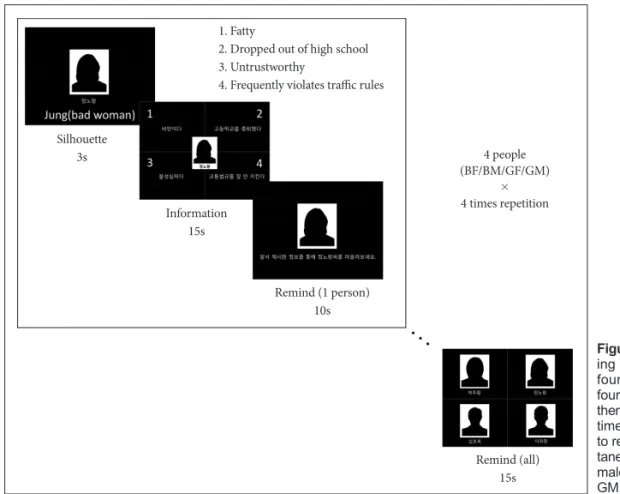
Experiment was done in two phases - attitude making and testing. In attitude making phase, silhouette of person with name was presented for 3 seconds. Then in next screen, 4 in-formation of that person was presented in one screen for 15 seconds and eye movement was tracked to find out pattern of using each information to make attitude. After information providing screen, silhouette of person with name was re-pre-sented and subjects were asked to imagine about that person as detailed as possible to make attitude effectively. This whole process was done for four virtual people each and repeated for four times. Finally, name and silhouette of all virtual people was presented in one screen and participants were asked to imagine about all virtual people (Figure 1). In test phase, ex-plicit attitude was measured by exex-plicit affinity test and be-havior prediction test. Also implicit attitude towards virtual people were measured by Implicit Attitude Test (IAT).
Measurements of attitudes: explicit
Participants answered two post-experiment surveys for final evaluation. The first one asked them to score their preference for each virtual people, using a Likert score with a seven point scale. In the second survey, behaviors in certain situations–for example, he or she kindly got a lost boy to his destination– were given and participants checked how much the virtual person was likely to do such things. A total of six cases were given, three of them were of good actions, while the others
were bad ones. A Likert score with an eleven point scale was used.
Measurements of attitudes: implicit
The Implicit Association Test (IAT)9 was used to detect im-plicit attitudes. We used freeIAT software (http://www4.ncsu. edu/~awmeade/FreeIAT/FreeIAT.htm) modifying some set-tings. Two sets of IAT tests, one for a virtual male, and another one for a virtual female were designed to measure the differ-ence of implicit attitudes formation between good and bad virtual person. Test were consisted of five blocks with twenty-stimuli each. Stimuli were consisted of 16 positive or negative words (eight each), silhouette, first name and last name and of each virtual people. Stimulus were presented on center of screen and participants were asked to making judgment of stimulus category which appeared on right and left side of screen by pressing ‘d’ for left or ‘k’ for right. Only data of block 3 and 5 were analyzed, which made judgment the stimulus of combined category. For example, in block 3 (congruent block), participants decided whether freedom belongs to category 1 (good man or positive word) or category 2 (bad man or nega-tive word). However, in block 5 (incongruent block), same stimulus was categorized to category 1 (good man or negative word) and category 2 (bad man or positive word). If a partic-ipant have positive or negative attitudes toward a virtual peo-ple, they would feel it hard to categorize the stimuli of block 5 than block 3. Therefore that difficulty of categorization would
have made reaction time or error rate greater in trial 5 than trial 3. For these reasons IAT test results were scored using an improved scoring algorithm which considered the response time difference between trial 3 and 5 and the error rate dif-ference as an index of implicit attitudes. These scores are called ‘D score’ and it has possible range from -2 to +2. Break points for ‘slight’ (0.15), ‘moderate’ (0.35) and ‘strong’ (0.65) were selected by previous study.10 Also we applied Student’s t test to D score to determine the existence of significant implicit attitude formation.
Eye tracking
To investigate the degree of participants’interest in each piece of information, eye movements were recorded during the information giving stage of the experiment using a Sen-soMotoric Instruments (SMI) REDmx Scientific eye tracker. The eye tracker recordings were taken from both the eyes of the participants’with 60 Hz frequency. The spatial accuracy of the eye tracker was better than 0.05 degrees. Participants were initially calibrated for recording eye position with the SMI eye tracker, and their eye movements were recorded un-til the end of the information giving session. Because the 4 in-formation were presented in each quadrant of the screen, the total eye gaze time on each quadrant of the screen was calcu-lated using the eye tracker, and this time was used as the in-formation reading time (IRT). We analyzed the sums IRT of all sessions, which we called the total information reading
Silhouette 3s Information 15s Remind (1 person) 10s Remind (all) 15s 1. Fatty
2. Dropped out of high school 3. Untrustworthy
4. Frequently violates traffic rules
4 people (BF/BM/GF/GM)
× 4 times repetition
Figure 1. Experimental design of mak-ing attitudes. Participants were given four kinds of information about each four virtual people and reminded about them. This process was repeated for four times. Finally, participants were asked to remind about all virtual people simul-taneously in the last screen. BF: bad fe-male, BM: bad fe-male, GF: good fefe-male, GM: good male.
time (TIRT), and then the IRT of each information giving session to discover varying tendencies of the IRT distribution over repetition.
Statistical analysis
To measure the effects of our paradigm on explicit affinity scores of four virtual people, we used a 2 (virtual person’s posi-tive/negative impression) by 2 (gender of virtual person) anal-ysis of variance (ANOVA). The differences in possibility of action among four people were also evaluated using a 2 by 2 ANOVA. In addition, the relationship between the affinity score and the possibility of action was measured using a par-tial correlation analysis. To analyze eye tracker data, 2 (virtual person’s positive/negative impression) by 2 (gender of virtual person) by 4 (information) ANOVA was used to determine the difference of TIRT and IRT of each session. Post-hoc anal-ysis was performed with an independent two sample t test for all ANOVA results. The sex of the subjects was used as a co-variate of all the analyses. All statistical tests were performed with ‘R version 3.1’ (http://www.r-project.org/) and a signifi-cant threshold of p<0.05 was used.
RESULTS
Explicit attitudes
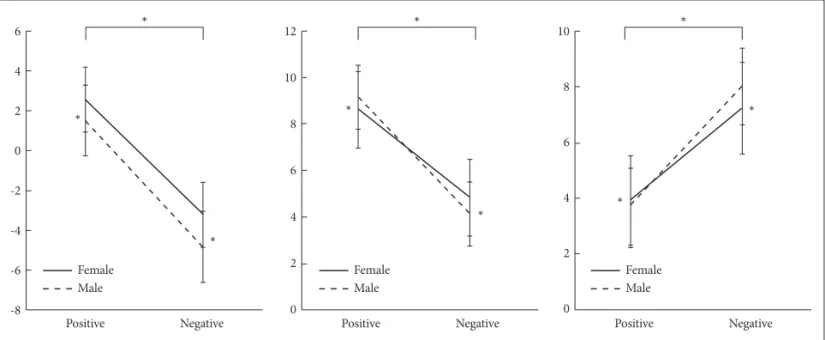
Explicit attitudes were measured with changes in affinity score between before and after exposure to information about the virtual person. In the affinity score, 2-factor, 2-level ANO-VA (Figure 2) showed significant main effects of both the virtual person’s polarity (positive/negative) of the applied in-formation [F (1, 111)=343.340, p<0.001] and the virtual
per-son’s sex [F (1, 111)=17.170, p<0.001]. But there was no inter-action [F (1, 111)=0.424, p=0.516] between them. Positive, compared with negative, information significantly increased affinity scores in both virtual men [t (56)=13.437, p<0.001] and women [t (56)=12.780, p<0.001] in an independent two sam-ple t test. Interestingly, the increment of affinity score elicited with positive information was significantly higher in virtual women than men [t (56)=2.833, p=0.006]. In contrast, the dec-rement of the affinity score by negative information was more remarkable in virtual men than women [t (56)=3.048, p= 0.004].
In the survey for expectation of doing positive or negative behaviors after exposure to the four kinds of information about the virtual person (Figure 2), there were significant main effects of the polarity of the applied information on the scores of negative behavior expectation [F (1, 111)=134.465, p<0.001] and positive behavior expectation [F (1, 111)= 189.699, p<0.001]. No interaction between valence and sex of the virtual person was shown in the negative behavior ex-pectation, but marginal interaction was shown in the positive behavior expectation [F (1, 111)=3.801, p=0.054]. Similar to the affinity score, virtual people with positive information were anticipated to perform positive behavior in virtual wom-en [t (56)=8.067, p<0.001] and mwom-en [t (56)=11.665, p<0.001] and virtual people with negative information were anticipat-ed to perform negative behavior in virtual women [t (56)= 7.355, p<0.001] and men [t (56)=8.912, p<0.001].
Implicit attitudes
D score of virtual men, 0.237, was higher than the break point for slight implicit attitude formation of 0.15, but the
6 4 2 0 -2 -4 -6 -8 10 8 6 4 2 0 12 10 8 6 4 2 0 Positive Negative * * * * * * * * * Positive Negative Positive Negative Female
Male FemaleMale FemaleMale
Figure 2. Changes in explicit attitudes to a virtual person. Affinity score result (left) shows a significant main effect in valence and gender of virtual people (both p<0.001). In behavior prediction results (middle and right), prediction toward virtual people varied by their valence (p<0.001) but not by gender. *p<0.05.
score of women, 0.042, was not. Statistical analyses with t-test also showed significant implicit attitude formation in D score of virtual men [t (28)=3.913, p<0.001], but not in women [t (28)=0.740, p=0.465]. To verify the difference of IAT results between men and women, we compared the reaction time and error rate each. In paired t-test for evaluating the reaction time difference between block 3 and 5, the reaction time was significantly delayed in block 5 than 3 in men [t (28)=2.102, p=0.045]. However, this delay was not found in women [t (28)=0.767, p=0.449]. Error rate did not show significant dif-ference in both virtual men [t (28)=-1.434, p=0.163] and women [t (28)=-0.166, p=0.869], which indicates that reac-tion time difference mainly affected the difference of D score. Although participant’s sex was added as a covariate, the sig-nificant gender effect of virtual people on D score was sur-vived [F (1, 55)=0.229, p=0.024]. But there were neither signif-icant effect of participant’s sex [F (1, 55)=5.424, p=0.634], nor interaction between gender effect of virtual people and par-ticipants [F (1, 55)=0.262, p=0.61].
The relationship between explicit and implicit
attitudes
Partial correlation analysis was performed to measure de-pendency between implicit and explicit attitudes. Because our IAT scores measure the implicit attitude difference be-tween good and bad virtual people, the difference of affinity score between good and bad virtual people was used as an ex-plicit attitude score. There was no significant correlation be-tween the two scores in virtual men [r (26)=0.178, p=0.366] and women [r (26)=0.061, p=0.758].
Information reading time in eye tracking
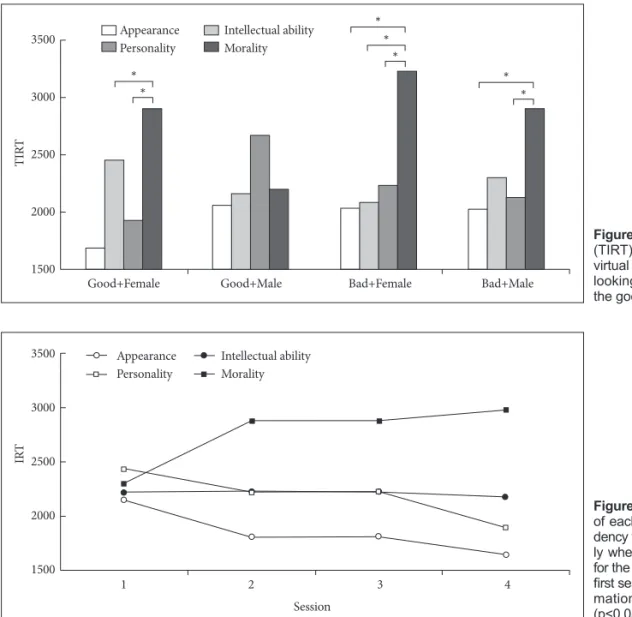
In our eye tracking data, the 2 by 2 by 4 (sex, the polarity of the applied information and aspect) ANOVA of TIRT (Fig-ure 3) showed significant main effect of aspects [F (3, 447)= 9.778, p<0.001]. And the sex of virtual people and the kind of information showed a marginal level of interaction [F (3, 447)=2.549, p=0.055]. In post-hoc analysis (Figure 3), gazing time on morality information was significantly longer than all other information in almost all virtual persons except the good man (all p<0.05) in an independent two sample t-test,
3500
3000
2500
2000
1500
Good+Female Good+Male Bad+Female
Appearance Intellectual ability Personality Morality * * * * * * * Bad+Male
Figure 3. Total information reading time (TIRT) on four kinds of aspects about virtual persons, people spent most time looking at morality information except the good male. *p<0.05.
TIR T 3500 3000 2500 2000 1500 1 2 3 Session Appearance Intellectual ability Personality Morality
4
Figure 4. Information reading time (IRT) of each session, people showed a ten-dency to gaze at all the information even-ly when they were provided information for the first time (session 1), but after the first session, the IRT of the morality infor-mation was dominant in all sessions (p<0.05 in session 2, 3, and 4).
except the morality of the good man and other information (p>0.05), and difference between intellectual ability and mo-rality of the bad man [t (56)=1.290, p=0.202] and the good woman [t (56)=0.151, p=0.880]. Also, in the post-hoc analy-sis of interaction, significant interaction between the sex of the virtual people and the kind of information appeared in the bad man and the bad woman pair [F (3, 223)=5.188, p<0.05] and the good man and the bad woman pair [F (3, 223)= 3.434, p<0.05].
In addition, in the same design ANOVA of IRT (Figure 4) of each piece of information showed no effect of aspects in session 1 [F (3, 447)=0.499, p=0.683], but significant effect of aspects were seen in the following sessions (all p<0.05) (Table 1). Post hoc analysis using an independent t-test showed that the IRT of morality information was longer than almost all other information in sessions 2, 3, and 4 (all p<0.05, except two t-test that showed marginal level of significance) (Table 2).
In the partial correlation analysis of the eye tracker result with the explicit preference score and the Implicit Association Test (IAT), none of them showedsignificant correlation.
DISCUSSION
Our results showing a significant difference in the explicit
affinity test score between good and bad and reporting the ex-pectation of positive behavior on positive virtual people indi-cate that explicit attitudes about virtual people can be formed with four fragmentary pieces of information. Our eye tracker data suggested that morality is the most important type of information in forming explicit affinity about a virtual person. However, IAT results showing a weak meaningful change only in men and not in woman suggested a gender effect of the fast changes in implicit attitudes.
According to the APE model, the formation of our explicit and implicit attitudes can be explained in two ways–top down or bottom up. The first possibility is that dominant explicit attitudes influence implicit attitudes by top-down process.11 A previous study reported this kind of attitude formation, which means that a proposition regarded as valid activates associated similar mental representations and induces im-plicit attitudes change.12 In our experiment, information like ‘Frequently violates traffic rules’ which is meaningful enough to infer about person, would be evaluated using a pre-exist-ing proposition and resulted negative explicit attitudes. In the imagination screen, mental representations associated with these negative propositions would arise in participants’ minds that affect implicit and explicit attitudes formation. And rep-etition strengthens these processes. The second possibility is Table 1. ANOVA of TIRT (of each session)
Session df MS F p
Session 1 3, 447 1.705×10⁶ 0.499 0.683
Session 2 3, 447 2.252×10⁷ 3.742 0.011
Session 3 3, 447 2.256×10⁷ 7.006 0.008
Session 4 3, 447 3.848×10⁷ 9.671 <0.001
ANOVA: analysis of variance, TIRT: total information reading time, df: degree of freedom, MS: mean square
Table 2. Post-hoc analysis of Table 1 (ANOVA of TIRT) with independent t-test
Session Difference df MD SE t p Session 1 M-A 3, 112 46.989 455.594 0.587 0.558 M-I 3, 112 85.386 455.594 0.342 0.733 M-P 3, 112 44.755 455.594 0.552 0.581 Session 2 M-A 3, 112 2118.269 929.457 2.827 0.005 M-I 3, 112 2363.614 929.457 1.748 0.082 M-P 3, 112 142.638 929.457 1.694 0.092 Session 3 M-A 3, 112 1775.000 473.394 4.131 <0.001 M-I 3, 112 578.228 473.394 2.489 0.014 M-P 3, 112 125.966 473.394 2.769 0.006 Session 4 M-A 3, 112 1696.866 488.814 4.522 <0.001 M-I 3, 112 658.221 488.814 2.563 0.011 M-P 3, 112 1321.707 488.814 3.610 <0.001 ANOVA: analysis of variance, TIRT: total information reading time, df: degree of freedom, MD: mean difference, SE: standard error, M: IRT of Morality, A: IRT of Appearance, I: IRT of Intellectual ability, P: IRT of Personality
that implicit attitudes were formed by conditioning with 4 negative or positive sets of information and 4 times of repeti-tion. It is known that a sufficient number of pairing with a strong stimulus can induce implicit attitudes13 and explicit attitudes can be derived from implicit attitudes.5,14 For exam-ple, 4 negative information would create a negative implicit at-titude toward virtual man and this atat-titude would make prop-ositions like ‘I don’t like him,’ which can appear in an explicit affinity test.
In our experimental paradigm, evidences supports top down process. In most of previous studies that showed bottom up process used large number of pairing about several hun-dreds. And these studies showed both strong implicit and explicit attitude5,14 and significant relationship between ex-plicit and imex-plicit tests.15 But in our implicit attitudes results, which were formed weakly only in virtual men and not in virtual woman, are not likely to make significant explicit atti-tudes. Also, there was no significant relationship between ex-plicit and imex-plicit tests. Finally, the imagination process can make or strengthen a weak implicit attitude about virtual men. Previous studies used imagination to change implicit and ex-plicit attitudes.16,17 And, in the studies of impression formation which is similar to attitude formation, showed just seeing in-formation and active impression making with given infor-mation induces different brain responses.18 From these stud-ies, we could infer that imagination using explicit information could make or strengthen implicit attitude differently with just perceiving information. These three pieces of evidenceatten-uates the possibility of bottom up process and support the top-down hypothesis and which means propositional validation of information formed explicit attitudes and even seems to have influenced implicit attitudes.
During propositional learning, people selectively search for information that supports the validity of their proposi-tion.19 Therefore, if some information is regarded as more im-portant in forming explicit attitudes, people would selectively search for this information after explicit attitudes are made. Our eye tracking data of each session showed that subjects spent an equal amount of time gazing at each piece of infor-mation during the first session. However, after the first ses-sion, people spent more time on moral information than oth-er information. We hypothesized that in first session people made explicit attitudes mostly based on moral information. Therefore, in the subsequent sessions, people spent more time looking at moral information which supports explicit attitudes toward person than other. Several studies reported that moral information is the most important one in impres-sion formation20 and making evaluation.21 Taken together, we can infer that moral information is most meaningful one in making attitudes.
There are some limitations to our study. First, although our results showed gender effect of IAT and we verified the factors that can cause this effect, this it is hard to confirm the differential implicit attitude formation toward men and wom-en because of small number of participants. Second, although we supported the top down process of making implicit atti-tude, it was hard to quantifying the effect of top down process in our experiment, because we didn’t controlled the duration or number of imagination and information. Therefore, consid-ering first and second limitation, future experiment should clarify the different implicit attitude formation by top down process toward men and women while controlling the effect of top down process by differentiating imagination condition. And this experiment should include sufficient number of subject to get enough statistical power and to see various group effect. Also, culture and ethnicity could affect the formation of attitudes. Further studies in subjects with multicultural back-grounds are needed to generalize our results.
In the past, people usually were exposed to information of limited number of people for long time. In these condition, which is similar to large number of pairing with various kind of information about a person, one could developproper im-plicit and exim-plicit attitude toward person. However, people in these days are frequently exposed to short pieces of informa-tion about someone which is meaningful but superficial. Our results suggested that these short and fragmentary amounts of information with imagination can make people to form explicit attitudes and even implicit attitudes, toward the per-son. This means that we might like or dislike a person deep in our mind even though we know only little of him/her. This would create biased judgment about him, even in situations that are not related to the given information. We believe our study provides beneficial evidence about how attitudes are formed in current social circumstances.
Acknowledgments
This study was supported by grant for KAIST Future Systems Healthcare Project from the Ministry of Education, Science and Technology (N10150017, N01150030 to B Jeong).
REFERENCES
1. Greenwald AG, Banaji MR. Implicit social cognition: attitudes, self-es-teem, and stereotypes. Psychol Rev 1995;102:4-27.
2. Greenwald AG, Poehlman TA, Uhlmann EL, Banaji MR. Understand-ing and usUnderstand-ing the Implicit Association Test: III. Meta-analysis of pre-dictive validity. J Pers Soc Psychol 2009;97:17-41.
3. Gawronski B, Bodenhausen GV. Associative and propositional pro-cesses in evaluation: an integrative review of implicit and explicit atti-tude change. Psychol Bull 2006;132:692-731.
4. Sritharan R, Gawronski B. Changing implicit and explicit prejudice. Social psychology. 2010;41:113-123.
5. Olson MA, Fazio RH. Implicit attitude formation through classical conditioning. PsycholSci 2001;12:413-417.
6. Rydell RJ, McConnell AR. Understanding implicit and explicit attitude change: a systems of reasoning analysis. J Pers Soc Psychol 2006;91: 995-1008.
7. Fazio RH, Jackson JR, Dunton BC, Williams CJ. Variability in automatic activation as an unobtrusive measure of racial attitudes: a bona fide pipeline? J Pers Soc Psychol 1995;69:1013-1027.
8. Moran T, Bar-Anan Y. The effect of object-valence relations on automat-ic evaluation. Cogn Emot 2013;27:743-752.
9. Greenwald AG, McGhee DE, Schwartz JL. Measuring individual dif-ferences in implicit cognition: the implicit association test. J Pers Soc Psychol 1998;74:1464-1480.
10. Greenwald AG, Nosek BA, Banaji MR. Understanding and using the implicit association test: I. An improved scoring algorithm. J Pers Soc Psychol 2003;85:197-216.
11. Gawronski B, Bodenhausen GV. The Associative-Propositional Evalu-ation Model: Operating Principles and Operating Conditions of Evalua-tion. In: Sherman JW, Gawronski B, Trope Y, Editors. Dual-Process Theories of the Social Mind. New York: The Guilford Press, 2014, p. 188-203.
12. Peters KR, Gawronski B. Mutual influences between the implicit and explicit self-concepts: the role of memory activation and motivated reasoning. J Exp Soc Psychol 2011;47:436-442.
13. Amodio DM. The neuroscience of prejudice and stereotyping. Nat Rev Neurosci 2014;15:670-682.
14. De Houwer J, Thomas S, Baeyens F. Association learning of likes and dislikes: a review of 25 years of research on human evaluative condition-ing. Psychol Bull 2001;127:853-869.
15. LeBel E, Gawronski B. Reasons versus feelings: Introspection and the relation between explicit and implicit attitudes. Poster presented at the 7th Annual Meeting of the Society for Personality and Social Psycholo-gy, Palm Springs, CA; 2006.
16. Turner RN, Crisp RJ. Imagining intergroup contact reduces implicit prejudice. Br J Soc Psychol 2010;49:129-142.
17. Vezzali L, Capozza D, Giovannini D, Stathi S. Improving implicit and explicit intergroup attitudes using imagined contact: an experimental intervention with elementary school children. Group Process Intergr Relat 2011;15:203-212.
18. Mitchell JP, Macrae CN, Banaji MR. Encoding-specific effects of social cognition on the neural correlates of subsequent memory. J Neurosci 2004;24:4912-4917.
19. Kunda Z. The case for motivated reasoning. Psychol Bull 1990;108: 480-498.
20. Brambilla M, Sacchi S, Rusconi P, Cherubini P, Yzerbyt VY. You want to give a good impression? Be honest! Moral traits dominate group impression formation. Br J Soc Psychol 2012;51:149-166.
21. Wojciszke B, Bazinska R, Jaworski M. On the dominance of moral cat-egories in impression formation. Pers Soc Psychol Bull 1998;24:1251-1263.