Y.-S. Jeong et al. (eds.), Ubiquitous Information Technologies and Applications, Lecture Notes in Electrical Engineering 280,
51 DOI: 10.1007/978-3-642-41671-2_8, © Springer-Verlag Berlin Heidelberg 2014
Reliable Transmission for Remote Device Management
(RDM) Protocol in Lighting Control Networks
Sang-Il Choi1, Sanghun Lee1, Seok-Joo Koh1, Sang-Kyu Lim2, Insu Kim2, and Tae-Gyu Kang2
1
Kyungpook National University, South Korea
2 Electronics Telecommunications Research Institute, South Korea {overcycos,lah1290}@gmail.com, [email protected],
{sklim,iskim,tgkang}@etri.re.kr
Abstract. The Remote Device Management (RDM) protocol is used to manage
lighting devices in the lighting control network. RDM provides bi-directional communication between lighting devices based on the modified DMX512 data link so as to perform device discovery, configuration, monitoring, and management of the devices connected through the DMX512 network. However, the RDM protocol does not provide a reliable packet transmission. To overcome this limitation, we propose the two retransmission schemes: sequence-based retransmission, and timer-based retransmission. In the existing RDM protocol, each response packet uses the same Transaction Number (TN) with that of the request packet from the controller. In the proposed schemes, we use TN to identify a lost or error message. For example, if a response packet with a specific TN number does not arrive within a pre-specified time, the controller will retransmit the concerned request message. From the numerical analysis, it is shown that the proposed retransmission schemes can give better reliability than the existing RDM protocol, and the sequence-based and timer-based retransmission schemes provide the different performance, depending on network environments.
Keywords: RDM, Lighting Devices, Retransmission, Reliability.
1
Introduction
One of the primary issues on the lighting control system is how to effectively control a lot of lighting devices in the network [1]. Some protocols for control of lighting devices have so far been made in the PLASA Technical Standards Program (TSP) [2], which include the Digital Multiplex 512-A (DMX512-A) and the Remote Device Management (RDM) [3, 4].
The RDM protocol provides the device discovery, configuration, monitoring, and management of console or other controlling devices connected through a DMX512 network. The RDM protocol is based on the pulling system. That is, only the controller can first initiate communication, and the devices will respond to the request of controller. However, in the RDM protocol, there is no retransmission mechanism. So, any error or loss of packet will not be recovered. From this reason, if the status of
the DMX512 network becomes worse with a large packet error rate, the controller cannot manage the lighting devices effectively due to the error or loss of the request or response packets.
To address this limitation, in this paper, we propose the two retransmission schemes for RDM protocol. The proposed retransmission schemes can be used to effectively provide reliable packet transmission in the RDM protocol, compared to the existing RDM protocol, as done in the Transmission Control Protocol [5].
This paper is organized as follows. Section 2 describes the data transmission mechanisms of the existing RDM protocol. In Section 3, we describe the proposed two retransmission schemes for RDM. Section 4 analyzes and compares the existing and proposed schemes in terms of the reliability and performance. Section 5 concludes this paper.
2
Packet Transmission Mechanisms in RDM
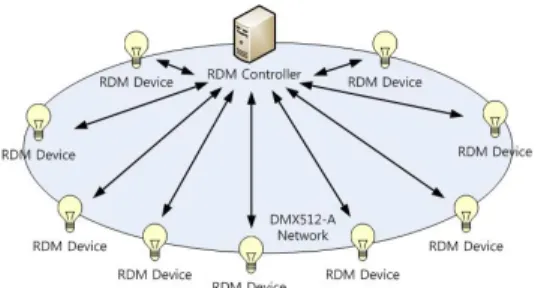
In RDM, each communication is only performed between controller and devices, and it is assumed that there is only one controller in the network and all devices are managed by the controller. Fig. 1 shows the network model of the RDM protocol in the lighting control networks.
Fig. 1. Network model of RDM in lighting control networks
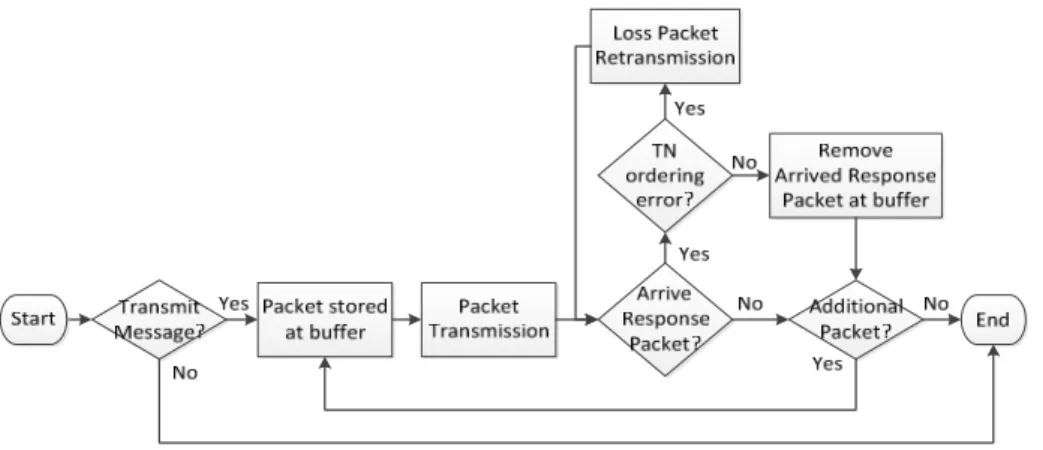
In the existing RDM protocol, there is no packet retransmission process. Fig. 2 shows the packet transmission mechanism of the existing RDM Protocol.
Fig. 2. Packet transmission of the existing RDM protocol
First, if the controller has a message to send, it makes a request packet including the associated control information and sends it to the device over the DMX512 data link. Then, the controller waits for the response packet from device for a specific time
(e.g., 2.1mS). If there is no response message in a specific time, the controller will decide that the response packet is lost and may send the request packet again. However, if the response packet arrives from devices, the controller just checks the Transaction Number (TN) field of the response packet to map between a request packet and a response packet and the checksum field to determine whether the packet has any error. After the reception of the response packet is completed, the controller resumes sending the request packets. When the controller has no additional request packet to send, the data transmission process is completed. As shown in Fig. 2, the existing RDM protocol has no consideration for recovery of the lost or error packets. Thus, if there are some errors in the response packet, the controller will just check an error using the checksum field. The controller does not attempt to recover the errors. Fig. 3 summarizes the data transmission procedures of the existing RDM scheme.
Fig. 3. Procedure for data transmission of existing RDM scheme
In addition, in the RDM protocol, there is a negative acknowledgement (NACK) packet to indicate that the responder is unable to reply with the requested command, and this NACK packet includes a reason for the error. However, after receiving the NACK packet, there is no retransmission process to recover the error packet. The NACK-based retransmission scheme may be considered for the RDM protocol. However, we do not discuss this scheme in this paper, because this scheme is only performed at a packet format error condition and cannot handle the packet loss condition.
3
Proposed Retransmission Schemes
To provide the reliable packet transmission for RDM, we propose the two retransmission schemes: sequence-based and timer-based schemes. For each scheme, we use the TN field of RDM packet. In addition, we define a buffer in the controller for temporarily storing packets for retransmission in the event of packet loss or error.
3.1 Sequence-Based Retransmission
In the sequence-based retransmission scheme, only the TN of a response packet is used. In this case, the packet retransmission is only performed when the order of TN contained in the response packet indicates a loss or error. With this concept, after only the further subsequent response packet arrives at the controller, the retransmission of previous packet can begin. Fig. 4 shows the packet retransmission mechanisms of the sequence-based retransmission scheme.
Fig. 4. Sequence-based retransmission scheme
First, if the controller has a message to send, it makes a request packet including the control information, temporarily stores the packet in the buffer, and then it sends the request packet over the DMX512 data link. Then, the controller waits for the response packet from the device. It is expected that the response packet has the same TN with that of the request packet that the controller sent. In this scheme, we focus on the loss of request or response packet, so we do not consider the reception of corrupted packet. If the response packet does not arrive, the controller waits for a specific time (2.1mS) and checks additional messages for device. On the other hand, if a response packet arrives from the device, the controller checks the order of TN for the response packet. After checking the order of TN, if the associated TN is different from the expected value of sequence counter at controller, it performs the retransmission of the lost request packet. On the other hand, in the successful reception case, the controller will remove the packet stored in the buffer. When the controller has no additional request packet to send, the data transmission process is completed.
Fig. 5 summarizes the data transmission procedures for the sequence-based retransmission scheme.
3.2 Timer-Based Retransmission
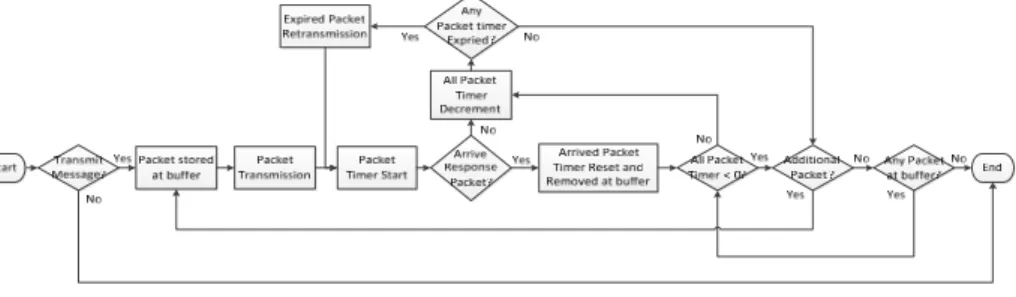
In the timer-based retransmission scheme, we use the TN of the response packet with temporary buffering. In addition, we define a retransmission timer for retransmission of each lost packet at the controller. This retransmission scheme also focuses on the packet loss rather than the packet error, as done in the sequence-based retransmission scheme. So, the packet retransmission is only performed when the retransmission timer is expired by a packet loss. Fig. 6 shows the packet transmission flow in the timer-based retransmission scheme.
Fig. 6. Packet transmission flow in the timer-based retransmission scheme
If the controller has a message to send, it stores the packet in the buffer, and sends it over the DMX512 data link. Then, the controller activates the retransmission timer for the transmitted request packet and waits for the response packet. If the associated response packet arrives before the retransmission timer is expired, the controller will process the response message successfully. Otherwise, if the response packet does not arrive with the retransmission time interval, the controller confirms that the request packet is lost for any reason, and the request packet will be retransmitted by the controller. Fig. 7 summarizes the data transmission procedure in the timer-based retransmission scheme.
4
Performance Analysis by Simulation
To evaluate the performance of the proposed retransmission schemes, we analyze the reliability and the packet transmission completion for the existing RDM protocol, the sequence-based retransmission scheme, and the timer-based retransmission scheme in various network conditions.
We define the parameters used for analysis in Table 1.
Table 1. Parameters used for numerical analysis
Parameter Description
Na Total number of ‘a‘(e.g., Npacket : number of total transmitted packet) Rb Ratio of ‘b‘ (e.g., Rloss : loss ratio of DMX512 link)
Tc
Time value of ‘c‘(e.g., Ttimer : timer period of controller, Tpacket : packet generation interval by controller)
For numerical analysis, we made the simulation code for each scheme by using the MATLAB [6]. In the analysis, we set a single request-response transation time over the DMX512-A link as 2.1mS + 3.484mS = 5.584mS by referring to [6].
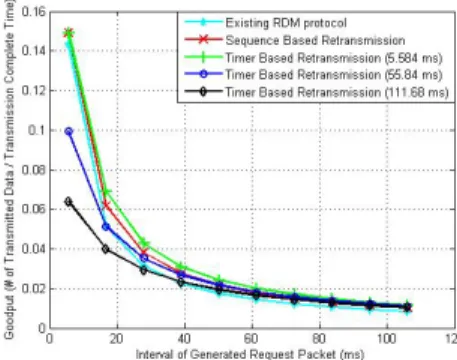
Fig. 8 shows the impact of the request packet generation time interval at the controller on goodput. The goodput is defined as the number of successfully transmitted data packets divided by the total transmission completion time. In this figure, the timer-based retransmission schemes give lower goodput performance because the timer-based schemes tend to spend so long time to recover the lost packets by using a long retransmission timer. However, as the packet generation time interval gets larger, all retransmission schemes show better goodtput than the existing RDM protocol.
Fig. 9 shows the impact of the packet loss rate on goodput. In this figure, as the packet loss rate increases, the existing RDM protocol provides the lowest goodput performance. This is because the goodput is decreased with more packet losses. Among the candidate retransmission schemes, the sequence-based retransmission and the timer-based retransmission (with the retransmission timer of 5.584ms) schemes show better performance than the other schemes.
Fig. 9. Impact of packet loss rate on goodput
Fig. 10 shows the impact of the packet generation time interval on the transmission completion time. In this figure, we can see that the timer-based retransmission scheme (with the timer of 111.68ms) shows the longest transmission completion time due to the long recovery time. We can also see that the sequence-based retransmission scheme gives the performance between the two timer-based schemes with the timer of 5.584ms and the timer of 55.84ms.
Fig. 10. Impact of packet generation interval on transmission completion time
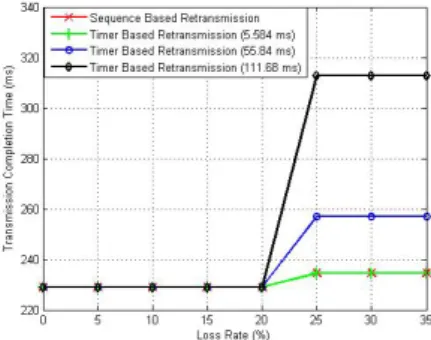
Fig. 11 shows the impact of the packet loss rate on the transmission completion time. In this figure, it is shown that the sequence-based scheme provides the same performance with the timer-based scheme with the timer of 5.584ms, and those two schemes give better performance than the other two schemes, when the packet loss rate is greater than 20%.
From the analysis, we see that the proposed sequence-based and timer-based retransmission schemes can recover the lost packets effectively and provide the reliable transmission in the lossy network. Among the candidate retransmission schemes, the sequence-based retransmission scheme gives robust and better performance than the timer-based schemes. However, if we set the retransmission timer more appropriately, the timer-based scheme can be used more effectively.
5
Conclusions
In this paper, we proposed the two retransmission schemes for the RDM protocol: sequence-based retransmission and timer-based retransmission. The sequence-based scheme is based on the Transaction Number of the request packet, whereas the timer-based scheme uses the retransmission timer.
By numerical analysis, the proposed retransmission schemes are compared with the existing RDM protocol in terms of reliability and transmission completion time. From the results, it is shown that the retransmission schemes can recover the lost packet effectively in the lossy network. Among the candidate retransmission schemes, the sequence-based retransmission scheme gives robust and better performance than the timer-based schemes. However, if we set the retransmission timer more appropriately, the timer-based retransmission scheme can provide the best performance.
Acknowledgment. This research was supported by the MSIP support program of
NIPA (NIPA-2013-H0301-13-2004), and ICT Standardization program of MSIP (Ministry of Science, ICT & Future Planning).
References
1. Roo, Y.-S., Jang, W.-C.: Implementation of Ubiquitous Lighting Network System Using Embedded Linux. In: Proceeding of the Institute of Electronics Engineers of Korea, pp. 613–614 (2007)
2. Professional Lighting And Sound Association (PLASA), http://tsp.plasa.org/ 3. American National Standard Institute(ANSI), Asynchronous Serial Digital Data
Transmission Standard for Controlling Lighting Equipment and Accessories, American National Standard E1.11 (2008)
4. American National Standard Institute(ANSI), Remote Device Management Over DMX512 Networks, American National Standard E1.20 (2006)
5. Cerf, V.G., Kahn, R.E.: A Protocol for Packet Network Intercommunication. IEEE Transaction on Communications Com-22(5) (1974)