저작자표시-비영리-변경금지 2.0 대한민국 이용자는 아래의 조건을 따르는 경우에 한하여 자유롭게 l 이 저작물을 복제, 배포, 전송, 전시, 공연 및 방송할 수 있습니다. 다음과 같은 조건을 따라야 합니다: l 귀하는, 이 저작물의 재이용이나 배포의 경우, 이 저작물에 적용된 이용허락조건 을 명확하게 나타내어야 합니다. l 저작권자로부터 별도의 허가를 받으면 이러한 조건들은 적용되지 않습니다. 저작권법에 따른 이용자의 권리는 위의 내용에 의하여 영향을 받지 않습니다. 이것은 이용허락규약(Legal Code)을 이해하기 쉽게 요약한 것입니다. Disclaimer 저작자표시. 귀하는 원저작자를 표시하여야 합니다. 비영리. 귀하는 이 저작물을 영리 목적으로 이용할 수 없습니다. 변경금지. 귀하는 이 저작물을 개작, 변형 또는 가공할 수 없습니다.
Master’s Thesis in Medicine
The Usefulness of Multiple Rapid
Swallows and Semi-solid Swallows
for Evaluation of Esophageal Motor
Function in Endoscopy-negative
Patients with Esophagopharyngeal
Symptoms
Graduate School of Ajou University
Department of Medical Sciences
The Usefulness of Multiple Rapid
Swallows and Semi-solid Swallows
for Evaluation of Esophageal Motor
Function in Endoscopy-negative
Patients with Esophagopharyngeal
Symptoms
Kwang Jae Lee, Advisor
I submit this thesis as the Master’s thesis in Medicine.
August, 2020
Graduate School of Ajou University
Department of Medical Sciences
The Master’s thesis of Yoo Hyun Jeong in Medicine
is hereby approved.
Thesis Defense Committee chair
Kwang Jae Lee Seal
Member Jae Yeon Jung Seal
Member Sung Jae Shin Seal
Graduate School of Ajou University
i -ABSTRACT-
The Usefulness of
Multiple Rapid Swallows and Semi-solid Swallows
for Evaluation of Esophageal Motor Function
in Endoscopy-negative Patients with
Esophagopharyngeal Symptoms
Background: The evaluation of esophageal motor function is generally based on high resolution manometry (HRM) with single water swallows. We aimed to evaluate whether multiple rapid swallows (MRS) and semi-solid swallows can increase diagnostic yield for esophageal motility disorders in endoscopy-negative patients with esophagopharyngeal symptoms.
Methods: Consecutive endoscopy-negative patients with
esophageal or pharyngeal symptoms who underwent HRM using a water perfused system were enrolled in the study. The patients were asked to perform 10 swallows of 5 mL water, followed by MRS (Study 1), and 10 swallows of 5 mL water, followed by 10 swallows of 5 mL semi-solid yoghurt (Study 2). Hypocontractile motility disorders were classified into mild ineffective esophageal
ii
motility (IEM), severe IEM (>70% ineffective sequences), and absent contractility.
Results: Study 1 and 2 were conducted in 240 patients (53.3±15.5 years, 50% female) and 154 patients (52.2±15.7 years, 50.6% female), respectively. Abnormal MRS responses were observed in 45.6% of patients with normal HRM diagnosis, 72.7% of patients with mild IEM, 83.8% of patients with severe IEM, 100% of patients with absent contractility, 73.1% of patients with esophagogastric
junction (EGJ) outflow obstruction, and 87.5% of patients with hypercontractile esophagus, 50% of patients with diffuse
esophageal spasm (DES), and 75% of patients with achalasia. In HRM using viscous yoghurt swallows, HRM diagnosis was changed in 17.9 % of patients with normal HRM diagnosis, 66.7% of patients with mild IEM, 21.9% of patients with severe IEM, 50% of patients with absent contractility, 15% of patients with EGJ outflow obstruction, 50% of patients with DES, and 50% of patients with achalasia.
Conclusions: MRS and semi-solid yoghurt swallows can increase the diagnostic yield for esophageal motility disorders, and provide clinically relevant information for esophageal motor function in patients with esophageal or pharyngeal symptoms who don’t have no remarkable findings on EGD.
iii
Keywords: Esophageal symptom, Esophageal motility disorder, High resolution manometry, Multiple rapid swallows, Semi-solid swallo- ws
iv
TABLE OF CONTENTS
ABSTRACT ··· i
TABLE OF CONTENTS ···iv
LIST OF FIGURES ··· vi
LIST OF TABLES ··· vii
I. INTRODUCTION··· 1
II. SUBJECTS AND METHODS··· 3
A. Subjects ···3
B. High resolution manometry ···3
C. Data analysis ··· 4 III. RESULTS··· 6 A. Demographics ··· 7 B. Study 1··· 11 C. Study 2··· 14 IV. DISCUSSION ···15 V. CONCLUSION ··· 19 REFERENCES ··· 20
v
(APPENDINX)···23 국문요약 ··· 25
vi
LIST OF FIGURES
Figure 1. Distribution of patients’ diagnosis in conventional HRM by 10 single water swallows and Chicago classification v.3.0 in the study 1.ㆍㆍㆍㆍㆍㆍㆍㆍㆍㆍㆍㆍㆍㆍㆍㆍㆍㆍㆍㆍㆍㆍㆍㆍㆍㆍㆍㆍ 8
Figure 2. Distribution of patients’ diagnosis in conventional HRM by 10 semi-solid swallows and Chicago classification v.3.0 in the study 2.ㆍㆍㆍㆍㆍㆍㆍㆍㆍㆍㆍㆍㆍㆍㆍㆍㆍㆍㆍㆍㆍㆍㆍㆍㆍㆍㆍㆍ 9
vii
LIST OF TABLES
Table 1. Characteristics of the enrolled patients in the study ㆍㆍ 6
Table 2. Findings of multiple rapid swallowing in the diagnostic groups of conventional high resolution manometry ㆍㆍㆍㆍㆍㆍㆍ 10
Table 3. Findings of high resolution manometry using semi-solid swallows in the diagnostic groups of convetional high resolution manometry using water swallows ㆍㆍㆍㆍㆍㆍㆍㆍㆍㆍㆍㆍㆍㆍㆍ 13
1
I. INTRODUCTION
Patients with esophageal symptoms who do not show positive diagnostic findings on upper gastrointestinal endoscopy are referred for physiologic investigations including esophageal high resolution manometry (HRM). Routine HRM studies are performed in the manner of 10 single water swallows [1]. However, a considerable number of patients who undergo HRM are not diagnosed with specific disorders that explain their symptoms, and often have normal results in manometric studies. Therefore, provocative tests such as multiple rapid swallows (MRS), rapid drink test, and semi-solid or semi-solid swallows have been proposed [2-6].
Swallowing is a series of processes that are composed of opening of upper esophageal sphincter, peristalsis of the esophageal body, and relaxation of esophagogastric junction (EGJ) [7,8]. Abnormali- ties in the function of upper esophageal sphincter, esophageal body, or EGJ relaxation may result in esophageal motility disorders and esophagopharyngeal symptoms. It has been suggested that esopha- geal motility disorders are caused by dysfunction of inhibitory and excitatory neural regulation [1].
MRS provokes an intense central and peripheral neural inhibition resulting in abolition of contractions in esophageal body and
2
prolonged and complete relaxation of the LES, indicating the function of inhibitory neural regulation. The last swallow of the MRS series is followed by a powerful peristaltic sequence in the esophageal body together with a postrelaxation contraction in the LES, suggesting the reserved function of excitatory neural regulation [5,6,9,10]. MRS is considered to be an easy and quick test increasing diagnostic yield for esophageal motility disorders.
Water swallows might not be representative of esophageal function during the ingestion of normal food. Therefore, semi-solid or solid test meals are suggested to increase the diagnostic sensitivity of HRM for the diagnosis of esophageal motility disorders [2,3].
The aim of this study was to investigate whether MRS and semi-solid (viscous yoghurt) swallows can increase diagnostic yield for esophageal motility disorders or provide clinically relevant information for esophageal motor function in endoscopy-negative patients with esophageal or pharyngeal symptoms.
3
II. SUBJECTS AND METHODS
A. Subjects
Consecutive patients with esophageal (chest pain, regurgitation, typical GERD symptoms, and/or dysphagia) or pharyngeal (globus) symptoms who underwent HRM from May, 2017 to May, 2019 at the department of Gastroenterology, Ajou University Hospital because of no remarkable findings on esophagogastroduodenoscopy were enrolled in the study.
B. High resolution manometry
HRM using a 22-channel water perfused system was performed in all study subjects. Distilled water circulated through it at a constant flow of 0.6 ml/min. The luminal diameter of each perfusion capillar was 0.4 mm. Each capillar was oriented radially, spaced at 1 cm in the areas recording the EGJ and 2 cm in the areas of the esophageal body. Pressure changes are transmitted to external transducers that transform the information in electric signals.
The patients were asked to perform 10 swallows of 5 mL water, administered at 20-30 s intervals with the patient in 30o
semi-4
supine position, and then followed by multiple rapid swallow of 50 mL water (Study 1). Subsequently, 10 swallows of 5 mL plain yoghurt (Yoplait) was performed (Study 2). Data was later analyzed with a specific software (Solar GI HRM, MMS, Enschede, The Netherlands).
C. Data Analysis
Interpretation of the HRM findings was based on the Chicago classification ver. 3.0 [1]. Previous studies have demonstrated that the normal values for the water-perfused HRM system were only slightly different from previously published values with solid-state HRM, and moderate to good agreement was observed between the two systems [11,12].
Patients’ diagnosis included achalasia, absent contractality, diffuse esophageal spasm (DES), hypercontractile esophagus, esophagoga- stric junction outflow obstruction (EGJ outflow obstruction or EGJOO), and ineffective esophageal motility [Appendinx 1,2]. Ineffective esophageal motility was arbitrarily subclassified into mild (ineffective contractions < 70%) and severe IEM (ineffective contractions ≥ 70%).
5
If the distal contractile integral (DCI) during MRS was greater than or equal to the DCI at the same location during the last single water swallow, we defined it as incomplete inhibition of body contraction during MRS, that was determined as an abnormal finding in MRS [5,6,9,10]. If the DCI after MRS was less than or equal to the DCI at the same location during the last single water swallow, we defined it as the absence of augmented body contraction after MRS, that was also determined as an abnormal finding in MRS [5,6,9,10]. Abnormality of EGJ relaxation during MRS was defined as the absence of further decrease of the integrated relaxation pressure (IRP) during MRS compared to median IRP during 10 water swallows.
All statistical analyses were performed using the statistical package for the social sciences software version 18.0 (SPSS, Chicago, IL, USA). Continuous variables were compared using Student’s t test, and categorical variables were compared using the
Chi-squared (χ2) test. P-values < 0.05 were considered
6
III. RESULTS
Table 1. Characteristics of the enrolled patients in the study.
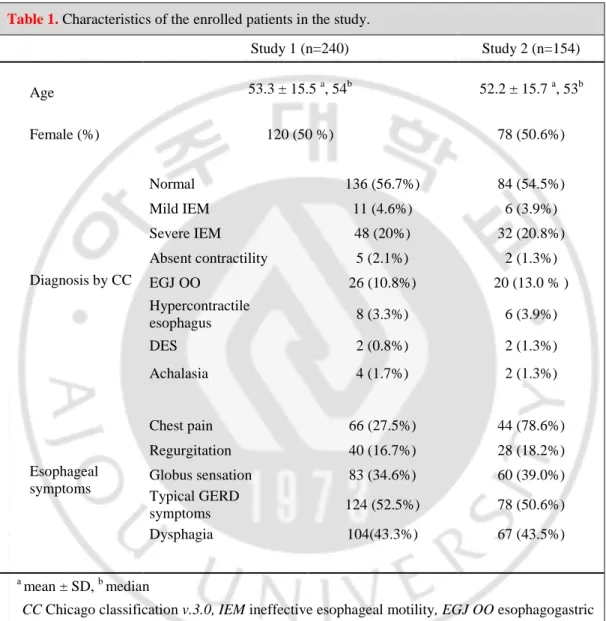
Study 1 (n=240) Study 2 (n=154) Age 53.3 ± 15.5 a, 54b 52.2 ± 15.7 a, 53b Female (%) 120 (50 %) 78 (50.6%) Diagnosis by CC Normal 136 (56.7%) 84 (54.5%) Mild IEM 11 (4.6%) 6 (3.9%) Severe IEM 48 (20%) 32 (20.8%) Absent contractility 5 (2.1%) 2 (1.3%) EGJ OO 26 (10.8%) 20 (13.0 % ) Hypercontractile esophagus 8 (3.3%) 6 (3.9%) DES 2 (0.8%) 2 (1.3%) Achalasia 4 (1.7%) 2 (1.3%) Esophageal symptoms Chest pain 66 (27.5%) 44 (78.6%) Regurgitation 40 (16.7%) 28 (18.2%) Globus sensation 83 (34.6%) 60 (39.0%) Typical GERD symptoms 124 (52.5%) 78 (50.6%) Dysphagia 104(43.3%) 67 (43.5%) a mean ± SD, b median
CC Chicago classification v.3.0, IEM ineffective esophageal motility, EGJ OO esophagogastric
junction outflow obstruction, DES diffuse esophageal spasm, GERD gastroesophageal reflux
7
A. Demographics
Table 1 shows clinical characteristics of the patients including the diagnosis of conventional HRM based on the Chicago classification ver. 3.0.
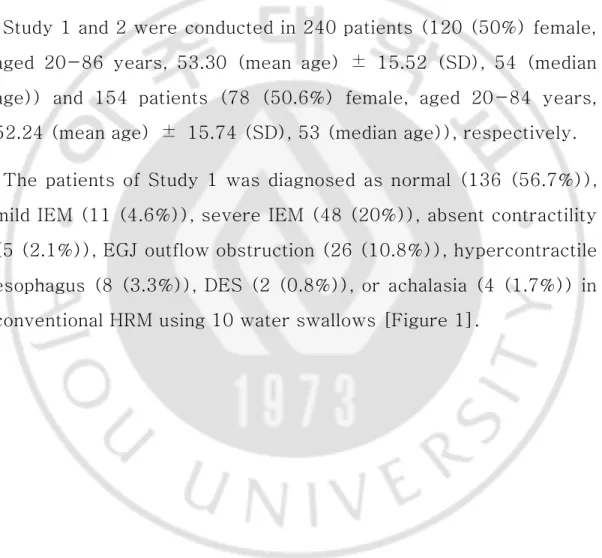
Study 1 and 2 were conducted in 240 patients (120 (50%) female, aged 20-86 years, 53.30 (mean age) ± 15.52 (SD), 54 (median age)) and 154 patients (78 (50.6%) female, aged 20-84 years, 52.24 (mean age) ± 15.74 (SD), 53 (median age)), respectively.
The patients of Study 1 was diagnosed as normal (136 (56.7%)), mild IEM (11 (4.6%)), severe IEM (48 (20%)), absent contractility (5 (2.1%)), EGJ outflow obstruction (26 (10.8%)), hypercontractile esophagus (8 (3.3%)), DES (2 (0.8%)), or achalasia (4 (1.7%)) in conventional HRM using 10 water swallows [Figure 1].
8
The patients of Study 2 was diagnosed as normal (84 (54.5%)), mild IEM (6 (3.9%)), severe IEM (32 (20.8%)), absent contractility (2 (1.3%)), EGJ outflow obstruction (20 (13.0 % )), hypercontra -ctile esophagus (6 (3.9%)), DES (2 (1.3%)), or achalasia (2 (1.3%)) in conventional HRM using 10 water swallows [Figure 2].
9
The patients of Study 1 complained of esophageal symptoms, including chest pain (66 (27.5%)), regurgitation (40 (16.7%)),
typical GERD symptoms (124 (52.5%)), and dysphagia
(104(43.3%)), and pharyngeal symptoms such as globus sensation (83 (34.6%). The patients of Study 2 complained of esophageal symptoms, including chest pain (44 (78.6%)), regurgitation (28 (18.2%)), typical GERD symptoms (78 (50.6%)), and dysphagia
10
(67 (43.5%)), and pharyngeal symptoms such as globus sensation (60 (39.0%)). Duplicate answers of symptoms were allowed.
.
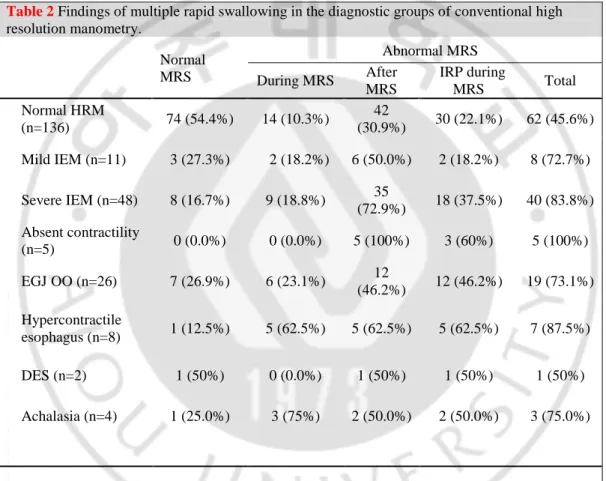
Table 2 Findings of multiple rapid swallowing in the diagnostic groups of conventional high resolution manometry. Normal MRS Abnormal MRS During MRS After MRS IRP during MRS Total Normal HRM (n=136) 74 (54.4%) 14 (10.3%) 42 (30.9%) 30 (22.1%) 62 (45.6%) Mild IEM (n=11) 3 (27.3%) 2 (18.2%) 6 (50.0%) 2 (18.2%) 8 (72.7%) Severe IEM (n=48) 8 (16.7%) 9 (18.8%) 35 (72.9%) 18 (37.5%) 40 (83.8%) Absent contractility (n=5) 0 (0.0%) 0 (0.0%) 5 (100%) 3 (60%) 5 (100%) EGJ OO (n=26) 7 (26.9%) 6 (23.1%) 12 (46.2%) 12 (46.2%) 19 (73.1%) Hypercontractile esophagus (n=8) 1 (12.5%) 5 (62.5%) 5 (62.5%) 5 (62.5%) 7 (87.5%) DES (n=2) 1 (50%) 0 (0.0%) 1 (50%) 1 (50%) 1 (50%) Achalasia (n=4) 1 (25.0%) 3 (75%) 2 (50.0%) 2 (50.0%) 3 (75.0%)
HRM high resolution manometry, MRS multiple rapid swallowing, IRP integrated relaxation pressure, IEM ineffective esophageal motility, EGJ OO esophagogastric junction outflow obstruction, DES diffuse esophageal spasm
11
B.
Study 1: Findings of multiple rapid swallowing in the diagnostic
groups of conventional HRM.
In patients with esophageal symptoms, abnormality of ‘During MRS’, that means incomplete inhibition of body contraction during MRS, was observed in 14 (10.3%) patients with normal HRM diagnosis, 2 (18.2%) patients with mild IEM, 9 (18.8%) patients with severe IEM, 6 (23.1%) patients with EGJ outflow obstruction, 5 (62.5%) patients with hypercontractile esophagus, and 3 (75%) patients with achalasia [Table 2].
Abnormality of ‘After MRS’, that means absence of augmented contraction after MRS, was observed in 42 (30.9%) patients with normal HRM diagnosis, 6 (50.0%) patients with mild IEM, 35 (72.9%) patients with severe IEM, 5 (100%) patients with absent contractility, 12 (46.2%) patients with EGJ outflow obstruction, 5 (62.5%) patients with hypercontractile esophagus, 1 (50.0%) patient with DES, and 2 (50.0%) patients with achalasia [Table 2].
Abnormality of ‘IRP during MRS’, that means no further decrease of IRP during MRS compared to that during 10 water swallows, was observed in 30 (22.1%) patients with normal HRM diagnosis, 2 (18.2%) patients with mild IEM, 18 (37.5%) patients with severe IEM, 3 (60%) patients with absent contractility, 12 (46.2%)
12
patients with EGJ outflow obstruction, 5 (62.5%) patients with hypercontractile esophagus, 1 (50.0%) patient with DES, and 2 (50.0%) patients with achalasia [Table 2].
There were abnormal MRS responses including abnormality of ‘During MRS’, ‘After MRS’, and/or ‘IRP during MRS’in 62 (45.6%) patients with normal HRM diagnosis, 8 (72.7%) patients with mild IEM, 40 (83.8%) patients with severe IEM, 5 (100%) patients with absent contractility, 19 (73.1%) patients with EGJ outflow obstruction, and 7 (87.5%) patients with hypercontractile esophagus, 1 (50.0%) patient with DES, and 3 (75.0%) patients with achalasia [Table 2].
13
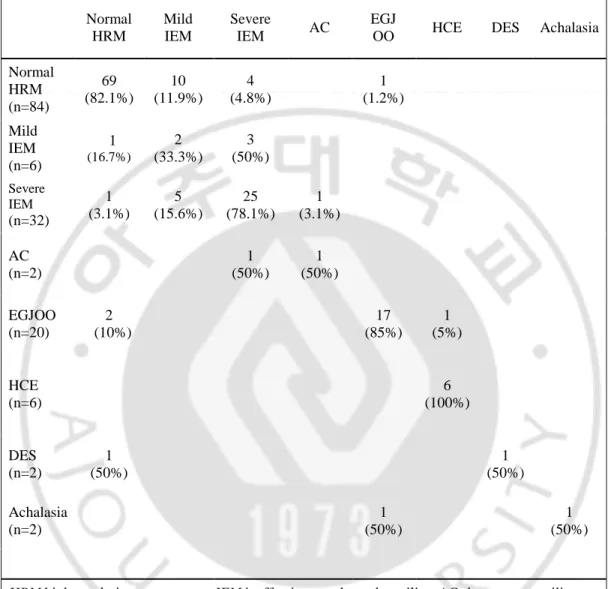
Table 3 Findings of high resolution manometry using semi-solid swallows in the diagnostic groups of conventional high resolution manometry using water swallows.
Normal HRM Mild IEM Severe IEM AC EGJ
OO HCE DES Achalasia Normal HRM (n=84) 69 (82.1%) 10 (11.9%) 4 (4.8%) 1 (1.2%) Mild IEM (n=6) 1 (16.7%) 2 (33.3%) 3 (50%) Severe IEM (n=32) 1 (3.1%) 5 (15.6%) 25 (78.1%) 1 (3.1%) AC (n=2) 1 (50%) 1 (50%) EGJOO (n=20) 2 (10%) 17 (85%) 1 (5%) HCE (n=6) 6 (100%) DES (n=2) 1 (50%) 1 (50%) Achalasia (n=2) 1 (50%) 1 (50%)
HRM high resolution manometry, IEM ineffective esophageal motility, AC absent contractility, EGJOO esophagogastric junction outflow obstruction, HCE hypercontractile esophagus, DES
14
C. Study 2: Findings of HRM using semi-solid swallows in the
diagnostic groups of conventional HRM using water swallows.
In HRM using viscous yoghurt swallows, HRM diagnosis was changed in 15 (17.9%) patients with normal HRM diagnosis (to mild IEM in 10 (11.9%) patients, severe IEM in 4 (4.8%) patients, EGJ OO in 1 (1.2%) patient), 4 (66.7%) patients with mild IEM (to normal HRM in 1(16.7%) patient and severe IEM in 3 (50%) patients), 7 (21.9%) patients with severe IEM (to normal HRM in 1(3.1%) patient, mild IEM in 5 (15.6%) patients, and absent contractility in 1 (50%) patient), 1 (50%) patient with absent contractility (to mild IEM in 1 (50%) patient), 3 (15%) patients with EGJOO (to normal HRM in 2 (10%) patients and hypercontractile esophagus in 1 (5%) patient), none (0%) of patients with hypercontractile esophagus, 1 (50%) patient with DES (to normal HRM in 1 (50%) patient), and 1 (50%) patient with achalasia (to EGJOO in 1 (50%) patient) [Table 3].
15
IV. DISCUSSION
Patients with esophageal symptoms who have no significant findings on esophagogastroduodenoscopy (EGD) are referred for esophageal HRM in order to find the cause of symptoms. Diverse esophageal motility disorders may be diagnosed by conventional HRM, based on the internationally accepted diagnostic criteria, Chicago criteria ver. 3.0 [1]. Diagnosis was made using 10 water swallows in conventional HRM. In the present study, 55.8% of study patients showed normal findings in HRM, although they complained of esophagopharyngeal symptoms. The disadvantage of conventio- nal HRM that normal results are common leads to the requirement of additional tests for further characterization of clinically relevant phenotypes or detecting motor abnormalities in those with normal HRM findings. Our findings of the present study demonstrated that MRS and the ingestion of a semi-solid (viscous yoghurt) bolus was useful additional tests in HRM.
In Study 1, abnormal MRS responses including abnormality of ‘During MRS’, ‘After MRS’, and/or ‘IRP during MRS’in 62 (45.6%) patients with normal HRM diagnosis. This finding indicates that MRS enhances diagnostic yield in HRM. Normally, peristaltic waves do not appear until the last swallows in MRS due to neural
16
inhibition and smooth muscle refractoriness. Incomplete inhibition of body contraction during MRS was observed in 10.3% of patients with normal HRM diagnosis, 18.2% of patients with mild IEM, 18.8% of patients with severe IEM, 23.1% of patients with EGJ outflow obstruction, 62.5% of patients with hypercontractile esophagus, and 75% of patients with achalasia. So, abnormality of inhibitory neural pathway is more likely to be associated with hypercontractile esophagus and achalasia rather than IEM.
The last swallow of MRS is normally followed by powerful peristaltic contractions of the esophageal body, that requires intact excitatory neural pathways and the integrity of the esophageal muscle. In the present study, absence of augmented contraction after MRS was observed in 30.9% of patients with normal HRM diagnosis, 50.0% of patients with mild IEM, 72.9% of patients with severe IEM, 100% of patients with absent contractility, 46.2% of patients with EGJ outflow obstruction, 62.5% of patients with hypercontractile esophagus, 50.0% of patients with DES, and 50.0% of patients with achalasia. These findings suggest that abnormality of excitatory neural pathways or esophageal muscle integrity can be associated with the majority of esophageal motility disorders. Particularly, this abnormality represents lack of the motor reserve in patients with esophageal symptoms and hypotensive peristalsis
17
such as IEM. This can be useful for predicting the development of dysphagia in patients who have plan to undergo anti-reflux surgery [13]. Normal response after MRS, that is increase the contraction amplitude of the distal body after MRS indicate intact contraction reserve. In that case, they might more respond to prokinetics than those with abnormal response after MRS, that warrants further investigation.
EGJ relaxation is sometimes difficult to evaluate and can often be normal in patients with dysphagia. This relaxation may represent inhibitory function of EGJ, that might be better evaluated by MRS. In the present study, the 4s IRP during the last 10s of MRS was measured as EGJ relaxation. Abnormality of ‘IRP during MRS’was observed in 22.1% of patients with normal HRM diagnosis, 18.2% of patients with mild IEM, 37.5% of patients with severe IEM, 60% of patients with absent contractility, 46.2% of patients with EGJ outflow obstruction, 62.5% of patients with hypercontractile esophagus, 50.0% of patients with DES, and 50.0% patients with achalasia. Those findings suggest that MRS is helpful for the evaluation of EGJ relaxation function.
In conventional HRM, evaluation of esophageal motor function is based on 10 water swallows. However, water swallows are not fully representative of routine meals, and often produce normal results.
18
In Study 2, we performed HRM using semi-solid (viscous yoghurt) swallows. In HRM using viscous yoghurt swallows, HRM diagnosis was changed in a part of patients. Particularly, diagnosis in 17.9% of patients with normal HRM findings was changed to abnormal findings including mild IEM in 11.9%, severe IEM in 4.8%, and EGJOO in 1.2%. Furthermore, there was change in the diagnosis of HRM in 66.7% of patients with mild IEM (to normal HRM in 16.7% and severe IEM in 50% patients). Similarly, diagnosis of HRM was changed by the use of semi-solid yoghurt swallows in 21.9% of patients with severe IEM, 50% of patients with absent contractility, 15% of patients with EGJOO, 50% of patients with DES, and 50% of patients with achalasia. Those findings of the present study suggest that water swallows are not enough to be representative of esophageal function during the ingestion of general food.
19
V. CONCLUSION
In conclusion, MRS and semi-solid yoghurt swallows can increase the diagnostic yield for esophageal motility disorders, and provide clinically relevant information for esophageal motor function in patients with esophageal or pharyngeal symptoms who don’t have no remarkable findings on EGD. Therefore, provocative tests such as MRS and semi-solid swallows seem to be useful complementary tests to detect abnormalities of esophageal motor function in patients with esophageal or pharyngeal symptoms, especially in those patients with normal results on conventional HRM.
20
REFERNCES
1. Kahrilas PJ, Bredenoord AJ, Fox M, et al. The Chicago
Classification of esophageal motility disorders, v3.0.
Neurogastroenterol Motil. 2015 February ; 27(2): 160–174.
2. Schultheiss C, Nusser-Müller-Busch R, Seidl RO. The semisolid bolus swallow test for clinical diagnosis of oropharyngeal dysphagia: a prospective randomised study. Eur Arch Otorhinolaryngol. 2011 Dec; 268(12): 1837–1844.
3. Keren S, Argaman E, Golan M. Solid swallowing versus water swallowing: manometric study of dysphagia. Digestive Diseases and Sciences. 1992; 37: 603– 8.
4. Leopold A, Yu D, Bhuta R, et al. Multiple rapid swallows (MRS) complements single‑swallow (SS) analysis for high‑resolution esophageal manometry (HREM). Digestive Diseases and Sciences. 2019; 64: 2206-2213.
21
5. Savojardo D, Mangano M, Cantu P et al. Multiple rapid swallowing in idiopathic achalasia: evidence for patients’heterogeneity. Neurogastroenterol Motil. 2007; 19: 263–9.
6. Shaker A, Stoikes N, Drapekin J, Kushnir V, Brunt LM, Gyawali CP. Multiple rapid swallow responses during esophageal high-resolution manometry reflect esophageal body peristaltic reserve. Am J Gastroenterol. 2013; 108: 1706-12.
7. Diamant NE. Physiology of esophageal motor function. Gastroenterol Clin North Am. 1989; 18: 179-94.
8. Goyal RK, Gidda JS. Relation between electrical and mechanical activity in esophageal smooth muscle. Am J Physiol. 1981; 240: G305–11.
9. Fornari F, Bravi I, Penagini R, Tack J, Sifrim D. Multiple rapid swallowing: a complementary test during standard oesophageal manometry. Neurogastroenterol Motil. 2009; 21: 718–e41.
22
10. Meyer GW, Gerhardt DC, Castell DO. Human esophageal response to rapid swallowing: muscle refractory period or neural inhibition? Am J Physiol. 1981; 241: G129–36.
11. Burgos-Santamaría D, Marinero A, Chavarría-Herbozo CM, et al. Normal values for water-perfused esophageal high-resolution manometry. Rev Esp Enferm Dig. 2015; 107: 354-358.
12. Kessing BF, Weijenborg PW, Smout AJ, Hillenius S, Bredenoord AJ. Kessing BF, et al. Water-perfused esophageal high-resolution manometry: normal values and validation. Am J Physiol Gastrointest Liver Physiol. 2014; 306: G491–G495.
13. Stoikes N, Drapekin J, Kushnir V, Shaker A, Brunt LM, Gyawali CP. The value of multiple rapid swallows during preoperative esophageal manometry before laparoscopic antireflux surgery. Surg Endosc. 2012; 26: 3401-7.
23
APPENDINX
Appendinx 1.
24 Appendinx 2.
25 -국문요약-
내시경적 특이 소견이 없는 식도 인두 증상을 호소하는
환자의 식도 운동 기능을 평가하는 데에 있어
Multiple rapid swallows (MRS)와 Semi-solid
swallows 의 유용성에 관한 연구
아주대학교 대학원 의학과
정 유 현
(지도교수 : 이 광 재)
배경 : 식도 운동 기능의 평가는 통상적으로 single water swallows 방식을 이용하는 고해상도 식도 내압 검사를 기초로 한다. 본 연구는 Multiple rapid swallows 와 Semi-solid swallows 를 이용한 방식이, 식도 인두 증상을 호소하나 위장관 내시경상 특이 소견이 없는 환자의 식도 운동 장애에 대해 진단적 효용성을 높일 수 있는지를 평가하고자 함에 그 목표가 있다.
방법: 식도 인두 증상을 호소하나 위장관 내시경상 특이 소견이 없어 water perfused system 의 고해상도 식도 내압 검사를 진행하게 된 환
26
자들을 대상으로 본 연구가 진행되었다. 연구1 은 5ml 의 물을 10회 삼 킨 후(single water swallows) MRS를 진행하여 그 결과를 비교하였고, 연구 2 는 single water swallows와 5ml의 pain yoghurt를 10회 삼킨 후 그 결과를 비교하였다. Hypocontractile motility disorders는 mild IEM, servere IEM, absent contractility로 세분화하였다.
연구결과: 연구 1과 2는 각각 240명 (53.30 ± 15.52 세, 여자: 50 %) 과 150명 (52.24±15.74 세, 여자: 50.6%)을 대상으로 하였다. 이상 MRS 반응은 mild IEM 환자의 72.7%, severe IEM 환자의 83.8 %, absent contractility 환자의 100%, EGJ outflow obstruction 환자의 73.1%, hypercontractility 환자의 87.5%, DES 환자의 50.0 %, achalasia 환자의 75%에서 나타났다. viscous Yoghurt swallows를 이 용하는 고해상도 식도 내압 검사에서는, single water swallows에서 normal HRM 환자의 17.9%, mild IEM 환자의 66.7%, severe IEM 환 자의 21.9%, absent contractality 환자의 50%, EGJ outflow obstruction 환자의 15%, DES 환자의 50%, achalasia 환자의 50%에 서 진단에 변화가 있었다. 결론: MRS와 Semi-solid swallows의 방식을 이용한 식도 내압 검사는 식도 운동 장애에 대한 진단률을 높일 수 있고, 식도 인두 증상을 호소 하나 위장관 내시경상 특이 소견이 없는 환자들에 있어 식도 운동 기능 에 관한 임상적으로 적절한 정보를 제공할 수 있을 것으로 기대된다.
27
핵심어: 식도 증상, 식도 운동 장애, 고해상도 식도 내압 검사, Multiple rapid swallows, Semi-solid swallows