National Health Priorities under the
Kim Jong Un regime in Democratic
People’s Republic of Korea
(DPRK), 2012–2018
Bo Kyung Shin, 1 Woo Taek Jeon2To cite: Shin BK, Jeon WT. National Health Priorities under the Kim Jong Un regime in Democratic People’s Republic of Korea (DPRK), 2012–2018. BMJ Global Health 2019;4:e001518. doi:10.1136/ bmjgh-2019-001518 Handling editor Seye Abimbola Received 18 February 2019 Revised 20 June 2019 Accepted 23 June 2019
1Medical Humanities and Social
Sciences, Yonsei University College of Medicine, Seoul, Republic of Korea
2Medical Education, Yonsei
University College of Medicine, Seoul, Republic of Korea Correspondence to Dr Woo Taek Jeon; wtjeon@ yuhs. ac © Author(s) (or their employer(s)) 2019. Re-use permitted under CC BY-NC. No commercial re-use. See rights and permissions. Published by BMJ.
Summary box
► To date, there have been no studies on the Sa-seol in the medical journals published (government-writ-ten editorials) in the Democratic People’s Republic of Korea (DPRK).
► We analyse the content of 56 Sa-seol published during the Kim Jong Un regime (2012–2018), and then classified them (into areas of most, medium and least concern) based on their relevance to each of the 12 items presented in the National Health Priorities (NHP) 2016–2020.
► The area of most concern has two items, including the development of medical science and technolo-gy, especially in DPRK’s traditional complementary medicine called ‘Koryo Medicine’.
► The area of medium concern has eight items, includ-ing disease control, maternal and child health, health system and social determinants for health.
► The area of least concern has two items, including response to emergencies and disasters and repro-ductive health services.
► Future cooperation of the international community with the DPRK healthcare sector needs to consider a balance between relief support and the development of medical technology.
AbSTrACT
The National Health Priorities (NHP) 2016–2020 is the healthcare policy which was most recently announced to the international community by the Democratic People’s Republic of Korea (DPRK). However, understanding DPRK’s internal and practical perspectives and priorities in the healthcare sector is difficult. Hence, there is a need to analyse domestic documents. One such document is the
Sa-seol—a kind of editorial in the first issue of the each
quarterly medical journal published in DPRK. We analyse the content of 56 Sa-seol published in eight medical journals during the Kim Jong Un regime (2012–2018), and then classified them in terms of their relevance to each of 12 items presented in NHP 2016–2020. Sa-seol mentioned a total of 612 medical and health issues which could be classified into 12 items based on NHP 2016–2020. We divided the items into three categories of concern in the NHP by summarising the total number of mentions: the areas of the most, medium and least concern. The areas of most concern (development of medical science and technology) are not directly related to the present improvement of health and rather, seem to focus on more future development. The areas of medium concern focused on disease control, health systems and social determinants of health. The areas of the least concern were emergency or disaster response and reproductive health services. This study suggests a two-track approach for healthcare cooperation with DPRK:, a well-balanced approach between ‘present’ and ‘future’ needs.
InTroduCTIon
The Democratic People’s Republic of Korea (DPRK) is one of the world's most closed countries. Accordingly, it is difficult to obtain accurate statistics on healthcare in DPRK, and even the internationally reported data do not inspire sufficient confidence in its accu-racy and reliability.1–3 Indeed, it is not known
what healthcare policy is actually in place in DPRK, and this is a cause of confusion when the international community discusses the healthcare sector with DPRK.
There are three main ways to understand the national healthcare policy in DPRK. The first is the healthcare policy that has tradi-tionally been proclaimed by DPRK. It is based on the three components of free medical service, preventive medicine and section doctor system (a system in which one doctor is responsible for the primary care of around 130 households).4 5 However, due to the
persisting economic difficulties, the health-care policy that DPRK promoted as the pride of the socialist system has not functioned properly since mid 1990s.
The second is the healthcare policy that the government, especially the Ministry of Public Health (MoPH), jointly produces and announces with international organisations
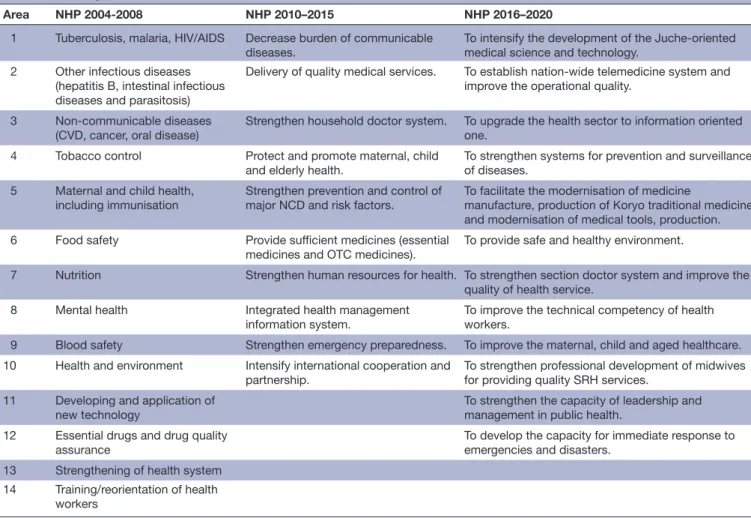
Table 1 Changes on the NHP of DPRK
Area NHP 2004-2008 NHP 2010–2015 NHP 2016–2020
1 Tuberculosis, malaria, HIV/AIDS Decrease burden of communicable
diseases. To intensify the development of the Juche-oriented medical science and technology. 2 Other infectious diseases
(hepatitis B, intestinal infectious diseases and parasitosis)
Delivery of quality medical services. To establish nation-wide telemedicine system and improve the operational quality.
3 Non-communicable diseases
(CVD, cancer, oral disease) Strengthen household doctor system. To upgrade the health sector to information oriented one. 4 Tobacco control Protect and promote maternal, child
and elderly health. To strengthen systems for prevention and surveillance of diseases. 5 Maternal and child health,
including immunisation
Strengthen prevention and control of major NCD and risk factors.
To facilitate the modernisation of medicine
manufacture, production of Koryo traditional medicine and modernisation of medical tools, production. 6 Food safety Provide sufficient medicines (essential
medicines and OTC medicines). To provide safe and healthy environment.
7 Nutrition Strengthen human resources for health. To strengthen section doctor system and improve the quality of health service.
8 Mental health Integrated health management
information system. To improve the technical competency of health workers. 9 Blood safety Strengthen emergency preparedness. To improve the maternal, child and aged healthcare. 10 Health and environment Intensify international cooperation and
partnership.
To strengthen professional development of midwives for providing quality SRH services.
11 Developing and application of new technology
To strengthen the capacity of leadership and
management in public health. 12 Essential drugs and drug quality
assurance
To develop the capacity for immediate response to
emergencies and disasters.
13 Strengthening of health system
14 Training/reorientation of health workers
CVD, cardiovascular disease; DPRK, Democratic People’s Republic of Korea; NCD, Noncommunicable Diseases; NHP, National Health Priorities; OTC, Over-the-Counter; SRH, Sexual and Reproductive Health.
such as the WHO, United Nations Children’s Fund and United Nations Fund for Population Activities. It can be confirmed mainly through three official reports : the National Health Priorities (NHP),i (table 1) 6–8 Country Cooperation Strategy (CCS),ii and Medium Term Stra-tegic Plan for Development of Health Sector DPRK (MTSP).iii All these are organically linked with each i The NHP has been published three times: 2004 (NHP 2004–
2008), 2009 (NHP 2010–2015), and 2016 (NHP 2016–2020). However, the original documents of DPRK’s NHP cannot possibly be obtained due to restrictions on access to DPRK’s domestic data. But it is included in the MTSP and CCS report as the part of a chapter.
ii The CCS suggests the Strategic Agenda aimed at making the
greatest contribution to global health, including strengthening the technical, intellectual, ethical, and political leadership of all the member states in the international health sector. The report has been published threetimes: 2004 (CCS 2004–2008), 2009 (CCS 2009–2013), and 2014 (CCS 2014–2019).
iii The MTSP suggests the Strategic Goals for providing the
framework in the coordination of development investment based on investigation of the health needs of DPRK through strategic investment area designation, national monitoring and evaluation systems, and financial gaps for priority interven-tions. The report has been published two times: 2009 (MTSP 2010–2015; MTSP 1) and 2016 (MTSP2016–2020; MTSP 2).
other through closed discussions with DPRK authorities and WHO DPRK representatives in the process of prepa-ration.9–12iv They represent that DPRK is making efforts to establish and implement healthcare policy in line with international standards. At the same time, however, there is a possibility that DPRK, which places great emphasis on national reputation and face, has possibly written these documents to demonstrate their national policies to the international community without enough intention to implement them. In fact, it is difficult to confirm whether the government is implementing healthcare activities in accordance with such internationally proclaimed national health policy.
The third is the healthcare policy instructed by the DPRK authorities to its own community-based healthcare workers which, may reflect the most practical and realistic health policy that the DPRK government seeks to imple-ment. Such instruction may be given in a variety of ways, and one of them is through the ‘Sa-seol’ (editorial) in the first issue of every quarterly medical journal published in iv According to the MTSP and CCS, WHO and many
interna-tional organizations which have representative offices and/ or have officials in DPRK, and support the MoPH of DPRK in developing the health care mid-term plan.
Figure 1 Composition of Sa-seol in medical journal of Democratic People’s Republic of Korea and its brief explanation.
DPRK. The Sa-seol tends to have a propaganda slogan as a title, and, as is the case of editorials, no specific author name. It is a directive message from the DPRK authori-ties which mainly contains an analysis of the healthcare contents of Kim Jong Un’s annual New Year’s address.13 v Hence, the Sa-seol,vi as a vivid resource, need to be
analyzed to compare the practical direction and imple-mentation of health care policies with the internationally proclaimed health policy in DPRK.
v In DPRK, New Year’s address is a very important document,
which reveals the specific tasks and practices in each social sector within a year. When a New Year’s address is announced, each sector of the national policy begins to re-organize its contents related to there spective specialty area and submits the specific plan based on the address.
vi Sa-seol in the medical journals contains such customized and
detailed contents as the instruction to health care workers about the authority’s directional goal during the year. It consists of two parts: the achievements in the health care sector of the last year and the future instructions to be achieved for the current year, conveyed in a strong, concise manner.
In this context, this paper has the following objectives. First, it aims to analyse how frequently the 12 items in NHP 2016–2020 are mentioned in the Sa-seol in order to identify DPRK’s domestic priorities. Second, it aims to find how the most mentioned NHP items are described and explained in the Sa-seol. Third, it aims to suggest some issues to be considered by the international community in future healthcare cooperation with DPRK.
In DPRK, there are nine medical journalsvii which
publishes original articles. Most of these are published four times a year. Among them, issues of the eight jour-nals published between 2012 (Kim Jong Un’s official vii There are nine medical journals such as Chosun
Medi-cine, Preventive MediMedi-cine, Basic MediMedi-cine, Korean Pharmacy, Dentistry, Otolaryngology, Ophthalmology, Internal Medicine, Orthopediiics, Pediatric Obstetrics & Gynecology Clinic, and Koryo Medicine. These journals are published by the Medical and Scientific Publisher in DPRK.
regime began in 2012) and 2018 could be obtained and copied from the Information Center on North Korea at the National Library of Korea. However, the Journal of
Koryo Medicine is only possibly obtained for 3 years issued,
between 2016 and 2018, so it is excluded from the analysis. Analysing how the items of NHP presented as the national plan are handled in the Sa-seol to examine the direction of DPRK’s healthcare plan indirectly under the circumstances of insufficient information on the status of healthcare in DPRK. Thus, a total of 56 Sa-seol from eight medical jour-nals within 7 years between 2012 and 2018 were collected and analysed sentence by sentence and then classified in terms of their relevance to each of 12 items presented in NHP 2016–2020 (figure 1). We calculated the percentage of mention of each item out of the total number of mentions and then rearranged the order of items by the frequency of mentions.
CATegorIeS of ConCern
The 12 items in NHP 2016–2020 were classified into three categories: the most, mentioned categories of concern (table 2). Notably, the way the two most mentioned items are explained in the Sa-seol are as follows:
(1) Production of pharmaceuticals and combination of the new medicine (western medicine) and Koryo medi-cine (traditional Korean medimedi-cine): As part of DPRK’s efforts to supplement the healthcare delivery system and to modernise the quality of medical care, it has increasingly emphasised the supply of medicines and the improvement of technology for combining Koryo medicine.14 viii The high consumption of Koryo
medi-cine is also reported in WHO as the essential drug policy of DPRK.15 Koryo medicine, which poses less financial
burden to use and is easily accepted by the people, has been strongly emphasised as the unique medical system of DPRK to be utilised in combination with western medi-cine. According to the Sa-seol, the combination of Koryo medicine and western medicine was related to (1) the interest in developing new drug productions with herbal ingredients16 17; (2) the emphasis on preventive treatment
through natural treatment methods, such as bathing in hot springs, mineral water and mud18 19; and (3) the
interest in health supplement food and the operation of medical facilities which are based on Koryo medicine.17
These seem to have come from DPRK’s attempt to solve the country’s medical problems by themselves and to increase the production of medicines in response to the difficulties in importing medicines and medical supplies amid strengthened sanctions.20–23
viii Koryo medicine is DPRK’s traditional medicine based on
acupuncture and botanical drugs, principally similar to South Korea’s “Hanmedicine”. Since the founding of the country, DPRK has consistently emphasized and promoted the devel-opment of Koryo medicine and urged the policy to combine it with Western medicine through Article 7 and 31 of the Medical Law and Article 16 and Chapter 4 of the People’s health Law.
(2) Independent development of medical science and technology and the reinforcement of healthcare workers: DPRK is striving to make substantial efforts to strengthen science and technology. DPRK urges the development of science and technology as the path to economic prog-ress.24 25 In particular, the repeated expression ‘the
devel-opment of our style of medical science and technology’ is closely related to the policy of ‘emphasis on scientific technology’ which would enable a leap into an economic power through the strengthening of the technical capacity of workers and the development of science and technology autonomously based on DPRK’s resource utilisation.26–29
In addition, the number of published articles in Science Citation Index (SCI) journals and the actual opportuni-ties to hold international academic conferences, including joint research with foreign researchers, have been steadily increasing.22 30 31 Further, active educational support for
the younger generations is provided, including the oppor-tunity to obtain a doctorate degree (PhD) in their 30s, far younger than the case in the past based on the previous DPRK’s standards.32–36
More fuTure developMenT THAn CurrenT TroubleSHooTIng
The healthcare sector needs to be developed step by step from primary care to more advanced technologies. However, our analysis suggests that DPRK is willing to leap forward through intensive investment and develop-ment of medical and scientific technologies even though the health system of DPRK still faces many challenges, and need more humanitarian work.37 DPRK’s attention is more focused on ‘future development’ than ‘current troubleshooting’. Such a policy may have a positive aspect, in that it prepares for the future in the long term. However, these principles may not be appropriate in healthcare. It may be necessary to promote tertiary care and the development of advanced medical technology after stabilising efforts to protect the lives and health of the people through basic primary and secondary health-care. Therefore, a well-balanced approach between ‘present’ and ‘future’ is needed in the priority of DPRK’s healthcare policy, for building a strong and sustainable healthcare system in DPRK.
This analysis has a couple of limitations. First, Sa-seol is not an official healthcare policy document. It is a propa-ganda document published in medical journals and so, there are limitations to using it only as a basis for under-standing DPRK’s national healthcare policy. However,
Sa-seol contains detailed information in each specialty area
sufficient to grasp the macro-direction of DPRK healthcare policy in a situation where official documents on DPRK healthcare policy are hard to obtain. Second, this study used frequency analysis to identify priorities in the national healthcare policy. However, the background and reason for such comments in the Se-seol were not analysed. This shall be the subject of further research.
Table 2
The number of fr
equency in the
Sa-seol
, in the eight medical jour
nals published during the Kim Jong Un r
egime (2012–2018), r
elevant to each of 12 items
pr
esented in NHP 2016–2020
Fr
equency
ranking
Items on the year NHP 2016–2020
2012 2013 2014 2015 2016 2017 2018
Total number of frequency
Per centage (%) Category of concer n 1
To facilitate the moder
nisation of medicine
manufactur
e, medical tools, and pr
oduction 9 12 14 14 10 13 25 97 27.1 Most To facilitate the pr
oduction of Koryo traditional
medicine 11 11 11 8 12 7 9 69 2
To intensify the development of Juche-oriented medical science and technology
21 21 19 18 24 17 15 135 22.1 3 To str
engthen systems for the pr
evention and monitoring of diseases 3 4 4 13 8 6 15 53 8.7 Medium 4
To upgrade the health sector into an information- oriented one
5 7 8 4 10 7 8 49 8.0 5 To impr
ove the technical competency of health
workers 6 7 8 7 7 7 5 47 7.7 6
To establish a nationwide telemedicine system and impr
ove operational quality
4 7 10 6 4 4 6 41 6.7 7 To str
engthen the capacity of leadership and
management in public health
1 3 5 6 10 5 10 40 6.5 8 To impr ove mater
nal, child, and aged healthcar
e 7 7 3 2 4 3 5 31 5.1 9 To str
engthen the section doctor system and impr
ove
the quality of health service
3 2 3 2 5 4 7 26 4.2 10 To pr
ovide a safe and healthy envir
onment 3 3 3 1 6 2 4 22 3.6 11
To develop the capacity for immediate r
esponse to
emer
gencies and disasters
0 0 0 0 0 1 0 1 0.2 Least 12 To str engthen the pr ofessional development of midwives for pr
oviding quality sexual and
repr
oductive health services
0 0 0 0 0 0 1 1 0.2 Total 73 84 88 81 100 76 110 612 100 NHP
ConCluSIon
Healthcare policy is one of the most fundamental and important policies in a country, especially for addressing the health needs of vulnerable groups such as the poor, aged, women and children. So, understanding the priority of national health policy is essential in inter-national cooperation. This study suggests a two-track approach for healthcare cooperation with DPRK in the future. It is necessary to progress international coopera-tion for the development of medical and scientific tech-nology, regarded as a priority issue by DPRK, and at the same time, to strengthen the primary healthcare system through the provision of sufficient supplies, human resource education and empowerment, and establish-ment of essential healthcare infrastructures. Further-more, sufficient dialogue is required in the process of international cooperation to ensure that the interna-tional community and DPRK understand each other's thoughts and positions.
funding The authors have not declared a specific grant for this research from any funding agency in the public, commercial or not-for-profit sectors.
Competing interests None declared. patient consent for publication Not required.
provenance and peer review Not commissioned; externally peer reviewed. data availability statement No data are available.
open access This is an open access article distributed in accordance with the Creative Commons Attribution Non Commercial (CC BY-NC 4.0) license, which permits others to distribute, remix, adapt, build upon this work non-commercially, and license their derivative works on different terms, provided the original work is properly cited, appropriate credit is given, any changes made indicated, and the use is non-commercial. See: http:// creativecommons. org/ licenses/ by- nc/ 4. 0/.
ReFeReNCes
1. McCurry J. North Korea's health system in disarray. Lancet
2010;376:318.
2. SEARO WHO. Health SDGProfile: Democratic People’s Republic of Korea, 2017. Available: http://www. searo. who. int/ entity/ health_ situation_ trends/ countryprofile_ dprk. pdf? ua=1
3. Shin H, Lee H, Ahn K, et al. North Korea’s Trends on Healthcare System in Kim Jong Un Era:concentrated on Healthcare Delivery and Organization System. J Peace Unific Stud 2016;08:181–211. 4. Korea UN. Researchand development division, Institute for
unification education. Seoul: Ministry of Unification, 2014.
5. UNICEF. Annual Report 2015 Korea,Democratic People’s Republic of UNICEF, 2015. Available: https://www. unicef. org/ about/ annualreport/ files/ Korea_( Democratic_ Peoples_ Republic_ of)_ 2015_ COAR. pdf 6. World HealthOrganization. WHO Country Cooperation Strategy
2004-2008 Democratic People’s Republic of Korea 2003:16–17. 7. World Health Organization. Medium term strategic plan for the
development of the health sector in DPRK 2010-2015. 19. Ministry of Public Health in partnership with WHO, 2010.
8. Ministry of Public Health, DPRK in partnership with WHO, UNICEF and UNFPA. Medium term strategic plan forthe development of the health sector in DPRK 2016-2020. 15, 2017.
9. Ministry of Public Health, DPRK in partnership with WHO, UNICEF and UNFPA. Medium term strategic plan for the development of the health sector in DPRK 2016-2020, 2017.
10. Ministry of Public Health, DPRK in partnership with WHO, UNICEF and UNFPA. WHO Country Cooperation Strategy 2009-2013
Democratic People’s Republic of Korea. Medium term strategic plan forthe development of the health sector in DPRK 2016-2020. 15, 2010.
11. World Health Organization. WHO Country Cooperation Strategy 2014-2019 Democratic People’s Republic of Korea, 2016. 12. World Health Organization. Medium term strategic plan for the
development of the health sector in DPRK 2010-2015. Ministry of public health in partnership with who, 2010.
13. Thae YH. Assessment of Kim Jong Un’s New Year’s Address 2- Meaning of New Year’s Address in North Korea. (translated from “ 김 은 년사 평가 2 – 북한에서 년사가 가지는 의미”). Thae Yong Ho’s Forum for Unification 2019. Available https:// thaeyongho. com/ 14. YM C. The Characteristics and Limitation of the Health-Medical Care
system and Law of North Korea – Focused on the Public Health and Social Welfare Perspectives. (translated from “북한 보건의료법 의 특성과 한계 – 4대 특성의 보건복지 근”). J Public Welfare Administration 2012;32:43–71.
15. Kathleen H. Democratic People’ Republic of Korea – Drug policy and Pharmaceuticals in Health Care Delivery. Regional Office for South East Asia, New Delhi, World Health Organization. Mission Report, 2012. Available: http://www. searo. who. int/ entity/ medicines/ dprk_ situational_ analysis_ 2012. pdf? ua=1
16. Sa-seol (editorial). Korean medicine. Pyongyang: DPRK Medical and Scientific Publisher, 2018: 1. 4.
17. Sa-seol (editorial). Korean medicine. Pyongyang: DPRK Medical and Scientific Publisher, 2013: 1. 3.
18. Sa-seol (editorial). Internal medicine. Pyongyang: DPRK Medical and Scientific Publisher, 2013: 1. 4.
19. Sa-seol (editorial). Internal medicine. Pyongyang: DPRK Medical and Scientific Publisher, 2016: 1. 4.
20. Kim JS. A study on the Characteristics and Limitations of North Korea’s Pharmaceutical Policy. (translated from “북한 의약품 책의 특징과 한계 분석”). Health and Social Welfare Review 2012;32:631–65.
21. Sa-seol (editorial). Korean pharmacy. Pyongyang: DPRK Medical and Scientific Publisher, 2018: 1. 3.
22. Sa-seol (editorial). Basic medicine. Pyongyang: DPRK Medical and Scientific Publisher, 2016: 1. 4.
23. Park SM, Lee HW. Current status of healthcare and effective
health aid strategies in North Korea. J Korean Med Assoc
2013;56:368–74.
24. Yoo KM. North Korean newspaper emphasizes “self-sufficient economy” ahead of North’s foundation day. Hankyoreh, 2018. Available: http:// english. hani. co. kr/ arti/ english_ edition/ e_ northkorea/ 860477. html
25. Kang TJ. North Korea’s High-Tech Pursuits- From bullet train to air purifier: North Korea’s ambition for scientific technologies. The Diplomat, 2018. Available: https:// thediplomat. com/ 2018/ 06/ north- koreas- high- tech- pursuits/
26. Sa-seol (editorial). Orthopedics. Pyongyang: DPRK Medical and Scientific Publisher, 2016: 1. 4.
27. Sa-seol (editorial). Orthopedics. Pyongyang: DPRK Medical and Scientific Publisher, 2018: 1. 4.
28. Sa-seol (editorial). Basic medicine. Pyongyang: DPRK Medical and Scientific Publisher, 2017: 1. 4.
29. Sa-seol(editorial). Orthopedics. Pyongyang: DPRK Medical and Scientific Publisher, 2016: 1. 4.
30. Choi HG, Noh KR. Analysis of the scientific citation index (SCI) in North Korea 2005~2015, Seoul: Korea Institute of science and technology information, (KISTI 2016.
31. Sa-seol (editorial). Orthopedics. Pyongyang: DPRK Medical and Scientific Publisher, 2017: 1. 4.
32. Sa-seol (editorial). Pediatric Obstetrics & Gynecology Clinic. Pyongyang: DPRK Medical and Scientific Publisher, 2015: 1. 3. 33. Sa-seol (editorial). Pediatric Obstetrics & Gynecology Clinic.
Pyongyang: DPRK Medical and Scientific Publisher, 2016: 1. 4. 34. Sa-seol (editorial). Orthopedics. Pyongyang: DPRK Medical and
Scientific Publisher, 2015: 1. 4.
35. Sa-seol (editorial). Orthopedics. Pyongyang: DPRK Medical and Scientific Publisher,, 2017: 1. 4.
36. Sa-seol (editorial). Pediatric Obstetrics & Gynecology Clinic. Pyongyang: DPRK Medical and Scientific Publisher, 2017: 1. 3. 37. UNICEF. Dpr Korea needs and priorities. UNICEF, 2018.