© Korean Powder Metallurgy Institute 883
-1. Introduction
Interest in the substitution of Co powder as a diamond binder has been driven by the high and often fluctuating price of Co. Fine Ni powder is often used in combination with Co, Fe and bronze-based powders by the diamond tool industry as a binder or backing material for diamond segments. Until recently, commercially available Ni powders have been coarser than extra-fine grade Co powders (XF Co), with a correspondingly lower sintering activity.
2. Experimental and Results
The metal powders used in this study were as follows: Co - Umicore Extra-fine grade d50 = 3.6 µm; Ni - Inco T110
PM d50 = 2.3 µm; fine carbonyl Fe - BASF CF grade d50 =
8.5 µm. XF Co is a sponge-like or filamentary powder whereas XF Ni and fine Fe are discrete, nominally spherical powders. XF Ni, XF Co and CF Fe powders were mixed by wet stirring in hexane. Dried powder blends were sintered by hot pressing in a graphite die at 20 MPa from 700 to 900°C. Samples were held at temperature for 30 min, with a cycle time of 2h. The sintered cylindrical discs were cut into transverse rupture strength (TRS) bars for mechanical testing. Apparent density, apparent hardness and bend strength (TRS) were compared for different compositions of Co:Ni:Fe [1].
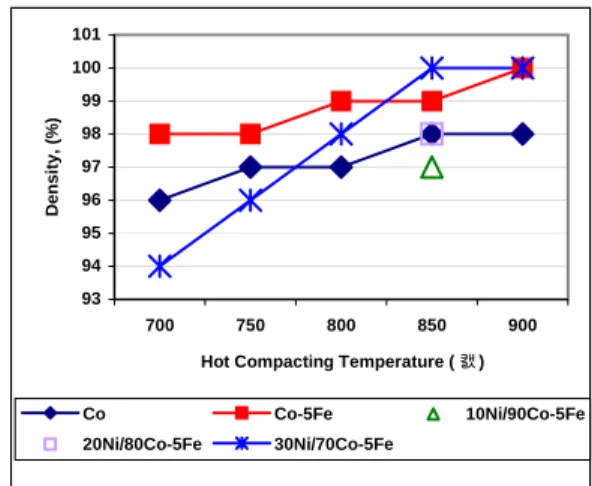
In Figure 1, the sinter density of various compositions of Co-Ni-Fe materials is compared at different sintering temperatures. The addition of Ni to Co-5Fe lowered the sinter density at temperatures below 800°C and increased sinter density above 800°C. This behaviour is thought to relate to the relative sintering activity of XF Co vs. XF Ni at relatively low sintering temperature. While XF Co has a
higher d50 than XF Ni, XF Co has a higher sinter activity
due to a sponge-like morphology compared to discrete, roughly spherical Ni particles.
93 94 95 96 97 98 99 100 101 700 750 800 850 900 Hot Compacting Temperature ( 캜)
D e ns ity , (% ) Co Co-5Fe 10Ni/90Co-5Fe 20Ni/80Co-5Fe 30Ni/70Co-5Fe
Fig. 1. Sinter density of Co-Ni-Fe binder materials The apparent hardness of Co-Ni-Fe materials increased with increasing sintering temperature, in line with the corresponding increase in sinter density (Fig. 2). The Ni-free materials achieved apparent hardness values > 100 HRB above 800°C, whereas the Ni-containing materials required sintering temperatures of at least 850°C to achieve 100 HRB. Figure 2 also shows the effect of increasing Ni content on the apparent hardness of Co-5Fe; increasing Ni from < 10% to > 20% decreased HRB by approximately 10 points at 850°C.
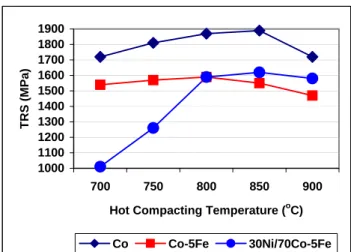
TRS was highest for pure Co (Fig. 3). Bend strength of the 30Ni/70Co-5Fe material was typically 10 to 15% lower than pure Co at sintering temperatures above 800°C. It should be noted however, that considerable softening of the 2006 POWDER METALLURGY
World Congress
C06-02-3
Extra-fine Ni Powder for Diamond Tool Binder Applications
Thomas F. Stephenson1,a, Maria Korotkin2,b, and Shawn Metcalfe2,c 1
Inco Special Products, 2101 Hadwen Road, Mississauga, Ontario, L5K 2L3, Canada
2
Inco Technical Services Limited, 2060 Flavelle Boulevard, Mississauga, Ontario, L5K 1Z9, Canada
a
[email protected], [email protected], [email protected] Abstract
A new extra-fine grade Ni powder (XF Ni) has demonstrated increased sintering activity in Co-Fe-Ni binders for diamond tool applications. XF Ni has the advantage of significantly lower cost than XF Co. Up to 30% of XF Co was substituted with XF Ni while maintaining comparable apparent hardness and transverse rupture strength to pure Co binders. Ni substantially increased the diffusion of Fe. Diamond tool producers can take advantage of the improved sintering properties of XF Ni powder to substantially lower material costs.
© Korean Powder Metallurgy Institute 884 -80 85 90 95 100 105 110 115 700 750 800 850 900 Hot Compacting Temperature ( o
C) Ap p a ren t Hard n ess (HRB) Co Co-5Fe 10Ni/90Co-5Fe 20Ni/80Co-5Fe 30Ni/70Co-5Fe
Fig. 2. Apparent Hardness of Co-Ni-Fe binders.
1000 1100 1200 1300 1400 1500 1600 1700 1800 1900 700 750 800 850 900
Hot Compacting Temperature (oC)
TRS
(MP
a)
Co Co-5Fe 30Ni/70Co-5Fe
Fig. 3. Transverse rupture strength of Co-Ni-Fe binders. materials occurred due to relatively long holding time (30 min) at temperature. TRS decreased for all materials above 850C probably due to excessive grain growth. High Ni content materials were extremely ductile when sintered above 800C as a result of the predominantly FCC structure and low work hardening rate.
Optical microscopy and SEM with x-ray mapping revealed that XF Ni was well mixed and uniformly distributed in the cobalt matrix. Porosity in Co-Ni-Fe materials decreased with increasing Ni content (Fig. 4). The principal diffusion mechanism appears to be the diffusion of Fe into Ni as seen in Fig. 5. There was no evidence of Fe diffusion in pure Co, nor interaction between Ni and Co phases. Oxygen content was highest in Fe-rich regions and was thought to be partially responsible for higher agglomeration of Fe as compared to XF Ni particles.
(a) (b)
Fig. 4. Microstructure of Ni/Co-5Fe binders with 10% (a) and 30% (b) of Ni, X500.
(a) (b)
Fig. 5 X-ray map of 30Ni/70Co-5Fe hot compacted at 850°C, showing uniform distribution of Ni (a) and active diffusion of Fe (b), X250.
3. Summary
XF Ni requires sintering temperatures greater than 750°C in order to develop sufficient strength. The sinter activity of XF Ni is lower than that of XF Co as a result of the sponge-like morphology of XFCo compared to discrete particles of XFNi powder. When sintered at temperatures above 800°C, the addition of up to 30 wt.% Ni to Co-5Fe resulted in mechanical properties approximately 10% lower than pure Co binders. Sinter density was > 98%, apparent hardness approached 100 HRB and TRS was > 1600 MPa.
Further work is planned to optimize the sintering conditions and to improve the distribution of Fe in the Co+Ni matrix.
4. References
1. “Standard Test Methods for Metal Powders and Powder Metallurgy Products”, 2006 Edition, Metal Powder Industries Federation, Princeton, NJ.