Gastromalcia is a postmortem dissolution of the stomach caused by endogenous enzymes. Postmortem release of both pepsinogen and hydrochloric acid from necrotic cells of the gastric wall gives rise to autodigestion of the gastric mucosa and eventual perforation, typically in the posterior wall of the gastric fundus. Radiographs and other diagnostic imaging modalities are unable to distinguish gastromalacia from other causes of intraperitoneal free air including premortem gastric perforation caused by ischemia, peptic ulcer disease, traumatic nasogastric intubation and blunt abdominal trauma. Therefore this postmortem change was stated by radiologists as gastrointestinal perforation caused by antemortem pathology, including inflicted trauma1-3). It also can mislead pathologists with insufficient forensic experience and even lead to a miscarriage of justice3). Diagnosis is based on autopsy findings which include thinning, gelatinous softening and discoloration of the gastric wall, and eventual perforation with no surrounding vital reaction such as peritonitis or mucosal inflammation. In this point of view, we present a case of full-blown gastromalacia with its typical autopsy findings. This case demonstrates that gastromalacia can occur rapidly after death, even in the absence of external and internal putrefactive features.
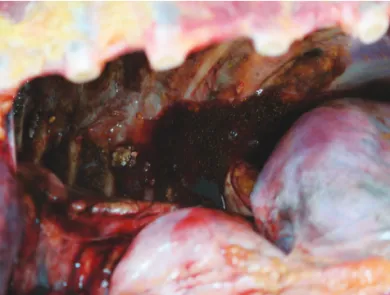
A 42-year-old woman with a past history of alcoholism was found deceased in her office. According to the postmortem investigation report of police officers, nothing is worthy of notice except the fact that she had recently suffered from insomnia and headache. As further details around her death were unclear, so this uncertainty led legal autopsy. It was performed approximately between 37 hours after she was last seen alive and 27 hours after confirmation of her death. Putrefactive changes were not assessed. No injury was identified on the whole body. Her death was attributed to hypertensive intracerebral hemorrhage, in which the caudate nucleus is designated as bleeding focus. Toxicologic analysis failed to detect any drugs, alcohol or unusual substances. On the other hand, there was a finding of gastric rupture at the posterior wall of the fundus. The rupture site measured about 15cm in length and showed somewhat rugged appearance with marked thinning and dark gray discoloration of its margin(Fig. 1). The left leaf of the diaphragm was also perforated with corrosion which measured 1.5cm in diameter and the gastric contents leaked out into pleural cavity through the opening of ruptured diaphragm(Fig. 2,3). The microscopic finding of rugged margin showed nothing but shadows of normal histologic structure with slight mucosal erosion of the stomach. The vital reaction, such as hemorrhage or ulcerative inflammatory lesions causative of the perforation were not found at surrounding gastric wall(Fig. 4).
A Case of Gastromalacia
Seong Mi Kim, Sang Hun Kim, Hyun Wook Kang
Department of Forensic Medicine, Jeju National University School of Medicine, Jeju, Korea
(Received November 1, 2016; Revised November 8, 2016; Accepted November 15, 2016)
Gastromalacia is a postmortem dissolution due to autodigestion of the gastric wall. It usually occurs in the area of the gastric fundus and may lead to gastric perforation. This rupture may also lead to pneumoperitoneum or pneumothorax. Such postmortem changes were stated by radiologists as gastro-intestinal perforation caused by antemortem pathology, including inflicted trauma. It also can confuse pathologists with insufficient forensic experience and even lead to a miscarriage of justice. In this report, we will introduce a case of full-blown gastromalacia with its typical autopsy findings. (J Med Life Sci 2016;12(2):75-77)
Key Words
: Gastromalacia, Postmortem, Gastric perforationIntroduction
Correspondence to : Hyun Wook Kang
Department of Forensic Medicine, Jeju National University School of Medicine, Aran 13gil 15, Jeju-si, Jeju Special Self-governing Province, 63241, Republic of Korea
E-mail : [email protected]
Abstract
Case report
The Journal of Medicine and Life Science Vol. 13, No. 2(December), 2016
75
Since the original description, 'the digestion of the stomach after death' by John Hunter in 1772, this postmortem autolytic rupture of the stomach known as gastromalacia has been recognized as an artifact phenomenon at autopsy by forensic pathologist but was less well known to general pathologists and diagnostic radiologists3,4). Basically the diagnosis of gastromalacia is based on autopsy findings showing no surrounding vital reactions, such as peritonitis, hemorrhage or mucosal inflammation. Some authors insist that histological analysis
of surrounding gastric wall is crucial for distinguishing gastromalacia from acute antemortem gastric perforation5). In this case, neither inflammatory response nor hemorrhage encountered. In the recumbent, acid and enzyme rich stomach contents flow up into the esophagus, causing digestion of the esophageal wall and spillage into the left chest cavity6). In this case, Spillage into the left chest cavity also encountered but it occurred through the opening of perforated diaphragm adjacent to rupture site of stomach without esophageal perforation. The timing of gastric perforation by gastromalacia has not been clearly defined in the literature, but in general, it can occur as early as 20
Seong Mi Kim, Sang Hun Kim, Hyun Wook Kang
76
-Discussion
Figure 1. The stomach wall was ruptured at posterior wall
of the fundus.
Figure 2. The left leaf of the diaphragm was also
perforated with corrosion.
Figure 3. Gastric contents leaked out into pleural cavity
through the opening of ruptured diaphragm.
Figure 4. The rugged margin of stomach showed nothing
but shadows of normal histologic structure with slight mucosal erosion(H&E, x100).
hours after death7). We estimated that the timing of gastric perforation had occurred in the period between 27 hours to 37 hours after her death. Gastromalacia is observed more often in cases of closed head injury and is possibly related to stimulation of the heat regulatory center in the brain and a terminal surge in body temperature, promoting autolysis6). Stress gastritis and gastroduodenal mucosal damage are common events after head injury and occur within 12 hours of sustaining that injury8). Head injury appears to specifically increase pancreatic polypeptide release, probably by affecting autonomic centers in the midbrain9). This presumption that head injury plays a role as an accelerator of gastromalacia seemed to be involved in the case. In this report, we present a typical and full-blown case of the gastromalacia in which the diagnosis was established by (1) characteristic macroscopic/microscopic findings of the lesion and lack of vital reaction in the adjacent tissue, (2) lack of autopsy evidence of trauma in adjacent organs, and (3) presence of discrete another cause of death.
1) O'Donnell CJ, Baker MA. Postmortem CT finding of gastromalacia: a trap for the radiologist with forensic interest. For Sci Med Pathol 2010;4:293-297.
2) Angela DL, Howard TH, Craig TM. Postmortem Imaging:
MDCT features of postmortem change and decomposition. Am J forensic Med Pathol 2010;31:12-17. 3) Akihito U, Yusuke K, Yoshiyuki H, Yoshie H, Haruo S,
Masato F. Case reports Postmortem radiography of gastromalacia. Japanese Journal of Radiology 2013;31:637-641.
4) Hunter J. On the digestion of the stomach after death. Phil Trans 1772;62:447-454.
5) Fabio DG, Maria L, Vincenzo LP, Antonio GS, Ernesto DA and Vincenzo A. An unusual case showing fatal rupture of a gastric ulcer or gastromalacia? The importance/role of histology for differential diagnosis. J Forensic Sci 2015;60;240-242.
6) Spitz WU, Spitz DJ. Spitz and Fisher's medicolegal investigation of death: guidelines for the application of pathology to crime investigation. 4th Ed. Thomas, 2004. 7) Laczniak AN, Sato Y, Nashelsky M. Postmortem gastric
perforation (gastromalacia) mimicking abusive injury in sudden unexplained infant death. Pediatr Radiol 2011;41:1595-1597.
8) Brown TH, Davidson PF, Larson GM. Acute gastritis occuring within 24 h of severe head injury. Gastrointest Endosc 1989;35:37-40.
9) Larson GM, Koch S, O'dorisio TM, Osadchey B, Mcgraw P, Richardson JD. Gastric response to severe head injury. Am J Surg 1984;147:97-105.
77
-A Case of Gastromalacia