Korean J. Mineral. Petrol. Vol. 34, No. 1, p. 1~14, 2021 https://doi.org/10.22807/KJMP.2021.34.1.1
운산 금 광상의 엽리상 석영맥에서 산출되는
백색운모와 녹니석의 산상 및 화학조성
유봉철1,2* 1한국지질자원연구원 DMR융합연구단, 2과학기술연합대학원대학교 광물지하수자원학과Occurrence and Chemical Composition of White Mica and Chlorite
from Laminated Quartz Vein of Unsan Au Deposit
Bong Chul Yoo1,2*
1Convergence Research Center for Development of Mineral Resources, Korea Institute of Geoscience and
Mineral Resources, Daejeon 34132, Korea
2Department of Mineral and Grroundwater Resources, University of Science and Technology, Daejeon 34113, Korea
요 약: 운산 금 광상은 한반도의 3대(대유동 광상, 광양 광상) 금 광상중의 하나였다. 이 광상의 지질은 선 캠브리아기의 변성퇴적암류와 중생대의 반상화강암으로 구성된다. 이 광상은 선캠브리아기의 변성퇴적암류와 중생대의 반상화강암내에 발달된 단층대를 따라 충진한 함 금 석영맥 광상으로 조산형 금 광상에 해당된다. 이 광상의 석영맥은 광물조합에 따라 1) 방연석-석영맥형, 2) 자류철석-석영맥형, 3) 황철석-석영맥형, 4) 페크 마틱 석영맥형, 5) 백운모-석영맥형 및 6) 단순석영맥형으로 분류된다. 연구된 석영맥은 황철석-석영맥형이며 견운모화작용, 녹니석화작용 및 규화작용이 관찰된다. 백색운모는 유색대에서 백색석영, 황철석, 녹니석, 금홍 석, 모나자이트, 저어콘, 인회석, 칼리장석 및 방해석 등과 함께 세립질 내지 중립질 입단으로 산출된다. 이 백색운모의 화학조성은 (K0.98-0.86Na0.02-0.00Ca0.01-0.00Ba0.01-0.00 Sr0.00)1.00-0.88(Al1.70-1.57Mg0.22-0.09Fe0.23-0.10Mn0.00Ti0.04-0.02Cr0.01-0.00
V0.00Ni0.00)2.06-1.95 (Si3.38-3.17Al0.83-0.62 )4.00O10(OH2.00-1.91F0.09-0.00)2.00로써 이론적인 이중팔면체형 운모류 값보다 Si가 높
고 K, Na, Ca는 낮다. 이 광상의 엽리상 석영맥에서 산출되는 백색운모의 화학조성 변화는 팬자이틱(phengitic) 또는 Tschermark 치환[(Al3+)VI+(Al3+)IV <-> (Fe2+ 또는 Mg2+)VI+(Si4+)IV] 및 직접적인 (Fe3+)VI <-> (Al3+)VI 치
환에 의해 일어났음을 알 수 있다. 엽리상 석영맥에서 산출되는 녹니석의 화학조성은 (Mg1.11-0.80Fe3.69-3.14 Mn0.01-0.00
Zn0.01-0.00K0.07-0.01Na0.01-0.00Ca0.04-0.01Al1.66-1.09)5.75-5.69 (Si3.49-2.96Al1.04-0.51)4.00O10 (OH)8로써 이론적인 녹니석보다 Si 함량
이 높다. 이 녹니석의 화학조성 변화는 팬자이틱(phengitic) 또는 Tschermark 치환(Al3+,VI+Al3+,IV <-> (Fe2+ 또
는 Mg2+)VI+(Si4+)IV) 및 팔면체적 Fe2+ <-> Mg2+ (Mn2+) 치환에 의해 일어났음을 알 수 있다. 따라서 운산 광
상의 엽리상 석영맥 및 변질광물은 조산운동 시 연성전단(ductile shear) 시기에 형성되었음을 알 수 있다. 핵심어: 운산 금 광상, 조산형 금 광상, 백색운모, 녹니석, 산상, 화학조성
Abstract: The Unsang gold deposit has been one of the three largest deposits (Daeyudong, Kwangyang) in Korea. The geology of this deposit consists of series of host rocks including Precambrian metasedimentary rock and Jurassic Porphyritic granite. The deposit consists of Au-bearing quartz veins which filled fractures along fault zones in Precambrian metasedimentary rock and Jurassic Porphyritic granite, which suggests that it is an orogenic-type deposit. Quartz veins are classified as 1) galena-quartz vein type, 2) pyrrhotite-quartz vein type, 3) pyrite-quartz vein type, 4) pegmatic quartz vein type, 5) muscovite-quartz vein type and 6) simple quartz vein type based on mineral assembles. The studied quartz vein is pyrite-quartz vein type which occurs as sericitization, chloritization and silicification. The white mica from stylolitic seams of laminated quartz vein occurs as fine or medium aggregate associated with *Corresponding author
Tel: +82-42-868-3505 E-mail: [email protected]
white quartz, pyrite, chlorite, rutile, monazite, apatite, K-feldspar, zircon and calcite. The structural formular of white mica from laminated quartz vein is (K0.98-0.86Na0.02-0.00Ca0.01-0.00Ba0.01-0.00 Sr0.00)1.00-0.88(Al1.70-1.57Mg0.22-0.09
Fe0.23-0.10Mn0.00Ti0.04-0.02Cr0.01-0.00V0.00Ni0.00)2.06-1.95 (Si3.38-3.17Al0.83-0.62 )4.00O10(OH2.00-1.91F0.09-0.00)2.00. It indicated that
white mica of laminated quartz vein has less K, Na and Ca, and more Si than theoretical dioctahedral micas. Compositional variations in white mica from laminated quartz vein are caused by phengitic or Tschermark substitution [(Al3+)VI+(Al3+)IV <-> (Fe2+ or Mg2+)VI+(Si4+)IV] and direct (Fe3+)VI <-> (Al3+)VI
substitution. The structural formular of chlorite from laminated quartz vein is(Mg1.11-0.80Fe3.69-3.14Mn0.01-0.00
Zn0.01-0.00K0.07-0.01Na0.01-0.00Ca0.04-0.01Al1.66-1.09)5.75-5.69 (Si3.49-2.96Al1.04-0.51)4.00O10(OH)8. It indicated that chlorite of
laminated quartz vein has more Si than theoretical chlorite. Compositional variations in chlorite from laminated quartz vein are caused by phengitic or Tschermark substitution (Al3+,VI+Al3+,IV <-> (Fe2+ or
Mg2+)VI+(Si4+)IV) and octahedral Fe2+ <-> Mg2+ (Mn2+) substitution. Therefore, laminated quartz vein and
alteration minerals of the Unsan Au deposit was formed during ductile shear stage of orogeny.
Keywords: Unsan Au deposit, Orogenic Au deposit, White mica, Chlorite, Occurrence, Chemical composition
서
언
운산 금 광상은 1945년 이전에 대유동 광상 및 광 양 광상과 더불어 한반도의 3대 금 광상 중의 하나 로 알려진 광상이다(Yoo, 2020b). Kinosaki (1933)에 의하면 이 광상의 석영맥은 리본(ribbon) 구조를 갖는 단순 괴상으로 판상 또는 렌즈상 형태로 산출되며 심 열수내지 중열수 금 석영맥 광상에 해당된다고 보고 하였다. 최근들어 Goldfarb et al. (2014)에 의하면 운산 금 광상은 조산형 금 광상으로 해석하였다. 운 산 금 광상의 석영맥들은 산출유형에 따라 함금유화 물석영맥, 견운모-규화대형 금광체와 함탄질물 압쇄대 및 파쇄단층대로 산출된다(Koh et al., 2019). 조산형 금 광상은 해양지각이 대륙지각 하부로 섭입하는 Accreted terranes에서 형성되며 형성 깊이에 따라 hypozonal 광상, mesozonal 광상 및 epizonal 광상 으로 분류하였다(Groves et al., 1998). 최근들어, 일 본 연구기관에서 습득된 운산 광상 석영맥에 대한 연 구 시 엽리상 조직이 관찰되었다(Yoo, 2020b). 이 석 영맥에서는 엽리상 조직 관찰된다. 엽리상 석영맥은 조산형 hypozonal 광상에서 일반적으로 관찰되며 이 엽리상 석영맥은 스러스트와 관련된 전단응력에 의해 형성되며 그 규모는 전단응력의 규모에 의해 좌우된 다고 보고하였다(Craw and MacKenzie, 2016). 조산 형 금 광상에서 관찰되는 엽리상 석영맥의 형성 시 맥석광물로는 석영, 백색운모, 녹니석, 방해석, 흑연 및 능철석 등이 산출되는 것으로 보고되어 있다(Craw and MacKenzie, 2016). Yoo (2020b)에 의한 엽리상 석영맥에서 백색운모 및 녹니석 등이 산출된다고 보 고하였다. 백색운모와 녹니석은 모암변질 및 초생광물써 산출되며 이들 광물들은 최근들어 광체 탐사 지 시자 및 생성환경 인자로 활용되는 연구들이 많이 보 고되어 있다(Christie and Brathwaite, 2003; Ayati et al., 2008; Cohen, 2011; Jimenez, 2011; Pearce et al., 2015; Craw and MacKenzie, 2016; Wallace, 2016; Wang et al., 2017; Gaillard et al., 2018; Uribe-Mogollon and Maher, 2018; Dehnavi et al., 2019; Yoo, 2019; 2020a).
과거 운산 금 광상에 대한 연구 및 보고는 Kinosaki (1933), Hori (1942), Shikazono and Shimizu (1986), Takashima and Kishimoto (1987), Ishihara et al., (2000), Ishihara (2006), Goldfarb et al. (2014), Koh et al., (2019), Yoo (2020b) 등이 있으나 엽리상 석 영맥에서 산출되는 백색운모 및 녹니석의 산상 및 화 학조성은 연구가 보고되어 있지 않다. 따라서 이 연 구에서는 처음으로 운산 금 광상의 엽리상 석영맥에 서 산출되는 백색운모와 녹니석의 산출상태 및 화학 조성을 보고하고 이들 자료를 토대로 기 연구된 조산 형 금-은 광상에서 산출되는 백색운모와 녹니석의 화 학조성을 비교함으로써 그 특징을 고찰해 보고자 한 다.
주변지질 및 광상개요
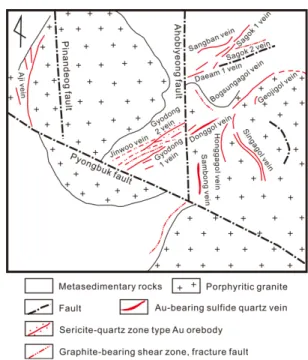
운산 금 광상의 주변지질 및 광상개요는 기존연구 및 보고(Kinosaki, 1933; Hori, 1942; Shikazono and Shimizu, 1986; Takashima and Kishimoto, 1987; Ishihara et al., 2000; Ishihara, 2006; Koh et al., 2019; Yoo, 2020b)에서 기술되어 있어 여기에서는 간략하게 기술하고자 한다. 이 광상의 주변지질은 선캠브리아기의 낭림층군인 변성퇴적암류와 이를 관입 한 중생대의 혜산암군인 반상화강암으로 구성된다 (Koh et al., 2019)(Fig. 1). 낭림층군의 변성퇴적암류 는 운산 광상의 동측 및 서측에 넓게 분포되며 주로 암회색내지 회색 편마암과 일부 운모편암이 협재된다 (Ishihara, 2006)(Fig. 1). 이 낭림층군의 변성퇴적암류 는 약 25억년 전에 백립암상 변성작용, 20∼19억년전 에 각섬암상 변성작용 및 그 후 녹색 편암상내지 녹 염석-각섬암상의 변성작용을 받았다(Koh et al., 2019). 변성퇴적암류의 편리 방향성은 지역에 따라 다 르나 일반적으로 광상의 동측에서 주향 NW내지 NE 방향성에 경사 60∼70oSW, 70∼80oSE, 서측에선 주 향 NE 방향성에 경사 50oNW를 갖는다(Kinosaki, 1933). 혜산암군은 중생대의 화성암류로써 송림-두만 강 화성활동기인 250∼213 Ma (흑운모 K-Ar 및 저 어콘 SIMS 년대측정)에 해당되며 반려암, 섬록암(1 상), 반상화강암(2상) 및 세립 흑운모 화강암, 편마상 흑운모 화강암(3상)으로 구성된다(Koh et al., 2019). 운산 광상일대 넓게 분포하는 반상화강암은 북진관입 암체의 2상에 해당된다(Koh et al., 2019). 이 반상 화강암은 반상흑운모화강암과 반상각섬석흑운모화강 암으로 구성되며 반정은 미사장석이며 때때로 직경이 8 cm 정도인 것도 관찰된다(Kinosaki, 1933). Koh et al. (2019)에 의하면 이들 반상화강암(반상화강암, 반 상흑운모화강암, 반상각섬석흑운모화강암)의 전암분석 에 의한 주원소 산화물 함량을 통한 총알칼리도표(TAS diagram)에 도시하여 보면 대부분 칼크-알칼리 계열 의 화강섬록암에 해당되며 일부 화강암에 해당된다. 또한 Ishihara (2006)에 의하면 반상흑운모화강암은 장석을 기준으로 한 metaluminous에 해당되며 121∼ 128 (Sr/Y 비)를 갖는 아다카이트질 기원에서 유래되 었다고 보고하였다. 운산 광상의 대암항에서 채취한 반상흑운모화강암의 자화도(magnetic susceptibility)가 1.5x10⁻³ SI 이하로 ilmenite 계열에 해당된다(Ishihara et al., 2000). 운산 광상은 1987년 미국인에 의하여 북진금산으 로 개발된 후 1940년 일본광업에 인수되었다(Lee et al., 2012). Kinosaki (1933)와 Ishihara (2006)에 의 하면 운산 광상의 조광생산량은 6,785,690 톤(1905년 ∼1931년)이며 산금량은 35,964 kg (5.3 g/t Au)라고 보고하였다. 이 광상은 1958년 처리능력 4만내지 9 만톤의 선광조업이 시작되었으며 1986년에는 일본 조 총련상공인들이 투자에 참여했고, 1995년에는 미국 모빌사와 모리슨 앤드커누슨사가 금맥 탐사를 하기도 하였다(Lee et al., 2012). 또한 2004년에는 중국 자 오진 그룹이 공동개발을 추진하였다(Lee et al., 2012). 1987년 추정에 의하면 운산 광상의 매장량은 150만톤(10 g/t Au, 9∼10 g/t Ag), 금속기준 금 15톤, 은 14톤이며 연간생산능력은 금속기준 2.63톤, 은 6.4톤으로 혼홍법과 청화제련법으로 생산하고 있다 (Lee et al., 2012). 운산 금 광상일대에는 여러 방향성의 단층들 및 석 영맥들이 관찰된다(Fig. 1). Kinosaki (1933)에 의하 면 시대순으로 반상화강암 이천동화강암 NE-SW계열 단층 석영반암 석영맥 N-S계열 단층 석영맥 NW-SE계열 단층 석영맥 분암 및 황반암 순으로 형성되었으며 함금-은석영맥 은 NE-SW계열, N-S계열 및 NW-SE계열 단층대에서 모두 산출된다고 보도하였다(Fig. 1), 운산 금 광상은 선캠브리아기의 변성퇴적암류와 중생대 반상화강암내 에 발달된 단층대를 따라 충진한 조산형 금 석영맥 광상으로 상반맥, 사곡1맥, 사곡2맥, 대암1맥, 거지골 맥, 복숭아골맥, 동골맥, 신가골맥, 홍가골맥, 삼봉맥, 교동1맥, 교동2맥, 진우맥 및 아지맥으로 구성된다
Fig. 1. Generalized geological map of the Unsan Au deposit, showing the orientation of the princi-pal quartz veins and faults (Modified after Koh et al., 2019; Yoo, 2020b).
(Koh et al., 2019)(Fig. 1). 또한 Fig. 1에서 보는 것과 같이, 이들 석영맥들은 산출유형에 따라 함금유 화물석영맥, 견운모-규화대형 금광체와 함탄질물 압쇄 대 및 파쇄단층대로 산출된다. Kinosaki (1933)와 Ishihara (2006)에 의하면 1933년 이전에 대암항, 교 동항, 진후항, 동곡항 및 삼봉항을 사갱으로 개설하여 주맥(교동항, 진후항, 동곡항, 삼봉항)과 주맥 및 A맥 (대암항)을 채굴하였다. 대암항은 주맥 주향방향 연장 길이로 총 1,6 km, 수직 길이로 0.91 km 정도 개발되 었으며 교동항과 진후항은 주향방향 연장 길이로 총 2.8 km,수직 길이로 0.57 km 정도 개발되었다(Ishihara, 2006). 또한 Shikazono and Shimizu (1986)에 의하 면 이들 항들에서 채취한 에렉트럼의 조성은 Au : 46.13∼62.54 wt.%, Ag : 36.60∼53.06 wt.% 및 Ag/ Au 비 : 1.07∼2.10를 갖는다고 보고하였다.
연구 방법
운산 금 광상의 석영맥에 대한 암석절단기를 이용 하여 우선 암편(rock slab)을 제작하여 조직 및 산출 광물의 종류, 산상 등을 관찰하였다(Fig. 2a-b). 암편 에서 관찰되는 조직 및 산출광물의 종류 및 산상을 기초로 연마박편을 제작하여 편투과/반사현미경 관찰 을 통하여 석영맥내의 광물의 종류, 산상 및 공생관 계를 관찰하였다(Fig. 2c-d). 백색운모와 녹니석의 화 학조성은 전북테크노파크 연구개발지원센터에서 보유 하고 있는 Shimazu사의 EPMA-1610(5채널 및 EDX 가 부착)을 이용하여 수행하였다. 분석조건은 가속전압 15 ke V, 시료 전류 2.0×10⁻⁸A, 전자선의 크기 5∼
10 μm이며 표준시료는 Si, Na: 알바이트(albite), Ti: titanium monoxide, Al, K: 정장석, Fe: 황철석, Mn: 장미휘석, Mg: MgO, Ca: 규회석, Cr: metal Cr, Hf: metal Hf, W: metal W, V: metal V, Nb: metal Nb, Ta: metal Ta를 사용하였다. 특성 X-선과 분광결 정은 PET: SiK, CaK, KK, HfM, WM, TaM, NbL, LiF: TiK, FeK, MnK, CrK, VKb, RAP: AlK, MgK, NaK를 사용하였다.
결과 및 토의
백색운모와 녹니석의 산상 및 산출광물 이번 연구에 이용된 엽리상 석영맥은 일본 연구기 관에서 소지하고 있던 시료로써 과거 일제 강점기에 운산 광상에서 채취된 것이다(Yoo, 2020b). 운산 광 상은 일제 강점기에 주로 교동항, 대암항, 진후항, 동 곡항 및 삼봉항을 개설하여 주맥과 A맥의 석영맥들 에서 금을 채취하였으며 모암은 북진관입암체인 반상 화강암(반상화강암, 반상흑운모화강암, 반상각섬석흑 운모화강암)이다(Kinosaki, 1933; Koh et al., 2019). 이 석영맥들은 광물조합에 따라 1)방연석-석영맥형, 2)자류철석-석영맥형, 3)황철석-석영맥형, 4)페크마틱 석영맥형, 5)백운모-석영맥형 및 6)단순석영맥형으로 분류하였다(Hori, 1942; Ishihara et al., 2000). 이번 연구에 이용된 석영맥 암편는 엽리상 조직과 더불어 자형의 황철석이 엽리상 조직의 방향성에 거의 평행 하게 산출된다(Fig. 2b). 따라서 이 엽리상 석영맥은 황철석-석영맥형에 해당된다. 또한 이 엽리상 석영맥 은 전반적으로 백색이며 괴상으로 산출되며 육안상 다른 유화광물은 관찰되지 않지만 엽리상 조직 부분 에선 암녹색을 띤다((Fig. 2b). 이 엽리상 석영맥은 스타일롤라이틱 심(stylolitic seams)의 폭이 다르게 산출되며 육안상 무색대와 유색대로 호상구조를 갖으 며 그 대간 두께는 수 mm에서 수 cm 정도이다(Fig. 2b). 엽리상 석영맥의 무색대는 주로 백색 석영으로 구성되며 일부 자형의 황철석이 산출된다(Fig. 2a-d). 엽리상 석영맥의 유색대는 황철석, 백색운모, 녹니석 및 방해석이 산출된다(Fig. 2c-d). 편투과/반사 현미경 과 전자현미분석을 통해 유색대는 주로 백색운모이며 소량 녹니석, 석영, 방해석, 황철석, 금홍석, 모나자이 트(monazite), 저어콘(zircon) 및 인회석 등이 관찰된 다(Figs. 2e-h and 3). 따라서 황철석-석영맥형의 모 암변질작용은 견운모화작용, 녹니석화작용, 규화작용 및 황철석화작용 등이 있었음을 알 수 있다(Fig. 2). 백색운모는 유색대에서 산출빈도와 산출량이 가장 많으며 백색석영, 황철석, 녹니석, 금홍석, 모나자이트, 저어콘, 인회석, K-장석 및 방해석 등과 함께 세립질 내지 중립질 입단(aggregate)으로 산출된다(Figs. 2e-h and 3). 이 백색운모는 후방산란전자상(BSE)으로 관 찰하면 서로 다른 2상(어두운 부분의 백색운모와 밝 은 부분의 백색운모)이 교호하며 산출된다(Fig. 3a-c). 녹니석은 유색대에서 백색운모에 비해 산출빈도와 산 출량이 적으며 백색석영, 백색운모, 황철석, 금홍석, 모나자이트, 저어콘, 인회석, K-장석 및 방해석 등과 함께 세립질로 산출된다(Figs. 2e -h and 3).이 녹니석 은 후방산란전자상(BSE)으로 관찰하면 1상으로 산출 된다(Fig. 3d).Fig. 2. Photographs, microphotograph and BSEs of laminated quartz vein sample and minerals representative for laminated quartz vein from the Unsan Au deposit. (a)-(b) stylolitic seams and pyrite in different laminated quartz vein (Yoo, 2020b), (c) photograph of polishing thin section for laminated quartz vein including white mica and chlorite (Yoo, 2020b), (d) microphotograph of laminated quartz vein including white mica and chlo-rite (Yoo, 2020b), (e) BSE of white mica, chlochlo-rite, rutile, pychlo-rite and white quartz in laminated quartz vein, (f) closed-up white mica, chlorite, rutile, monazite, apatite and white quartz, (g)-(h) BSEs of white mica, chlo-rite, K-feldspar, rutile, monazite, zircon, calcite and white quartz in laminated quartz vein (Yoo, 2020b).
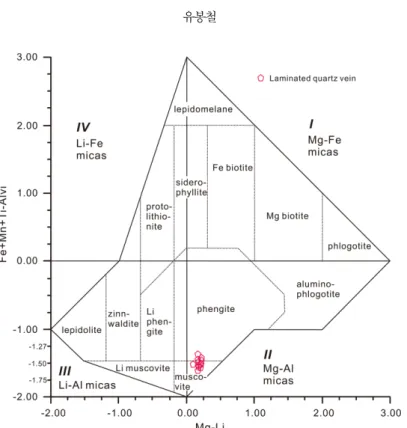
백색운모와 녹니석의 화학조성 운산 광상의 엽리상 석영맥에서 산출되는 백색운모 에 대한 전자현미분석(EPMA) 정량분석 결과는 Table 1과 같으며 구조식 계산은 산소원자 11로 계산하였다. 일반적으로 백색운모의 구조식은 XY2Z4O10(OH,F)2로 써 X에는 K+, Na+, Ca2+, Ba2+, Rb+, Cs+, Sr2+ 등 원소들, Y에는 Al3+, Mg2+, Fe2+, Fe3+, Mn2+, Cr3+, Ti4+, Li+, V3+, Ni2+ 등 원소들이 Z에는 Si4+, Al3+ 원소들로 구성된다(Rieder et al., 1999; Deer et al., 2003). Table 1에서 보는 것과 같이, 운산 광상의 엽 리상 석영맥에서 산출되는 백색운모의 구조식은 (K0.98-0.86Na0.02-0.00Ca0.01-0.00Ba0.01-0.00Sr0.00)1.00-0.88(Al1.70-1.57 Mg0.22-0.09Fe0.23-0.10Mn0.00Ti0.04-0.02Cr0.01-0.00V0.00Ni0.00)2.06-1.95 (Si3.38-3.17Al0.83-0.62)4.00O10(OH2.00-1.91F0.09-0.00)2.00로써 이론 적인 이중팔면체형 운모류 값보다 Si가 높고 K, Na, Ca는 낮다. Table 1에서 보는 것과 같이, 이 엽리상 석영맥의 백색운모의 층간 양이온(K+Na+Ca+Ba+Sr) 은 0.88∼1.00 apfu로써 다소 낮은 함량을 갖지만 팔 면체 자리에서의 Fe+Mg+Mn+Ti+Cr+V+Ni 함량은 1.95∼2.06 apfu로써 다소 높은 함량을 갖는다. 일반적 으로 운모류는 이상적인 사면체 자리(tetrahedral site) 의 Si:Al 비율이 3:1이면 백운모이고 3:1보다 크면 팬자이트라고 정의하였지만(Deer et al., 2013), Si 함량에 따라 Si 값이 3.0에서 3.1사이는 백운모, 3.5 에서 4.0사이는 셀라도나이트 계열 광물, 3.1에서 3.5 사이는 팬자이트 계열 광물(patassic dioctahedral mica) 이라 하였다(Tappert et al., 2013). 운산 광상의 엽리 상 석영맥에서 산출되는 백색운모에 대해 Tischendorf
et al. (1997)이 제시한 Mg-Li 대 Fe+Mn+Ti-Alvi 분
류 관계도에 도시하여 보면 백운모와 팬자이트에 해 당된다(Fig. 4). 이 백색운모는 서로 다른 2상(어두운 부분의 백색운모와 밝은 부분의 백색운모, Fig. 3a-c) 으로 산출되며 그에 대한 화학조성을 살펴보면 각각 다음과 같다. SiO2 함량은 50.63∼50.91 wt.%, 47.71 ∼49.79 wt.%, TiO2 함량은 0.26∼0.30 wt.%, 0.36∼ 0.80 wt.%, Al2O3 함량은 27.87∼31.51 wt.%, 31.04 ∼32.55 wt.%, FeO 함량은 1.34∼3.25 wt.%, 2.08∼ 2.96 wt.%, MgO 함량은 1.69∼2.24 wt.%, 0.95∼2.02 wt.%, BaO 함량은 0.01∼0.02 wt.%, 0.03∼0.25 wt.%, Na2O 함량은 0.01∼0.04 wt.%, 0.05∼0.15 wt.%, K2O
Fig. 3. BSEs of white mica and chlorite crystals showing different phases (dark white mica and light white mica). Red circles indicate quantitative analysis points.
Table 1. Chemical composition of white mica from the Unsan Au deposit
Laminated quartz vein
Sample No. US-3 US-4 US-5 US-7 US-9 US-10 US-11 US-12 US-14 US-15 US-16US-17 US-18 SiO2 48.66 48.81 49.54 50.20 48.51 48.79 50.03 49.53 48.14 50.63 50.91 49.79 47.71 TiO2 0.34 0.40 0.31 0.45 0.53 0.80 0.49 0.62 0.560.30 0.260.360.60 Al2O3 31.63 30.26 32.67 31.75 31.04 32.55 31.05 32.20 31.62 31.51 27.87 31.43 31.96 Cr2O3 0.05 0.09 0.03 0.03 0.00 0.04 0.03 0.01 0.03 0.03 0.02 0.00 0.00 V2O3 0.02 0.03 0.01 0.02 0.01 0.02 0.01 0.02 0.04 0.07 0.00 0.03 0.06 Nb2O5 0.00 0.00 0.03 0.00 0.03 0.03 0.00 0.00 0.00 0.00 0.00 0.00 0.00 FeO 3.65 3.73 2.58 2.41 2.10 2.16 2.14 1.62 2.40 1.34 3.25 2.96 2.08 MnO 0.04 0.01 0.02 0.01 0.04 0.00 0.01 0.00 0.03 0.00 0.00 0.02 0.01 MgO 1.62 1.65 1.72 2.31 2.02 1.71 2.10 2.10 1.69 1.69 2.24 0.95 1.68 NiO 0.02 0.02 0.00 0.00 0.02 0.01 0.00 0.00 0.02 0.03 0.01 0.00 0.00 ZnO 0.03 0.09 0.00 0.05 0.10 0.03 0.03 0.13 0.05 0.01 0.00 0.04 0.02 CaO 0.09 0.08 0.09 0.060.060.02 0.07 0.04 0.00 0.02 0.02 0.00 0.03 BaO 0.08 0.11 0.18 0.17 0.15 0.25 0.11 0.18 0.17 0.01 0.02 0.03 0.25 SrO 0.00 0.03 0.03 0.07 0.00 0.01 0.00 0.00 0.04 0.05 0.05 0.04 0.05 Na2O 0.060.07 0.07 0.10 0.11 0.15 0.10 0.12 0.15 0.04 0.01 0.05 0.15 K2O 10.25 11.15 11.03 11.27 10.92 11.1610.89 10.97 11.54 11.6611.22 11.51 10.90 F 0.20 0.38 0.22 0.45 0.25 0.01 0.15 0.49 0.24 0.27 0.22 0.15 0.35 Total 96.74 96.91 98.53 99.35 95.89 97.74 97.21 98.03 96.72 97.66 96.10 97.36 95.85
Structural formulae based on 11 oxygen atoms
Si 3.210 3.233 3.203 3.217 3.222 3.190 3.269 3.199 3.188 3.283 3.384 3.268 3.170 AlIV 0.790 0.767 0.797 0.783 0.778 0.810 0.731 0.801 0.812 0.717 0.616 0.732 0.830 AlVI 1.670 1.595 1.693 1.615 1.652 1.698 1.661 1.650 1.657 1.692 1.567 1.700 1.673 Ti 0.017 0.020 0.015 0.022 0.0260.039 0.024 0.030 0.028 0.015 0.013 0.018 0.030 Cr 0.005 0.009 0.003 0.003 0.000 0.004 0.003 0.001 0.003 0.003 0.002 0.000 0.000 V 0.001 0.001 0.000 0.001 0.000 0.001 0.000 0.001 0.002 0.003 0.000 0.001 0.003 Nb 0.000 0.000 0.001 0.000 0.001 0.001 0.000 0.000 0.000 0.000 0.000 0.000 0.000 Fe 0.201 0.207 0.140 0.129 0.117 0.118 0.117 0.087 0.133 0.073 0.181 0.162 0.116 Mn 0.002 0.001 0.001 0.001 0.002 0.000 0.001 0.000 0.002 0.000 0.000 0.001 0.001 Mg 0.159 0.163 0.166 0.221 0.200 0.167 0.205 0.202 0.167 0.163 0.222 0.093 0.166 Ni 0.001 0.001 0.000 0.000 0.001 0.001 0.000 0.000 0.001 0.002 0.001 0.000 0.000 Zn 0.001 0.004 0.000 0.002 0.005 0.001 0.001 0.0060.002 0.000 0.000 0.002 0.001 Ca 0.0060.0060.0060.004 0.004 0.001 0.005 0.003 0.000 0.001 0.001 0.000 0.002 Ba 0.002 0.003 0.005 0.004 0.004 0.0060.003 0.005 0.004 0.000 0.001 0.001 0.007 Sr 0.000 0.001 0.001 0.003 0.000 0.000 0.000 0.000 0.002 0.002 0.002 0.002 0.002 Na 0.008 0.009 0.009 0.012 0.014 0.019 0.013 0.015 0.019 0.005 0.001 0.0060.019 K 0.863 0.942 0.910 0.921 0.925 0.931 0.908 0.904 0.975 0.965 0.951 0.964 0.924 F 0.042 0.080 0.045 0.091 0.053 0.002 0.031 0.100 0.050 0.055 0.0460.031 0.074 OH* 1.958 1.920 1.955 1.909 1.947 1.998 1.969 1.900 1.950 1.945 1.954 1.969 1.926 Cations 6.937 6.961 6.949 6.935 6.952 6.988 6.940 6.904 6.993 6.922 6.940 6.949 6.941 K/(K+Na+Ca) 0.982 0.982 0.979 0.978 0.9760.972 0.978 0.9760.9760.993 0.997 0.993 0.971 Mg/(Mg+Fe+Mn) 0.439 0.440 0.541 0.630 0.627 0.585 0.635 0.698 0.553 0.692 0.551 0.362 0.589 Fe/Fe+Mg 0.558 0.559 0.457 0.369 0.368 0.415 0.364 0.302 0.443 0.308 0.449 0.636 0.410 Al(vi)/(sum Oct) 0.811 0.797 0.839 0.810 0.824 0.8360.8260.834 0.831 0.867 0.789 0.860 0.841
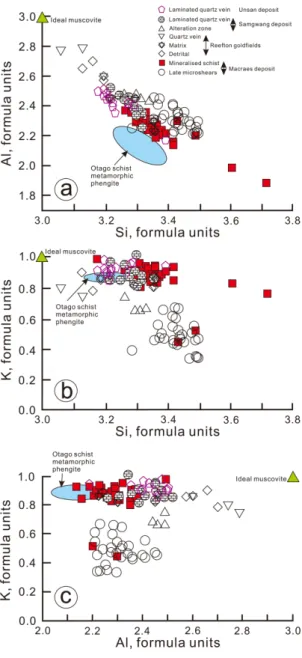
함량은 11.22∼11.66 wt.%, 10.90∼11.54 wt.% 값으 로 밝은 부분의 백색운모가 어두운 부분의 백색운모 보다 TiO2, Al2O3, FeO, BaO 및 Na2O 함량이 높 게 산출된다(Table 1). 운산 금 광상의 엽리상 석영맥에서 산출되는 백색 운모에 대한 층간 양이온의 K 함량과 팔면체 및 사 면체 자리에서의 Si 및 Al 함량을 기초로 조산형 금 -은 광상인 삼광 광상, Macraes 광상 및 Re e fton goldfields 광상에서 산출되는 백색운모들과 비교하여 보았다(Christie and Brathwaite, 2003; Craw and MacKenzie, 2016; Yoo, 2020a)(Fig. 5). Fig. 5a에 서 보는 것과 같이, 운산 금 광상의 엽리상 석영맥에 서 산출되는 백색운모의 Al 함량은 삼광 광상에서 산 출되는 백색운모의 Al 함량과 거의 일치하나 Re e fton goldfields 광상에서 산출되는 백색운모의 Al 함량보 다 낮은 함량을 갖으며 Macraes 광상에서 산출되는 백색운모의 Al 함량보단 높은 함량을 갖는다. 이들 광상에서 산출되는 백색운모들의 Si, Al에 대한 K 함량을 비교하면, 운산 광상의 엽리상 석영맥에서 산 출되는 백색운모의 K 함량은 삼광 광상의 엽리상 석 영맥과 Macrae s 광상의 mineralised schist (광화작용 의 ductile shear 시기)에서 산출되는 백색운모들의 K
함량과 거의 일치하나 삼광 광상의 모암변질, Reefton goldfields 광상 및 Macraes 광상의 late microshears (광화작용의 brittle shear 시기)에서 산출되는 백색운 모들의 K 함량보다 높은 함량을 갖는다(Fig. 5b-c). 더불어 운산 광상을 제외한 다른 조산형 금-은 광상 들에서 산출되는 백색운모의 Si, Al 및 K 함량들은 정출시기에 따라 함량이 다름을 알 수 있다(Fig. 5). 또한 팔면체 자리에서의 Fe+Mg 함량과 사면체 자리 에서의 Si 함량을 기초로 운산 광상의의 백색운모와 삼광 광상, Reefton goldfields 광상에서 산출되는 백 색운모와 비교해 본 결과, 운산 광상의 엽리상 석영 맥에서 산출되는 백색운모는 삼광 광상에서 산출되는 백색운모(엽리상 석영맥과 모암변질)와 Fe +Mg 및 Si 함량이 거의 일치하나 Reefton goldfields 광상에서 산출되는 백색운모보다 Fe +Mg 및 Si 함량이 다소 높은 값을 갖는다(Fig. 6). 따라서 운산 광상의 엽리 상 석영맥에서 산출되는 백색운모의 화학조성은 삼광 광상의 엽리상 석영맥과 Macraes 광상의 mine ralise d schist (광화작용의 ductile shear 시기)에서 산출되는 백색운모들의 화학조성과 매우 유사함을 알 수 있다. 백색운모에 대한 화학조성 변화는 일반적으로 4가 지의 치환 메카니즘에 의해 일어난다고 보고되어 있
다(Cohen, 2011; Yoo, 2019; 2020a). 첫 번째 치환
메카니즘은 팬자이틱 또는 Tschermark 치환[(Al3+)VI+
(Al3+)IV <-> (Fe2+ 또는 Mg2+)VI+(Si4+)IV], 두 번째 치 환 메카니즘은 직접적인 (Fe3+)VI <-> (Al3+)VI 치환, 세 번째 치환 메카니즘은 illitic 치환[(K+)interlayer cation site
+(Al3+)IV <-> (Si4+)IV+( )interlayer cation site] 및 네 번째
치환 메카니즘은 층간 양이온 자리에서 Na+ <-> K+
치환이다(Cohen, 2011). 운산 광상의 엽리상 석영맥 에서 산출되는 백색운모에 대한 치환 유형을 알아보 기 위하여 삼광 광상과 Reefton goldfields 광상에서 산출되는 백색운모들과 함께 비교해 보았다. 첫 번째
로 팬자이틱 또는 Tschermark 치환[(Al3+)VI+(Al3+)IV
<-> (Fe2+ 또는 Mg2+)VI+(Si4+)IV]과 직접적인 (Fe3+)VI
<-> (Al3+)VI 치환간의 관계를 알아보면, 운산 광상에
서 산출되는 백색운모 대부분은 팬자이틱 치환선 [(Al3+)VI+(Al3+)IV <-> (Fe2+ 또는 Mg2+)VI+(Si4+)IV](lower line in Fig. 7a)과 (Fe3+)VI <-> (Al3+)VI 치환선(upper line in Fig. 7a) 사이에 도시되나 일부는 팬자이틱 치환선[(Al3+)VI+(Al3+)IV <-> (Fe2+ 또는 Mg2+)VI+(Si4+)IV] (lower line in Fig. 7a) 아래에 도시된다(Fig. 7a). 그러나 삼광 광상 및 Reefton goldfields 광상에서
산출되는 백색운모 모두가 팬자이틱 치환선[(Al3+)VI+
(Al3+)IV <-> (Fe2+ 또는 Mg2+)VI+(Si4+)IV](lower line in Fig. 7a)과 (Fe3+)VI <-> (Al3+)VI 치환선(upper line in Fig. 7a) 사이에 도시된다(Yoo, 2020a)(Fig. 7a). 이것은 운산 광상에서 산출되는 백색운모의 Fe가
Fe2+와 Fe3+가 존재하지만 주로 Fe2+ 우세함을 의미한
다. 그러나 삼광 광상과 Reefton goldfields의 조산형
금 광상에서 산출되는 모든 백색운모의 Fe가 Fe2+와
Fe3+가 함께 존재함을 의미한다(Yoo, 2020a). Cohen
(2011)는 Fe+Mg+Mn에 대해 0.2 apfu 이상의 값을 갖는 것을 팬자이틱 백운모(phengitic muscovite)라 명명하였다. 운산 광상에서 산출되는 백색운모는 삼
Fig. 5. Compositional variations of white micas from the Unsan Au deposit (Modified after Craw and MacKenzie, 2016). Also are shown the Samgwang deposit (Yoo, 2020a), the Reefton goldfields (Christie and Brathwaite, 2003) and Macraes deposit (Craw and MacKenzie, 2016).
Fig. 6. Compositional variation in white mica in terms of total Si (apfu) vs. Fe+Mg (apfu) (Modified after Christie and Brathwaite, 2003). Also are shown the Samgwang deposit (Yoo, 2020a)
광 광상에서 산출되는 백색운모와 같이 팬자이틱 백 운모에 해당되나 Reefton goldfields 광상에서 산출되
는 백색운모는 백운모와 팬자이틱 백운모에 해당된다 (Fig. 7a).
또한 팬자이틱 또는 Tschermark 치환[(Al3+)VI+
(Al3+)IV <-> (Fe2+ 또는 Mg2+)VI+(Si4+)IV]과 illitic 치환 [(K+)interlayer cation site+(Al3+)IV <-> (Si4+)IV+( )interlayer cation site] 간의 관계를 알아보기 위하여 total Al 대 K+Na+2Ca 관계도에 도시하여 보았다(Fig. 7b). 그림 7b에서 보 는 것과 같이, 운산 광상, 삼광 광상 및 Re e fton goldfields 광상에서 산출되는 백색운모들은 illitic 치환이 관찰되지 않는다. 더불어 팬자이틱 또는 Tschermark 치환[(Al3+)VI+(Al3+)IV <-> (Fe2+ 또는 Mg2+)VI+(Si4+)IV]과 층간 양이온 자리에서 Na+ <-> K+ 치환간의 관계를 알아보기 위하여 total Al 대 K/ (K+Na+2Ca) 관계도에 도시하여 보았다(Fig. 7c). 그 림 7c에서 보는 것과 같이, 운산 광상, 삼광 광상 및 Reefton goldfields의 광상에서 산출되는 백색운모들은 층간 양이온 자리에서 Na+ <-> K+ 치환이 관찰되지 않는다. 따라서 운산 광상의 엽리상 석영맥에서 산출 되는 백색운모의 화학조성 변화는 삼광 광상과 Reefton goldfields 광상에서 산출되는 백색운모들과 같
이 팬자이틱 또는 Tschermark 치환[(Al3+)VI+(Al3+)IV
<-> (Fe2+ 또는 Mg2+)VI+(Si4+)IV] 및 직접적인 (Fe3+)VI
<-> (Al3+)VI 치환 메카니즘에 의해 일어났음을 알 수 있다. 운산 광상의 엽리상 석영맥에서 산출되는 녹니석에 대한 전자현미분석(EPMA) 정량분석 결과는 Table 2 와 같으며 구조식 계산은 산소원자 14로 계산하였다. 일반적으로 녹니석의 구조식은 (R2+,R3+) 6vi(Si4-xAlx)iv O10(OH)8로써 R2+에는 Mg, Fe2+, Zn, Ni, Mn 등 원소들, R3+에는 Al, Fe , Cr, Ti4+, V3+, Cu2+, Li+ 등 원소들로 구성된다(Deer et al., 2009; Jimenez, 2011). Table 2에서 보는 것과 같이, 운산 광상의 엽리
상 석영맥에서 산출되는 녹니석의 구조식은 (Mg1.11-0.80
Fe3.69-3.14Mn0.01-0.00Zn0.01-0.00K0.07-0.01Na0.01-0.00Ca0.04-0.01 Al1.66-1.09)5.75-5.69(Si3.49-2.96Al1.04-0.51)4.00O10(OH)8로써 이론 적인 녹니석((Mg,Fe)6(Si,Al)4O10(OH)8, Si=2.30-3.39 apfu)보다 Si 함량이 높다. 더불어 이론적인 녹니석에 는 K, Na 및 Ca 원소들(층간양이온 자리)이 존재하 지 않지만 운산 광상의 엽리상 석영맥에서 산출되는 녹니석에서는 이들 원소들이 소량 함유되어 있다 (Table 1). 이 녹니석의 Fe /(Fe +Mg) 값은 0.74∼0.82 로서 0.62∼0.75(삼광 광상의 엽리상 석영맥), 0.26∼ 0.57(Reefton goldfields 광상의 석영맥), 0.41∼0.59
Fig. 7. Compositional variation in white mica from Unsan Au deposit. (a) total Al (apfu) vs. Fe+Mg+Mn (apfu), (b) total Al (apfu) vs. K+Na+2Ca (apfu), (c) total Al (apfu) vs. K/ (K+Na+2Ca) (apfu) (Modified after Cohen, 2011). Arrows represent compositional vectors for main substitution mechanisms and black open symbols represent end-member composi-tions. Also are shown the Samgwang deposit (Yoo, 2020a) and the Reefton goldfields (Chris-tie and Brathwaite, 2003).
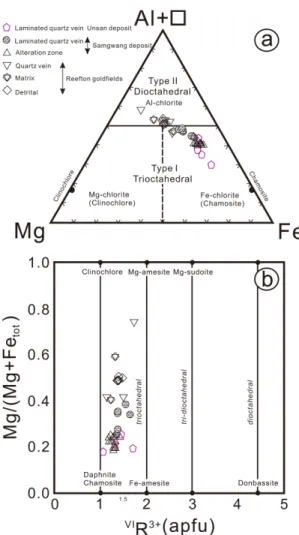
(Reefton goldfields 광상의 모암변질) 및 0.49∼0.51 (Reefton goldfields 광상의 모암) 보다 높은 값을 갖 으나 0.74∼0.81(삼광 광상의 모암변질)과 유사하다. Zane and Weiss (1998)에 의하면 녹니석 분류는 크 게 2단계를 기술하였다. 첫 번째 단계는 녹니석 형 (type)를 분류하고 두 번째 단계는 녹니석 이름(name) 를 분류하는 것이다. 첫 번째 녹니석 형은 녹니석내 Mg, Fe 및 Al 함량을 토대로 Type I (XMg+XFe≥ XAl+X□)과 Type II (XMg+XFe<XAl+X□)로 분류하고 두 번째 녹니석 이름은 팔면체 자리내에 이들 주 양 이온들의 함량을 토대로 Mg-녹니석, Fe-녹니석 및 Al-녹니석 명명하였다(Zane and Weiss,1998). 운산 광상의 엽리상 석영맥에서 산출되는 녹니석에 대한 분 석결과를 가지고 Zane and Weiss (1988) 및 Yavuz et al. (2015)가 제시한 다이어그램에 도시하면 Type I trioctahedral (Fe-chlorite) 영역부분에 해당된다(Fig. 8a). 더불어 삼광 광상의 엽리상 석영맥 및 모암변질 에서 산출되는 녹니석은 운산 광상의 녹니석과 같이 Type I trioctahedral (Fe-chlorite) 영역부분에 해당되 나(Fig. 8a) Reefton goldfields 광상에서 산출되는 녹니석은 대부분이 Type II dioctahedral (Al-chlorite) 에 해당되고 일부는 Type I trioctahedral (Fe-chlorite)
에 해당된다(Fig. 8a). 또한 녹니석내 Mg/(Mg+Fetot)
및 VIR3+(apfu)함량을 이용하여 trioctahedral,
tri-dioctahedral 및 tri-dioctahedral로 분류할 수 있다 (Plissart et al., 2009; Yavuz et al, 2015)(Fig. 8b). Fig. 8b에서 보는 것과 같이, 운산 광상의 엽리상 석 영맥에서 산출되는 녹니석뿐만 아니라 삼광 광상과 Reefton goldfields 광상에서 산출되는 녹니석 모두 trioctahedral 영역부분에 해당된다. 일반적으로 녹니석 과 같은 고용체 광물들은 단순한 화학분석자료로부터 각 단종을 유추하기는 한계가 있어 각 원소에 대한 몰분율(Xi, i=원소)의 계산도 녹니석의 결정학적 구조 내에 존재 위치(site)에 따라 불분명하다(Yoo et al., 2009). 그래서 녹니석의 정량분석결과로부터 몰분율 및 활동도계산은 Neall and Phillips (1987)이 제시한 가정과 방법에 의해 구하였다. 또한 열역학적 자료는 Walshe (1986), Walshe and Solomon (1981) 및 Helgeson et al. (1978)의 것을 참조하였다. 계산된 운 산 광상의 엽리상 석영맥에서 산출되는 녹니석 단종 의 활동도는 a3(Fe5Al2Si3O10(OH)8=0.0242∼0.0306, a1 (Mg6Si4O10(OH)8=1.43E-13∼3.56E-7, a2 (Mg5Al2Si3O10
(OH)8=4.37E-14∼4.25E-7로써 Fe- rich 녹니석이 우세
Table 2. Chemical compositions of chlorite from the Unsan Au deposit
Laminated quartz vein
Sample No. US-1 US-2 US-6US-13 SiO2 26.88 27.43 30.38 30.45 TiO2 0.04 0.01 0.04 0.05 Al2O3 20.84 18.58 15.83 11.89 Cr2O3 0.02 0.02 0.00 0.03 V2O3 0.03 0.00 0.01 0.00 FeO 34.80 33.93 36.48 38.55 MnO 0.02 0.060.12 0.12 MgO 4.85 6.70 5.81 4.88 NiO 0.00 0.00 0.00 0.02 ZnO 0.01 0.14 0.10 0.01 CaO 0.160.07 0.37 0.26 SrO 0.05 0.00 0.00 0.08 BaO 0.00 0.08 0.00 0.04 Na2O 0.01 0.01 0.03 0.00 K2O 0.05 0.04 0.14 0.46 Total 87.74 87.0689.31 86.82
Structural formulae based on 14 oxygen atoms Si 2.9563.038 3.305 3.486 AlIV 1.044 0.962 0.695 0.514 AlVI 1.657 1.464 1.335 1.090 Ti 0.003 0.001 0.003 0.004 Cr 0.002 0.002 0.000 0.003 V 0.003 0.000 0.001 0.000 Fe 3.200 3.143 3.319 3.690 Mn 0.002 0.0060.011 0.012 Mg 0.795 1.1060.942 0.833 Ca 0.019 0.008 0.043 0.032 Ni 0.000 0.000 0.000 0.002 Zn 0.001 0.011 0.008 0.001 Sr 0.003 0.000 0.000 0.005 Ba 0.000 0.003 0.000 0.002 Na 0.002 0.002 0.0060.000 K 0.007 0.0060.019 0.067 Cations 9.693 9.751 9.689 9.740 Fe/Fe+Mg 0.80 0.74 0.78 0.82 Mg/Fe+Mg 0.20 0.260.22 0.18 a1 1.04E-10 3.56E-07 1.33E-08 1.43E-13 a2 1.73E-10 4.25E-07 8.11E-09 4.37E-14 a3 0.0298 0.0242 0.0261 0.0306
a1 = Mg6Si4O10(OH)8, a2 = Mg5Al2Si3O10(OH)8,
함을 알 수 있다(Table 2). 녹니석에 대한 화학조성 변화는 일반적으로 2가지의 치환 메카니즘에 의해 일 어난다고 보고되어 있다(Cohen, 2011). 첫 번째 치환
메카니즘은 팬자이틱 또는 Tschermark 치환(Al3+,VI+
Al3+,IV <-> (Fe2+ 또는 Mg2+)VI+(Si4+)IV), 두 번째 치
환 메카니즘은 팔면체적 Fe2+ <-> Mg2+ (Mn2+) 치환
이다(Cohen, 2011). 운산 광상의 엽리상 석영맥에서 산출되는 녹니석에 대한 치환 유형을 알아보기 위하 여 삼광 광상과 Reefton goldfields 광상에서 산출되
는 녹니석들과 함께 비교해 보았다(Fig. 9). 첫 번째로 팬자이틱 또는 Tsche rmark 치환(Al3+,VI+Al3+,IV <-> (Fe2+ 또는 Mg2+)VI+(Si4+)IV) 관계를 알아보면, 운산 광상 뿐만 아니라 삼광 광상 및 Reefton goldfields 광상에서 산출되는 녹니석 대부분은 반비례로 도시됨 을 알 수 있다(Fig. 9a). Cohen (2011)에 의하면 백 운모 또는 일라이트와 함께 산출되는 녹니석의 팔면
체적 Al 함량은 >0.20 (AlVI/sum oct) 로써 프로필
리틱 변질대에서 산출되는 녹니석의 Al 함량보다 높
다고 보고하였다. 또한 팔면체적 Fe2+ <-> Mg2+
(Mn2+) 치환관계를 알아보면, 운산 광상 뿐만 아니라
삼광 광상 및 Reefton goldfields 광상에서 산출되는 녹니석 대부분은 반비례로 도시됨을 알 수 있다(Fig.
Fig. 8. Compositional diagram for chlorite from the Unsan Au deposit. (a) Al+□-Mg-Fe ternary dia-gram (Modified after Zane and Weiss, 1998; Yavuz et al., 2015), (b) VIR3+ (apfu) vs. Mg/
(Mg+Fetot) diagram (Modified after Plissart et
al., 2009; Yavuz et al., 2015). Also are shown the Samgwang deposit (Yoo, 2020a) and the Reefton goldfields (Christie and Brathwaite, 2003).
Fig. 9. Compositional variation in chlorite from the Unsan Au deposit. (a) Si (apfu) vs. AlVI/(sum
oct) diagram (Modified after Cohen, 2011), (b) Si (apfu) vs. Fe/(Fe+Mg+Mn) diagram (Modi-fied after Cohen, 2011). Dashed lines represent chlorite species divisions according to Foster (1962). Also are shown the Samgwang deposit (Yoo, 2020a) and the Reefton goldfields (Chris-tie and Brathwaite, 2003).
9b). 따라서 운산 광상의 엽리상 석영맥에서 산출되는 녹니석의 화학조성 변화는 삼광 광상과 Re e fton goldfields 광상에서 산출되는 녹니석들과 같이 팬자 이틱 또는 Tschermark 치환(Al3+,VI+Al3+,IV <-> (Fe2+ 또는 Mg2+)VI+(Si4+)IV) 및 팔면체적 Fe2+ <-> Mg2+ (Mn2+) 치환 메카니즘에 의해 일어났음을 알 수 있다.
사
사
이 연구는 2020년 정부(과학기술정보통신부)의 재 원으로 국가과학기술연구회 융합연구단 사업(No. CRC-15-06-KIGAM) 또는 한국지질자원연구원 융합 사업인 “북한 광물자원 탐사기술 실증 및 잠재성 평 가(19-8901, 20-8901)” 과제 지원을 받아 수행되었으 며 이에 사의를 표한다. 바쁘신 와중에도 이 논문의 미비점을 지적, 수정하여 주신 심사위원님들께 깊이 감사드립니다REFERENCES
Ayati, F., Yavuz, F., Noghreyan, M., Haroni, H.A. and Yavuz, R., 2008, Chemical characteristics and composi-tion of hydrothermal biotite from the Dalli porphyry cop-per prospect, Arak, central province of Iran. Mineralogy and Petrology, 94, 107-122.
Christie, A.B. and Brathwaite, R.L., 2003, Hydrothermal alteration in metasedimentary rock-hosted orogenic gold deposits, Reefton goldfield, South Island, New Zealand. Mineralium Deposita, 38, 87-107.
Cohen, J.F., 2011, Compositional Variations in Hydrother-mal White Mica and Chlorite from Wall-Rock Alteration at the Ann-Mason Porphyry Copper Deposit, Nevada. Master thesis, Oregon State University, Oregon, USA, 121p.
Craw, D. and MacKenzie, D., 2016, Macraes orogenic gold deposit (New Zealand) Origin and development of a world class gold mine. Springer, 127p.
Deer, W.A., Howie, R.A. and Zussman, J., 2003, Rock-forming minerals, sheet silicates: Micas, 2, 308p. Deer, W.A., Howie, R.A. and Zussman, J., 2009,
Rock-Forming Minerals, Layered Silicates Excluding Micas and Clay Minerals, 2nd edition, 81-156.
Deer, W.A., Howie, R.A. and Zussman, J., 2013, An intro-duction to the rock-forming minerals, 3rd edition.
Steve-nage, Berforts Information Press, 498p.
Dehnavi, A.S., McFarlane, C.R.M., Lentz, D.R., McClen-aghan, S.H. and Walker, J.A., 2019, Chlorite-white mica pairs’ composition as a micro-chemical guide to
finger-print massive sulfide deposits of the Bathurst mining camp, Canada. Minerals, 9,125.
Foster, M.D., 1962, Interpretation of the composition and a classification of the chlorites. Geological Survey Profes-sional Paper, 414-A, 1-33.
Gaillard, N., Williams-Jones, A.E., Clark, J.R., Lypaczewski, P., Salvi, S., Perrouty, S., Piette-Lauziere, N., Guilmette, C. and Linnen, R.L., 2018, Mica composition as a vector to gold mineralization: Deciphering hydrothermal and metamorphic effects in the Malartic district, Quebec. Ore Geology Reviews, 95, 789-820.
Goldfarb, R.J., Taylor, R.D., Collins, G.S., Goryachev, N.A. and Orlandini, O.F., 2014, Phanerozoic continental growth and gold metallogeny of Asia. Gondwana Research, 25, 48-102.
Groves, D.I., Goldfarb, R.J., Gebre-Mariam, M., Hagemann, S.G. and Robert, F., 1998, Orogenic gold deposits: A pro-posed classification in the context of their crustal distri-bution and relationship to other gold deposit types. Ore Geology Reviews, 13, 7-27.
Helgeson, H.C., Delany, J.M., Nesbitt, H.W. and Bird, D.K., 1978, Summary and critique of the thermodynamic prop-erties of rock forming minerals. American Journalof Sci-ence, 278-A, 229p.
Hori, S., 1942, Geology and ore deposits of the eastern Unsan mining district, Korea. The Journal of the Geolog-ical Society of Japan, 49, 1-29.
Ishihara, S., 2006, North Korea, a country of gold? Gold mineralizations in the Korean Peninsular and their base-ment setting. Chishitsu News, 617, 8-23.
Ishihara, S., Jin, M.S. and Sasaki, A., 2000, Source diversity of ore sulfur from Mesozoic-Cenozoic mineral deposits in the Korean Peninsula region. Resource Geology, 50, 203-212.
Jimenez, T.R.A., 2011, Variation in hydrothermal muscovite and chlorite composition in the Highland valley porphyry Cu-Mo district, British Columbia, Canada. Master thesis, University of British Columbia, Vancouver, Canada, 233p. Kinosaki, Y., 1933, Geological Atlas of Chosen, No. 15:
Hokuchin and Gyukenchin Sheets, 25p.
Koh, S.M., Lee, G.J., You, B.W., Kim, N.H. and Lee, B.H., 2019, Geology and mineralization of the Northern Korean Peninsula. Korea Institute of Geoscience and Mineral Resources, 322p.
Lee, K.H., Lee, J.I., Yu, C.C., Jung, K.R., Cho, D.H., Lee, K.K., Kwon, H.H. and Cho, W.J., 2012, Korea Mining Centennial History. Korea Mining Association, 840p. Neall, F.B. and Phillips, G.N., 1987, Fluid-wallrock
interac-tion in an Archean hydrothermal gold deposit: A thermo-dynamic model for the Hunt mine, Kambalda. Economic Geology, 82, 1679-1694.
Pearce, M.A., White, A.J.R., Fisher, L.A., Hough, R.M. and Cleverley, J.S., 2015, Gold deposition caused by
carbon-ation of biotite during late-stage fluid flow. Lithos, 239, 114-127.
Plissart, G., Femenias, O., Maruntiu, M., Diot, H. and Demaiffe, D., 2009, Mineralogy and geothermometry of gabbro-derived listvenites in the Tisovita-Iuti ophiolite, southwestern Romania. Canadian Mineralogist, 47, 81-105.
Rieder, M., Cavazzini, G., D'Yakonov, Y.S., Frank-Kame-netskii, V.A., Gottardi, G., Guggenhein, S., Koval, P.V., Muller, G., Neiva, A.M.R., Radoslovich, E.W., Robert, J., Sassi, F.P., Takeda, H., Weiss, Z. and Wones, D.R., 1999, Nomenclature of the micas. Mineralogical Magazine, 63, 267-279.
Shikazono, N. and Shimizu, M., 1986, Compositional vari-ations in Au-Ag series minerals from some gold deposits in the Korean Peninsula. Mining Geology, 36, 545-553. Takashima, K. and Kishimoto, F., 1987, Gold deposits of
Unsan and its vicinity - A sketch of the Democratic Peo-ple’s Republic of Korea. Chishitsu News, 398, 28-41 (in Japanese).
Tappert, M.C., Rivard, B., Giles, D., Tappert, R. and Mauger, A., 2013, The mineral chemistry, near-infrared, and mid-infrared reflectance spectroscopy of phengite from the Olympic Dam IOCG deposit, South Australia. Ore Geol-ogy Reviews, 53, 26-38.
Tindle, A.G. and Webb, P.C., 1990, Estimation of lithium contents in trioctahedral micas using microprobe data : application to micas from granittic rocks. European Jour-nal of Mineralogy, 2, 595-610.
Tischendorf, G., Gottesmann, B., Forster, H.J. and Trumbull, R.B., 1997, On Li-bearing micas: estimating Li from electron microprobe analyses and an improved diagram for graphical representation. Mineralogical Magazine, 61, 809-834.
Uribe-Mogollon, C. and Maher, K., 2018, White mica geo-chemistry of the Copper Cliff porphyry Cu deposit: Insights from a vectoring tool applied to exploration. Economic Geology, 113, 1269-1295.
Wallace, C.J., 2016, Latite dikes, phyllic alteration and geo-chemical variations of micas at the copper flat hydrother-mal system, Hillsboro, Sierra county, New Mexico, USA. Master thesis, New Mexico Institute of Mining and Tech-nology, New Mexico, USA, 107p.
Walshe, J.L, 1986, A six-component chlorite solid solution model and the conditions of chlorite formation in
hydro-thermal and geohydro-thermal system. Economic Geology, 81, 687-703.
Walshe, J.L. and Solomon, M., 1981, An investigation into the environment of formation of the volcanichosted Mt. Lyell copper deposits, using geology, mineralogy, stable isotopes, and a six-component chlorite solid solution model. Economic Geology, 76, 246-284.
Wang, R., Cudahy, T., Laukamp, C., Walshe, J.L., Bath, A., Mei, Y., Young, C., Roache, T.J., Jenkins, A., Roberts, M., Barker, A. and Laird, J., 2017, White mica as a hyperspectral tool in exploration for the Sunrise Dam and Kanowna Belle gold deposits, Western Australia. Eco-nomic Geology, 112, 1153-1176.
Yavuz, F., Kumral, M., Karakaya, N., Karakaya, M.C. and Yildirim, D.K., 2015, A windows program for chlorite calculation and classification. Computers & Geosciences, 81, 101-113.
Yoo, B.C., 2019, White mica and chemical composition of Samdeok Mo deposit, Republic of Korea. Journal of the Mineralogical Society of Korea, 32, 223-234.
Yoo, B.C., 2020a, Occurrence and chemical composition of white mica and ankerite from laminated quartz vein of Samgwang Au-Ag deposit, Republic of Korea. Korean Journal of Mineralogy and Petrology, 33, 53-64. Yoo, B.C., 2020b, Occurrence and chemical composition of
W-bearing rutile from the Unsan Au deposit. Korean Journal of Mineralogy and Petrology, 33, 115-127. Yoo, B.C., Lee, G.J., Lee, J.K., Ji, E.K. and Lee, H.K.,
2009, Element dispersion and wallrock alteration from Samgwang deposit. Economic and Environmental Geol-ogy, 42, 177-193.
Zane, A. and Weiss, Z., 1998, A procedure for classifying rock-forming chlorites based on microprobe data. Rendi-conti Lincei. Scienze Fisiche e Naturali, 9, 51-56. Received February 18, 2021
Review started February 19, 2021 Accepted February 26, 2021 [ 저 자 정 보 ]
• 유봉철 : 한국지질자원연구원/책임연구원; 과학기술연 합대학원 광물·지하수자원학과/교수