Print ISSN: 2288-4637 / Online ISSN 2288-4645 doi:10.13106/jafeb.2021.vol8.no6.1171
How Adversity Quotient and Organizational Justice Reduce
Turnover Intention Empirical Evidence from Indonesia
Rita ARYANI1, Widodo WIDODO2, Chandrawaty CHANDRAWATY3 Received: March 10, 2021 Revised: May 08, 2021 Accepted: May 15, 2021
Abstract
This study investigates the effect of adversity quotient (AQ) and organizational justice on turnover intention mediating by affective commitment. This research uses a quantitative approach with a survey method using a Likert scale model questionnaire prepared by the researchers. All the questionnaire items were valid with corrected item-total correlation values >0.361. The questionnaire is also reliable at alpha coefficient >0.7. The respondents were 439 honorary teachers at private schools in Indonesia. Data analysis uses structural equation modeling (SEM) supported by correlational and descriptive statistics. Data processing used SPPS 26 and Lisrel 8.80. The research results reveal that all hypotheses are supported. AQ and organizational justice had a direct effect on affective commitment and turnover intention. AQ and organizational justice have also an indirect effect on turnover intention mediating by affective commitment. Besides, a new model of the effect of AQ and organizational justice on turnover intention mediating by affective commitment was confirmed. This research suggested that the teachers’ turnover intention can be reduced through AQ and organizational justice, mediating affective commitment. Therefore, practitioners can adopt the new empirical model to mitigate turnover intention. The new empirical model could also be explored and adopted in further research.
Keywords: Adversity Quotient, Organizational Justice, Affective Commitment, Turnover Intention JEL Classification Code: A21, C83, D23, J24, M12
or leaders. Therefore, the turnover intention is an “enemy in the blanket” for the organization because if it happens, it can be detrimental to the organization. Empirical facts show that turnover intention can interfere with organizational performance (Lai & Chen, 2012) and organizational effectiveness (Ahmed et al., 2016). According to Hall and Smith (2019), turnover intention is a phenomenon that will harm the company. If this is a common occurrence, the company will have to pay a huge price to anticipate it. Turnover also influences the flow of work flexibility, the relationships among the team members, and communication between themselves and the top management (Siddiqi, 2013). Whenever a team member leaves an organization, the whole team will be affected, both in the teams’ quality and performance (Gupta, 2019). At the individual level, the turnover intention is claiming to reduce employee performance (Lin & Huang, 2020), productivity (Park, Kim, & Kim, 2013), organizational citizenship behaviors, and related deviance behaviors (Mai et al., 2016). Turnover intention occurs for many reasons. It is a tendency or desire to escape that is induced within employees and stimulated by factors outside the organization. These stimulants
1 First Author and Corresponding Author. Senior Lecturer, Universitas Pancasakti, Bekasi, Indonesia [Postal Address: Jl. Raya Hankam No. 54, RT.005/RW.002, Jatirahayu, Kecamatan Pd. Melati, Kota Bekasi, Jawa Barat 17414, Indonesia]
Email: [email protected]
2 Senior Lecturer, Department of Social Science Education, Postgraduate Faculty, Universitas Indraprasta PGRI, Jakarta, Indonesia. Email: [email protected]
3 Senior Lecturer, Faculty of Teacher Training and Education, Universitas Muhammadiyah Prof. Dr. HAMKA, Jakarta, Indonesia. Email: [email protected]
© Copyright: The Author(s)
This is an Open Access article distributed under the terms of the Creative Commons Attribution Non-Commercial License (https://creativecommons.org/licenses/by-nc/4.0/) which permits unrestricted non-commercial use, distribution, and reproduction in any medium, provided the original work is properly cited.
1. Introduction
In the organization, the turnover intention is like a ghost. Its existence is often hidden beneath the surface so that it is not easy to detect. Employees involved in turnover intention try to hide their desire to leave the organization so that other employees do not know, especially their supervisors
operate based either on employees’ dissatisfaction with their current job or organization or on their yearning for better job opportunities (Wang & Wang, 2020). Turnover is the percentage or number of employees leaving an organization and getting replaced with other new ones (Wei, 2015).
Turnover always starts with intention. Because of that, the term turnover intention is popular until now. Turnover intention refers to employees’ intention to quit or desire to leave their organization (Wombacher & Felfe, 2017). Related to it, Robbins and Judge (2019) state that employee layoffs are divide into voluntary turnover initiated by emplo-yees and involuntary turnover undertaken by the company. Voluntary turnover is a process in which an employee decides whether to stay or leave the organization. The voluntary turnover rate is the total number of employees leaving the organization divided out of the total number of employees, often measured over one year (Hausknecht & Trevor, 2017). Whereas involuntary turnover is when the organization con-trol whether the employee stays or goes (Long et al., 2012). Turnover intention consists of five dimensions: the emergence of thoughts to leave the organization, the possibility of quitting a current job, motivation to find other jobs, obtaining the external possibility of work, and intention to leave the organization (Chen et al., 2021; Suyono et al., 2021).
Turnover intention can occur in profit-oriented and non-profit organizations, including private school organizations in Indonesia. Private schools in Indonesia tend to be managed semi-profit institutions. In general, private schools are managed by a non-profit-oriented foundation. However, because private schools were built with a large amount of investment, their management was then carried out on a semi-profit basis with the excuse of maintaining the survival of the school organization. Few private schools are trying to keep their survival and trying to get a profit in practice. It is in this perspective that private schools are managed on a semi-business basis, including treating honorary teachers as part-time workers who are paid based on monthly teaching hours, without additional facilities and other welfare guarantees. Their average accumulated monthly income is far below the regional (provincial) minimum wage standard. This condition creates pressure for honorary teachers, stimulating them to look for a more decent job, thus encouraging them to be in a turnover intention. However, that was not the only reason. Other factors can trigger turnover intention, among others, AQ, organizational commitment, and affective commitment.
2. Literature Review and
Hypothesis Development
2.1. AQ and Turnover Intention
Adversity quotient (AQ) is increasingly attracting the attention of academics and practitioners after being
empirically proven to have a significant contribution to the lives of individuals, groups, and organizations. AQ helps individuals strengthen their abilities and perseverance in facing the challenges of everyday life (Ablaña, Isidro, & Cabrera, 2016). AQ also affects organizational citizenship behavior (Siphai, 2015) and performance (Wolor et al., 2020; Tansiongco & Ibarra, 2020). In the educational context, AQ proves increasing graduates’ quality (Puspitacandri et al., 2020). AQ is a theory that scientifically explains steps and strengthens how people respond to various kinds of difficulties (Venkatesh & Shivaranjani, 2015). AQ refers to a persons’ capacity to deal with and respond to life’s difficulties such as stress and the difficulties he faces (Tigchelaar & Bekhet, 2015), or a persons’ ability to survive in the face of difficulties and efforts to resolve difficulties (Hastuti, Sari, & Riyadi, 2018).
Stoltz (2007) mentions four dimensions of AQ: control, origin ownership, reach, and endurance (CO2RE). Control refers to the ability of individuals to positively influence a situation and control the response to the situation. Origin ownership reflects the individuals’ ability to place feelings on him and dare to bear the consequences of the situation, improving the problems. Reach is related to an individuals’ ability to reach out and limit problems to reach other areas of an individuals’ life. Endurance is individuals’ ability to perceive difficulties and strength in dealing with these difficulties by creating ideas for problem-solving so that the hardness of heart and courage in solving problems can be realized. This dimension, if an adequate condition can reduce turnover intention, is reflected in the emergence of thoughts to leave the organization, the possibility of quitting a current job, motivation to find other jobs, obtaining the external possibility of work, and intention to leave the organization. The investigation by Song and Woo (2015) and Youngjin and Sujeong (2020) also proved that AQ affects turnover intention. Based on the studies above, the first hypothesis in this study is:
H1: AQ has a direct effect on turnover intention.
2.2. Organizational Justice and Turnover Intention
Organizational justice has consistently been an interesting issue until now because it has a multiplier effect, both for individuals and organizations. Empirically, an employees’ perception of justice determines the quality of exchanging relationships with the organization (Swalhi et al., 2017). When employees perceive fair treatment from the organization and its authorities, they may feel a sense of obligation to create a good act in return (Ghosh et al., 2017). Otherwise, the perception of injustice can threaten employees’ resources and give them a feeling of
inappropriate resources. It makes them feel frustrated and even wears them out, which, in turn, evolves into burnout and destructive organizational behaviors, such as theft, sabotage, withdrawal, and harassment (Shkoler & Tziner, 2017). Pekurinen et al. (2017) also claimed that low organizational justice might harm nurses’ behavior toward colleagues (e.g., collaboration). They may lead to poor employee-patient interactions and change nurses’ behavior toward patients. Moreover, organizational justice also influenced employees’ job performance (Shan, Ishag, & Shaheen, 2015) and organizational productivity (Imran, Majeed, & Ayub, 2015).
Pekurinen et al. (2017) state that justice is recognized as an action or decision that is understood to be morally right on the basis of ethics, religion, fairness, equity, or the law. It is a major area of concern for both employees and organizations (Swalhi et al., 2017). According to Ivancevich, Konopaske, and Matteson (2018), organizational justice is the extent to which individuals feel treated fairly in the workplace. For Schultz and Schultz (2016), organizational justice is how fairly employees feel that the company treated them. Besides, organizational justice also can describe as a persons’ perception of fairness within the organization, which includes perceptions of how decisions are made in rela-tion to the distriburela-tion of results and perceprela-tions of fairness for the outcomes themselves (Asadullah et al., 2017).
Aamodt (2016) identified three dimensions of organiza-tional justice: distributive, procedural, and interacorganiza-tional justice. Distributive justice refers to the perceived fairness of the actual decision made in an organization. Procedural justice is related to the perceived fairness of the method used to arrive at a decision. Interactional justice refers to the perceived fairness of the interpersonal treatment received. If in good condition, these dimensions can mitigating turnover intention, reflected in the emergence of thoughts to leave the organization, the possibility of quitting a current job, motivation to find other jobs, obtaining the external possibility of work, and intention to leave the organization (Chen et al., 2021; Suyono et al., 2021). The studies by scholars (e.g., Song et al., 2020; Putra, Yadnyana, & Ratnadi, 2020; Mengstie, 2020; Chong et al., 2021) also indicated that organizational justice related to turnover intention. Based on the argues and studies above, the second hypothesis in this study is:
H2: Organizational justice has a direct effect on turnover
intention.
2.3. Affective Commitment and Turnover Intention
Turnover intention also can be affected by affective commitment. The investigation by Yukongdi and Shrestha (2020) proved that affective commitment influences turnover intention. Similar studies reveal that organizational
commitment included affective commitment related to turnover intention (e.g., Wahono & Riyanto, 2020; Santi, Nandini, & Alfiansyah, 2020; Živković, Franjković, & Dujak, 2021). Commitment is the degree to which an employee identifies with the organization and wants to continue actively participating in it, willing to put forth effort on its behalf (Noe et al., 2019; Newstrom, 2017). Commitment is considered as the ‘highest stage in a relational bond’ (Martono et al., 2020) between individuals or employees with the organizations (Yukongdi & Shrestha, 2020). It deserves to be called organizational commitment, which is employee believing in the organizations’ goal and value and employee effort to attain the organizations’ goals (Doan, Nguyen, & Nguyen, 2020). Organizational commitment also reflects a strong desire to become a part of the comity, a readiness to utilize greater effort for the benefit of the organization, and a definite belief and acceptance of the values and goals of the organization (Riana, 2021). Besides, organizational commitment can describe employees’ desire to remain members of the organization and the state of employees who side with the organization and its goals and desires to maintain its membership (Beardwell & Thompson, 2017; Robbins & Judge, 2019). Moreover, organizational commitment related to the mentality or type of an individuals’ conduct towards the association as faithfulness and the accomplishment of the associations’ vision, mission, and objectives (Ingsih et al., 2020), so it provides many benefits to organizations (Eliyana et al., 2019). For example, the research result by Tang, Shao, and Chen (2019) claimed that organizational commitment influences innovative behavior. The other studies indicated that organizational commitment affects organizational citizenship behavior (Widodo & Gunawan, 2020) and performance (Sungu, Weng, & Xu, 2019; Hendri, 2019).
One of the components of organizational commitment suspected to be the most determining individuals’ behavior is affective commitment, which is the employees’ emotional attachment to organizational values – how much an employee likes the organization (Wang & Zhang, 2020). Affective commitment is also the positive emotions of employees to try and choose to remain part of the organization, such as feelings are identical to organizational goals, a feeling of being involved in organizational tasks, and feeling loyal to the organization (Newstrom, 2017; Ivancevich, Konopaske, & Matteson, 2018). If the three-dimension in high levels can reduce turnover intention, manifested in the emergence of thoughts to leave the organization, the possibility of quitting a current job, motivation to find other jobs, obtaining the external possibility of work, and intention to leave the organization. Based on the studies and argument above, the third hypothesis in this study is:
H3: Affective commitment has a direct effect on turnover
2.4. AQ and Affective Commitment
In addition to affecting turnover intention, affective commitment is also influenced by AQ. The studies by Qamaruddin, Mukti, and Margaretha (2019) and Subagyo, Akbar, and Wibowo (2019) prove that AQ has a significant effect on affective commitment. As an illustration, the teacher who has high endurance reflected in an ability to perceive difficulties and strength in dealing with these difficulties by creating ideas in problem-solving so that the hardness of heart and courage in solving problems can be realized will tend to be actively involved in various school organization activities. Likewise, teachers who have high origin ownership manifested in an ability to place feelings on them and dare to bear the consequences of the situation will consider the school organizations’ actual conditions as reasons for staying and loyal to school organizations. It confirms the meaning that AQ is an essential determinant for affective commitment. Based on the studies and argument above, the fourth hypothesis in this study is:
H4: AQ has a direct effect on affective commitment.
2.5. Organizational Justice and Affective Commitment
Affective commitment is also affected by organizational commitment. Investigating by Yesil, Otken, and Beser (2017), Hayuningtyasa et al. (2018), and Song and Yang (2020) claimed that organizational justice influences affective commitment. Similar studies also indicated organizational justice related to organizational commitment, including affective commitment (Jang, Lee, & Kwon, 2019; Tamghe, 2019; Suifan, 2019). In practice, the organizational school that upholds and applies the values of organizational justice, such as distributive, procedural, and interactional justice (Aamodt, 2016), will encourage teachers actively involved in various school organizational activities as a manifestation of their affective commitment. For example, the teachers who are fairly needed by school leaders will tend to be actively involved in various school activities, even loyal to the school. This condition indicates an adequate relationship between AQ and affective commitment. According to the studies and argument above, the fifth hypothesis in this study is:
H5: Organizational justice has a direct effect on affective
commitment.
2.6. AQ and Turnover Intention Mediating by Affective Commitment
Organizational commitment can also play a role as a mediator variable in the relationship between AQ and
turnover intention. As shown in various previous studies, on the one hand, organizational commitment is influenced by AQ (Qamaruddin, Mukti, & Margaretha, 2019; Subagyo, Akbar, & Wibowo, 2019). Meanwhile, on the other hand, organizational commitment affects turnover intention (Oh, 2019; Güllü, Yildiz, & Kaya, 2020; Astiti & Surya, 2020). These two empirical facts position affective commitment between AQ and turnover intention to play a role and function as a mediator variable. In reality, the teacher in high control, origin ownership, reach, and endurance can stimulating affective commitment manifested in feelings that are identical to organizational goals, a feeling of being involved in organizational tasks, and feeling loyal to the organization, and then implicate to mitigate turnover intention reflected in the emergence of thoughts to leave the organization, the possibility of quitting a current job, motivation to find other jobs, obtaining the external possibility of work, and intention to leave the organization. For example, the teacher in high endurance reflected in an ability to perceive difficulties, and strength in dealing with these difficulties by creating ideas in problem-solving so that the hardness of heart and courage in solving problems can be realized will tend to be actively involved in various school organization activities so reducing intention to leave the organization. Based on the studies and argument above, the sixth hypothesis in this study is:
H6: AQ has an indirect effect on turnover intention
mediated by affective commitment. 2.7. Organizational Justice and
Turnover Intention Mediating by Affective Commitment
Affective commitment is also mediating relationship between organizational justice and turnover intention. Several studies by scholars revealed that organizational justice related to affective commitment (Yesil, Otken, & Beser, 2017; Hayuningtyasa et al., 2018; Song & Yang, 2020) and affective commitment influences turnover intention (Scales & Brown, 2020; Zhou, Li, & Gao, 2020). In the case, the organizational school that upholds and applies the values of organizational justice, such as distributive, procedural, and interactional justice will encourage can stimulating teachers’ affective commitment manifested in feelings are identical to organizational goals, a feeling of being involved in organizational tasks, and feeling loyal to the organization, and then implicate to mitigate turnover intention reflected in the emergence of thoughts to leave the organization, the possibility of quitting a current job, motivation to find other jobs, obtaining the external possibility of work, and intention to leave the organization. As illustration, the teachers who are fairly needed by school leaders tend to be actively
involved in various school activities, even loyal to the school, so mitigating the potential turnover intention. Based on the studies and argument above, the sixth hypothesis in this study is:
H7: Organizational justice has an indirect effect on
turnover intention mediated by affective commitment.
3. Research Methods
This research was conducted using a quantitative approach to the survey method through a questionnaire in a Likert scale model with five alternative answers: 1–strongly disagree, 2–disagree, 3–neutral, 4–agree, and 5–strongly agree. The questionnaire was designed by the researchers based on the theoretical inputs of experts. The dimensions of AQ: control (Con), origin ownership (OO), reach (Rea), endurance (End) (Stoltz, 2007); organizational justice (OJ): distributive justice (DJ), procedural justice (PJ), interactional justice (IJ) (Aamodt, 2016); affective commitment: identical to organizational goals (IOG), a feeling of being involved in organizational tasks (IOT), and feeling loyal to the organization (FLO); and turnover intention: the emergence of thoughts to leave the organization (ETLO), the possibility of quitting a current job (PQRJ), motivation to find other jobs (MFOJ), obtaining the external possibility of work (OEPW), and intention to leave the organization (ILO) (Chen et al., 2021; Suyono et al., 2021). The AQ questionnaire consists of eight items with an alpha coefficient = 0.765, organizational justice consists of six items with an alpha coefficient = 0.816, affective commitment consists of nine items with an alpha coefficient = 0.909, and turnover intention consists of 10 items with alpha coefficients = 0.949. All variables have an alpha coefficient >0.7, so it is reliable as a research instrument (van Griethuijsen et al., 2014; Hair et al., 2018).
The participants to the research were 439 honorary private school teachers in Indonesia spread across seven provinces, namely, Jakarta, Banten, West Java, Central Java, Riau Islands, East Nusa Tenggara, and East Kalimantan. The determination of samples was conducted by accidental sampling based on the willingness of participants to fill out a questionnaire when the research was carried out
(Widodo, 2019). Description of the participants is shown in Figure 1. The majority is female (64.01%), respondents are aged between 26 and 35 years (40.77%), have a bachelor education (87.24%), are married (70.62%), and have been teaching ≤5 years (40.55%).
Data analysis was conducted by structural equation modeling (SEM) supported by correlational and descriptive statistics. Descriptive and correlational analyzes were performed by SPSS version 26, while SEM by LISREL 8.80.
4. Results and Discussion
The descriptive statistical analysis for the four research variables shows mean values dimension of AQ from the lowest to the highest in succession: Rea = 7.39, Con = 7.70, OO = 7.79, and End = 8.66; organizational justice: IJ = 8.49, PJ = 8.59, and DJ = 9.06; affective commitment: IOG = 11.77, FLO = 12.43, and IOT = 13.11; turnover intention: PQRJ = 2.62, OEPW = 2.85, ETLO = 3.03, ILO = 3.20), and MFOJ = 3.21). The standard deviation (SD) values dimension of AQ from the lowest to the highest in succession: End = 977), OO = 1.196, Con = 1.201, and Rea = 1.439; organizational justice: DJ = 0.948, PJ = 1.007, and IJ = 1.083; affective commitment: IOT = 1.695, FLO = 1.772, and IOG = 2.114; turnover intention: PQRJ = 1.136, ETLO = 1.184, OEPW = 1.208, ILO = 1.508, and MFOJ = 1.516. In general, the standard deviation value is smaller than the mean values, so that it reflects a good representation of the overall data. Meanwhile, the correlation analysis results in all research variables dimensions had significant relationships with the other variables at level p < 0.01. This condition indicates that all the dimensions have a mutual relationship with each other.
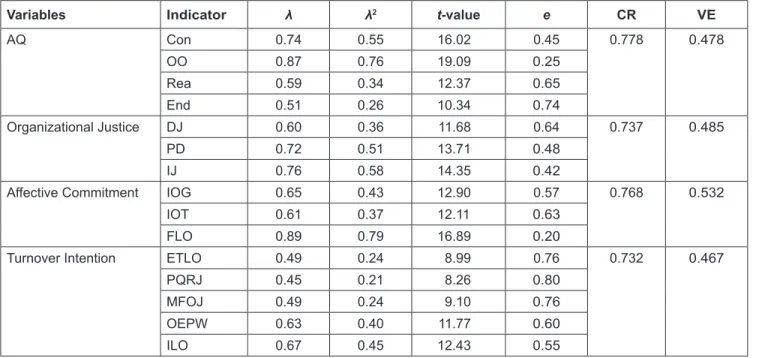
The confirmatory factor analysis is presented in Table 1. All the factors loading values (λ ≥ 0.3) (Costello & Osborne, 2005) and the t-value greater than the critical value (≥1.65) indicate that all indicators were valid. That means all indicators as manifest variables can measure all research variables as latent variables. Meanwhile, the reliability was determined based on the construct reliability (CR) and variance extracted (VE) values. The CR values of all variables are greater than 0.70. The VE values are greater
than 0.50 for affective commitment and AQ, organizational justice, and turnover intention slightly below 0.50. This indicates good reliability and acceptable convergence.
The result of the goodness of fit (GOF) is shown in Table 2. From the eleven criteria measurement, nine indices met the requirements, while two others did not (Chi-Square and Sig. probability values). According to Hair et al. (2018), Chi-Square is highly sensitive to large sample sizes (> 200); it needs accompaniment by another testing. The research participants consist of 439 teachers, therefore the χ2 and Sig.
probability values were rendered ineffective. Nevertheless, it was considered valid because the other nine criteria tested had suitable requirements.
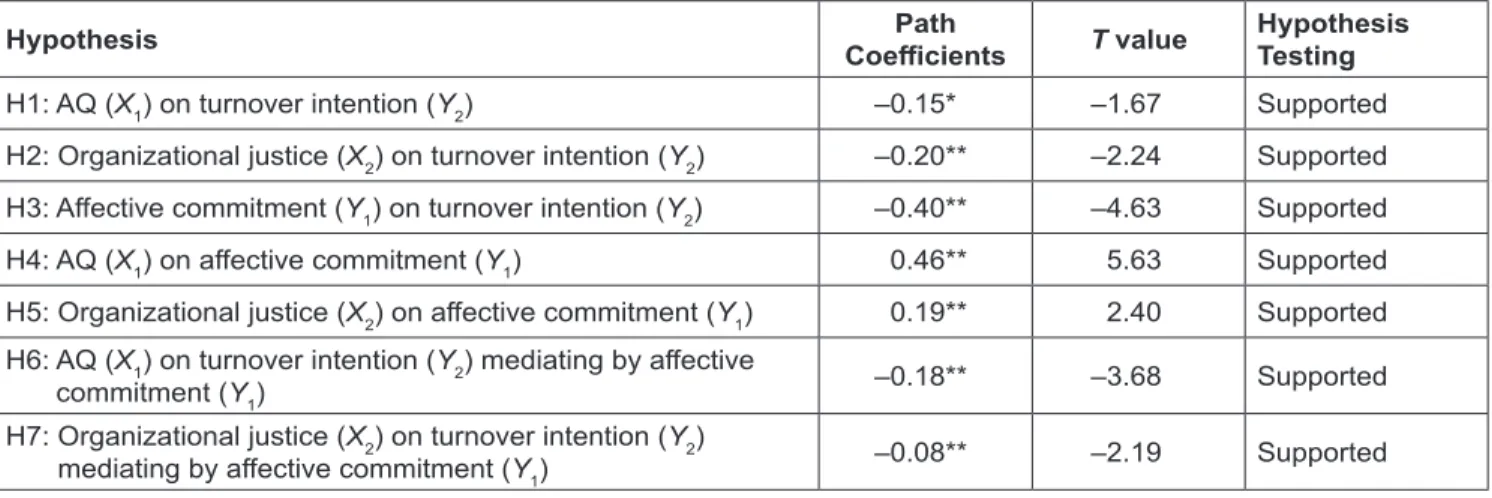
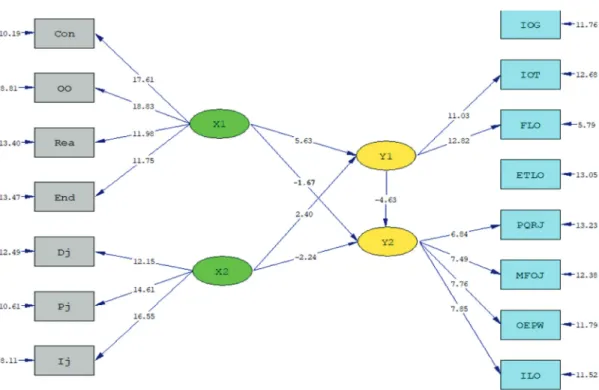
The results of the hypothesis testing are summarized in Table 3 and visualized in Figure 2 and Figure 3. All of the hypotheses were supported (t value > t table at α = 0.01 & 0.05). AQ had a negative direct effect on turnover intention. Organizational justice had a negative significant direct effect on turnover intention. The affective commitment had a negative significant direct effect on turnover intention. AQ had a positive significant direct effect on affective commitment. Organizational justice had a positive significant direct effect on affective commitment. AQ had a negative significant indirect effect on turnover intention mediated by affective commitment. Organizational justice had a negative significant indirect effect on turnover intention mediated by affective commitment.
This research revealed that AQ and organizational justice significantly affected turnover intention, directly
Table 1: Results of Confirmatory Factor Analysis
Variables Indicator λ λ2 t-value e CR VE
AQ Con 0.74 0.55 16.02 0.45 0.778 0.478 OO 0.87 0.76 19.09 0.25 Rea 0.59 0.34 12.37 0.65 End 0.51 0.26 10.34 0.74 Organizational Justice DJ 0.60 0.36 11.68 0.64 0.737 0.485 PD 0.72 0.51 13.71 0.48 IJ 0.76 0.58 14.35 0.42
Affective Commitment IOG 0.65 0.43 12.90 0.57 0.768 0.532
IOT 0.61 0.37 12.11 0.63
FLO 0.89 0.79 16.89 0.20
Turnover Intention ETLO 0.49 0.24 8.99 0.76 0.732 0.467
PQRJ 0.45 0.21 8.26 0.80
MFOJ 0.49 0.24 9.10 0.76
OEPW 0.63 0.40 11.77 0.60
ILO 0.67 0.45 12.43 0.55
Table 2: Goodness of Fit Statistics Goodness of
Fit Index Cut of Value Result Information Absolute Fit Measures
Chi-Square χ2 < χ2 table 253.32 Poorly
Sig. Probability P > 0.05 0.00 Poorly
GFI ≥0.09 0.93 Good
RSMEA ≤0.08 0.069 Good
Incremental Fit Measures
NFI >0.90 0.94 Good
NNFI ≥0.90 0.95 Good
AGFI ≥0.90 0.90 Good
CFI ≥0.90 0.96 Good
RFI ≥0.90 0.92 Good
Parsimony Fit Measures
Normed χ2 1–2 or <3 2.56 Properly
PNFI 0–1 0.75 Good
or indirectly mediated by affective commitment. This evidence shows that affective commitment plays a significant role as a mediator of the effect of AQ, and organizational justice significantly affected turnover
intention. This research also indicates the vitality of AQ, organizational justice, and affective commitment for turnover intention. That means the existence of AQ, organizational justice, and affective commitment are crucial determinants for reducing turnover intention. It is in line with previous studies that turnover intention influenced by AQ (e.g., Song & Woo, 2015; Youngjin & Sujeong, 2020), organizational justice (e.g., Song et al., 2020; Mengstie, 2020; Chong et al., 2021), and affective commitment (e.g., Wahono & Riyanto, 2020;
Scales & Brown, 2020; Zhou, Li, & Gao, 2020; Živković, Franjković, & Dujak, 2021).
This empirical fact confirms that AQ, organizational justice, and affective commitment are vital for reducing teachers’ turnover intention so that it needs to manage and develop optimally. Consequently, as top leaders in private schools with the support of school foundation management, school principals need to be more serious in creating a school climate that can genuinely guarantee justice for teachers, both distributive, procedural, and interactional
Table 3: Summary of Path Coefficients and T-values
Hypothesis CoefficientsPath T value HypothesisTesting
H1: AQ (X1) on turnover intention (Y2) –0.15* –1.67 Supported
H2: Organizational justice (X2) on turnover intention (Y2) –0.20** –2.24 Supported
H3: Affective commitment (Y1) on turnover intention (Y2) –0.40** –4.63 Supported
H4: AQ (X1) on affective commitment (Y1) 0.46** 5.63 Supported
H5: Organizational justice (X2) on affective commitment (Y1) 0.19** 2.40 Supported
H6: AQ (X1) on turnover intention (Y2) mediating by affective
commitment (Y1) –0.18** –3.68 Supported
H7: Organizational justice (X2) on turnover intention (Y2)
mediating by affective commitment (Y1) –0.08** –2.19 Supported
**p < 0.01; *p < 0.05.
Figure 3: T-value Structural Model
justice. Besides, school principals also need to create school conditions that genuinely reflect a learning organization that allows all school members to learn comfortably, develop their full potential and freely, provide better welfare for teachers, and provide appropriate rewards for teachers who have made achievements. It is essential and necessary to stimulate teachers’ affective commitment. More than that, school principals also need to provide constructive opportunities and challenges for teachers that can encourage teacher AQ to grow, hone, and be adequately actualized. This kindness has implications for reducing teacher turnover intention so that school effectiveness and performance can be well maintained and guaranteed.
Finally, the research results found a new empirical model of AQ and organizational justice on turnover intention mediated by affective commitment based on Indonesia’s honorary private school teachers’ data. This model can be discussed among researchers and practitioners to built models of mitigating turnover intention. Moreover, the model also can adopt new approaches to mitigating teachers’ turnover intention.
5. Conclusion
This research found that AQ and organizational justice had a direct effect on affective commitment and
turnover intention. AQ and organizational justice is also an indirect effect on turnover intention mediated by affective commitment. Besides, a new model of the effect of AQ and organizational justice on turnover intention mediated by affective commitment was confirmed. This research suggested that the teachers’ turnover intention can be reduced through AQ and organizational justice, mediating affective commitment. Therefore, practitioners can adopt the new empirical model to mitigate turnover intention. The new empirical model, for researchers, can also adopt and explore in further research with add new other relevant dimensions.
References
Aamodt, M. G. (2016). Industrial/organizational psychology:
An applied approach (8th ed.). Belmont, CA: Thomson
Learning, Inc.
Ablaña, M. V. V., Isidro, D. J., & Cabrera, G. A. (2016). Correlation between adversity quotient and job performance of LGU employees of Tayabas City: input to effective public personnel management. Journal of Research of the College of Arts and
Sciences, Southern Luzon State University, Lucban, Quezon, PH, 8(2), 109–122.
Ahmed, Z., Sabir, S., Khosa, M., Ahmad, I., & Bilal, M. A. (2016). Impact of employee turnover on organizational effectiveness in telecommunication sector of Pakistan. IOSR Journal of
Business and Management (IOSR-JBM), 18(11), 128–136.
https://doi.org/10.9790/487X-181104128136
Asadullah, M. A., Akram, A., Imran, H., & Arain, G. A. (2017). When and which employees feel obliged: a personality perspective of how organizational identification develops. Rev.
Psicol. Del Trabajo y de las Organ, 33, 125–135. https://doi.
org/10.1016/j.rpto.2017.02.002
Astiti, M. W., & Surya, I. B. K. (2020). The role of organizational commitments in mediating the effect of work motivation and job satisfaction towards turnover intention on nurses private hospital. International Research Journal of Management, IT
and Social Sciences, 8(1), 25–34. https://doi.org/10.21744/
irjmis.v8n1.1101
Beardwell, V., & Thompson, V. (2017). Human resource
management: A contemporary approach (8th ed.). London: Pearson Education Limited.
Chen, G., Sang, L., Rong, J., Yan, H., Liu, H., Cheng, J., Wang, L., Ding, H., & Chen, R. (2021). Current status and related factors of turnover intention of primary medical staff in Anhui Province, China: a crosssectional study. Human Resources
for Health, 19(23), 1–10.
https://doi.org/10.1186/s12960-021-00563-6
Chong, A., Hussain, I. A., Ahmad, N., Singh, J. S. K. (2021). Organisation justice towards’ employees voluntary turnover: A perspective of SMEs in Malaysia. International Journal of
Human Resource Studies, 11(2), 58–70. https://doi.org/10.5296/
ijhrs.v11i2.18459
Costello, A. B., Osborne, J. W. (2005). Best practices in exploratory factor analysis: four recommendations for getting the most from your analysis. Practical Assessment Research and Evaluation,
10(7), 1–9. https://doi.org/10.7275/ jyj1-4868
Doan, T. T. T., Nguyen, L. C. T., & Nguyen, T. D. N. (2020). Emotional intelligence and project success: The roles of transformational leadership and organizational commitment.
Journal of Asian Finance, Economics and Business, 7(3),
223–233. https://doi.org/10.13106/jafeb.2020. vol7.no3.223 Eliyana, A., Ma’arif, S., & Muzakki. (2019). Job satisfaction and
organizational commitment effect in the transformational leadership towards employee performance. European Research
on Management and Business Economics, 33, 144–150. https://
doi.org/10.1016/j.iedeen.2019. 05.001
Ghosh, D., Sekiguchi, T., & Gurunathan, L. (2017). Organizational embeddedness as a mediator between justice and in-role performance. Journal of Business Research, 75, 130–137. https://doi.org/10.1016/j.jbusres.2017.02. 013
Güllü, S., Yildiz, B. S., & Kaya, R. (2020). The mediating effect of organizational commitment between mobbing and turnover intention: An application on physical education and sports teachers. European Journal of Education Studies, 7(2), 182–189. https://doi.org/10.5281/zenodo.3726362
Gupta, V. (2019). Talent management dimensions and its relationship with Generation Y employee’s intention to quit: an Indian hotel perspective. International Journal of
Tourism Cities, 6(3), 583–600.
https://doi.org/10.1108/IJTC-02-2019-0018
Hair, J. F., Babin, B. J., Anderson, R. E., & Black, W. C. (2018). Multivariate data analysis. (8th ed.). India: Cengage India.
Hall, M., & Smith, D. (2009). Mentoring and turnover intentions in public accounting firms: a research note. Accounting,
Organizations and Society, 34, 695–704. https://doi.org/
10.1016/j.aos.2008.11 .003
Hastuti, T. D., Sari, D. R., & Riyadi. (2018). Student profile with high adversity quotient in math learning. IOP Conf. Series:
Journal of Physics: Conf. Series, 983, 1–6.
Hausknecht, J. P. (2017). Collective turnover. Annual review
of organizational psychology and organizational behavior, 4(1), 527–544. https://doi.org/10.1146/annurev-orgpsych-
032516-113139
Hayuningtyasa, R. F., Do, B. R., Irawanto, D. W., & Sudiro, A. (2018). Organizational justice and affective organizational commitment: Mediated by organizational trust and perceived organizational support. Asia-Pacific Management and
Business Application, 6(3), 175–196. https://doi.org/10.21776/
ub.apmba.2018.006.03.4
Hendri, M. I. (2019). The mediation effect of job satisfaction and organizational commitment on the organizational learning effect of the employee performance. International
Journal of Productivity and Performance Management, 68(7),
1208–1234. https://doi.org/10.1108/IJPPM-05-2018-017 Imran, R., Majeed, M., & Ayub, A. (2015). Impact of organizational
justice, job security, and job satisfaction on organizational productivity. Journal of Economics, Business and Management,
3(9), 840–845.
Ingsih, K., Prayitno, A., Waluyo, D. E., & Suhana, S. (2020). Mediating roles of job satisfaction toward the organizational commitment of employees in the public sector. Journal of
Asian Finance, Economics and Business, 7(10), 999–1006.
https://doi.org/10.13106/jafeb.2020.vol7.no10.999
Ivancevich, J. M., Konopaske, R., & Matteson, M. T. (2018).
Organizational behavior and management (11th ed.). New York: McGraw Hill Company.
Jang, J., Lee, D. W., & Kwon, G. (2019). An analysis of the influence of organizational justice on organizational commitment. International Journal of Public Administration, 1–9. https://doi.org/10.1080/01900692.2019.1672185
Lai, M.-C., & Chen, Y.-C. (2012). Self-efficacy, effort, job performance, job satisfaction, and turnover intention: The effect of personal characteristics on organization performance.
International Journal of Innovation, Management and Technology, 3(4), 387–391.
Lin, C.-Y., & Huang, C.-K. (2020). Employee turnover intentions and job performance from a planned change: The effects of an organizational learning culture and job satisfaction.
International Journal of Manpower. https://doi.org/10.1108/
Long, C. S., Thean, L. Y., Ismail, W. K., & Jusho, A. (2012). Leadership styles and employees’ turnover intention: Exploratory study of academic staff in a Malaysian College.
World Applied Sciences Journal, 19(4), 575–581. https://doi.
org/10.5829/idosi.wasj.2012.19.04.155
Mai, K. E., Ellis, A. P. J., Christian, J. S., & Porter, C. O. L. H. (2016). Examining the effects of turnover intentions on organizational citizenship behaviors and deviance behaviors: A psychological contract approach. Journal of Applied Psychology, 101(8), 1067–1081.
Martono, S., Khoiruddin, M., Wijayanto, A., Ridloah, S., Wulansari, N. A., & Udin, U. (2020). Increasing Teamwork, Organizational Commitment and Effectiveness through the Implementation of 9borative Resolution. Journal of Asian
Finance, Economics and Business, 7(6), 427–437. https://doi.
org/10.13106/jafeb.2020.vol7.no6.427
Mengstie, M. M. (2020). Perceived organizational justice and turn-over intention among hospital healthcare workers. BMC psycho-
logy, 8(1), 1–11. https://doi.org/10.1186/s40359-020-0387-8
Newstrom, J. W. (2017). Organizational behavior: Human behavior
at work (12th ed.). Boston: McGraw Hill.
Noe, R. A., Hollenbeck, J. R., Gerhart, B., & Wright, P. M. (2019). Human resource management: Gaining a competitive
advantage (11th ed.). New York: McGraw-Hill Education. Oh, H. S. (2019). Organizational commitment profiles and
turnover intention: using a person-centered approach in the Korean context. Frontiers in Psychology, 10, 1–9. https://doi. org/10.3389/fpsyg. 2019.01499
Park, K. O., Kim, S.Y., & Kim, J. K. (2013). Hospital nurses’ experience of bullying in the workplace and burnout, organizational commitment, turnover intention and nursing productivity. Journal of Korean Clinical Nursing
Research, 19(2), 169–180. https://doi.org/10.22650/JKCNR.
2013.19.2.169
Pekurinen, V. M., Välimäki, M., Virtanen, M., Salo, P., Kivimäki, M., & Vahtera, J. (2017). Organizational justice and collaboration among nurses as correlates of violent assaults by patients in psychiatric care. Psychiatric Services, 68, 490–496. https:// doi.org/10.1176/appi.ps.201600171
Puspitacandri, A., Warsono, Soesatyo, Y., Roesminingsih, E., & Susanto, H. (2020). The effects of intelligence, emotional, spiritual and adversity quotient on the graduates quality in Surabaya shipping polytechnic. European Journal of
Educational Research, 9(3), 1075–1087. https://doi.org/
10.12973/eu-jer.9.3.1075
Putra, A. A. G. W., Yadnyana, I. K., & Ratnadi, N. M. D. (2020). The effect of organizational justice and auditor professionalism on turnover intention with organizational commitments as intervening variables. SSRG International Journal of
Economics and Management Studies, 7(10), 32–38. https://doi.
org/10.14445/23939125/IJEMS-V7I10P106
Qamaruddin, Q., Mukti, A., & Margaretha, M. (2019). Effects of leadership and adversity quotient on the employee commitment.
NICCT, 1–8. http://doi.org/10.4108/eai.20-9-2019.2296610
Riana, I. G. (2021). Influence of Spiritual Leadership, Organiza-tional Commitment and its Effect on the Performance of Lembaga Perkreditan Desa. Journal of Asian Finance,
Economics and Business, 8(2), 1111–1124. https://doi:10.13106/
jafeb.2021.vol8.no2.1111
Robbins, S. P., & Judge, T. A. (2019). Organizational behavior (18th ed.). Global edition, Harlow, England: Pearson Education Limited.
Santi, M. W., Nandini, N., & Alfiansyah, G. (2020). The effect of burnout syndrome on turnover intention using organizational commitment as an intermediate variable. Jurnal Administrasi
Kesehatan Indonesia, 8(2), 109–122. https://doi.org/10.20473/
jaki.v8i2.2020.109-122
Scales, N., & Brown, H. Q. (2020). The effects of organizational commitment and harmonious passion on voluntary turnover among social workers: A mixed-methods study. Children and
Youth Services Review, 110, 1–10. https://doi.org/10.1016/j.
childyouth.2020.104782
Schultz, D., & Schultz, S.E. (2016). Psychology and work today. London: Routledge.
Shan, S., Ishag, H. M., & Shaheen, M. A. (2015). Impact of organizational justice on job performance in libraries: Mediating role of leader-member exchange relationship.
Library Management, 36(1/2), 70–85. https://doi.org/10.1108/
LM-01-2014-0003
Shkoler, O., & Tziner, A. (2017). The mediating and moderating role of burnout and emotional intelligence in the relationship between organizational justice and work misbehavior. Rev.
Psicol. del Trabajo y de las Organ, 33, 157–164. https://doi.
org/10.1016/j.rpto.2017.05.002
Siddiqi, M. A. (2013). Examining work engagement as a precursor to turnover intentions of service employees. International
Journal of Information, Business and Management, 5(4),
118–132.
Siphai, S. Influences of moral, emotional, and adversity quotient on good citizenship of Rajabhat University’s students in the Northeast of Thailand. Academic Journal, 10(17), 2413–2421. Song, J.-H., & Woo, H.-Y. (2015). Study on AQ (adversity quotient),
job satisfaction and turnover intention according to work units of clinical nursing staff in Korea. Indian Journal of Science and
Technology, 8(S8), 74–78. https://doi.org/10.17485/ijst/2015/
v8iS8/71503
Song, L., & Yang, L. (2020). Effect of organizational justice on affective organizational commitment: mediating role of perceived organizational support. Psychology and Behavioral
Sciences, 9(5), 61–67. https://doi.org/10.11648/j.pbs.
20200905.11
Song, X., Lowman, G. H., & Harms, P. (2020). Justice for the crowd: organizational justice and turnover in crowd-based labor. Administrative Sciences, 10(93), 1–37. https://doi. org/10.3390/admsci 10040093.
Stoltz, P. G. (2007). Adversity quotient: Turning obstacles into
Subagyo, S., Akbar, M., & Wibowo. (2019). The effect of leadership, adversity quotient on organizational commitment of PT. Jaya Konstruksi Manggala Pratama Tbk. International
Journal of Entrepreneurship and Business Development, 2(2),
271–279. https://doi.org/10.29138/ ijebd.v2i2.854
Suifan, T. S. (2019). The effect of organizational justice on employees’ affective commitment: The mediating role of job satisfaction. Modern Applied Science, 13(2), 42–53. https://doi. org/10.5539/ mas.v13n2p42
Sungu, L. J., Weng, Q., & Xu, X. (2019). Organizational commitment and job performance: Examining the moderating roles of occupational commitment and transformational leadership. International Journal of Selection and Assessment, 1–11. https://doi.org/10.1111/ijsa.12256
Suyono, J., Eliyana, A., Ratmawati, D., & Ahmad, M. A. (2021). Psychological capital, work environment, and workload on turnover intention: the mediating role of organizational commitment. Systematic Reviews in Pharmacy, 12(1), 131–1321. Swalhi, A., Zgoulli, S., & Hofaidhllaoui, M. (2017). The influence of organizational justice on job performance: the mediating effect of affective commitment. Journal of Management Development,
36, 542–559. https://doi.org/10.1108/JMD-11-2015-0162
Tamghe, C. D. D. K. (2019). Organizational justice and organizational commitment of public secondary school teachers in Cameroon. Journal of Education and Practice,
10(36), 157–166. https://doi.org/10.7176/JEP/10-36-18
Tang, Y., Shao, Y-F., & Chen, Y-J. (2019). Assessing the mediation mechanism of job satisfaction and organizational commitment on innovative behavior: The perspective of psychological capital. Frontiers in Psychology, 10, 1–12. https://doi.org/ 10.3389/fpsyg.2019.02699
Tansiongco, L. N., & Ibarra, L. P. (2020). Educational leader’s adversity quotient, management style and job performance: Implications to school leadership. Indonesian Research Journal
in Education, 4(2I), 386–401.
Tigchelaar, L., & Bekhet, K. E. (2015). The relationship of adversity quotient and personal demographic profile of private business leaders in Egypt. International Journal of Sciences: Basic and
Applied Research, 1, 403–422.
Van Griethuijsen, R. A. L. F., van Eijck, M. W., Haste, H., den Brok, P. J., Skinner, N. C., Mansour, N., Gencer, A. S., & BouJaoude, A. (2014). Global patterns in students’ views of science and interest in science. Research in Science Education,
45(4), 581–603. https://doi.org/10.1007/s11165-014-9438-6
Venkatesh, J., & Shivaranjani, G. (2015). Adversity quotient profile: an effective psychometric tool to hire the finest aspirant for contemporary organization. Scholars Journal of Economics,
Business, and Management, 2(12), 1159–1164.
Wahono, I., & Riyanto, S. (2020). Effect of organizational commitment, job stress, and job satisfaction on turnover intention. International Journal for Innovation Education and
Research, 8(10), 286–316. https://doi.org/10.31686/ijier.vol8.
iss10.2682
Wang, C., & Zhang, X. E. (2020). Binary effects of exploratory and exploitative learning on opportunity identification: The different moderations of environmental munificence and entrepreneurial commitment. Asian Business & Management, 1–28. https://doi.org/10.1057/s41291-020-00136-w
Wang, Q., & Wang, C. (2020). Reducing turnover intention: perceived organizational support for frontline employees (2020). Frontiers of Business Research in China, 14(6), 1–16. https://doi.org/10.1186/s11782-020-00074-6
Wei, Y. W. (2015). Do employees high in general human capital tend to have higher turnover intentions? The moderating role of high-performance HR practices and P-O fit. Personnel Review,
44(5), 739–756. https://doi.org/10.1108/PR-07-2013-0137
Widodo, W. (2019). Popular & practical research methodologies. Depok: Rajawali Pers.
Widodo, W., & Gunawan, R. M. B. (2020). The antecedence of lecturer’s OCB: Evidence from Indonesia. Management
Science Letters, 10, 2281–2286. https://doi.org/10.5267/
j.msl.2020.3.008
Wolor, C. W., Pratama, A., Aditya, S., Fadillah, F. D., & Purwana, D. (2020). Adversity quotient in improving millennial generation sales people’s performance in the industrial revolution 4.0.
Humanities & Social Sciences Reviews, 8(1), 220–226.
https://doi.org/10.18510/hssr.2020.8131
Wombacher, J. C., & Felfe, J. (2017). Dual commitment in the organization: Effects of the interplay of team and organi-zational commitment on employee citizenship behavior, efficacy beliefs, and turnover intentions. Journal of
Vocational Behavior, 102, 1–14. https://doi.org/10.1016/
j.jvb.2017.05.004
Yesil, H., Otken, A. B., & Beser, H. S. G. (2017). Organizational justice as a determinant of affective commitment and silence of employees. PressAcademia Procedia (PAP), 3, 825–840. http:// doi.org/10.17261/Pressacademia.2017.435
Youngjin, G., & Sujeong, H. (2020). Effects of the Adversity Quotient on Turnover Intention of New Nurses in General Hospitals: Focusing on the Mediating Effect of Reality Shock. Journal of Korean Academy of Nursing
Administration, 26(5), 457–467. https://doi.org/10.11111/
jkana.2020.26.5.457
Yukongdi, V., & Shrestha, P. (2020). The influence of affective commitment, job satisfaction and job stress on turnover intention: A study of Nepalese Bank Employees. Review of
Integrative Business and Economics Research, 9, 88–98.
Zhou, S., Li, X., & Gao, B. (2020). Family/friends support, work-family conflict, organizational commitment, and turnover intention in young preschool teachers in China: A serial mediation model. Children and Youth Services Review, 113, 1–8. https://doi.org/10.1016/j.childyouth.2020.104997
Živković, A., Franjković, J., & Dujak, D. (2021). The role of organizational commitment in employee turnover in logistics activities of food supply chain. LogForum, 17(1), 25–36. https://doi.org/10.17270/J.LOG.2021.536