P2-104 / K.-J. Kim
IMID 2009 DIGEST •
Abstract
Fullerene/polystyrene nanoparticles having the average size of 300 nm ~ 1 µm were prepared by emulsion polymerization in aqueous medium. Poly(vinyl pyrrolidone) and potassium persulfate were used as a dispersant and an initiator, respectively. The contents of fullerene in the nanoparticle were controlled to be from 10 to 57 wt% by varying the feed ratio, which was confirmed by IR-spectroscopy, thermogravimetric analyses, and elemental analyses. Dynamic light scattering experiments revealed the particles have a broad size distribution. Further characterizations of the nanoparticles were performed by using SEM and TEM observation. The high content of fullerene in the particles will find applications in photovoltaic and organic semiconducting area.
1. Introduction
Fullerene (C60) is a widely studied material due to
its unique optical, electrical, and chemical properties. However, one of the issues in the practical application of fullerene comes from its extremely low solubility in organic solvents. Besides, C60 tends to form
aggregated clusters which hinder the homogeneous dispersion in the molecular level. Encapsulated particles consisting of an organic or inorganic functional material and a polymer can make advanced applications with better control of optical properties, charge carrier mobility, surface chemistry, stability, and etc. Since the functional materials are encapsulated by a polymer with controlled particle size in nanometer scale, enhanced physical properties are to be expected. The dispersion stability of composite particles themselves is determined by the contribution of three main factors: van der Waals attractive force, electrostatic forces, and steric repulsive force between particles. In this study, polystyrene (PS) and C60 composite nanoparticles
ware prepared by emulsion polymerization of styrene in the presence of C60 in aqueous medium.
2. Experimental
C60/PS particles were prepared by using potassium
persulfate (KPS) as an initiator and poly(vinyl pyrrolidone) (PVP) as a dispersing agent in aqueous medium. Firstly, a mixture of styrene monomer and 10 wt% (to styrene) of divinylbenzene (DVB) as a crosslinker in aqueous solution of PVP was treated ultrasonically for 1 h to obtain a fine emulsion. Another emulsion was prepared by ultrasonificating C60 dispersed in an aqueous PVP solution for 1 h.
Then, the two solutions were mixed, and ultrasonificated for 1 h to obtain a homogeneously dispersed emulsion. The mixture was stirred at 300 rpm for 15 min, the temperature was increased to 70
o
C, and aqueous KPS solution was slowly added. The mixture was stirred for 24 h while keeping the temperature variation in less than ±5 oC. The resulting polymer particles were washed with deionized water repeatedly.
3. Results and discussion
The resulting particles were analyzed by using Fourier transform infrared spectroscopy (FT-IR), thermogravimetric analyses (TGA), elemental analyses (EA), scanning electron micrscopy (SEM), tunneling electron microscopy (TEM), and dynamic light scattering (DLS).
The FT-IR of C60/PS particles showed characteristic
vibrational bands of both PS and C60 implying that the
prepared particles are consisted of PS and C60 (Figure.
1). The C60 contents in the C60/PS particles were
determined by measuring the char yields at 600 oC from the TGA and estimations from the EA results, of which the results are reasonably coincided with each other. C60 content in the particles increased with initial
C60 feed ratio, ranging from 10 to 56 wt%. The results
are summarized in Table 1.
Preparation of Fullerene/Polystyrene Nanoparticles by
Emulsion Polymerizations
Kun-Ji Kim, Sooyeon Park, and Myong-Hoon Lee
Dept. of Polymer.Nano Science and Technology, CHONBUK NATIONAL UNIVERSITY, Jeonju, Jeonbuk, 561-756, Korea
Tel.:82-63-270-2337, E-mail: [email protected]
P2-104 / K.-J. Kim
• IMID 2009 DIGEST
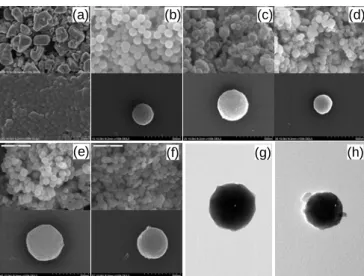
By using DLS, average particle size was measured to be 300 nm ~ 1 µm with broad particle-size distribution in most cases. Slight decrease of particle size with increasing amount of C60 was observed. The surface
morphology was observed by using SEM and TEM. As shown in Figure 2(a-f), homogeneous particles were obtained for lower C60 contents, while particle
size distribution became wider for high C60 contents.
TEM revealed that the particle is composed of small aggregates (~30 nm) with irregular spherical shape as shown in Figure 2(g-h).
4. Summary
We report the first preparation of C60/PS composite
particles with high C60 contents. C60/PS composite
particles containing more than 15 wt% of C60 have
never been reported to our knowledge. We expect the C60/PS nanoparticles with high fullerene contents can
find many application areas such as dielectrophoretic displays, photovoltaic cells and organic microelectronics.
Acknowledgement
This work was supported by the Korea Science and Engineering Foundation (KOSEF) grant funded by the Korea government (MOST) (No. R01-2007-000-20050-0[1]).
5. References
1. X.Du, J. He, J. Appl. Polym. Sci., 108, 1755 (2008). 2. H. Xu, L. Cui, N. Tong, and H. Gu, J. Am. Chem.
Soc., 128, 15582 (2006).
3. J. Fabian, Physical Review B, 53(20), 13864 (1996). 4. M. Treubig Jr., P. R. Brown, J. Chrom. A, 960, 135
(2002).
5. Y. Rong, H.-Z. Chen, G. Wu, M. Wang, Mater.
Chem. Phys., 91, 370 (2005).
6. D.-G. Yu, J. H. An, J. Y. Bae, Y. E. Lee, S. D. Ahn, S.-Y. Kang, K. S. Suh, J. Appl. Polym. Sci., 92, 2970 (2004).
7. W.-J. Liu, W.-D. He, Y.-M. Wang, D. Wang, Z.-C. Zhang, Polym. Int., 55, 520 (2006).
Table 1. Fullerene content (wt%) in C60/PS particles estimated by TGA and elemental analysis.
Sample Name FP-1 FP-2 FP-3 FP-4 FP-5 Fullerene in feed (wt%) 8.47 17.24 26.31 35.71 45.45 TGA (wt%) 15 24 32 45 57 EA (wt%) 10.39 17.66 29.73 42.48 56.11 (d) (a) (b) (c) (h) (f) (e) (g)
Fig 2. SEM photographs of (a) pristine fullerene, (b) FP-1, (c) FP-2, (d) FP-3, (e) FP-4, (f) FP-5, and TEM photographs of (g) FP-4, and (h) FP-5. 40003500 3000 2500 2000 1500 1000 500 T( % ) Wavenumber (cm-1) Fullerene PS C60PSparticles (a) (b) (c)
Fig 1. FT-IR spectra of (a) untreated C60(KBr
pellet), (b) Polystyrene, and (c) C60 /PS