Effects of Extraction Methods on In Vitro Biological Capacities
and Rheological Properties of Polysaccharides from Red Pepper
Stems
Sang-Hun Yoo1 and Yoon Hyuk Chang2
1Department of Asian Cuisine and Culinary Arts, Youngsan University, Busan 48015, Korea 2
Department of Food and Nutrition, Kyung Hee University, Seoul 02447, Korea pISSN 2287-1098ㆍeISSN 2287-8602
Received 19 July 2017; Accepted 17 August 2017; Published online 30 September 2017 Correspondence to Yoon Hyuk Chang, Tel: +82-2-961-0552, E-mail: [email protected] Copyright © 2017 by The Korean Society of Food Science and Nutrition. All rights Reserved.
This is an Open Access article distributed under the terms of the Creative Commons Attribution Non-Commercial License (http://creativecommons.org/licenses/by-nc/4.0) which permits unrestricted non-commercial use, distribution, and reproduction in any medium, provided the original work is properly cited.
ABSTRACT: The purposes of this study were to produce polysaccharides from red pepper stems using different extrac-tion methods and evaluate their chemical composiextrac-tion, in vitro biological capacities, and rheological properties. Two poly-saccharides were extracted from red pepper stems using an autoclave and alkali treatments, and the extracts were named PAU and PAL, respectively. The contents of total phenolics and flavonoids were significantly higher in PAU than those in PAL. PAU exhibited greater scavenging activities on 2,2-diphenyl-1-picrylhydrazyl radicals, 2,2’-azino-bis(3-ethylbenzo-thiazoline-6-sulfonic acid) diammonium salt radicals, superoxide radicals, and nitrite compared to PAL, suggesting that PAU served as better antioxidants. Similarly, in vitro inhibitory abilities against carbohydrate hydrolyzing enzymes of PAU were higher than those of PAL. Steady shear rheological analysis demonstrated that PAU showed higher psuedoplastic shear-thinning behavior compared to PAL. Based on the results from dynamic shear rheological properties, it was found that both samples had predominantly viscous behavior rather than elastic behavior.
Keywords: red pepper stem, polysaccharide, antioxidant ability, antidiabetic ability, rheological property
INTRODUCTION
Globally, agricultural areas produce agricultural biomass such as oil seeds, cereals, and other crops, resulting in the accumulation of agricultural waste every year. Most of these wastes are discarded and only a little amount of them are used as ingredients for animal feed or energy production. Agricultural crop residues, including plant stem and cereal straw, are known as rich sources of diet-ary fibers, which are composed of polysaccharides, oligo-saccharides, lignin, and other plant related materials (1, 2). Therefore, it is important to study the structural, phy-sicochemical, and functional characteristics of dietary fi-bers derived from agricultural crop residues in order to use them as functional ingredients in nutraceuticals or food products.
Polysaccharides, which are the main dietary fiber con-stituents, have been extensively investigated (3-5). It was revealed that polysaccharides obtained from plants had various therapeutic properties, such as antioxidant, anti-diabetic, anticancer, and antimicrobial activities (6,7). Be-sides, polysaccharides can be used as fat replacers, gelling
agents, emulsifiers, thickeners, and stabilizers in the food industry (8,9).
Among the agricultural crops, which are usually con-sumed in Korea, red peppers are one of the most com-monly cultivated vegetable crops. Accordingly, a large number of agricultural crop residues, mainly stems, are produced, but these are left unused and discarded, result-ing in considerable waste for producers (10). Supposresult-ing that the agricultural crop residues are an under-utilized source of dietary fibers, which have specific physicochem-ical properties and health benefits, studies on characteri-zation of polysaccharides extracted from red pepper stems are important to evaluate their application in value-added food products.
Until now, many researchers have studied efficient ex-traction methods of polysaccharides from various fiber- rich sources and evaluated the structural, physicochemi-cal, and biological characteristics of extracted polysac-charides (11,12). Commonly used extraction methods of polysaccharides are hot-water extraction, alkali or acid extraction, enzyme extraction, and microwave or ultra-sonic assisted extraction. It is reported that extracted
pol-ysaccharides have different characteristics depending on the extraction methods (13). To the best of our knowl-edge, there are only a few studies regarding polysaccha-rides extracted from red pepper stems using different ex-traction methods (14). In the present study, two different polysaccharides were extracted from red pepper stems using an autoclave (hot water) and alkali extraction methods and their chemical composition, in vitro biologi-cal properties (antioxidant activities and α-glucosidase and α-amylase inhibitory activities), and rheological prop-erties were investigated.
MATERIALS AND METHODS
Materials
For polysaccharide extraction by different methods, pep-per stems were obtained from a local farm (Sangju, Ko-rea) and rinsed off with tap water. The rinsed pepper stems were dried in a dry oven (DMC-122SP, Daeil En-gineering Co., Gyeonggi, Korea) at 50oC, ground to a 80 mesh, and stored in a refrigerator at 4oC. D-glucose, D- galacturonic acid, Folin-Ciocalteu reagent, gallic acid, ca-techin, 2,2-diphenyl-1-picrylhydrazyl (DPPH), L-ascorbic acid, 2,2’-azino-bis(3-ethylbenzothiazoline-6-sulfonic ac-id) diammonium salt (ABTS), Griess reagent, α-glucosi-dase from Saccharomyces cerevisiae, p-nitrophenyl-α-D-glu-copyranoside, α-amylase from porcine pancreas, and 3,5- dinitrosalicylic acid (DNS) were purchased from Sigma- Aldrich Co. (St. Louis, MO, USA). All other reagents used in this study were of analytical grade.
Extraction of polysaccharides
Autoclave treatment: The powder of dried red pepper stems (10.0 g) was extracted with distilled water (10%, w/v) by autoclaving for 2 h at 121oC. The extract was filtered using filter paper (8 μm pore size), and the filtrate was concentrated in a rotary evaporator (N-1000S, EYELA, Tokyo, Japan) under reduced pressure at 40oC. The poly-saccharide was precipitated by the addition of 80% etha-nol (v/v) and incubated overnight at 4oC. The precipi-tated polysaccharide was then collected by filtration and dried in a dry oven at 35oC for later use. This polysaccha-ride was designated PAU.
Alkali treatment: The powder of dried red pepper stems (10.0 g) was extracted with 100 mL of potassium hydrox-ide solution (10%, w/v) by autoclaving for 2 h at 121oC. The extract was filtered using filter paper (8 μm pore size), and the filtrate was neutralized by 1 N acetic acid to pH 7.0. The polysaccharide was precipitated by the addition of 80% ethanol (v/v) and incubated overnight at 4oC. The precipitated polysaccharide was then collected by filtration and dried in a dry oven at 35oC for later use. This polysaccharide was designated PAL.
Chemical composition analysis
Moisture, crude ash, crude lipid, and crude protein con-tents in PAU and PAL were analyzed by standard AOAC methods (15). Carbohydrate content was determined by the phenol-sulphuric acid method, and D-glucose was used as a standard (16). Uronic acid content was colori-metrically measured according to the m-hydroxydiphenyl- sulphuric acid method, with D-galacturonic acid as a standard (17).
Determination of total phenolic contents
Total phenolic contents of PAU and PAL were determined according to the Folin-Ciocalteu colorimetric method (18) with slight modifications. The sample solution (1 mL) in distilled water at concentrations of 0, 2.0, 4.0, 6.0, 8.0, and 10.0 mg/mL was mixed with 1 mL of Folin-Cio-calteu reagent (1 N). The mixture was vortexed and al-lowed to stand at 25oC for 5 min. Next, the mixture was mixed with 1 mL of sodium bicarbonate (10%) and then incubated at 30oC for 1 h. Finally, the absorbance of the reaction mixture was measured at 700 nm, using a UV-visible spectrophotometer. Gallic acid was used as a standard, and the total phenolic contents in both sam-ples were expressed as mg gallic acid equivalents (GAE) per 100 g of dry mass.
Determination of total flavonoid contents
Total flavonoid contents of PAU and PAL were deter-mined according to the aluminium chloride colorimetric method (18) with slight modifications, using catechin as a standard. The sample solution (1 mL) in distilled wa-ter at concentrations of 0, 2.0, 4.0, 6.0, 8.0, and 10.0 mg/ mL was mixed with 200 μL of sodium nitrite solution (5%), followed by vigorous vortexing, and allowed to stand at room temperature for 5 min. Next, the mixture was mixed with 300 μL of aluminium chloride solution (10%) and allowed to stand at room temperature for 5 min. Finally, 1.0 mL of sodium hydroxide solution (1 N) was added into the mixture, and the absorbance of the reaction mixture was measured at 510 nm using a spec-trophotometer. The total flavonoid contents in both sam-ples were expressed as mg catechin equivalents (CE) per 100 g of dry mass.
Analysis of in vitro antioxidant properties
DPPH radical scavenging activity: The DPPH radical scav-enging activities of PAU and PAL were measured accord-ing to a modified version of the method by Shimada et al. (19). The sample solution (200 μL) in distilled water at concentrations of 0, 2.0, 4.0, 6.0, 8.0, and 10.0 mg/mL was added to 1.2 mL of DPPH solution in ethanol (0.1 mM). The mixture was vortexed and then incubated in the dark for 30 min at room temperature. Finally, the absorbance of the reaction mixture was monitored
spec-trophotometrically at 517 nm. L-ascorbic acid was used as a reference antioxidant. The antioxidant capacity was expressed as percentage inhibition of DPPH radical rela-tive to the control and was determined, based on the fol-lowing formula:
DPPH radical scavenging activity (%)=
Acontrol−Asample×100 Acontrol
where Acontrol is the absorbance of the control (DPPH solution without the tested sample) and Asample is the ab-sorbance in the presence of the tested sample. The sam-ple concentration providing 50% of DPPH radical scav-enging activity, IC50 value, was obtained by interpolation of linear regression analysis.
ABTS radical scavenging activity: The ABTS radical scav-enging activities of PAU and PAL were performed ac-cording to the method described by Re et al. (20) with slight modifications. The ABTS radical cation (ABTS+・) was produced by reacting 2.5 mL of ABTS stock solution (7 mM) with 0.5 mL of potassium persulfate (15 mM), and then, the mixture was left in the dark at room tem-perature for 12∼16 h before use. At the moment of use, the ABTS+・ solution was freshly diluted with ethanol to get the absorbance of 0.70±0.02 at 734 nm and equili-brated at 30oC. Each sample solution (0.2 mL) in distilled water at concentrations of 0, 2.0, 4.0, 6.0, 8.0, and 10.0 mg/mL was added to a 0.8 mL of ABTS+・ solution. The decrease in absorbance was measured at 734 nm after the reaction at 25oC for 15 min. L-ascorbic acid was used as a standard antioxidant. The ABTS+・ scavenging effect was expressed as shown in the following formula:
ABTS+・ scavenging activity (%)=Acontrol−Asample×100 Acontrol
where Acontrol is the absorbance of the control (ABTS+・ solution without the tested sample) and Asample is the ab-sorbance in the presence of the tested sample. The IC50 value was obtained by interpolation of linear regression analysis.
Superoxide radical scavenging activity: The superoxide radi-cal scavenging activities of PAU and PAL were assessed according to the method of Marklund and Marklund (21) with slight modifications. Each sample solution (200 μL) in distilled water at concentrations of 0, 2.0, 4.0, 6.0, 8.0, and 10.0 mg/mL was mixed with 3 mL of Tris-HCl buf-fer (50 mM, pH 8.5) and 0.2 mL of pyrogallol (7.2 mM). The reaction was kept for 10 min at room temperature and 0.1 mL of HCl (1 N) was added to the above mixture to terminate the reaction. The absorbance was taken at 420 nm, and L-ascorbic acid was used as a positive con-trol. The scavenging ability of superoxide radical was
ex-pressed according to:
Superoxide radical scavenging activity (%)=
Acontrol−Asample×100 Acontrol
where Acontrol represents the absorbance of the control (a mixture of distilled water and 1 mM of NaNO2) and Asample is the absorbance in the presence of the tested sample. The IC50 value was obtained by interpolation of linear regression analysis.
Nitrite scavenging activity: The nitrite scavenging activities of polysaccharides extracted by PAU and PAL were per-formed according to a method using Griess reagent (22), with slight modifications. Each sample solution (1 mL) in distilled water at concentrations of 0, 2.0, 4.0, 6.0, 8.0, and 10.0 mg/mL was mixed with 1 mL of NaNO2 (1 mM) and then 0.1 N HCl was added dropwise to the mixture until the pH was 1.2. The pH-adjusted mixture was di-luted with distilled water to make the final volume up to 10 mL and incubated at 37oC for 1 h. After incubation, 5 mL of 2% acetic acid and 0.4 mL of Griess reagent were added to the reaction mixture. The reaction mixture was incubated at room temperature for 15 min and then the absorbance was measured at 520 nm. L-ascorbic acid was used as a standard antioxidant. The result was calculated by the following equation:
Nitrite scavenging activity (%)= Acontrol−Asample×100 Acontrol
where Acontrol represents the absorbance of the control (a mixture of distilled water and 1 mM of NaNO2) and Asample is the absorbance in the presence of the tested sample. The IC50 value was obtained by interpolation of linear regression analysis.
Analysis of in vitro α-glucosidase and α-amylase inhibitory activities
α-Glucosidase inhibitory activity: The α-glucosidase inhib-itory activities of PAU and PAL were measured according to a modified version of the method by Ranilla et al. (23). Each sample solution (500 μL) in distilled water at con-centrations of 0, 100, 200, 300, 400, and 500 μg/mL was mixed with 1.0 mL of phosphate buffer (0.1 M, pH 6.9) containing α-glucosidase solution (1.0 U/mL). After in-cubation at 25oC for 10 min, 500 μL of p-nitrophenyl-α- D-glucopyranoside solution (5 mM) in phosphate buffer (0.1 M, pH 6.9) was added to the mixture at timed inter-vals, and then the mixture was incubated at 25oC for 5 min. Before and after the incubation period, the absorb-ance of the reaction mixture was measured spectropho-tometrically at 405 nm and compared to a blank, which contained 500 μL of buffer solution in place of sample
solution. The percentage of α-glucosidase inhibition was calculated by:
% Inhibition=∆Ao405−∆Ae405×100 ∆Ao405
where ∆Ao405 is the absorbance of control without sample solution, and ∆Ae405 is the absorbance in the presence of sample solution.
α-Amylase inhibitory activity: The α-amylase inhibitory ac-tivities of PAU and PAL were measured according to the method described by Ranilla et al. (23) with slight modi-fications. Each sample solution (500 μL) in distilled wa-ter at concentrations of 0, 100, 200, 300, 400, and 500 μg/mL was mixed with 500 μL of sodium phosphate buf-fer (0.02 M, pH 6.9 with 0.006 M sodium chloride) con-taining α-amylase solution (0.5 mg/mL), followed by in-cubation at 25oC for 10 min. After the pre-incubation, 500 μL of starch solution (1%) in sodium phosphate buf-fer (0.02 M, pH 6.9 with 0.006 M sodium chloride) was added to the mixture. After re-incubation at 25oC for 10 min, the reaction was stopped with 1.0 mL of DNS color reagent. Next, the mixture was incubated in boiling wa-ter bath for 5 min and cooled to room temperature. Afwa-ter diluting the mixture with 10 mL of distilled water, the absorbance of the reaction mixture was measured spec-trophotometrically at 540 nm. The percentage of α-amy-lase inhibition was calculated by:
% Inhibition=∆Ao540−∆Ae540×100 ∆Ao540
where ∆Ao540 is the absorbance of control without sam-ple solution, and ∆Ae540 is the absorbance in the presence of sample solution.
Rheological measurements
Preparation of polysaccharide dispersions: Polysaccharide dis-persions (20% w/v) were prepared by mixing PAU and PAL with distilled water. The dispersions were stirred for 1 h at room temperature and then heated at 95oC in a water bath for 30 min with mild agitation in order to avoid the entry of air into the dispersions. The hot sam-ple dispersions were immediately transferred to a rhe-ometer plate to measure the rheological properties. Steady shear rheological measurement: The steady and dy-namic shear rheological properties of the polysaccharide dispersions were obtained using a strain controlled rheo-meter (Physica MCR 301, Anton Paar GmbH, Graz, Aus-tria) with a parallel plate system (5 cm diameter) at a gap of 0.5 mm. Each sample dispersion was transferred to the rheometer plate at 30oC.
Steady shear data were obtained over the shear rate in the range of 0.1∼1000 s−1. To describe the steady shear
rheological properties of the samples, the data were fitted to the well-known power law [Eq. (1)] and Casson [Eq. (2)] models, which are as follows:
σ=Kγn (1)
σ0.5=Koc+Kcγ0.5 (2)
where σ is the shear stress (Pa), γ is the shear rate (s−1), K is the consistency index (Pa・sn), n is the flow behavior index (dimensionless), and (Kc)2 is the Casson plastic viscosity (ηc). Casson yield stress (σoc) according to the Casson model [Eq. (2)] was determined as the square of the intercept (Koc) that was obtained from the linear re-gression of the square roots of the γ versus σ data. Using the magnitudes of K and n, apparent viscosity (ηa,100) at 100 s−1 was calculated. All steady shear rheological measurements were performed in triplicate.
Dynamic shear rheological measurement: Dynamic shear rhe-ological properties [storage modulus (G′), loss modulus (G′′), complex viscosity (η*), and tan δ (G′′/G′)] of poly-saccharide dispersions were determined on a strain con-trolled rheometer. Dynamic rheological data were ob-tained from frequency sweeps over the range of 0.63∼63 rad/s at 2% strain. The 2% strain was in the linear visco-elastic region. Frequency sweep tests were also conducted at 30oC. Rheometer Data Analysis software (Rheoplus version 3.62) was used to obtain the experimental data and to calculate the G′, G′′, η*, tan δ. All dynamic shear rheological measurements were performed in triplicate. Statistical analysis
All statistical analyses were conducted using SAS version 9.3 (SAS Institute Inc., Cary, NC, USA). Analysis of var-iance (ANOVA) was done using the general linear mod-els procedure in order to determine significant differ-ences amongst the samples. Means were compared us-ing Fisher’s least significant difference procedure. All ex-periments were replicated at least three times for each treatment and their means±standard deviation were re-ported. Values of P<0.05 was considered significant.
RESULTS AND DISCUSSION
Chemical composition analysis
Moisture, crude ash, crude lipid, crude protein, carbohy-drates, uronic acids, total phenolics, and total flavonoids contents of PAU and PAL are summarized in Table 1. The predominant component of both PAU and PAL was carbohydrates (93.90% and 92.77%, respectively). Addi-tionally, in both samples, the crude ash and lipid were
Fig. 1. The scavenging activities of PAU and PAL determined by DPPH radical scavenging assay (A), ABTS radical scavenging assay (B), superoxide radical scavenging assay (C), and nitrite scavenging assay (D). Error bars represent standard deviation of three independent experiments. PAU, polysaccharides extracted by autoclave treatment; PAL, polysaccharides extracted by alkali treatment.
Table 1. Chemical composition of PAU and PAL
Compounds PAU PAL
Moisture (%) 5.35±0.75b 7.38±0.89a Crude ash (%) ND1) ND Crude lipid (%) ND ND Crude protein (%) 0.91±0.21a 0.06±0.023b Carbohydrates (% D-glucose equivalent) 93.90±0.49a 92.77±0.28b
Uronic acids (% GalA equivalent)
6.55±0.22b 7.65±0.91a
Total phenolics (mg GAE/100 g) 315.33±3.19a 231.11±3.81b Total flavonoids (mg CE/100 g) 243.71±7.24a 155.83±9.12b
Each value represents the mean of triplicate experiments± standard deviation.
Mean values in the same row with different letters (a,b) are significantly different (P<0.05).
PAU, polysaccharides extracted by autoclave treatment; PAL, polysaccharides extracted by alkali treatment.
GAE, gallic acid equivalents; CE, catechin equivalents.
1)Not detected.
not detected and only a trace amount of proteins existed. These results indicated a high purity of the extracted pol-ysaccharides.
PAU had significantly higher contents of total phenol-ics and flavonoids compared with PAL (Table 1). Accord-ing to Hromádková et al. (24) and Mandalari et al. (25),
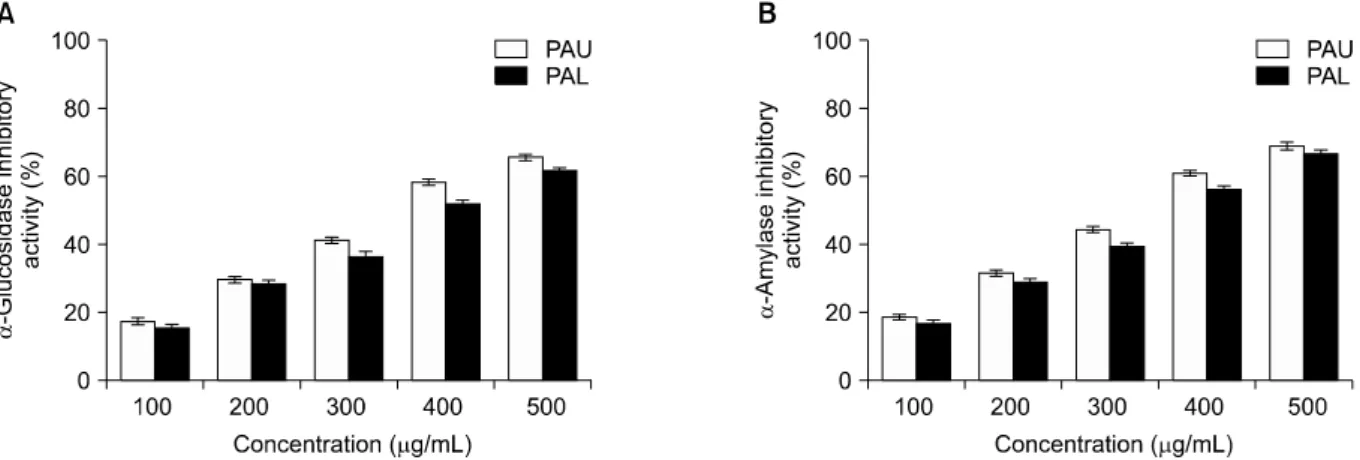
the alkali treatment attacked the cell wall matrix and hy-drolyzed some alkali-labile bonds between the polysac-charides and phenolics, therefore lowering the content of phenolics. Furthermore, it was suggested in the pres-ent study that the contpres-ents of phenolics and flavonoids, which were covalently or physically bound to PAU and PAL, could contribute to the pharmacological effects in-cluding antioxidant activity and carbohydrate hydrolyzing enzyme inhibitory activity, as shown in Fig. 1 and Fig. 2. Analysis of in vitro antioxidant properties
In vitro chemical methods including DPPH, ABTS, and superoxide radicals- and nitrite-scavenging activities were used to evaluate the antioxidant properties of PAU and PAL. As shown in Fig. 1, the antioxidant activities in 5 different concentrations (2.0∼10.0 mg/mL) of both PAU and PAL were analyzed. A dose-response relationship was observed in all assays, and the antioxidant abilities were raised as the concentration increased for each sam-ple. Additionally, the IC50 values of PAU and PAL ob-tained from each assay are presented in Table 2.
In the DPPH radical scavenging assay, the radical scav-enging ability ranged from 7.7% to 49.1% for PAU and 6.5% to 38.2% for PAL. The IC50 value (9.88 mg/mL) of PAU was significantly lower than that of PAL (13.36 mg/
Fig. 2. α-Glucosidase inhibitory activity (A) and α-amylase inhibitory activity (B) of PAU and PAL. Error bars represent standard deviation of three independent experiments. PAU, polysaccharides extracted by autoclave treatment; PAL, polysaccharides extracted by alkali treatment.
Table 2. DPPH radical scavenging activity, ABTS radical scav-enging activity, superoxide radical scavscav-enging activity, and ni-trite scavenging activity with IC50 values of PAU and PAL
(unit: mg/mL) Samples
Scavenging activities (IC50)
DPPH ABTS Superoxide Nitrite
PAU 9.88±0.03b 9.77±0.02b 10.24±0.09b 8.66±0.18b PAL 13.36±0.00a 13.32±0.02a 13.54±0.02a 9.07±0.03a
Each value represents the mean of triplicate experiments± standard deviation.
Mean values in the same column with different letters (a,b) are significantly different (P<0.05).
DPPH, 2,2-diphenyl-1-picrylhydrazyl; ABTS, 2,2’-azino-bis(3-ethylbenzothiazoline-6-sulfonic acid) diammonium salt. PAU, polysaccharides extracted by autoclave treatment; PAL, polysaccharides extracted by alkali treatment.
mL), indicating the stronger scavenging activity of PAU compared to PAL.
In the ABTS radical scavenging assay, PAU had 7.5∼ 50.3% scavenging activity whereas PAL presented 6.5∼ 38.1% scavenging activity. The IC50 value (9.77 mg/mL) of PAU was significantly lower than that of PAL (13.32 mg/mL). With regard to the superoxide radical scaveng-ing assay, the scavengscaveng-ing activities were 46.8% and 38.3 % at 10.0 mg/mL with IC50 values of 10.24 and 13.54 mg /mL for PAU and PAL, respectively, showing a more po-tent radical scavenging activity of PAU compared to PAL. Similarly, the nitrite scavenging activity of PAU was greater than that of PAL, as shown by the IC50 values (8.66 mg/mL for PAU and 9.07 mg/mL for PAL). From these results, it was confirmed that PAU was a more ef-fective antioxidant than PAL. According to previous stud-ies (26), there is a good correlation between total poly-phenol contents and in vitro antioxidant activity. There-fore, the greater antioxidant property of PAU could be ex-plained by its higher total phenolic and flavonoids con-tents compared to PAL, as shown in Table 1.
Analysis of in vitro α-glucosidase and α-amylase inhibitory activities
Fig. 2 shows the dose-response curves of the inhibitory effects of PAU and PAL against α-glucosidase and α-am-ylase. The inhibitory activities of PAU and PAL against α-glucosidase and α-amylase were increased with an in-crease in the concentrations of both samples from 100 μg/mL to 500 μg/mL. PAU and PAL at the highest con-centration of 500 μg/mL presented the highest α-gluco-sidase and α-amylase inhibitory effects with the inhib-itory rate of 65.6% and 68.9% for PAU and 61.8% and 66.8% for PAL, respectively. In addition, the results ob-tained from each assay revealed that the inhibitory effects of PAU against α-glucosidase and α-amylase were supe-rior at all concentrations (100∼500 μg/mL) compared with those of PAL. According to Kim et al. (27), polyphe-nolic compounds can restrain the α-glucosidase and α- amylase activities because of their binding ability with proteins such as enzyme proteins. Therefore, the results of this study may be explained by the higher contents of total phenolic and flavonoid compounds of PAU, as indi-cated in Table 1. In conclusion, these outcomes indiindi-cated that PAU could potentially control the rise in post-pran-dial glucose by starch.
Steady and dynamic shear rheological properties
The σ versus γ data for PAU and PAL at 30oC were well fitted to two rheological models (power law and Casson models) with high correlation coefficient (0.99, data are not shown), as shown in Fig. 3 and Table 3. Both PAU and PAL presented a shear-thinning behavior because of the n values were less than 1. The pseudoplastic proper-ties of both samples could be explained by conforma-tional changes of polysaccharide molecules as a result of shearing. Specifically, the junction zones in the tested polysaccharides were broken in response to shearing, consequently leading to molecule disaggregation (7,28). In addition, in the present study, PAU had a lower n
val-Fig. 3. Shear rate-shear stress plot for PAU (○) and PAL (△). PAU, polysaccharides extracted by autoclave treatment; PAL, polysaccharides extracted by alkali treatment.
Table 3. Steady shear rheological properties of PAU and PAL Samples ηa,100 (Pa・s) K (Pa・sn) n (−) σoc (Pa)
PAU 0.45±0.00a 3.79±0.13a 0.46±0.02b 9.37±0.13a PAL 0.37±0.01b 3.10±0.05b 0.49±0.01a 7.50±0.14b
Each value represents the mean of triplicate experiments± standard deviation.
Mean values in the same column with different letters (a,b) sig-nificantly different (P<0.05).
ηa,100, apparent viscosity; K, consistency index; n, flow behavior
index; σoc, Casson yield stress.
PAU, polysaccharides extracted by autoclave treatment; PAL, polysaccharides extracted by alkali treatment.
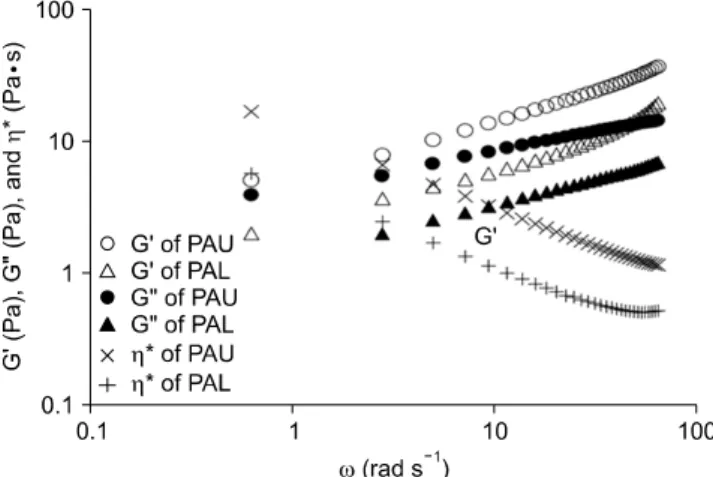
Fig. 4. Comparison of storage modulus (G′), loss modulus (G′′), complex viscosity (η*) versus function of frequency (ω) for PAU and PAL. PAU, polysaccharides extracted by autoclave treat-ment; PAL, polysaccharides extracted by alkali treatment.
ue (0.46) than PAL (0.49), indicating the higher pseudo-plastic (non-Newtonian) behavior for PAU.
The steady shear rheological data of both samples showed ηa,100, K, and σoc of PAU were significantly higher than those of PAL (Table 3). According to Tan and Gan (7), a more highly branched conformation of polysaccha-rides could interrupt entanglement of polysaccharide chains compared to a less branched polysaccharide. There-fore, it was speculated that PAU had a more complicated structure than PAL.
Fig. 4 provides changes in G′, G′′, and η* as a function of frequency (ω) for PAU and PAL at 30oC. The magni-tudes of G′ and G′′ for both samples were increased with an increase in ω with a high frequency dependency. How-ever, η* values for both samples declined with an in-crease in ω, presenting shear-thinning properties in ac-cordance with the power law model. G′′ values were sig-nificantly lower than G′ values at all ω values (0.63∼ 62.8 rad/s) in PAU and PAL, indicating that both sam-ples had predominantly viscous behavior rather than the elastic behavior. In addition, G′ and G′′ values of PAU were much greater than those of PAL at all values of ω (0.63∼62.8 rad/s), demonstrating the higher viscoelas-tic property of PAU. The greater viscoelasviscoelas-tic properties of PAU can be associated with its tighter network
ture and greater stiffness compared to PAL. Such struc-ture implies a more limited mobility, and subsequently the longer relaxation times, which result in higher elastic properties (29,30).
In conclusion, two polysaccharides (PAU and PAL) were extracted from red pepper stems by autoclave and alkali treatments, respectively. The in vitro antioxidant activities and inhibitory effects against carbohydrate hy-drolyzing enzymes of PAU were significantly higher than those of PAL. According to the results obtained from steady and dynamic shear rheological analysis, when compared to PAL, PAU showed relatively stronger shear- thinning behaviors and viscoelastic properties. Based on the results, it was demonstrated in this study that alkali treatment was an effective method to obtain functional polysaccharides from red pepper stems. Moreover, it was suggested that PAU could be used as a functional ingre-dient or thickening agent in food industries.
ACKNOWLEDGEMENTS
This work was supported by a 2017 research grant from the Youngsan University, Republic of Korea.
AUTHOR DISCLOSURE STATEMENT
The authors declare no conflict of interest.
REFERENCES
1. Sun RC, Fang JM, Rowlands P, Bolton J. 1998. Physicochem-ical and thermal characterization of wheat straw hemicellu-loses and cellulose. J Agric Food Chem 46: 2804-2809. 2. Kuan CY, Yuen KH, Bhat R, Liong MT. 2011.
Physicochem-ical characterization of alkali treated fractions from corncob and wheat straw and the production of nanofibres. Food Res Int 44: 2822-2829.
3. Yang B, Wang J, Zhao M, Liu Y, Wang W, Jiang Y. 2006. Iden-tification of polysaccharides from pericarp tissues of litchi (Litchi chinensis Sonn.) fruit in relation to their antioxidant ac-tivities. Carbohydr Res 341: 634-638.
4. Sila A, Bayar N, Ghazala I, Bougatef A, Ellouz-Ghorbel R, Ellouz-Chaabouni S. 2014. Water-soluble polysaccharides from agro-industrial by-products: functional and biological properties. Int J Biol Macromol 69: 236-243.
5. Wei X, Cai X, Xiong S, Wang Y. 2012. Hypoglycemic effect of oral crude tea flower polysaccharides on alloxan modeling Sprague-Dawley rats and the possible mechanism. CyTA-J Food 10: 325-332.
6. Ai L, Wu J, Che N, Wu Y, Cui SW. 2012. Extraction, partial characterization and bioactivity of polysaccharides from boat- fruited sterculia seeds. Int J Biol Macromol 51: 815-818. 7. Tan HF, Gan CY. 2016. Polysaccharide with antioxidant, α-
amylase inhibitory and ACE inhibitory activities from Mo-mordica charantia. Int J Biol Macromol 85: 487-496.
8. Poli A, Anzelmo G, Fiorentino G, Nicolaus B, Tommonaro G, Di Donato P. 2011. Polysaccharides from wastes of vegetable industrial processing: new opportunities for their eco-friend-ly re-use. In Biotechnology of Biopoeco-friend-lymers. Elnashar M, ed. InTech Publisher, Rijeka, Croatia. p 33-56.
9. Bao H, You SG, Cao L, Zhou R, Wang Q, Cui SW. 2016. Chem-ical and rheologChem-ical properties of polysaccharides from fruit body of Auricularia auricular-judae. Food Hydrocolloids 57: 30-37. 10. Won KY, Oh KK. 2009. Optimization the xylose fractionation
conditions of pepper stem with dilute sulfuric acid. KSBB J 24: 361-366.
11. Wu W, Zhu Y, Zhang L, Yang R, Zhou Y. 2012. Extraction, preliminary structural characterization, and antioxidant ac-tivities of polysaccharides from Salvia miltiorrhiza Bunge. Carbohydr Polym 87: 1348-1353.
12. Wang ZB, Pei JJ, Ma HL, Cai PF, Yan JK. 2014. Effect of ex-traction media on preliminary characterizations and antioxi-dant activities of Phellinus linteus polysaccharides. Carbohydr Polym 109: 49-55.
13. Shen S, Cheng H, Li X, Li T, Yuan M, Zhou Y, Ding C. 2014. Effects of extraction methods on antioxidant activities of pol-ysaccharides from camellia seed cake. Eur Food Res Technol 238: 1015-1021.
14. Paik SY, Ra KS, Chang IS, Park YC, Park HS, Baik HS, Yun JW, Choi JW. 2003. Purification and characterization of com-plement-activating acidic polysaccharides from the fruits of Capsicum annuum. J Biochem Mol Biol 36: 230-236.
15. AOAC. 2000. Moisture, ash, lipid, and protein: AOAC method no. 934.01, 942.05, 960.39, and 994.12. In AOAC Official Methods of Analysis. 17th ed. Association of Official Analytical Chemists, Gaithersburg, MD, USA.
16. DuBois M, Gilles KA, Hamilton JK, Rebers PA, Smith F. 1956. Colorimetric method for determination of sugars and related substances. Anal Chem 28: 350-356.
17. Blumenkrantz N, Asboe-Hansen G. 1973. New method for quantitative determination of uronic acids. Anal Biochem 54: 484-489.
18. Singleton VL, Rossi JA. 1965. Colorimetry of total phenolics with phosphomolybdic-phosphotungstic acid reagents. Am J Enol Vitic 16: 144-158.
19. Shimada K, Fujikawa K, Yahara K, Nakamura T. 1992. Anti-oxidative properties of xanthan on the autoxidation of soy-bean oil in cyclodextrin emulsion. J Agric Food Chem 40: 945- 948.
20. Re R, Pellegrini N, Proteggente A, Pannala A, Yang M, Rice- Evans C. 1999. Antioxidant activity applying an improved ABTS radical cation decolorization assay. Free Radic Biol Med 26: 1231-1237.
21. Marklund S, Marklund G. 1974. Involvement of the superox-ide anion radical in the autoxidation of pyrogallol and a con-venient assay for superoxide dismutase. Eur J Biochem 47: 469- 474.
22. Choi DB, Cho KA, Na MS, Choi HS, Kim YO, Lim DH, Cho SJ, Cho H. 2008. Effect of bamboo oil on antioxidative activ-ity and nitrite scavenging activactiv-ity. J. Ind Eng Chem 14: 765-770. 23. Ranilla LG, Kwon YI, Apostolidis E, Shetty K. 2010. Phenolic
compounds, antioxidant activity and in vitro inhibitory po-tential against key enzymes relevant for hyperglycemia and hypertension of commonly used medicinal plants, herbs and spices in Latin America. Bioresour Technol 101: 4676-4689. 24. Hromádková Z, Kost'álová Z, Ebringerová A. 2008.
Compar-ison of conventional and ultrasound-assisted extraction of phenolics-rich heteroxylans from wheat bran. Ultrason Sonochem 15: 1062-1068.
25. Mandalari G, Faulds CB, Sancho AI, Saija A, Bisignano G, LoCurto R, Waldron KW. 2005. Fractionation and character-isation of arabinoxylans from brewers’ spent grain and wheat bran. J Cereal Sci 42: 205-212.
26. Pan Y, He C, Wang H, Ji X, Wang K, Liu P. 2010. Antioxidant activity of microwave-assisted extract of Buddleia officinalis and its major active component. Food Chem 121: 497-502. 27. Kim JS, Hyun TK, Kim MJ. 2011. The inhibitory effects of
eth-anol extracts from sorghum, foxtail millet and proso millet on α-glucosidase and α-amylase activities. Food Chem 124: 1647-1651.
28. Rao MA. 2010. Rheology of fluid and semisolid foods: principles and applications. Springer, New York, NY, USA. p 351-370. 29. Kim DD, Lee YS, Yoo B. 2009. Rheological properties of waxy
rice starch-gum mixtures in steady and dynamic shear. J Food Sci Nutr 14: 233-239.
30. Saba N, Jawaid M, Alothman OY, Paridah MT. 2016. A re-view on dynamic mechanical properties of natural fibre rein-forced polymer composites. Constr Build Mater 106: 149-159.